

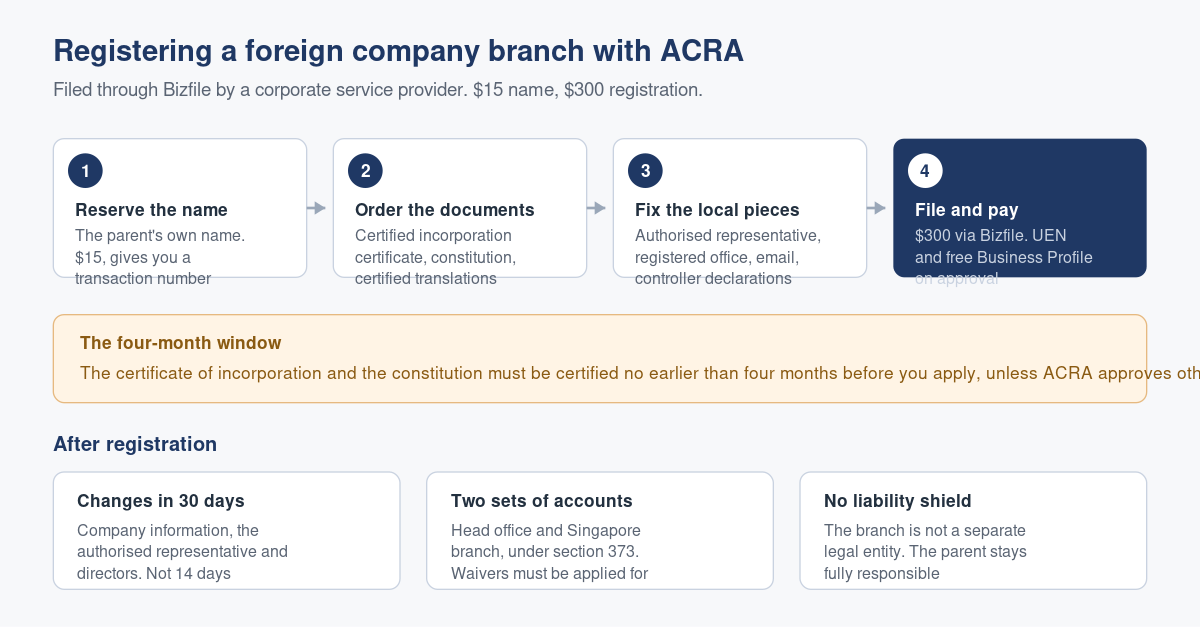
A foreign company branch is registered with ACRA through Bizfile by a corporate service provider, costs $300 in government fees on top of the $15 name application, and requires certified copies of the parent’s certificate of incorporation and constitution certified no earlier than four months before you apply. You must also appoint at least one authorised representative who is ordinarily resident in Singapore.
Raffles Corporate Services works with a panel of experienced Singapore law firms who offer cost-effective and efficient legal service and advice. This article is general information only and is not legal advice.
The branch is your parent company operating here under its own name. It is not a separate legal entity, so there is no shareholding to structure and no local constitution to draft. That makes the registration conceptually simpler than incorporating a subsidiary, and in practice harder, because everything turns on documents that have to come out of your home jurisdiction in exactly the right form. Document preparation is where branch registrations stall. Almost never the filing.
Before you start: two things that are not optional
You must engage a corporate service provider. ACRA requires every foreign business to register through a corporate service provider, whatever structure it chooses. There is no self-service route for a foreign parent. The provider files under its own Corppass credentials and carries its own obligations under the Corporate Service Providers Act 2024, which is why the identity questions arrive before anything else does.
You must reserve the name first. Name approval is a separate application with its own $15 fee and its own transaction number, and the registration cannot be filed without it. A branch is registered in the foreign company’s own name, so the parent’s name has to be available and acceptable in Singapore. If it is already taken here, or contains a controlled word that triggers a referral to another agency, you have a problem to solve before you can file at all.
What you need to prepare
| What ACRA needs | Detail that catches people out |
|---|---|
| Approved name and transaction number | From the name application, before registration |
| The foreign company’s details | Home country, home registration number, date of incorporation, legal form, whether it has share capital |
| The parent’s home country registered office | As it appears in the home register |
| A Singapore registered office address | No P.O. box. The public must be able to reach it for a minimum of three hours in normal business hours, every business day. Need not be where you operate |
| A business email address | Used for ACRA correspondence |
| At least one authorised representative | Must meet the local residency requirement. Can be held personally responsible if the branch fails its legal obligations |
| Each position holder’s personal details | Identification type and number, full name, date of birth |
| Each position holder’s residential address | Purchasable by the public. A contact address can be filed instead, free, but ACRA still posts official letters to the residential address |
| Nominee and controller declarations | Whether the company is exempt from the nominee registers and the Register of Registrable Controllers |
| Certified copy of the certificate of incorporation | Certified true by the home country official custodian of the original, in a role equivalent to ACRA’s |
| Certified copy of the parent’s constitution | Wider set of permitted certifiers, see below |
| Latest home country financial statements | Where required |
| Certified English translations | For every document not in English |
The four-month certification window
This is the trap worth putting on your project plan. Both the certificate of incorporation and the constitution must be certified no earlier than four months before you apply, unless ACRA has approved otherwise.
That window is short if your home registry is slow, or if the certifying official sits in a country you no longer have an office in. Groups that order certified documents at the start of a six-month Singapore project routinely find them out of date by the time the name is approved. Order them once the name application is in, not before.
Who may certify the constitution
The constitution has a broader list of acceptable certifiers than the certificate of incorporation:
- The home country official custodian of the original, in a role equivalent to ACRA’s.
- A notary public.
- A director, manager or secretary of the foreign company, by affidavit. If the company was formed within the Commonwealth, a statutory declaration will do instead.
- The registered qualified individual who will lodge the registration documents, provided they have verified the constitution’s authenticity.
That last route is the one most corporate service providers use. Ask about it early, because it can remove a week of chasing a notary in another time zone.
Translations
Any document not written in English needs a certified English translation. Where the translation is done abroad, the certifier must be the home country official custodian of the original in a role equivalent to ACRA’s, a notary public or sworn translator there, or a Singapore consular officer in that country. Where it is done here, the certifier must be someone ACRA has approved for the purpose. Do not have it done by a bilingual member of staff. It will be rejected, and you will pay twice.
The steps, in order
- Apply for and reserve the name. $15. The branch is registered in the parent’s name, so check availability before you commit to a timeline.
- Order the certified documents. Certificate of incorporation and constitution, certified within the four-month window, plus certified English translations where needed.
- Appoint the authorised representative. At least one, meeting the local residency requirement. Get their consent and their identification details.
- Fix the Singapore registered office. A real address the public can reach for a minimum of three hours every business day, not a P.O. box.
- Settle the nominee and controller position. Decide whether the company is exempt from the nominee registers and the Register of Registrable Controllers, and if not, gather the nominator and controller details.
- File through Bizfile. Your provider logs in under its Corppass credentials, opens the register a new business entity service, retrieves details against the name application transaction number, then works through the entity, position holder, nominator, controller and document upload screens.
- Review, declare and pay. $300, by credit card, debit card or online banking. The declaration is a real declaration: read it before you tick it.
- Collect the outcome from the Bizfile inbox. On approval you receive the notice of successful registration, the UEN, and a link to download a free Business Profile.
Straightforward applications tend to clear very quickly once payment goes through. ACRA allows itself up to 15 working days for a complex one, and 14 to 60 days where a referral authority has to weigh in. Build the referral scenario into your plan if your parent’s activity touches a regulated sector.
What the branch commits you to afterwards
Registration is the easy part. The branch then sits under Part 11 Division 2 of the Companies Act 1967, and its obligations differ from a local company’s.
Changes are filed within 30 days. Changes to company information, the authorised representative or the directors must be updated with ACRA within 30 days. That is a different clock from the 14 days a local company gets for officer and shareholding changes, and mixing the two up is a common source of late lodgement penalties.
Two sets of financial statements go to ACRA. This surprises almost every parent. Under Section 373 of the Companies Act 1967, a foreign company files financial statements for its head office as well as for its Singapore branch operations. An active branch files audited statements showing the profit and loss of the Singapore operations, the assets used here and the liabilities arising from them. A dormant branch may file unaudited statements. Waivers and reliefs exist under Section 373, but they must be applied for and granted. See ACRA’s annual filing for foreign companies page.
The authorised representative carries personal exposure. They can be held personally responsible if the branch does not meet its legal requirements.
The parent’s name and status must be disclosed. Section 375 requires the foreign company to state its name, whether liability is limited, and its country of incorporation.
The parent remains fully liable. A branch has no separate legal personality, so there is no ring fence. If that matters, read our note on the subsidiary option before you file.
What goes wrong in practice
The certified documents go stale. The four-month window is the commonest cause of a delayed branch registration. Sequence the document order after the name approval.
The name is not available. A branch cannot be registered under a trading name of convenience. It is the parent’s name or nothing. Check first.
The residential address disclosure is discovered late. Position holders’ residential addresses are visible to anyone who buys information about the business. The free contact address alternative exists precisely for this, but it has to be filed at registration rather than fixed afterwards in a hurry.
Nobody plans for the head office accounts. A parent whose home jurisdiction does not require audited accounts finds out in month eleven that ACRA wants a version of them. The Section 373 reliefs are real, but they are applications, and applications take time.
The branch is the wrong structure in the first place. Many branch enquiries should have been subsidiaries. The parent chose the branch because it sounded lighter, then found it heavier: no liability protection, no Singapore tax residency by default, and the head office accounts on the public file. Our notes on the branch option and the common branch mistakes cover the trade-off, and if the parent’s real intention is to move its legal home here, re-domiciliation is worth testing.
Frequently asked questions
How much does it cost to register a foreign company branch in Singapore?
Government fees are $15 to apply for the name and $300 to register the entity, so $315 at ACRA. On top of that you pay your corporate service provider, and you pay for certified copies and certified translations in your home jurisdiction, often the larger of the two numbers.
How long does registration take?
Straightforward applications tend to clear very quickly once payment goes through. ACRA allows up to 15 working days for a complex one, and 14 to 60 days where a referral authority is involved. The real constraint is not ACRA’s processing time, it is how quickly your home jurisdiction produces certified documents inside the four-month window.
Who can be the authorised representative?
At least one authorised representative must meet ACRA’s local residency requirement. They may be someone in your group who lives here, or a person provided by your corporate service provider. They can be held personally responsible if the branch fails to meet its obligations, so document the appointment properly rather than agreeing it in an email.
Does a branch need a company secretary?
No. The statutory company secretary requirement in Section 171 of the Companies Act 1967 applies to companies incorporated in Singapore. A branch instead needs an authorised representative under Section 370. That is one of the few places where a branch is lighter than a subsidiary.
Must a branch file the parent company’s accounts publicly?
In substance, yes. Under Section 373 of the Companies Act 1967 a foreign company files financial statements for its head office as well as its Singapore branch operations. Reliefs exist for form and content, and waivers for the branch statements, but they must be applied for and approved. Assume the head office figures become public unless you have relief.
Getting the documents right the first time
Branch registrations are won and lost on paperwork logistics. A certificate of incorporation certified by the right official, a constitution and translations certified by someone ACRA accepts, and all of it inside four months of the filing date. Get that sequence right and the Bizfile submission is a short afternoon.
Raffles Corporate Services registers foreign company branches with ACRA, acts as authorised representative where the group has nobody resident here, and manages the head office and branch financial statement filings afterwards. If you are not yet sure the branch is the right structure, have that conversation before you order a single certified document.
You can reach us through Raffles Corporate Services, or read more on Singapore corporate secretarial practice at Singapore Secretary Services.
— The Editorial Team, Raffles Corporate Services
Need help with corporate secretarial or compliance matters?
If you would like help with your company's corporate secretarial, governance or compliance requirements, email [email protected] or WhatsApp +65 8501 7133.
Our team can assist with corporate secretarial, accounting and tax matters. Where legal advice is needed, advisers from our associated law firms can assist.