

Most foreign companies that ask about re-domiciling to Singapore do not qualify, and the reason is almost always size. You must satisfy at least two of three thresholds on assets, revenue and headcount, then clear a solvency test and a set of legal conditions, before ACRA will look at your paperwork at all.
Raffles Corporate Services works with a panel of experienced Singapore law firms who offer cost-effective and efficient legal service and advice. This article is general information only and is not legal advice.
Transfer of registration is the one route into Singapore that keeps your company alive. You do not incorporate a new entity and migrate the business across. The same legal person simply changes the register it sits on, so the corporate history, the contracts, the bank facilities, the intellectual property assignments and the litigation all travel with it. That is enormously valuable if you have twenty years of trading history or a contract that would need counterparty consent to novate.
It is also the most heavily gated registration ACRA operates. This article deals only with whether you are eligible. The application itself, the documents, the timing and what changes after you land are covered in part 2.
What transfer of registration means in law
Transfer of registration is the statutory mechanism by which a foreign corporate entity becomes a Singapore company limited by shares without being wound up in its home jurisdiction and reincorporated here. The application provision is section 358 of the Companies Act 1967, and registration is dealt with under section 359. The minimum requirements an applicant must satisfy are prescribed by regulation under the Companies (Transfer of Registration) Regulations 2017.
The practical effect is worth stating plainly, because it is the whole point of the exercise. Your company’s legal identity survives. Its assets and liabilities are not transferred to anyone, because there is no transferee. Nothing needs to be assigned, novated or re-registered on the strength of a change of owner, because the owner has not changed.
Compare the alternatives. A branch registration leaves the parent foreign and gives it a registered presence here. A fresh incorporation gives you a clean Singapore entity but a brand new legal person, which means every contract, licence and banking relationship has to be moved by hand. Our Singapore branch office of a foreign parent FAQ sets out the branch side of the comparison.
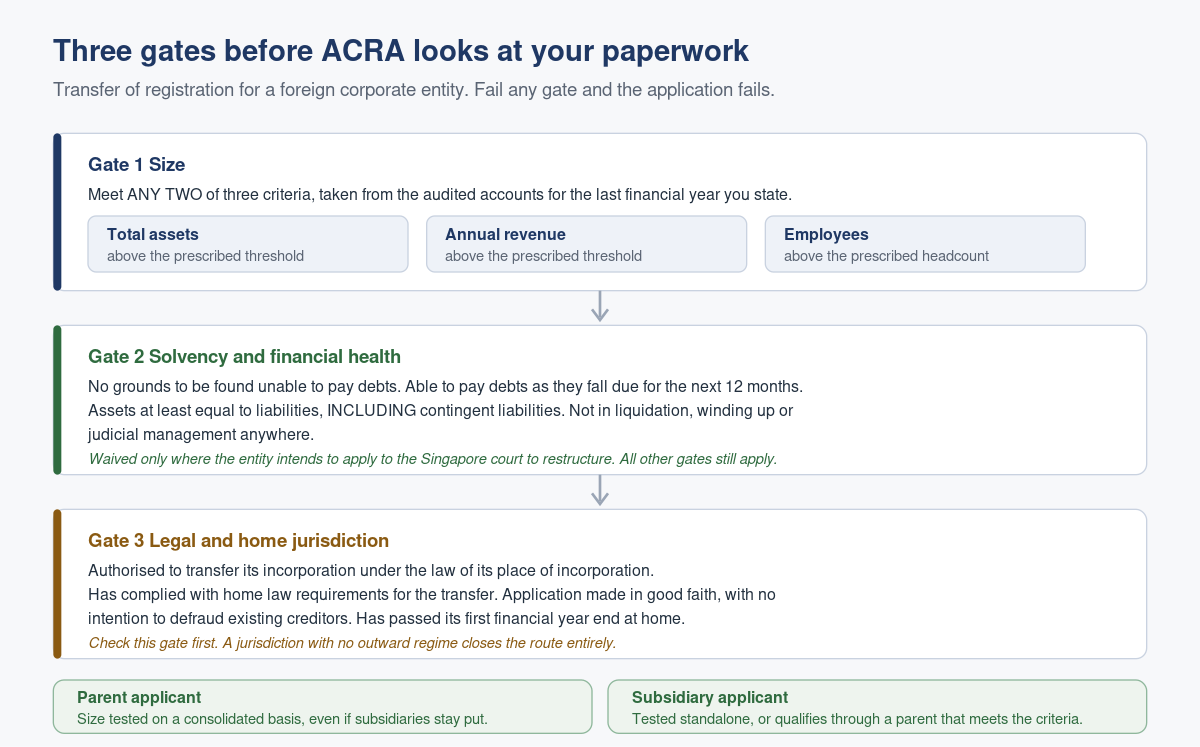
Gate one: the size test
This is the gate that stops most applicants, and it is purely arithmetical. You must meet any two of three criteria.
| Criterion | Threshold | How it is usually evidenced |
|---|---|---|
| Total assets | Valued over S$10 million | Audited balance sheet for the last financial year stated in the application |
| Annual revenue | Valued over S$10 million | Audited statement of comprehensive income for the same year |
| Employees | More than 50 | Payroll records and the group’s own headcount reporting |
Two of the three. Not two on a good year and one on a bad one, and not two measured at different dates. The figures come out of the audited financial statements for the last financial year you state in the application, which is why the accounting year you nominate matters more than people expect.
Three things trip up otherwise comfortable applicants. Asset-light service businesses with strong revenue and a small team meet one criterion and fail. Holding companies with a large balance sheet but no operating revenue and no staff meet one criterion and fail. And companies whose figures are stated in a foreign currency need to be satisfied that the Singapore dollar equivalent clears the threshold, not just that the local-currency number looks large.
How the size test works for a group
The size test is not always applied to the applicant alone, and this is the single most useful thing to know before you conclude that you fail.
| Applicant | Basis of assessment |
|---|---|
| Parent company | Consolidated basis, even where the subsidiaries are not themselves applying |
| Subsidiary | Standalone basis, but a subsidiary also qualifies if its parent meets the criteria, whether the parent is already registered in Singapore or is applying at the same time |
So a small subsidiary of a substantial group is not shut out. And where a parent and a subsidiary apply together, the parent’s application is assessed first and the subsidiary’s is assessed after it, which affects sequencing rather than eligibility.
Gate two: solvency and financial health
The second gate is about whether your company can pay its way. All of the following must be true of the foreign corporate entity.
- There are no grounds on which it could be found unable to pay its debts.
- It will be able to pay its debts as they fall due during the twelve months after the date of the application.
- If it intends to wind up within twelve months after applying, it will be able to pay its debts in full within twelve months after the winding up date.
- Its assets are worth at least as much as its liabilities, including contingent liabilities.
- It is not under judicial management, in liquidation, being wound up, or subject to any similar proceedings anywhere.
Item four is the one that catches people, because contingent liabilities are expressly in scope. Guarantees given for group borrowings, unresolved warranty claims, an indemnity in a share sale agreement and an unquantified tax dispute all have to be brought into the assessment. A balance sheet that looks healthy on recognised liabilities alone can fail once the contingent column is added.
There is one important carve-out. A foreign corporate entity that intends to apply to the Singapore court for restructuring or judicial management after registration does not have to meet the financial health requirements. It must still meet every other minimum requirement, including the size test. That is a deliberate policy choice: Singapore is willing to take on a distressed company that wants to restructure here, but it is not willing to take on a small one.
Gate three: the legal and home-jurisdiction conditions
The third gate asks whether the move is lawful where you are coming from, and whether you are moving for a legitimate reason.
You must be authorised to transfer your incorporation under the law of your place of incorporation. Singapore cannot pull a company out of a jurisdiction that does not let it leave. Plenty of jurisdictions have no outward re-domiciliation regime at all, in which case transfer of registration is simply unavailable and you are back to incorporating fresh. This is the first thing to check, and it is a question for local counsel rather than for your Singapore adviser.
You must have complied with the requirements of your home law in relation to the transfer. Board and shareholder approvals, creditor notifications, regulatory consents and any local filing all have to be done properly and in the right order.
The application must be made in good faith and not with the intention of defrauding existing creditors. This is not a box-tick. It sits behind the solvency evidence and it is the hook on which a poorly documented, creditor-adverse migration will be refused.
You must have passed your first financial year end in your place of incorporation. A company incorporated abroad six months ago cannot re-domicile, whatever its balance sheet says. That rule also connects to the audited accounts you will need to produce, because there has to be a completed financial year to audit.
What goes wrong in practice
Testing eligibility after the name application. The Singapore process starts with reserving a business name, and reserving it under the wrong company type will invalidate the transfer application later. People reserve first and run the eligibility analysis second, then discover they never qualified.
Assuming the size test is forgiving. It is not. There is no discretion to admit a company that is close, and there is no “substance in Singapore” argument that makes up for missing figures. If you fail on two of three, the answer is either to wait until the numbers change or to incorporate a Singapore company and move the business across commercially.
Ignoring what the home jurisdiction requires on the way out. Deregistration in the home jurisdiction is not optional, and it is time limited after you land. Part 2 covers the deadline, but the planning for it belongs here, at the eligibility stage, because a jurisdiction that will not deregister you on request creates a problem you cannot fix from Singapore.
Forgetting the group has options. Where a parent fails the standalone test, look at whether the group as a whole clears it, and whether the entity you actually want in Singapore can come in as a subsidiary of a qualifying parent. This is often the difference between a refusal and an approval.
If the entity you are trying to relocate is an investment fund structure rather than an operating company, transfer of registration into a Singapore company is the wrong target. The fund route leads to a Variable Capital Company under the Variable Capital Companies Act 2018 instead, with its own eligibility rules and its own re-domiciliation process.
Frequently asked questions
Does my company need to meet all three size criteria?
No. You need any two of the three: total assets over the prescribed threshold, annual revenue over the prescribed threshold, or more than the prescribed number of employees. Meeting all three is common among applicants but it is not required. Meeting only one is fatal, with no discretion to admit a borderline case.
Can a newly incorporated foreign company re-domicile to Singapore?
No. You must have passed your first financial year end in your place of incorporation before you can apply. That rule exists partly to make the audited financial statement requirement workable, since there has to be a completed financial year to audit and submit with the application.
We are a small subsidiary of a large group. Are we automatically out?
Not necessarily. A subsidiary is assessed on a standalone basis, but it also qualifies if its parent meets the size criteria, whether the parent is already registered in Singapore or is applying for transfer of registration at the same time. Where both apply together, the parent’s application is assessed first.
Our company is in financial difficulty. Is re-domiciliation available?
Possibly. A foreign corporate entity that intends to apply to the Singapore court for restructuring or judicial management after registration does not have to satisfy the financial health requirements. Every other minimum requirement still applies, including the size criteria and the home-jurisdiction conditions, so distress alone does not open the door.
What if our home jurisdiction has no outward re-domiciliation regime?
Then transfer of registration is not available to you, because the legal condition requires that you be authorised to transfer your incorporation under the law of your place of incorporation. Your realistic options become a Singapore branch registration or a fresh Singapore incorporation with a commercial transfer of the business.
How long does eligibility assessment take?
Eligibility is assessed as part of the substantive application rather than as a separate pre-clearance step, so the answer is the full processing time for the transfer. That means the analysis has to be done properly before you file, because there is no cheap early signal that you have failed.
Work out the answer before you spend anything
Eligibility for transfer of registration is a research exercise, not a filing exercise. It involves your audited accounts, your contingent liabilities, your group structure and the company law of the jurisdiction you are leaving, and all four have to line up before a Singapore application is worth preparing.
Raffles Corporate Services runs that assessment as a discrete piece of work, so you get a clear yes, no, or “yes if we restructure the group this way” before any fee is committed. Our notes on the eligibility and requirements checklist and the common mistakes and rejection reasons go further into the failure modes, and the inward re-domiciliation guide covers the whole journey end to end.
When you are satisfied you qualify, part 2 takes you through the application, the certified documents, the timing and what changes once you are a Singapore company.
— The Editorial Team, Raffles Corporate Services
Need help with corporate secretarial or compliance matters?
If you would like help with your company's corporate secretarial, governance or compliance requirements, email [email protected] or WhatsApp +65 8501 7133.
Our team can assist with corporate secretarial, accounting and tax matters. Where legal advice is needed, advisers from our associated law firms can assist.