

Redenomination converts your company’s share capital, or a class of it, from one currency into another. It takes an ordinary resolution, not a special one. The resolution must specify a spot rate drawn from a window before it was passed, the redenomination lapses if it has not taken effect within 28 days of the resolution, and the notice must reach ACRA within 14 days of the resolution.
Raffles Corporate Services works with a panel of experienced Singapore law firms who offer cost-effective and efficient legal service and advice. This article is general information only and is not legal advice.
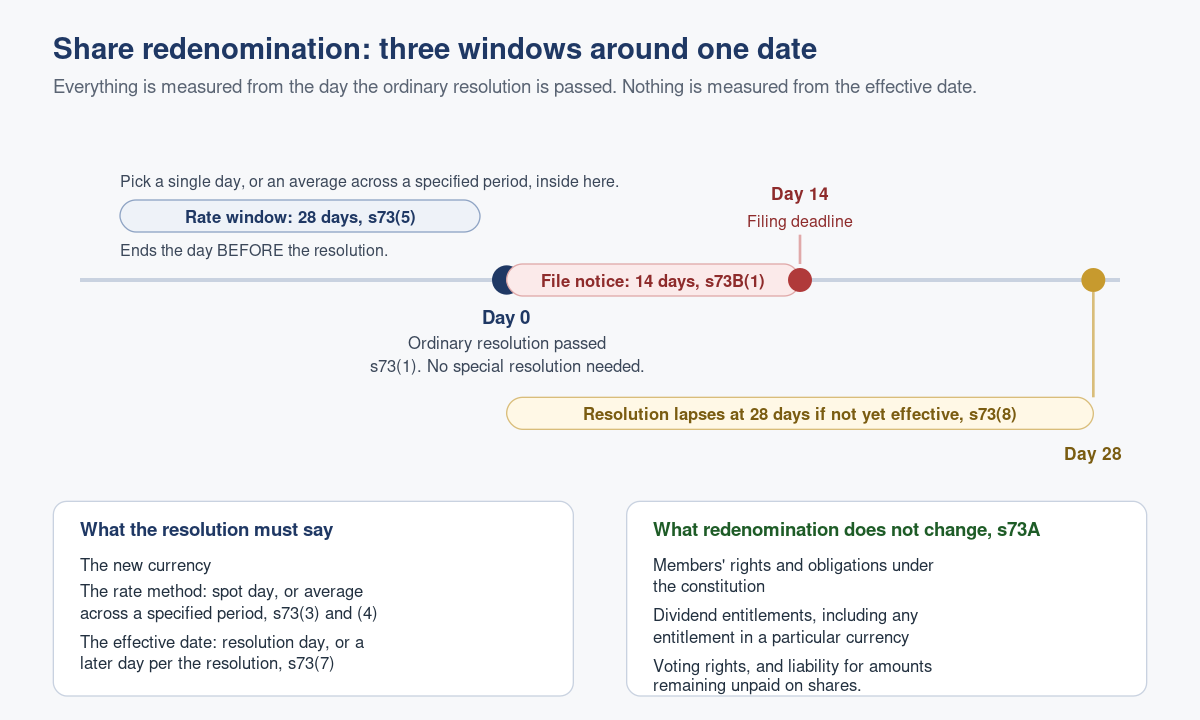
Two clocks, both starting on the same day. Most companies that get redenomination wrong miss one of them.
The transaction itself is simple enough. A company with SGD share capital that now earns and reports in USD wants the capital denominated in USD too. Nothing about who owns what changes, and the statute is careful to say so.
What redenomination is not
Redenomination is one of three share transactions that get muddled constantly, and the muddle is expensive because share filings are hard to unwind.
| If what you are changing is… | Then the transaction is… | Governing provision |
|---|---|---|
| The currency the share capital is expressed in | Redenomination | Sections 73, 73A and 73B |
| The class of existing shares, ordinary into A shares or preference shares | Conversion of shares | Section 74A |
| The number or structure of shares: subdivision, consolidation, cancellation of untaken shares | Alteration of share capital | Section 71 |
Section 73(10) defines redenomination as the conversion of share capital or any class of shares from one currency to another. Note the word “conversion” sitting inside the definition. That is exactly why the confusion with a Section 74A conversion persists, so be deliberate about the language in your minutes.
Changing classes rather than currency? Read our companion guide to filing a conversion of shares under Section 74A. Subdividing, consolidating or cancelling? Read altering share capital under Section 71 and subdivision and consolidation of shares.
The resolution: what Section 73 actually requires
An ordinary resolution is enough. Section 73(1) empowers a company having a share capital to convert its share capital, or any class of shares, from one currency to another by ordinary resolution: a simple majority of members voting, a much lower bar than the 75% a special resolution needs. Our note on ordinary versus special resolutions sets out the distinction.
The content, though, is prescribed, and the statute is strict about the exchange rate.
The rate must be a spot rate specified in the resolution
Section 73(3) requires the redenomination to be made at a spot rate of exchange specified in the resolution. Under section 73(4) that rate must be either a rate prevailing on a day specified in the resolution, or the average of rates prevailing on each consecutive day of a specified period.
Two methods, then, and either way the day or period has to be written in. A resolution saying the rate will be “the prevailing rate on the effective date” does not comply.
The rate window is 28 days before the resolution
Section 73(5) is the provision people miss entirely. The day or period specified for the rate must fall within the period of 28 days ending on the day before the resolution is passed.
The rate must therefore be historical, and recent. No rate from three months ago because it flattered the balance sheet, and no future rate. Pass the resolution on 20 October 2026 and the rate day or period has to sit inside the 28 days ending 19 October 2026.
The effective date, and the 28-day lapse
Section 73(7) allows the redenomination to take effect on the day the resolution is passed, or on a later day determined in accordance with it, and section 73(6) allows the resolution to specify conditions that must be met first, which is useful where the redenomination is contingent on a financing completing.
Section 73(8) then imposes the hard stop: the resolution lapses if the redenomination has not taken effect at the end of 28 days beginning on the date it was passed.
This is the clock that catches companies who build conditions into the resolution. Make the redenomination conditional on something that takes six weeks and the resolution dies first, leaving you to start again with a fresh resolution and rate. Section 73(2) does permit a resolution to authorise redenomination on more than one occasion, at a specified time or in specified circumstances, but the 28-day lapse still governs.
Section 73(9) also allows a constitution to exclude or restrict the power. Check it first; if it does, our guide on how to alter a company constitution covers the route through.
What redenomination does not disturb
Section 73A is short and reassuring. A redenomination does not affect members’ rights or obligations under the constitution, any restrictions affecting them under it, any entitlement to dividends (including one in a particular currency), voting rights, or liability for amounts unpaid on shares. Section 73A(2) extends the reference to the constitution to include the terms on which shares were allotted or held.
The practical reading: a shareholder entitled to a dividend in SGD does not have that entitlement silently converted by a move to USD. Where the intention is to change the currency of dividends or of unpaid liability, redenomination is the wrong instrument, and the answer lies in the constitution and the terms of allotment.
The filing, the deadline and the penalty
Section 73B(1) requires the company to deliver a notice in the specified form to the Registrar within 14 days after passing the Section 73 resolution.
Note the trigger. The 14 days run from the passing of the resolution, not the effective date. Pass the resolution on 1 October 2026 with an effective date of 25 October 2026 and your deadline is still mid-October. Companies that key off the effective date file late.
Sections 73B(2) and (3) prescribe the contents, all stated in the redenominated capital: total issued shares, the paid and unpaid amounts on them, total issued share capital, then the same breakdown for every class, plus that class’s voting rights, dividend and distribution rights, capital participation rights including on a winding up, and whether it is redeemable. A substantial data set, which is why the capital table needs preparing before anyone opens Bizfile.
| What you need to know | Detail |
|---|---|
| Resolution required | Ordinary resolution |
| Filing deadline | Within 14 days after passing the resolution, under Section 73B(1) |
| Resolution lapse | 28 days from the date passed, if not yet effective, under Section 73(8) |
| Rate window | Within 28 days ending the day before the resolution, under Section 73(5) |
| Fee | No filing fee |
| Processing | ACRA states an approval time of 7 working days |
| Default | Section 73B(4): every officer in default is liable on conviction to a fine not exceeding $4,000 and a default penalty of $250 |
Section 73B(4) is worth reading twice. Liability falls on every officer in default personally, not on the company: director-level exposure for a filing that takes minutes.
The steps, in order
- Check the constitution for any exclusion or restriction under Section 73(9).
- Choose the rate method, and confirm the day or period falls inside the 28 days ending the day before the resolution.
- Draft the resolution: new currency, rate method with its day or period, effective date, any conditions.
- Pass the ordinary resolution and minute it with the date clearly recorded.
- Prepare the redenominated capital table in full, by class, to the Section 73B(2) and (3) specification.
- Log in to Bizfile as a business user through Corppass. Our note on logging in as a business user covers access.
- Open the shares eService, select redenomination, key the figures and submit inside the 14 days.
- Diarise the 28-day lapse date and confirm the redenomination has taken effect before it expires.
What goes wrong, and what it costs
Counting the 14 days from the wrong date. The deadline runs from the resolution, not the effective date. Where those differ, and Section 73(7) allows them to, the filing gets missed and Section 73B(4) exposes every officer in default personally.
A resolution that specifies no rate day. “At the prevailing market rate” does not comply with Section 73(3) and (4). The resolution has to name the day, or the averaging period.
Picking a rate day outside the window. A rate day more than 28 days before the resolution, or on or after it, breaches Section 73(5). This happens most often where a board approves the redenomination in principle in one quarter and passes the resolution in the next, on the old rate.
Conditions that outlive the resolution. Section 73(8) kills the resolution 28 days after it is passed if the redenomination has not taken effect. Conditions must be satisfiable inside four weeks. And if the figures are keyed wrongly and a Notice of Error will not cure it, fixing the register may need an Order of Court.
Assuming redenomination solves an accounting problem. It does not, by itself. Redenominating share capital and changing your functional or presentation currency are different exercises with different tests. Our note on foreign currency transactions and FX gain and loss covers the reporting side, and the accounting treatment of share capital, share premium and reserves covers where the redenominated capital then sits.
Frequently asked questions
What is share redenomination in Singapore?
Redenomination converts a company’s share capital, or a class of shares, from one currency into another, for example SGD to USD. Section 73(10) of the Companies Act 1967 defines it that way. The currency denomination changes while the shares’ value is maintained, and ownership, voting and dividend entitlements are unaffected.
Do I need a special resolution to redenominate shares?
No. Section 73(1) requires only an ordinary resolution, a simple majority of members voting, well below the 75% threshold for a special resolution. Section 73(9) does allow a constitution to exclude or restrict the power, so check it before relying on an ordinary resolution.
How long do I have to file the notice of redenomination with ACRA?
Fourteen days. Section 73B(1) requires the notice to reach the Registrar within 14 days after the Section 73 resolution is passed. The clock runs from the resolution date, not the effective date of the redenomination. Section 73B(4) makes every officer in default personally liable on conviction.
What exchange rate must I use for a redenomination?
A spot rate specified in the resolution. Section 73(4) allows either a rate prevailing on a specified day, or an average across each consecutive day of a specified period. Under Section 73(5), that day or period must fall within the 28 days ending on the day before the resolution is passed.
Can a redenomination resolution expire before it is used?
Yes. Section 73(8) provides that the resolution lapses if the redenomination has not taken effect by the end of 28 days beginning on the date it was passed. That matters most where the resolution makes the redenomination conditional under Section 73(6). If the condition takes more than four weeks, you need a fresh resolution.
Getting the two clocks right
A small filing, a tidy set of rules, two overlapping deadlines: precisely the combination that produces late filings. The content is prescriptive, the rate window narrow, the lapse unforgiving, and the default penalty lands on directors personally.
Raffles Corporate Services drafts redenomination resolutions, prepares the capital schedules to the Section 73B specification, and files inside the 14-day window. If your company has drifted into reporting in a currency other than the one its share capital is denominated in, that is worth a conversation before your next year end.
The provisions sit in the Companies Act 1967 on Singapore Statutes Online, and ACRA’s note is on the share redenomination page. For more on Singapore corporate secretarial practice, see Singapore Secretary Services.
— The Editorial Team, Raffles Corporate Services
Need help with corporate secretarial or compliance matters?
If you would like help with your company's corporate secretarial, governance or compliance requirements, email [email protected] or WhatsApp +65 8501 7133.
Our team can assist with corporate secretarial, accounting and tax matters. Where legal advice is needed, advisers from our associated law firms can assist.