

A Singapore company limited by shares can reduce its share capital without going anywhere near a court. It passes a special resolution, its directors sign a solvency statement, it waits six weeks for creditors to object, and then it files. That is the whole architecture.
Raffles Corporate Services works with a panel of experienced Singapore law firms who offer cost-effective and efficient legal service and advice. This article is general information only and is not legal advice.
Most reductions take this route. It is faster and it costs a fraction of the court alternative. If your company cannot satisfy the solvency test, or a creditor will object and you know it, you need the court approved route instead, which is Part 2 of this pair.
What follows: what you may reduce, what the solvency statement commits your directors to, and the two filing windows that catch companies out.
What a capital reduction is, and what it is not
A reduction lowers the issued share capital figure recorded against your company at ACRA. It is not a share transfer, a buy-back or a subdivision.
Division 3A of Part 4 of the Companies Act 1967 sets out what a reduction may do. Section 78A(1) allows a company to extinguish or reduce liability on shares in respect of share capital not paid up, to cancel paid-up share capital that is lost or unrepresented by available assets, and to return to shareholders paid-up share capital that is more than the company needs.
Two constraints matter. Section 78A(2) says a company may not reduce its share capital except by a procedure provided for in that Division, so there is no informal route. Section 78A(3) allows a constitution to exclude or restrict the power, which makes the constitution the first document to read. The Division also does not apply to redemptions of preference shares under section 70(1) or to a company acquiring its own shares under sections 76B to 76G: if your transaction is really a share buy-back, a different regime applies.
The solvency statement: what your directors are signing
The solvency statement is not a formality, and it is not the company’s statement. It is a personal statement of opinion by every director.
Section 7A of the Companies Act 1967 defines it. The directors must have formed the opinion that, as at the date of the statement, there is no ground on which the company could then be found unable to pay its debts; that it will be able to pay its debts as they fall due during the 12 months immediately after that date (or, if a winding up is intended within 12 months, that debts will be paid in full within 12 months of its commencement); and that the value of the company’s assets is not less than the value of its liabilities, including contingent liabilities, and will not become less after the reduction.
Section 7A(3) requires directors to take contingent liabilities into account. Guarantees to a subsidiary’s bank, unresolved litigation and warranty tails all belong in the analysis.
The form the statement must take
Section 7A(2) draws a line by audit status. If the company is exempt from audit requirements under section 205B or 205C, the statement must be a written declaration signed by every director. If it is not audit exempt, the declaration must be signed by every director, or be accompanied by a report from the company’s auditor stating that the auditor has inquired into the affairs of the company and is of the opinion that the statement is not unreasonable given all the circumstances.
“Every director” is literal. A director on extended leave, a nominee director, an overseas director who never attends: all sign, or it is not a solvency statement.
The timing window, and it is short
For a private company, section 78B(3) requires the statement to be made in time to comply with the members’ inspection requirement, but not before the beginning of the period of 20 days ending with the resolution date. For a public company, section 78C(3) sets the equivalent window at 30 days, and adds a condition: a copy of the solvency statement must be lodged with the Registrar, together with the copy of the resolution required under section 186, within 15 days beginning with the resolution date.
When you do not need one at all
Sections 78B(2) and 78C(2) dispense with the solvency requirements where the reduction involves neither a reduction or distribution of cash or other assets by the company, nor a release of any liability owed to the company. A pure accounting reduction that cancels capital lost and unrepresented by assets sits inside that exception. Anything that puts money in a shareholder’s hand does not.
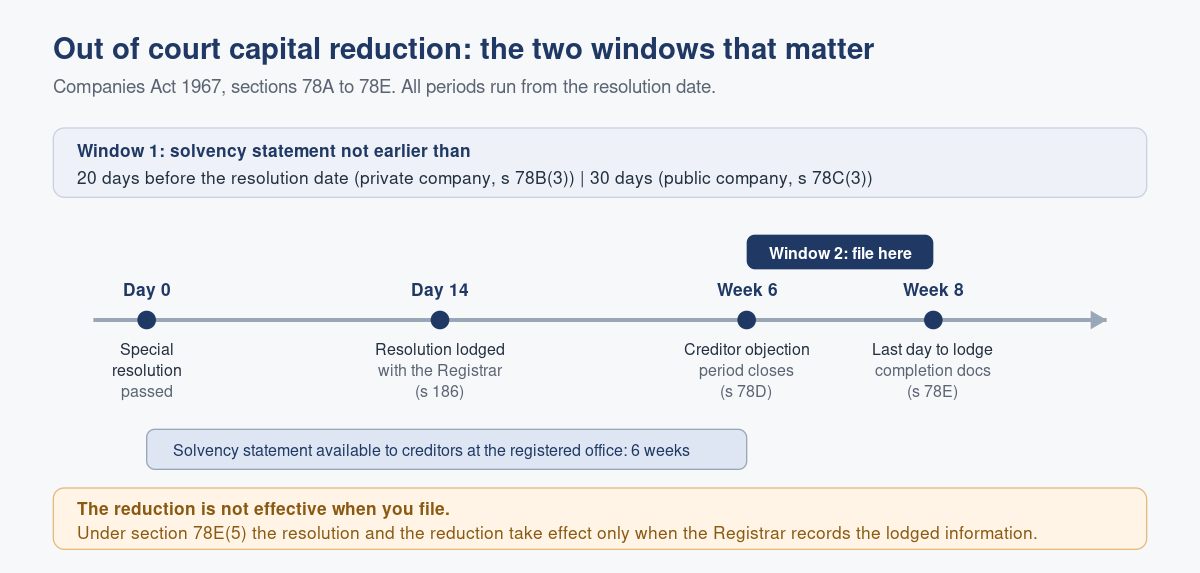
The sequence, in order
- Read the constitution. Confirm the power is not excluded or restricted under section 78A(3).
- Prepare the solvency statement (unless the section 78B(2) or 78C(2) exception applies), dated inside the 20 day window for a private company or 30 days for a public company.
- Pass the special resolution. A 75 per cent majority, in general meeting or, for a private company, by written means under section 184A. By written means, every copy served under section 183(3A) or 184C(1) must be accompanied by the solvency statement; in general meeting, it must be available for inspection throughout.
- Make the statement available to creditors at the registered office, free of charge, throughout the six weeks beginning with the resolution date.
- File the special resolution within 14 days, as section 186 requires. See our guide to filing the special resolution in Bizfile.
- File the publication of the proposed reduction, the publicity requirement that sections 78B(1)(c) and 78C(1)(c) leave to be prescribed by the Minister. ACRA operates it as a separate Bizfile transaction with a shorter deadline than the resolution filing.
- Wait out the six weeks, during which any creditor may apply to court.
- File the completion documents after six weeks and before eight weeks from the resolution date.
The creditor window, then the completion filing
Section 78D gives any creditor six weeks beginning with the resolution date to apply to the court for the resolution to be cancelled. The qualifying creditors are those entitled, at the date of their application, to a debt or claim that would be admissible in proof against the company if that date were the commencement of a winding up. Section 78D(4) requires the creditor to serve the application on the company as soon as possible, and the company to notify the Registrar.
Under section 78F the court must cancel the resolution if the debt or claim is still outstanding and the court is satisfied both that it has not been secured and the applicant has no other adequate safeguards, and that safeguards are not unnecessary in view of the assets the company would have after the reduction. Otherwise it dismisses the application. A creditor who is paid, secured or otherwise safe cannot stop your reduction. A creditor who is genuinely exposed can.
If no creditor applied, section 78E(1) requires a private company to lodge the resolution under section 186 and then, after the end of six weeks and before the end of eight weeks from the resolution date, to lodge the solvency statement (if applicable), a directors’ statement confirming the publicity and solvency requirements were met and that no cancellation application has been made, and a notice containing the reduction information (defined in section 78A(4) as the amount of capital reduced and the number of shares cancelled). Section 78E(2) is the public company equivalent.
Section 78E(5) sets the moment of legal effect: the resolution and the reduction take effect when the Registrar has recorded the lodged information. Not when the resolution passes. Not when you file. When it is recorded.
| Step | Private company (s 78B) | Public company (s 78C) |
|---|---|---|
| Solvency statement earliest date | Not before 20 days ending with the resolution date | Not before 30 days ending with the resolution date |
| Solvency statement lodged early? | No separate early lodgment | Yes, with the resolution, within 15 days |
| Statement available to members | With every copy of a written resolution, or throughout the meeting | Throughout the meeting |
| Statement available to creditors | Six weeks, at the registered office | Six weeks, at the registered office |
| Special resolution lodged | Within 14 days (s 186) | Within 14 days (s 186) |
| Completion filing window | After six weeks, before eight weeks (s 78E(1)) | After six weeks, before eight weeks (s 78E(2)) |
| Reduction takes effect | When the Registrar records the information (s 78E(5)) | Same (s 78E(5)) |
What goes wrong
The eight week deadline is missed. The most common failure by a distance. The company passes the resolution, files it, waits out the six weeks, and then somebody goes on leave. The window under section 78E is not merely a filing deadline: it is a condition for the reduction to take effect. Miss it and you are back to a fresh resolution, a fresh solvency statement and a fresh six week wait.
The solvency statement is dated too early, or one director does not sign. A statement signed 25 days before a private company’s resolution date falls outside the 20 day window in section 78B(3). And section 7A requires every director: two signatures out of three does not satisfy the solvency requirements.
The statement is not kept available at the registered office. Sections 78B(4)(b) and 78C(4)(b) require availability for the full six weeks. Sections 78B(5) and 78C(5) preserve the resolution’s validity despite a breach, but every officer in default is guilty of an offence.
The confirming statement is wrong. Section 78J makes it an offence for a director to make a statement under the relevant paragraphs of section 78E where it is false and is not believed to be true. Signing the confirmation without checking whether a creditor application was made is a bad habit.
Frequently asked questions
Do I need a court order to reduce my company’s share capital in Singapore?
Not usually. A company limited by shares can reduce capital out of court under section 78B (private) or 78C (public), using a special resolution supported by a solvency statement from all directors, followed by a six week creditor objection period. The court route under section 78G is an alternative, not a precondition.
How long does an out of court capital reduction take?
Plan for about two months from the resolution date. The creditor objection period alone is six weeks, and the completion documents can only be lodged after six weeks and before eight weeks from that date. Preparation before the resolution is on top of that.
Can we reduce share capital if the company is loss-making?
Often yes. Cancelling paid-up capital that is lost or unrepresented by available assets is expressly permitted by section 78A(1), and if nothing leaves the company the solvency requirements may not apply at all. But if cash or assets go out to shareholders, the directors must still sign the solvency statement.
What happens if a creditor objects?
The creditor applies to court within the six week window under section 78D and must serve the application on the company, which then notifies the Registrar. Under section 78F the court cancels the resolution only if the debt is outstanding, unsecured and without adequate safeguards, and security is not unnecessary given post-reduction assets.
Does the reduction take effect on the date of the special resolution?
No. Under section 78E(5) both the resolution and the reduction take effect only when the Registrar records the lodged information. Until then the issued share capital is legally unchanged.
Getting the two windows right
A capital reduction is not difficult law. It is difficult diary management. Two dates decide whether it works: the earliest date the solvency statement may be signed, and the narrow span between six and eight weeks when the completion documents must be lodged.
Raffles Corporate Services runs capital reductions end to end, from the constitutional check to the final Bizfile filing, with the diary behind them.
Next in this pair: the court approved route, and for the mechanics, filing the special resolution in Bizfile. Related: ordinary versus special resolutions, share capital, share premium and reserves, and subdivision and consolidation of shares. Statutory text on Singapore Statutes Online; ACRA’s overview at acra.gov.sg.
— The Editorial Team, Raffles Corporate Services
Need help with corporate secretarial or compliance matters?
If you would like help with your company's corporate secretarial, governance or compliance requirements, email [email protected] or WhatsApp +65 8501 7133.
Our team can assist with corporate secretarial, accounting and tax matters. Where legal advice is needed, advisers from our associated law firms can assist.