

Converting shares means changing existing shares from one class into another, ordinary into A shares, or ordinary into preference shares. Your constitution must authorise it, a private company effects it by lodging a notice with ACRA, the filing is free and immediate, and it does not legally take effect until the Registrar updates the electronic register of members.
Raffles Corporate Services works with a panel of experienced Singapore law firms who offer cost-effective and efficient legal service and advice. This article is general information only and is not legal advice.
That last clause is the one that catches people. Directors sign a resolution, the secretary files the notice, and everyone treats the shares as converted from the resolution date. Legally they are not. Section 74A(4) of the Companies Act 1967 says a conversion by a private company on or after 3 January 2016 does not take effect until the electronic register is updated by the Registrar under section 196A(5).
The effective date is a registry event, not a board event. Get that wrong in a shareholders’ agreement or an investment round and the consequences are not academic.
Conversion, redenomination, alteration: three different things
Before anything else, the terminology. Three share transactions get confused with each other constantly, they sit under three different sections, and filing the wrong one is the kind of error that can end up needing a court order to fix.
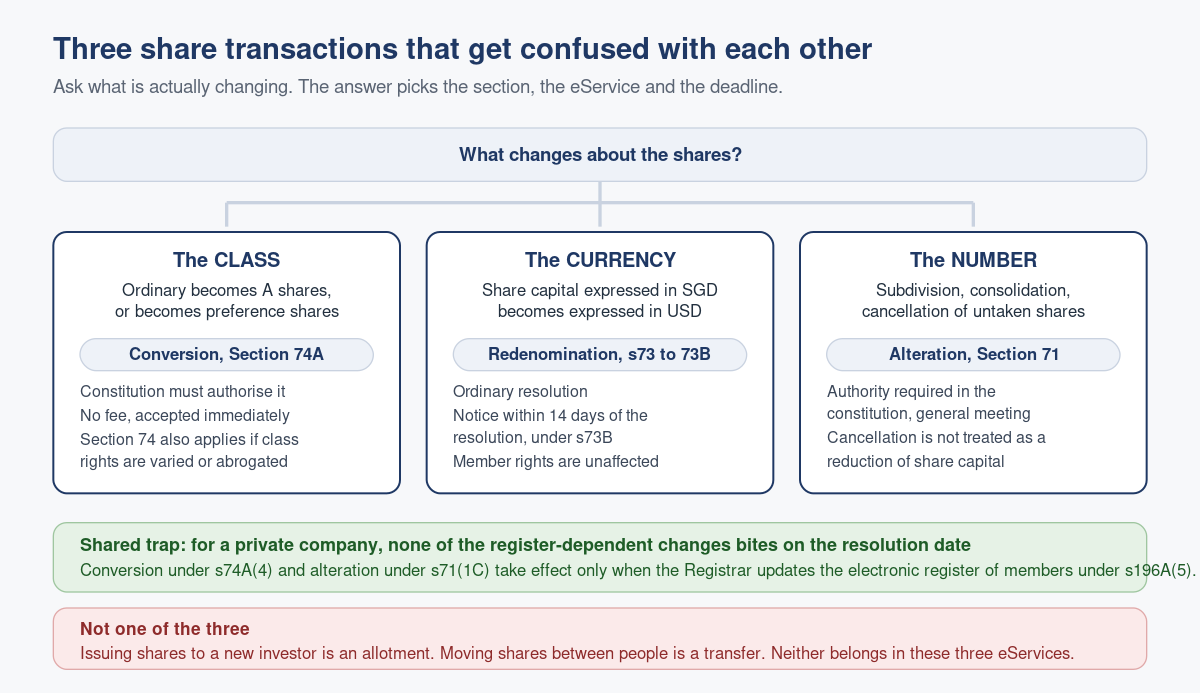
| Transaction | What actually changes | Governing provision | What you file |
|---|---|---|---|
| Conversion of shares | The class of existing shares, for example ordinary shares becoming A shares or preference shares | Section 74A | Notice of conversion of shares |
| Redenomination of shares | The currency the share capital is expressed in, for example SGD to USD | Sections 73, 73A and 73B | Notice of redenomination, within 14 days |
| Alteration of share capital | The number or structure of shares: consolidation, subdivision, conversion into stock, cancellation of untaken shares | Section 71 | Notice of alteration of share capital |
None of these is a share issue and none is a share transfer. Conversion does not create new shares and does not move shares between people. The same shares, held by the same members, acquire a different set of rights.
If what you need is the currency change, read our companion piece on filing a notice of share redenomination. If it is a subdivision, consolidation or cancellation, read altering share capital under Section 71 and subdivision and consolidation of shares.
When companies actually convert shares
The commercial reasons cluster into four situations. An investment round where the incoming investor wants preference shares with a liquidation preference and no votes, and converting existing holdings is cleaner than issuing a fresh class. A founder or family split, where converting a block of ordinary shares into alphabet shares (A, B and C) gives different holders different dividend, voting or capital entitlements without moving any shares. A reorganisation or sale, where a buyer wants a tidy class structure before completion. And plain housekeeping: plenty of Singapore SMEs carry a class structure that made sense to someone in 2009 and to nobody now.
What has to be true before you file
The constitution must authorise it
Section 74A(1) is the gateway. A company whose share capital is divided into different classes may make provision in its constitution to authorise the conversion of one class into another. Read that carefully: the authority has to be in the constitution. If your constitution is silent, you do not have the power, and filing a notice does not give you one.
That is where the extra step comes from. If the constitution does not permit the conversion, you alter it first, which needs a special resolution passed by not less than 75% of the members voting, lodged with ACRA through the Notice of Resolution eService. Our guide on how to alter a company constitution covers that sequence, and ordinary versus special resolutions explains the thresholds and notice periods.
Public companies work differently. Under section 74A(2), a public company may convert class A into class B by special resolution only if its constitution permits B to be issued and sets out the rights attached to B. No shortcut exists.
If class rights are being varied, Section 74 bites as well
This is the most under-appreciated part of the exercise. Section 74A(5) provides that section 74 applies where a conversion involves a variation or an abrogation of the rights attached to any class of shares.
Section 74 is the class rights machinery: the procedure for varying rights, the consent thresholds, and the right of a dissenting minority holding a specified proportion of the affected class to apply to court to have the variation cancelled. If your conversion touches the rights of an existing class, you are running a class rights variation as well as a conversion, and a notice filing alone will not protect you. Our guide to variation of class rights under Section 74 sets out that procedure, and where the classes are already in dispute, a court application to determine share class rights is the route.
Preference shares carry their own precondition
Section 75(1) prohibits a company from converting any issued shares into preference shares unless the constitution already sets out the holders’ rights as to repayment of capital, participation in surplus assets and profits, cumulative or non-cumulative dividends, voting, and priority of payment of capital and dividend relative to other shares. You cannot convert to preference shares and work out the terms later. The terms go into the constitution first.
One conversion is simply prohibited
Section 74A(6) is absolute: a share that was not a redeemable preference share when issued cannot afterwards be converted into one. No resolution, no constitutional amendment and no filing will achieve it. If the deal depends on redeemability, the instrument must be issued as a redeemable preference share from the start, which makes it an allotment question rather than a conversion question.
The filing itself
Company officers, meaning a director or the company secretary, can file directly. You can also appoint a corporate service provider to file on your behalf.
| What you need to know | Detail |
|---|---|
| Fee | No filing fee |
| Processing | Accepted immediately on submission |
| Who may file | Director, company secretary, or an appointed CSP |
| Legal effect | Not until the Registrar updates the electronic register of members |
The steps:
- Confirm the constitution authorises the conversion. If not, pass and lodge the special resolution to alter it first.
- If class rights are being varied or abrogated, run the Section 74 variation procedure properly, including any class consent required.
- Pass the board and member resolutions that the constitution and the deal require, and minute them with the precise class descriptions and share numbers.
- Log in to Bizfile as a business user through Corppass. Our note on logging in to Bizfile as a business user covers the access side.
- Open the shares eService and select the conversion of shares transaction.
- Enter the class you are converting from, the class you are converting to, and the exact number of shares for each affected member.
- Submit, then pull the updated electronic register of members and confirm the conversion is actually reflected.
Step seven is not optional housekeeping. It is how you establish the effective date.
What goes wrong, and what it costs
Treating the resolution date as the effective date. Under section 74A(4) it is not. If your subscription agreement, option deed or dividend calculation keys off “the date of conversion”, and the parties assumed that meant the resolution, you have a mismatch between the document and the register. This surfaces during due diligence, at the worst possible moment.
Filing a conversion when the transaction is really something else. A currency change is a redenomination. A five-for-one split is an alteration of share capital. A new class issued to a new investor is an allotment. Each has its own eService.
Filing the wrong numbers and discovering the fix is hard. Share filings are not freely editable. A mistake that cannot be cured by a Notice of Error may need an Order of Court to correct, which is an expensive way to fix a typing error. Take the numbers off a checked schedule, not out of somebody’s head.
Converting to preference shares with an empty constitution. Section 75 means the rights have to be in the constitution first. Companies routinely do this in the wrong order, then find the conversion is vulnerable.
Forgetting the accounting consequences. A conversion can change the composition of share capital and the entitlements attached to it, which flows into the financial statements. Our note on the accounting treatment of share capital, share premium and reserves is worth reading alongside the filing, and the class structure you end up with will shape every subsequent new investor admission.
Frequently asked questions
What is a conversion of shares in Singapore?
A conversion changes existing shares from one class into another, for example ordinary shares into A shares or into preference shares. It is governed by Section 74A of the Companies Act 1967. No new shares are created and no shares change hands. The same members hold the same shares, with different rights attached.
Do I need a special resolution to convert shares?
Not necessarily. If your constitution already authorises the conversion, a private company effects it by lodging a notice with ACRA. If the constitution does not authorise it, you must first alter the constitution by special resolution, requiring at least 75% of members voting, and lodge that resolution with ACRA. A public company converts by special resolution.
When does a share conversion legally take effect?
For a private company, Section 74A(4) provides that a conversion on or after 3 January 2016 does not take effect until the Registrar updates the company’s electronic register of members under Section 196A(5). The resolution date is not the effective date. Always verify the updated register before relying on the conversion.
Can ordinary shares be converted into redeemable preference shares?
No. Section 74A(6) prohibits it outright: a share that was not a redeemable preference share when issued cannot afterwards be converted into one. If redeemability is commercially essential, the shares must be issued as redeemable preference shares from the start, which is an allotment rather than a conversion.
How much does it cost to file a conversion of shares with ACRA?
ACRA does not charge a filing fee for the conversion of shares notice, and the filing is accepted immediately. The real cost sits elsewhere: drafting or amending the constitution, running any class rights variation procedure correctly, and professional fees. Correcting a mis-filed conversion is far more expensive than filing it properly.
Is conversion the same as redenomination of shares?
No, and confusing them is a common and costly error. Conversion changes the class of shares under Section 74A. Redenomination changes the currency the share capital is expressed in, under Sections 73 to 73B, and carries a 14-day filing deadline. They are separate transactions with separate eServices.
Getting the class structure right before you file
Share transactions are unforgiving. The filing is free and takes minutes, but the analysis in front of it, whether the constitution authorises the conversion, whether class rights are being varied, whether Section 75 applies, whether the deal needs a conversion at all, is where the value and the risk both sit.
Raffles Corporate Services handles share conversions, class rights variations and constitutional amendments for Singapore private companies, and we reconcile the electronic register of members after every filing rather than assuming it went through. If you are contemplating a new class of shares for an investor or a founder split, have that conversation before the resolution is drafted, not after.
You can read the provision itself at Section 74A of the Companies Act 1967 on Singapore Statutes Online, and ACRA’s own procedural note sits on the conversion of shares page. For more on Singapore corporate secretarial practice, see Singapore Secretary Services.
— The Editorial Team, Raffles Corporate Services
Need help with corporate secretarial or compliance matters?
If you would like help with your company's corporate secretarial, governance or compliance requirements, email [email protected] or WhatsApp +65 8501 7133.
Our team can assist with corporate secretarial, accounting and tax matters. Where legal advice is needed, advisers from our associated law firms can assist.