

A registered foreign company files its financial statements with ACRA as documents, not as XBRL. There is no taxonomy, no BizFinx preparation tool and no validation engine. You upload files through the “File annual returns” eService, answer a set of register questions, and submit.
Raffles Corporate Services works with a panel of experienced Singapore law firms who offer cost-effective and efficient legal service and advice. This article is general information only and is not legal advice.
That comes as a relief to most foreign parents, and then as a surprise, because the filing demands things a Singapore company never has to think about. Two sets of accounts rather than one. A declaration about registers you may not have known you were required to keep. A filename convention that will reject your document if you get it wrong.
Here is what the filing consists of, who may make it, and what causes it to fail.
Who this applies to, and who it does not
This is the annual filing for a registered foreign company, which in ordinary language usually means a branch: a foreign-incorporated company that has registered a presence in Singapore under Part XI Division 2 of the Companies Act 1967 rather than incorporating a local subsidiary.
If your Singapore presence is a private limited company owned by a foreign parent, none of this applies to you. That entity is a Singapore company. It files an annual return and, unless exempt, XBRL financial statements like any other. The difference between the two structures, and why the accounts obligation is the single biggest reason to choose one over the other, is set out in our branch office of a foreign parent FAQ.
A representative office is different again. It has no filing of this kind because it is not a registered entity carrying on business, and it is time limited. See our note on the representative office sunset.
Who may file
Two categories of person can make the filing:
- The company’s authorised representative in Singapore, appointed under the Companies Act 1967 when the foreign company registered here
- A registered corporate service provider acting for the company
Note what is absent. There is no company secretary in a branch structure, so the filing does not route through one. The authorised representative carries the obligation personally, which is worth knowing if you are the person who agreed to take the role without reading the statute. Corporate service providers who file on behalf of clients have their own obligations under the Corporate Service Providers Act 2024, summarised in our CSP Act compliance FAQ.
What you have to prepare
This is where it pays to read carefully, because the required set depends on facts about your company rather than being one fixed list.
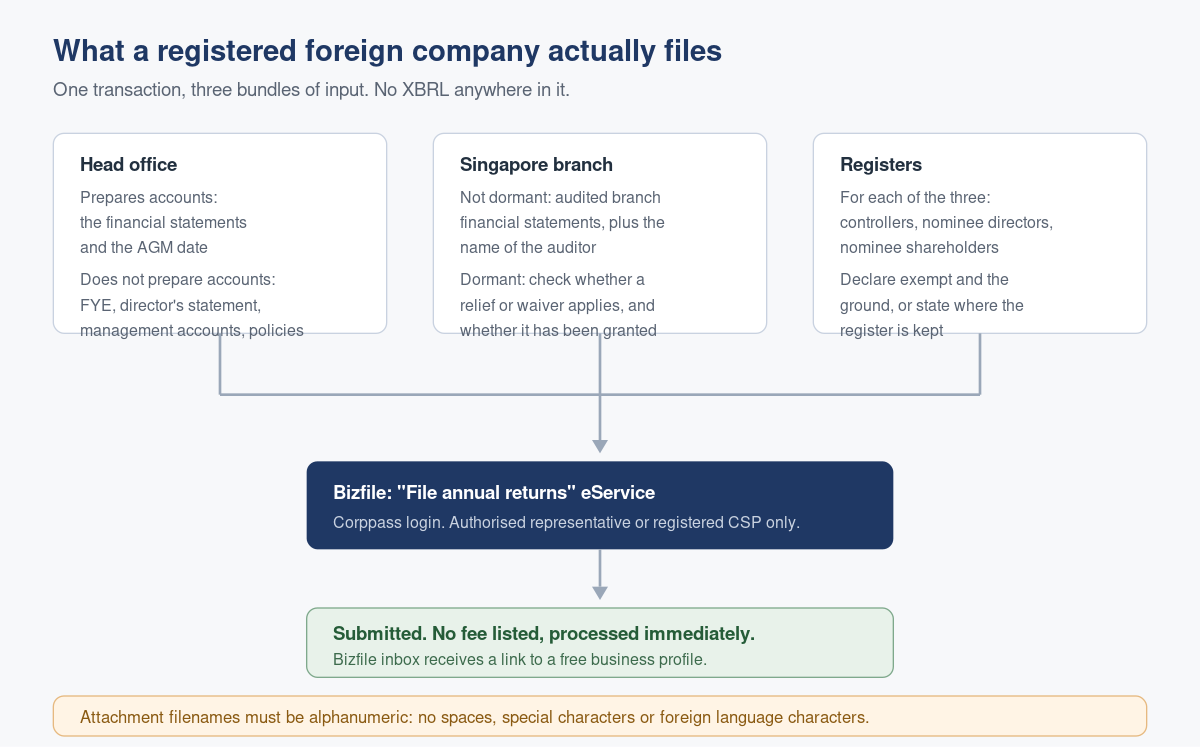
| Your situation | What you attach or provide |
|---|---|
| Foreign company that does not prepare financial statements | Financial year end date, a director’s statement, management accounts, and the material accounting policies |
| Foreign company that is required to prepare financial statements | AGM date, and the financial statements themselves |
| Singapore branch that is not dormant | Audited financial statements of the Singapore branch, plus the name of the auditor who audited them |
| Not exempt from maintaining the statutory registers | The location of the register of controllers, the register of nominee directors and the register of nominee shareholders |
The first two rows are about the head office. Under section 373 of the Companies Act 1967, a registered foreign company’s obligation reaches the accounts of the company itself, not merely its Singapore operations. A parent incorporated somewhere that does not require it to prepare accounts at all still has to give ACRA something: a director’s statement, management accounts and the accounting policies.
The third row is about the Singapore branch. If the branch is not dormant, its financial statements must be audited, and you must name the auditor who signed them off.
Reliefs and waivers do exist under section 373, including relief from aspects of form and content and, in the right circumstances, a waiver of the branch statements. They are applications, granted on criteria. They are not entitlements, and they are not quick. Assume you are filing unless you hold a written relief.
The filename rule that quietly breaks filings
Financial statement attachments must have alphanumeric filenames. No spaces, no special characters, no foreign language characters.
That means FY2025 Accounts (final) & Notes.pdf will give you trouble, and FY2025AccountsSingaporeBranch.pdf will not. It is a trivial thing that costs people an afternoon, usually because the document came from a head office finance team whose naming conventions were never designed for a Singapore regulator.
The registers nobody mentioned at registration
A registered foreign company is not outside Singapore’s beneficial ownership regime. Unless exempt, it must maintain a register of registrable controllers, and it may need to maintain registers of nominee directors and nominee shareholders.
The filing asks you to declare, for each of those three registers, either that the company is exempt and on what ground, or where the register is kept. You cannot skip the question. If you have never set the registers up, the filing is the moment you find out, and the honest answer is that you are already late.
Sort this out before you open the eService, not during it. Our guide to what a registered foreign company must keep after registration works through each register, and ACRA sets out the framework on its register of registrable controllers pages.
The filing, step by step
- Log in to Bizfile using Corppass as a business user. If the login itself is the problem, see our note on logging in to Bizfile as a business user.
- Select the entity you are filing for. If you act for several, switching to the wrong one is the classic way to waste twenty minutes. Our guide to switching profiles on Bizfile covers it.
- Open the “File annual returns” eService and start the transaction.
- Check the entity information ACRA holds and confirm it is current before you go any further. If the registered particulars are out of date, fix them first: an annual filing made against stale particulars is a filing you will revisit.
- Enter the financial year end date. You do this on the first filing only. For later years ACRA computes it.
- Attach the documents appropriate to your situation, using the table above. Alphanumeric filenames.
- Name the auditor, if the Singapore branch is not dormant.
- Answer the register questions, one by one, for controllers, nominee directors and nominee shareholders. Exempt, and on what ground, or the location of the register.
- Review everything, tick the declaration, and submit.
- Check your Bizfile inbox. A notification lands there, carrying a link to download a free business profile for the entity.
ACRA lists no fee for this annual filing and processes it immediately. That is genuinely useful: unlike the XBRL route, there is no validation queue and no exemption process standing between you and a completed filing.
Why there is no XBRL here
The logic explains the shape of the whole exercise. XBRL exists so that ACRA can hold Singapore company financial data in a structured, machine-readable form built on a Singapore taxonomy. A foreign company’s head office accounts are prepared under a foreign framework, in a foreign currency, to a foreign regulator’s requirements. There is no sensible way to force those into the ACRA taxonomy, and no regulatory benefit in trying.
So the foreign company route is a documents route. Everything the XBRL articles in this series worry about, the taxonomy mapping, the validation errors and their fixes, the exemption requests, simply does not arise. What replaces it is a disclosure problem instead of a technical one.
What goes wrong in practice
The head office finds out its accounts are going public. This is the recurring one. A group registers a branch because it is quicker than incorporating, and eleven months later discovers that the parent’s financial statements are going onto a Singapore public register where anyone can buy them. Competitors included. If that outcome is unacceptable, the answer was a subsidiary, and the decision needed to be made before registration rather than after.
Nobody applied for the relief in time. Section 373 reliefs and waivers are real, but they are applications with criteria and a processing period. A relief sought in the week the filing is due is a relief you will not have.
The branch was treated as dormant when it was not. Dormancy has a statutory meaning. A branch with a bank charge, a service fee and one invoice is not dormant in the sense that matters, and filing unaudited branch statements on that basis is a misstep that is awkward to unwind.
The registers were never set up. The filing asks a direct question about the register of controllers. Answering it honestly when no register exists is uncomfortable. Answering it dishonestly is considerably worse.
The particulars were stale. Changes to the foreign company’s own details, its authorised representative, or its registered office in Singapore all carry their own filing obligations with their own deadlines. The annual filing is not the place to catch up on a year of unfiled changes, and ACRA’s alerts on missed deadlines will have been telling you so.
Frequently asked questions
Does a foreign company branch file XBRL financial statements?
No. A registered foreign company files its financial statements as document attachments through the “File annual returns” eService on Bizfile. There is no XBRL taxonomy, no BizFinx preparation tool and no validation engine involved. The requirement to file in XBRL applies to Singapore-incorporated companies.
Do we have to file the parent company’s accounts, or just the Singapore branch’s?
Both, in substance. Under section 373 of the Companies Act 1967 the obligation reaches the foreign company’s own financial statements as well as its Singapore operations. A non-dormant branch additionally files audited Singapore branch statements and names the auditor. Reliefs and waivers exist but must be applied for and granted.
What if our head office is not required to prepare financial statements anywhere?
You still file something. ACRA expects a director’s statement, management accounts and the material accounting policies, alongside the financial year end date. The absence of a home country accounts requirement is not an absence of a Singapore filing requirement.
Who is allowed to make the filing?
The company’s authorised representative in Singapore, or a registered corporate service provider acting for the company. A branch has no company secretary, so the obligation sits with the authorised representative, which is one of the underrated risks of accepting that role.
Is there a fee?
ACRA lists no fee for the annual filing itself and processes the transaction immediately. Budget instead for the cost of the branch audit where the branch is not dormant, and for any professional work needed to produce head office accounts in a form the filing will accept.
Why does the form ask where our register of controllers is kept?
Because a registered foreign company is within Singapore’s beneficial ownership regime unless it is exempt. The same applies to the registers of nominee directors and nominee shareholders. You must either claim an exemption and give the ground, or state where each register is kept.
Before your first filing, not during it
Almost every difficult foreign company filing is difficult for reasons decided a year earlier: the structure chosen, the reliefs not applied for, the registers never built. The filing itself is a twenty minute transaction once the inputs exist.
Raffles Corporate Services acts as authorised representative for registered foreign companies in Singapore, maintains their statutory registers, and handles the annual filing. If you are weighing a branch against a subsidiary, or you have a branch whose first filing is coming due and nobody has looked at the head office accounts question, that is worth a conversation now rather than in month eleven. If the structure itself is under review, our FAQ on re-domiciling a foreign company into Singapore covers the alternative.
You can reach us through Raffles Corporate Services, or read more on Singapore corporate secretarial practice at Singapore Secretary Services.
— The Editorial Team, Raffles Corporate Services
Need help with accounting or bookkeeping?
If you would like accounting, bookkeeping or financial reporting support for your business, email [email protected] or WhatsApp +65 8501 7133.
Our accounting and tax advisers can assist. Where legal advice is needed, advisers from our associated law firms can also assist.