

Your foreign company is now on ACRA’s register. Three things are due almost immediately: a public register of members, set up within 30 days of registration and kept in Singapore; Corppass, available one day after the UEN is issued; and the free Business Profile, which expires 60 days after registration.
Raffles Corporate Services works with a panel of experienced Singapore law firms who offer cost-effective and efficient legal service and advice. This article is general information only and is not legal advice.
The public register of members is the one that surprises groups. A branch has no Singapore shareholders, so nobody expects a shareholder register. But Sections 379 and 380 of the Companies Act 1967 require a registered foreign company to keep a public register of the parent’s members, in Singapore, open to inspection by anyone who asks and pays a dollar.
That is a genuinely different obligation from anything a local company has, and it is the single most commonly missed item on a branch’s post-registration list.
The public register of members: what it is and why it exists
A registered foreign company must keep a register listing the persons or entities who are members of the foreign company. Who counts as a member is determined by the law of the parent’s own jurisdiction, not Singapore’s.
It is called a public register because anyone may inspect it or request a copy. That is the point of it. Singapore allows a foreign company to trade here without incorporating, and in exchange requires that the ownership of the entity your counterparties are dealing with be discoverable locally.
What the register must contain
| Parent’s listing status | What the register must show |
|---|---|
| Not listed | Names of members, addresses of members, number of shares held by each member, amounts paid on shares |
| Listed on the Singapore Exchange | The Central Depository alone, because share certificates are registered in CDP’s name and CDP keeps depositor records separately |
| Listed on an overseas exchange | May need to list only the central depository or nominee, depending on that exchange’s arrangements, the legislation governing it, and your home jurisdiction’s law |
Exemptions exist. Listed foreign companies should check whether they fall within the Companies (Listed Foreign Companies, Exemption from section 379) Regulations 2023 before building the register at all.
If your home jurisdiction already requires a register of members similar to the one Sections 379 and 380 describe, you may adapt that register to meet the Singapore requirement rather than maintaining a second one from scratch.
Format, location and the notification you must not forget
The register may be electronic, for example a spreadsheet, or in hardcopy. It must be kept either at your Singapore registered office or at another place in Singapore. A spreadsheet on a machine physically located in Singapore satisfies the location requirement.
You do not submit the register to ACRA. You do have to tell ACRA the address where you keep it, and if that address changes, you must notify ACRA within 30 days.
That notification is the part firms forget. The register gets built, the address gets filed once, then the office moves and nobody connects the move to a separate register-location filing.
Inspection and copy fees, and the 21-day deadline
| Request | Fee | Deadline |
|---|---|---|
| Inspection by a member of the foreign company | Free | Immediate access on request |
| Inspection by any other person | $1 per inspection, or a lower fee the company sets | Immediate access on request |
| Copy of the register | $1 per page, or a lower fee the company sets, paid in advance | Within 21 days from the day after the request is received, or longer if ACRA considers it reasonable |
A copy supplied on request can only include the names of members, their addresses, the number of shares each holds and the amounts paid on those shares. Nothing else from your internal records goes out with it. ACRA’s own public register of members page sets out the fee schedule.
The 21-day deadline is short if the person who maintains the register sits in the parent’s head office in another time zone. Decide now who in Singapore answers such a request, because the obligation is the branch’s, not the parent’s.
Everything else on the post-registration list
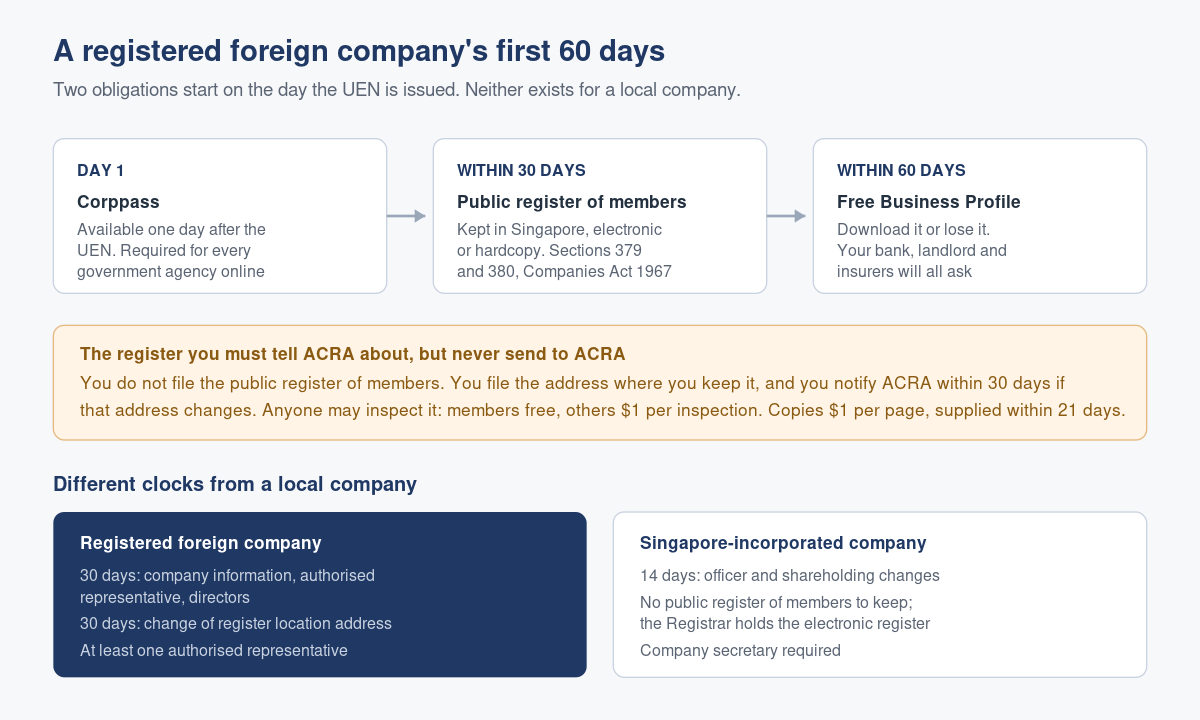
- Apply for Corppass. Available one day after your UEN is issued, and required for every online dealing with a government agency, including Bizfile. Do it first. Our walkthrough on setting up Corppass covers the administrator appointment, and who should get Bizfile access covers the roles question that follows.
- Set up the public register of members. Within 30 days of registration, kept in Singapore, with the location notified to ACRA.
- Download the free Business Profile. Within 60 days. After that the free copy expires and you buy it like anyone else.
- Open a corporate bank account. Banks typically want the persons authorised to sign, a board decision and certified company documents, identity checks on directors and on the persons who own the business, and most directors physically present in Singapore. Plan for the travel, because this is where branch launches slip.
- Check licences and permits. Sector licensing is separate from ACRA registration. If you move goods across the border you will also need a Customs account before you can apply for trade permits.
- Apply for a CPF Submission Number, if you will hire staff, before your first payroll run.
- Register a Data Protection Officer with the PDPC. A standing requirement under the Personal Data Protection Act 2012, and rarely just a form for a branch, because customer data usually flows back to the head office. Our note on the PDPA transfer limitation explains what sending personal data overseas requires.
- Settle the tax position. The entity is taxed in its own name at corporate income tax rates. GST registration is compulsory once taxable turnover exceeds $1 million at the end of any calendar year, or once you reasonably expect it to exceed $1 million in the next 12 months. Our guide to compulsory versus voluntary GST registration works through both limbs.
The clocks that differ from a local company’s
This is the section to print and put on the wall, because mixing up the two sets of deadlines is the commonest source of late lodgement penalties in a foreign company’s first two years.
| Event | Foreign company | Local company |
|---|---|---|
| Changes to company information, the authorised representative or the directors | 30 days | 14 days for officer and shareholding changes |
| Change of address where the public register of members is kept | 30 days | Not applicable |
| Public register of members | Must be set up within 30 days of registration and kept in Singapore | Not applicable, the electronic register of members is held by the Registrar |
| Local anchor person | At least one authorised representative | Company secretary, plus directors meeting the local residency requirement |
| Financial statements | Head office statements as well as Singapore operations, under Section 373 of the Companies Act 1967 | One set, for the company |
Late lodgement is charged per late transaction under ACRA’s late lodgement penalties, so a branch that lets three changes drift accumulates three penalties rather than one.
A note on the company secretary question
ACRA’s post-registration checklist for foreign companies carries a line about appointing a company secretary within six months and an auditor within three months of registration. That wording belongs to the local company checklist, and it does not sit easily with the statutory scheme, under which the company secretary requirement applies to companies incorporated in Singapore and a registered foreign company’s local anchor is its authorised representative.
If you are registering a branch, do not assume you need a Singapore company secretary because a checklist line says so, and do not assume you are free of an audit obligation either. The financial statements duty under Section 373 of the Companies Act 1967 is real, it reaches the head office accounts as well as the Singapore operations, and the reliefs and waivers that exist must be applied for and granted rather than assumed. Our branch office FAQ and the note on registering the branch itself cover that filing in more detail.
What goes wrong in practice
The public register of members is never built. Thirty days pass, nobody in the group has met this requirement in any other jurisdiction, and the first anyone hears of it is when a counterparty asks to inspect it. It takes an afternoon to create. It is embarrassing not to have it.
The register exists but nobody told ACRA where it lives. Or the address was filed and then the office moved. Both are filings, and both carry the 30-day clock.
The 14-day and 30-day clocks get crossed. Groups that also run a Singapore subsidiary apply the subsidiary’s 14-day rule to the branch, or the reverse. Keep one calendar per entity.
The head office accounts arrive as a surprise in month eleven. A parent whose home jurisdiction does not require audited accounts discovers that ACRA wants a version of them anyway. Start that conversation at registration, not at the filing deadline.
The authorised representative treats the role as ceremonial. They can be held personally responsible if the branch fails its legal obligations. That is a reason to give them the filing calendar and the register, not a reason to refuse the role.
The structure was wrong from the start. Many branch registrations should have been subsidiaries. If you are still early enough to change course, compare the branch, the subsidiary and the representative office properly, and if the real intention is to move the parent’s legal home here, test re-domiciliation instead.
Frequently asked questions
Does a Singapore branch of a foreign company need a register of members?
Yes. Sections 379 and 380 of the Companies Act 1967 require a registered foreign company to keep a public register of the parent’s members, in Singapore, and to notify ACRA of the address where it is kept. It must be set up within 30 days of registration. Some listed foreign companies are exempt under the 2023 exemption regulations.
Where must the public register of members be kept?
At the foreign company’s Singapore registered office or at another place in Singapore. It may be electronic or hardcopy. You do not submit it to ACRA, but you must tell ACRA the address, and notify ACRA within 30 days if that address changes.
Who can inspect a foreign company’s public register of members, and what does it cost?
Anyone. Members of the foreign company inspect free. Any other person pays $1 per inspection, or a lower fee the company sets. A copy costs $1 per page, paid in advance, and must be supplied within 21 days from the day after the request, unless ACRA allows longer.
How long does a foreign company have to file changes with ACRA?
Thirty days for changes to company information, the authorised representative or the directors. That is a longer window than the 14 days a local company gets for officer and shareholding changes, and groups running both entities routinely apply the wrong one.
When does the free Business Profile expire?
Sixty days after registration. Download it on day one and keep the PDF where your bank, landlord and insurers can be sent a copy from. After 60 days you buy it from Bizfile.
Does a registered foreign company have to file its parent’s accounts in Singapore?
In substance, yes. Under Section 373 of the Companies Act 1967 a foreign company files financial statements for its head office as well as for its Singapore operations. Reliefs on form and content, and waivers for the branch statements, exist but must be applied for and granted. Assume the head office figures become public unless you hold relief.
Getting the first 60 days right
A branch is easy to register and easy to under-administer. The obligations are not heavy, but they are unfamiliar, and two of them run on a 30-day clock that starts the day your UEN is issued.
Raffles Corporate Services sets up and maintains public registers of members for registered foreign companies, acts as authorised representative where the group has nobody resident here, keeps the 30-day filing calendar, and manages the head office and Singapore financial statement filings. If your branch has been registered for more than a month and you are not certain the register exists, that is a short conversation.
You can reach us through Raffles Corporate Services, or read more on Singapore corporate secretarial practice at Singapore Secretary Services.
— The Editorial Team, Raffles Corporate Services
Need help with corporate secretarial or compliance matters?
If you would like help with your company's corporate secretarial, governance or compliance requirements, email [email protected] or WhatsApp +65 8501 7133.
Our team can assist with corporate secretarial, accounting and tax matters. Where legal advice is needed, advisers from our associated law firms can assist.