

Your registration as a corporate service provider lasts two years. You can renew from 60 days before it expires, the fee is $400 and it is non-refundable, and every appointed RQI must endorse within 14 days or the application lapses. Miss all of that and you stop being able to file for clients.
Raffles Corporate Services works with a panel of experienced Singapore law firms who offer cost-effective and efficient legal service and advice. This article is general information only and is not legal advice.
That last sentence is the whole point. A lapsed CSP registration is not a paperwork problem, it is a trading problem. The moment your status changes to expired, you cannot lodge transactions with ACRA on behalf of your clients. Every annual return, every officer change, every share transfer sitting in your queue stops moving, and your clients’ deadlines do not stop with it.
The renewal itself is straightforward. What catches firms out is the sequencing.
The timeline you need in your diary
| Point in time | What happens |
|---|---|
| 60 days before expiry | Renewal window opens in Bizfile |
| Submission | $400 paid, non-refundable regardless of outcome |
| Submission plus 14 days | All appointed RQIs must have endorsed, or the application lapses |
| Expiry date | Status becomes “Registration expired and has not been renewed”. You cannot file for clients |
| Expiry plus 60 days | Last day to renew. RQIs, employees and client list survive intact |
| After expiry plus 60 days | Renewal is gone. You apply fresh, as a new registrant, and pay the application fee |
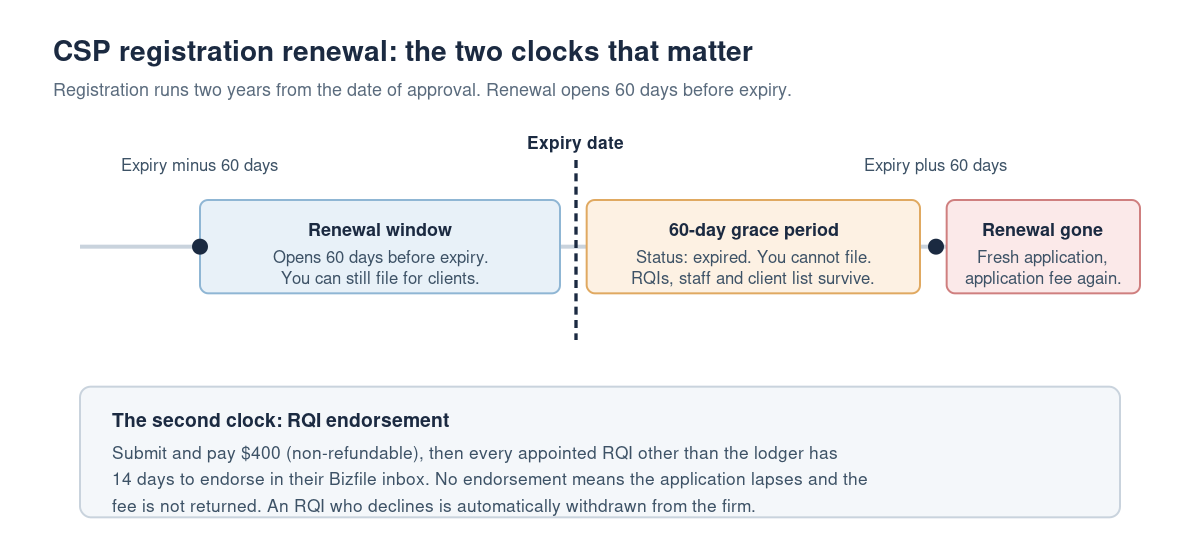
Two things are worth pulling out of that table.
First, the 60 days after expiry is a genuine grace period with a real benefit: renew inside it and your RQIs, your employees and your client list carry over unchanged. That is not a small mercy. Rebuilding a client list in Bizfile from scratch is tedious work, and every client you have to re-add is a client whose filings are on hold while you do it.
Second, the grace period is not a free pass. You still cannot file during it. Your registration has expired; you are simply still allowed to fix it.
What you must still satisfy to renew
Renewal is not a rubber stamp. You are re-establishing, two years on, that your firm still meets the registration requirements under the Corporate Service Providers Act 2024 and its regulations.
The requirements that firms actually have to work at are these.
The training and proficiency test. At least one director, owner or partner must complete the mandatory training course and the proficiency test within six months before renewal. Read that window carefully. It is not “at some point during the two years”. A test passed eighteen months ago does not count. This is the single most common reason a renewal is not ready when the firm thinks it is, because six months is short enough that you have to plan for it and long enough that you forget.
MAS sanctions alerts. Your firm must be subscribed to the Monetary Authority of Singapore’s alerts about changes to the targeted financial sanctions lists. This is a subscription, not a one-off. If the person who originally subscribed has left the firm, the alerts may be going to a mailbox nobody reads, which is functionally the same as not being subscribed.
Terrorist designation knowledge. You are expected to understand the legislation on countering terrorism financing and terrorist designation, through the Inter-Ministry Committee material published by the Ministry of Home Affairs. ACRA reviews your understanding of anti-money laundering, terrorist designation and targeted financial sanctions after you submit.
A clean, current record. Your CSP information has to be up to date before you renew. Types of corporate services offered, nature of business, list of RQIs. If any of it has drifted, you file the update through General Lodgement first and then come back to the renewal. Our guide on notifying ACRA of changes in CSP or RQI particulars covers exactly what falls into that category.
The steps, in order
You must be an authorised position holder of the CSP (director, company secretary, partner or owner) or an RQI of it. Anyone else in the firm will not see the transaction.
- Prepare first. Pull the list of appointed RQIs and confirm each one is active and will remain appointed. Have your training and proficiency test records to hand. If anything about the firm’s information is wrong, fix it through General Lodgement now, not halfway through the renewal.
- Log in to Bizfile as a business user through Corppass, and select the right entity profile if you are prompted. If you hold positions in several entities this is where renewals go wrong quietly. Our note on switching profiles in Bizfile explains the mechanics, and the business user login guide covers the Corppass route itself.
- Open the renewal transaction from the Manage menu, under corporate service provider, and start it.
- Verify your CSP information on screen. This is the checkpoint, not a formality. If it is wrong, stop and file the update first.
- Confirm your RQIs. Tick each RQI who is active and staying. Anyone you do not tick is not coming with you.
- Submit and pay the $400. It is non-refundable even if ACRA later rejects the application.
- Chase the endorsements. Every appointed RQI other than the lodger receives a Bizfile inbox notification and must endorse within 14 days.
The endorsement step is where renewals die
If the person filing the renewal is also the appointed RQI, there is nothing further to do. In every other case, the appointed RQIs have 14 days to endorse their appointment, and if they do not, the application lapses and you start again. The $400 does not come back with it.
The outcomes are binary. An RQI who accepts continues as an RQI of your firm. An RQI who declines is automatically withdrawn as an RQI of your firm. There is no middle state and no negotiation inside the system.
So before you submit, speak to your RQIs. Not email them, speak to them. Confirm that each one intends to stay, knows the notification is coming, and knows it is time-limited. An RQI on leave, or one whose registered email address is out of date, is a fortnight-long hole in your renewal that you will not notice until it is too late. If you are not sure your RQI records are current, fix that before you file, and see appointing and withdrawing RQIs if the position has actually changed.
What ACRA looks at after you submit
Once the endorsements are in, ACRA reviews more than the form. Expect scrutiny of:
- Your conduct and compliance history as a CSP over the registration period
- Any professional misconduct, including breach of fiduciary duty or serious negligence bearing on your commercial integrity
- Your understanding of anti-money laundering obligations, terrorist designation legislation and targeted financial sanctions
Approval arrives as a notification in your Bizfile inbox, and you can file for clients again from that point. The renewed registration then runs for two years from the date of approval, which is worth noting: it runs from approval, not from your old expiry date, so a late renewal shifts your cycle rather than preserving it.
One more point that surprises people. There are no refunds for early de-registration or for a cancellation of registration by ACRA. You are buying two years of registration, not two years of use.
What goes wrong in practice
The proficiency test gets left too late. Six months is the window, and course places are finite. A firm that starts thinking about renewal at the 60-day mark may find the person who needs to sit the test cannot get a slot in time. Diarise the training at nine months out, not two.
Nobody is watching the Bizfile inbox. Renewal reminders, endorsement requests and the approval notification all land there. A firm that treats the inbox as somewhere ACRA puts receipts will miss all three. Our piece on ACRA alerts and notifications makes the wider case for treating it as a monitored channel.
Payment is treated as completion. Paying the $400 does not renew anything. It starts a 14-day endorsement clock. Firms that file on a Friday and go quiet lose two of the fourteen days immediately. If a payment problem is what actually stopped you, our guide to paying ACRA on Bizfile covers failed payments and receipts.
The 60-day grace period gets mistaken for an extension. It is not. You cannot file for clients during it. A firm that drifts into the grace period and keeps quoting for filing work is promising something it cannot deliver.
The whole thing is treated as one person’s job. Renewal touches the directors (training), the RQIs (endorsement), the compliance function (MAS subscriptions) and whoever maintains the client list. A single administrator cannot deliver it alone, and the firms that miss renewals are usually the firms that thought one could.
Frequently asked questions
How long is a CSP registration valid?
Two years, running from the date ACRA approves the registration or the renewal. Because the clock restarts on approval rather than on your previous expiry date, renewing late shifts your renewal cycle permanently. Renew inside the 60-day window before expiry to keep your dates predictable.
What does it cost to renew CSP registration?
$400, payable on submission and non-refundable, including if ACRA rejects the application. If the renewal lapses because RQIs did not endorse within 14 days, you re-apply and pay again. There are also no refunds for early de-registration or for a cancellation by ACRA.
What happens if my CSP registration expires?
Your status changes to expired and you cannot file transactions with ACRA for clients. You have 60 days from the expiry date to renew, and if you do, your RQIs, employees and client list carry over unchanged. Past 60 days, you must apply as a new registrant and pay the application fee.
Who in the firm can file the renewal?
An authorised position holder of the CSP, meaning a director, company secretary, partner or owner, or an RQI of the firm. The filer logs in as a business user through Corppass and must select the CSP’s own entity profile before starting the transaction.
Do all our RQIs have to do something?
Yes, unless the person lodging the renewal is themselves the appointed RQI. Every other appointed RQI receives a Bizfile notification and must endorse within 14 days. Accepting keeps them as your RQI; declining withdraws them automatically. No endorsements means the application lapses.
Can we renew if our CSP details are out of date?
Not cleanly. The renewal asks you to verify your CSP information, and if it is wrong you must file the correction through General Lodgement before continuing. Sorting particulars out in advance is much faster than discovering the problem with the renewal half-completed.
Treat renewal as a twelve-month process
Raffles Corporate Services is a registered CSP, so we run this cycle ourselves. The approach that works is simple: put the training requirement in the diary at nine months out, confirm RQI intentions at three months, file at 60 days, and chase endorsements the day after submission rather than the week before the deadline.
If your firm is approaching a renewal and you are not sure whether your particulars, your RQI list or your training records will stand up to it, that is worth a conversation now rather than in the grace period. Our Corporate Service Providers Act 2024 compliance FAQ sets out the wider obligations, and CSP registration requirements covers the standards you must continue to meet.
You can reach us through Raffles Corporate Services, consult ACRA’s corporate service provider pages for the official position, or read more on Singapore corporate secretarial practice at Singapore Secretary Services.
The Editorial Team, Raffles Corporate Services
Need help with corporate secretarial or compliance matters?
If you would like help with your company's corporate secretarial, governance or compliance requirements, email [email protected] or WhatsApp +65 8501 7133.
Our team can assist with corporate secretarial, accounting and tax matters. Where legal advice is needed, advisers from our associated law firms can assist.