

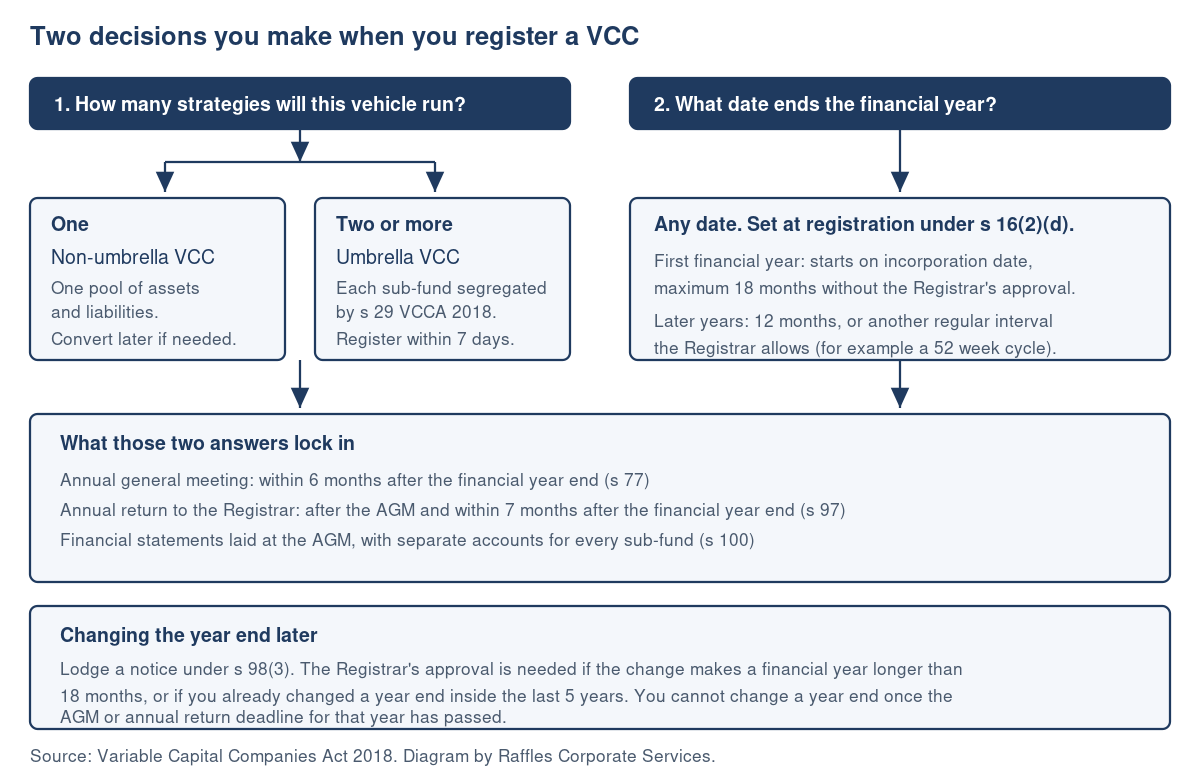
Two decisions at registration shape everything that follows: whether your variable capital company is umbrella or non-umbrella, and what date you nominate as its financial year end. The first determines whether you can ring-fence strategies from each other. The second sets every filing deadline you will ever have.
Raffles Corporate Services works with a panel of experienced Singapore law firms who offer cost-effective and efficient legal service and advice. This article is general information only and is not legal advice.
Neither is irreversible. You can add sub-funds later and you can change the financial year end later, within limits. But both changes cost time and money that the five minutes of thought at registration would have saved.
Here is how to make each decision properly, and what the Variable Capital Companies Act 2018 actually requires once you have made it.
Umbrella or non-umbrella: what actually separates them
A non-umbrella VCC is a single collective investment scheme in corporate form. One constitution, one pool of assets, one set of liabilities, one strategy.
An umbrella VCC is the same corporate shell holding two or more sub-funds. Each sub-fund has its own assets and liabilities, its own registration number, and its own accounts, while sharing the VCC’s directors, manager, secretary, auditor and registered office.
The difference that matters is not administrative convenience. It is statutory segregation. Section 29 of the Variable Capital Companies Act 2018 states that the assets of a sub-fund must not be used to discharge a liability of the VCC or of any other sub-fund, and that a sub-fund’s liabilities must be discharged solely out of that sub-fund’s assets. That holds even in a winding up. Section 29(2) goes further: any provision of the constitution, or of any agreement or contract, is void to the extent it is inconsistent with the segregation rule.
That is a much harder ring-fence than a contractual one. It does not depend on a counterparty agreeing to limited recourse language, and it cannot be bargained away.
The Act backs it with real consequences. An umbrella VCC that contravenes the segregation rule without reasonable excuse commits an offence, and so does every officer in default. Where the contravention was committed with intent to defraud, the fine on conviction can reach $150,000. In any other case it can reach $50,000.
The comparison, side by side
| Non-umbrella VCC | Umbrella VCC | |
|---|---|---|
| Number of investment schemes | One | Two or more sub-funds |
| Asset segregation | Not applicable | Statutory, under section 29 |
| Registration number | VCC UEN only | VCC UEN plus a sub-fund number for each sub-fund |
| Financial statements | One set for the VCC | One set for the VCC, plus separate accounts for each sub-fund |
| Adding a strategy later | Needs a new VCC, or conversion to umbrella | Register another sub-fund |
| Disclosure burden on documents | Standard | Every document mentioning a sub-fund must name it, give its registration number, and state that its assets and liabilities are segregated |
| Cost profile | Lower fixed cost | One shared governance layer across several strategies |
When the umbrella structure is worth it
Choose umbrella if any of the following is true on day one or plausibly true within two years.
You will run more than one strategy. A long-only Asian equity sleeve and a private credit sleeve do not belong in the same pool of assets. Segregate them and a drawdown in one cannot reach the other.
Your investors differ by mandate, not just by class. Share classes inside one fund can deal with fee differences and currency hedging. They cannot deal with genuinely different portfolios.
You expect to seed, test and close strategies. A sub-fund can be wound up or dissolved without disturbing the rest of the umbrella. Our guide on winding up or dissolving a VCC sub-fund sets out how that works in practice.
You want one governance stack across several funds. One board, one manager relationship, one auditor, one company secretary, one set of anti-money laundering procedures.
Choose non-umbrella if you have a single strategy, a single closing, and no realistic second product. You can convert later. Many managers do.
The obligations umbrella structures carry
Section 27 of the Act requires an umbrella VCC to apply to register a sub-fund within 7 days after forming it. Miss that and the VCC and every officer in default commit an offence carrying a fine of up to $1,000, plus a default penalty that accrues.
Section 30 then imposes a continuing disclosure duty. Every agreement, business letter, statement of account, invoice, official notice, cheque, order, receipt and letter of credit that mentions a sub-fund must set out the sub-fund’s name, its registration number, and the fact that its assets and liabilities are segregated under section 29. Where the umbrella VCC enters into an oral agreement for a sub-fund’s purposes, it must disclose the same points before contracting.
This is the obligation that quietly slips. Letterhead gets updated at registration and then a subscription agreement template drafted eighteen months later omits the segregation statement. The point of section 30 is that counterparties are told, every time, whose balance sheet they are actually dealing with.
Choosing the financial year end
You nominate the last day of the VCC’s first financial year when you apply for registration. That is a specific requirement of section 16(2)(d), not an afterthought, and section 98 builds everything else on it.
The rules that constrain you:
- The first financial year starts on the date of incorporation.
- The first financial year must not be longer than 18 months unless the Registrar approves a longer period on application.
- Each subsequent financial year starts immediately after the previous one ends and runs 12 months, or such other regular interval as the Registrar allows. That is what makes a 52 week accounting cycle possible where a manager’s reporting systems run on weeks rather than calendar months.
- Any date can be the financial year end. There is no requirement to use a quarter end.
What the date actually commits you to
| Obligation | Deadline measured from financial year end | Authority |
|---|---|---|
| Hold the annual general meeting | Within 6 months after the end of the financial year | Section 77(1), Variable Capital Companies Act 2018 |
| Lodge the annual return with the Registrar | After the AGM and within 7 months after the end of the financial year | Section 97(1) |
| Lay financial statements before the VCC | At the AGM for that financial year | Section 100(1) |
| Separate accounts for each sub-fund | Within the VCC’s financial statements, on the same accounting standards | Section 100(2)(b) |
Note that a VCC need not hold an AGM at all in some circumstances. Section 78 allows directors to dispense with it by giving members written notice at least 60 days before the last date the AGM would have had to be held, or by sending members the relevant documents in time. Members holding at least 10 per cent of the paid-up voting shares can still require one.
Practical grounds for picking a date
Avoid 31 December if you can. Every auditor, fund administrator and tax agent in Singapore is busiest in the first quarter. A 30 June or 30 September year end usually buys you better attention and a calmer close.
Match the feeder or master fund. If your VCC sits in a master-feeder or parallel structure, aligning year ends removes a whole category of consolidation headaches.
Think about the first year, not the steady state. Incorporate in November with a 31 December year end and your first financial year is under two months long, with a full audit and AGM cycle attached to almost no activity. Pushing the first year end to the following December instead gives you roughly fourteen months, well inside the 18 month ceiling.
Consider your investors’ reporting expectations. Institutional allocators often want audited figures on a particular cycle. Find out before you file, not after.
What goes wrong
Changing the year end later is harder than people assume. Section 98(3) lets a VCC specify a new last day of its financial year by lodging a notice with the Registrar. But section 98(4) requires the Registrar’s approval where the change would make a financial year longer than 18 months, or where the notice is lodged less than 5 years after the end of an earlier financial year whose end date was already changed. And section 98(5) shuts the door entirely once the AGM deadline under section 77 or the annual return deadline under section 97 has passed for the year you are trying to change. In other words, you cannot retrospectively fix a year end after you have already missed the filing window for it.
Starting non-umbrella and bolting on strategies informally. A non-umbrella VCC running two distinct portfolios internally has no segregation. If one blows up, creditors reach the whole pool. Section 29 protection only exists where sub-funds are properly registered.
Forgetting the sole object restriction. Section 15 limits a VCC’s sole object to being one or more collective investment schemes in corporate form, and prohibits it from carrying on business inconsistent with that object. A VCC is not a general purpose holding company. Fines here reach $150,000, with imprisonment of up to two years available against an officer in default.
Treating sub-fund accounts as an audit formality. Section 100(2)(b) requires separate accounts for each sub-fund, prepared on the same accounting standards as the VCC’s own. Fund administrators who have only run single-fund mandates sometimes discover this late. Ask the question before you appoint.
Frequently asked questions
Can I change from non-umbrella to umbrella after registration?
Yes. The VCC type is not fixed at registration. You would register the first sub-fund with ACRA, which then has to be done within 7 days of forming it under section 27, and update your constitution and offering documents to reflect the segregated structure and the section 30 disclosure requirements.
Does each sub-fund need its own directors, manager or auditor?
No. Sub-funds are not separate legal entities. They share the umbrella VCC’s board, its fund manager, its company secretary and its auditor. What they do not share is assets and liabilities, which section 29 keeps strictly apart.
What financial year end do most Singapore VCCs choose?
The common dates are 31 March, 30 June, 30 September and 31 December, largely because they align with quarterly reporting cycles. There is no legal preference. Choose for your investors’ reporting needs and your service providers’ capacity rather than convention.
How long can my first financial year be?
Up to 18 months, measured from the date of incorporation, without needing anything from the Registrar. Longer than 18 months requires the Registrar’s approval on application under section 98(2). Most managers use the flexibility to avoid an absurdly short first audit.
Can a sub-fund have a different financial year end from the umbrella VCC?
No. The financial year is a feature of the VCC itself under section 98, and the sub-fund accounts sit inside the VCC’s financial statements under section 100. One year end applies across the whole umbrella.
If a sub-fund becomes insolvent, can creditors reach the other sub-funds?
No. Section 29(1) expressly extends the segregation to a winding up, and section 29(2) voids any contractual provision to the contrary. That statutory protection is the main structural reason managers choose an umbrella VCC over separate companies.
Getting the structure right before you file
If you are still working out whether a VCC suits your fund at all, start with our overview of what a VCC is and who it suits. If you have already decided, the next step is how to register a VCC, and if the fund already exists offshore, look at re-domiciling it into Singapore rather than launching a parallel vehicle.
The regulatory context matters too. Your manager needs to be licensed or exempt appropriately, which our note on the MAS Capital Markets Services licence covers, and MAS has been tightening expectations around fund governance, as our piece on the 2026 valuation and risk management papers for VCC sub-funds explains.
The primary sources are worth bookmarking: the Variable Capital Companies Act 2018 on Singapore Statutes Online, ACRA’s VCC legislation page, and MAS’s variable capital companies framework page.
Raffles Corporate Services advises on VCC structuring, registers umbrella and non-umbrella VCCs, and maintains the statutory registers, AGM cycle and annual returns afterwards. If you are weighing umbrella against non-umbrella, or trying to work out which year end will cost you least over the next five years, that is a short conversation.
The Editorial Team, Raffles Corporate Services
Need help with corporate secretarial or compliance matters?
If you would like help with your company's corporate secretarial, governance or compliance requirements, email [email protected] or WhatsApp +65 8501 7133.
Our team can assist with corporate secretarial, accounting and tax matters. Where legal advice is needed, advisers from our associated law firms can assist.