

A Variable Capital Company, or VCC, is a Singapore corporate vehicle built for investment funds rather than for trading businesses. It can hold one fund, or it can sit as an umbrella over many sub-funds whose assets and liabilities are legally walled off from each other. It must have a licensed or otherwise permitted fund manager.
Raffles Corporate Services works with a panel of experienced Singapore law firms who offer cost-effective and efficient legal service and advice. This article is general information only and is not legal advice.
That last sentence is the one most people skip, and it is the one that decides whether a VCC is available to you at all. A VCC is not a private limited company with a fancier name. It is a regulated fund structure, and the regulator sits behind it.
This is part 1 of 2. It covers what the structure is and who it suits. Part 2 covers how to register one, from name reservation through to the first week after incorporation.
What a VCC is, in one paragraph
A VCC is a company incorporated under the Variable Capital Companies Act 2018. Like a private limited company it has separate legal personality: it can own property, contract, sue and be sued in its own name, and its members have limited liability. Unlike a private limited company, its constitution must restrict it to carrying on the business of one or more collective investment schemes. Section 15 of the Act deals with the object of a VCC, and it is a real constraint. You cannot use a VCC to run a restaurant, a consultancy or a software product.
The “variable capital” part is not marketing. A VCC’s share capital is required to equal its net asset value at all times, which is what makes the vehicle work as a fund.
Why the capital has to be variable
A fund has to be able to take money in and pay money out continuously. An investor subscribes and gets units of value; an investor redeems and takes value out. If the vehicle’s capital were fixed, every subscription would be a capital-raising exercise and every redemption a capital reduction, with the solvency statements, notices and waiting periods that go with them under ordinary company law.
The VCC framework removes that friction in two ways.
Shares can be issued and redeemed without member approval. Section 35 of the Act deals with a VCC’s power to repurchase or redeem its own shares. In practice this means the fund can process subscriptions and redemptions as an operational matter rather than a corporate one.
Dividends may be paid out of capital, not only out of profits. For a fund making distributions from realised investments rather than trading profit, that is essential rather than exotic. It also means the directors’ judgement on solvency matters more, not less, because the usual profits test is not doing the work for them.
There is a quieter feature that matters commercially: a VCC’s register of members is kept under section 81 of the Act and is not open to public inspection the way a company’s register of members is. Regulators, law enforcement and other public authorities can require it. The public cannot browse it. For funds with investors who do not want their holdings visible to anyone who buys a business profile, that is often the deciding factor.
The umbrella and sub-fund architecture
This is the part of the VCC that has no clean equivalent in ordinary Singapore company law.
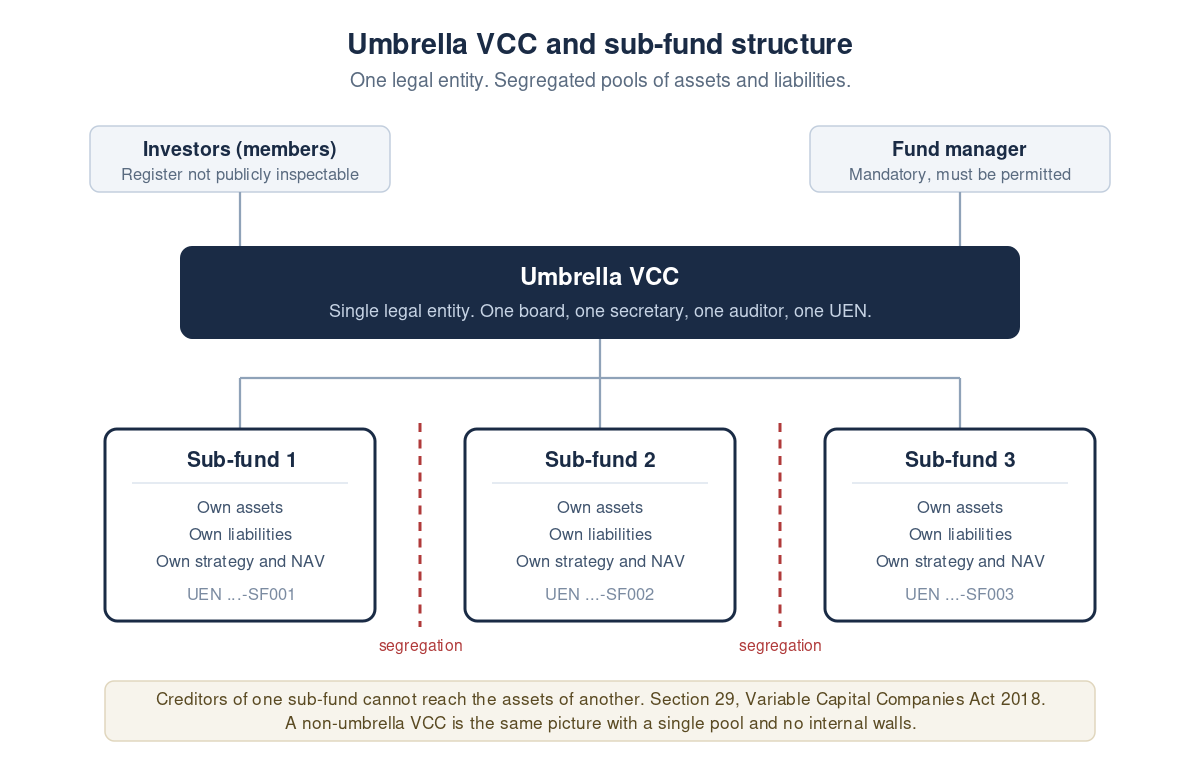
An umbrella VCC is a single legal entity whose constitution provides that it consists of two or more collective investment schemes. Each of those is a sub-fund. A sub-fund is not a separate legal person. It has no company number of its own in the ordinary sense, though it does receive its own identifier appended to the VCC’s UEN.
What it does have is segregation. Section 29 of the Variable Capital Companies Act 2018 segregates the assets and liabilities of each sub-fund. The practical effect is that the assets attributable to sub-fund A are available to meet the liabilities of sub-fund A and are not available to creditors of sub-fund B. One strategy can blow up without dragging the others down with it.
What segregation buys you, and what it does not
It buys you the ability to run genuinely different strategies, currencies, investor groups and fee structures under one roof, while sharing one board, one company secretary, one auditor and one set of corporate infrastructure. That is a meaningful cost saving once you are past two or three strategies.
It does not buy you immunity from sloppy administration. Segregation depends on assets and liabilities actually being attributable to a particular sub-fund. If your books do not clearly allocate a contract, an expense or a position, you are asking a court to do later what your fund administrator should have done at the time. Valuation discipline sits at the centre of this, which is why we have written separately on what the MAS valuation and risk management papers mean for VCC sub-funds.
Sub-funds can also be wound up or struck off individually, without touching the rest of the umbrella. That is a real advantage at the end of a strategy’s life, and it has its own process, which we cover in winding up or dissolving a VCC sub-fund.
The fund manager requirement
Every VCC must have a fund manager. Section 46 of the Act deals with the manager, and the manager must be a person permitted to manage the VCC’s assets, which in practice means a Capital Markets Services licence holder for fund management, a licensed bank or other permitted institution, or an entity relying on an exemption that the framework recognises.
This is the requirement that quietly disqualifies most enquirers. A family that wants to hold its own portfolio through a Singapore vehicle and manage it themselves does not automatically get a VCC. They need a manager that qualifies, which usually means standing up a fund management entity and taking it through MAS, or appointing a third-party manager. Our notes on the MAS licensed fund management company regime and the streamlined fund manager framework set out what that actually involves.
The VCC also has to appoint an eligible financial institution to carry out its anti-money laundering and counter-financing of terrorism checks. MAS sets those obligations out in Notice VCC-N01. This is not a formality you can defer.
VCC compared with a private limited company and with older fund structures
| Private limited company | Unit trust | Limited partnership | VCC | |
|---|---|---|---|---|
| Separate legal entity | Yes | No, trust | No, partnership | Yes |
| Can run an operating business | Yes | No | Limited | No, funds only |
| Capital flexible for subscriptions and redemptions | No | Yes | Yes | Yes |
| Dividends payable out of capital | No | N/A | N/A | Yes |
| Register of members public | Yes | N/A | Partner register filed | No, not publicly inspectable |
| Multiple ring-fenced strategies in one entity | No | Separate trusts needed | Separate partnerships needed | Yes, sub-funds |
| Fund manager mandatory | No | Manager required | No | Yes |
| Re-domiciliation into Singapore available | Yes, for companies | No | No | Yes, for comparable fund entities |
The honest summary: if you are running a business, use a private limited company. If you are running one small fund with a stable investor base and no need for segregated strategies, an older structure may still be cheaper. The VCC earns its keep when you need segregation, redemption flexibility, investor privacy, and a Singapore-tax-resident corporate entity in one package.
Existing offshore funds do not have to start again. A comparable foreign fund entity can transfer its registration to Singapore as a VCC, which preserves its history and its contracts. The general principles are the same ones covered in our re-domiciliation FAQ, with a VCC-specific overlay on financial health and jurisdictional consent.
The tax and incentive context, at a high level
A VCC is taxed as a company, at Singapore corporate income tax rates. For an umbrella VCC, each sub-fund is treated separately for tax purposes, while the umbrella files as a single entity. That combination is deliberate: one filing entity, sub-fund-level tax treatment.
The vehicle is usually chosen alongside one of the fund tax incentive schemes rather than on its own, and the incentive is applied at sub-fund level for an umbrella. Which scheme fits depends on your assets under management, your spending commitments and your investor profile, not on the vehicle. We cover the mechanics separately in 13O to 13U transition mechanics and the section 13D offshore fund scheme. GST is its own question, and the fund-specific remission is explained in our note on the fixed recovery rate for Singapore funds.
Do not choose a VCC because someone told you it is tax-efficient. The vehicle does not create the exemption. The scheme does, and you have to qualify for it.
Who should use one, and who should not
A VCC suits you if: you are launching two or more strategies and want them ring-fenced; you need open-ended subscriptions and redemptions; you want a Singapore-resident corporate fund that can access the treaty network; you have a manager that qualifies, or are prepared to build one; your investors value privacy of the member register.
A VCC does not suit you if: you are running a trading or services business; you are a single family holding a static portfolio with no qualifying manager and no intention of getting one; your assets under management do not justify the cost base; or you want something you can set up cheaply and forget about. On that last point, multi-jurisdiction family office structures is usually the better place to start the conversation.
What goes wrong in practice
People register a VCC before they have a manager. The fund manager is not a box to tick after incorporation. Without a qualifying manager the application does not complete, and the entity you have paid for sits idle.
People underestimate the running cost. A VCC requires a company secretary, an auditor, a fund administrator, an AML-eligible financial institution and annual filings, at umbrella level and in substance at sub-fund level too. The registration fee is the small number. The annual number is the one that decides whether the structure makes sense.
Sub-fund accounting is treated as an afterthought. Segregation is only as strong as the attribution behind it. Get the administrator and the chart of accounts right on day one, because retrofitting attribution across a year of transactions is expensive and never fully convincing.
The service provider is not properly licensed. If a foreign founder engages someone to register on their behalf, that provider must be a registered corporate service provider. The obligations are set out in our Corporate Service Providers Act 2024 compliance FAQ.
Frequently asked questions
Is a VCC the same as a private limited company?
No. A VCC is incorporated under the Variable Capital Companies Act 2018, must be used for collective investment schemes rather than an operating business, must appoint a fund manager, and can issue and redeem shares and pay dividends out of capital. A private limited company can do none of those last three.
Can one person own a whole VCC?
Yes. A VCC needs at least one member, and there is no maximum. A single investor can hold the entire fund. What you cannot do is dispense with the manager, the company secretary or the auditor.
Are sub-funds separate legal entities?
No. A sub-fund is part of the umbrella VCC, which is the single legal person. The Act segregates each sub-fund’s assets and liabilities, so creditors of one sub-fund cannot reach another’s assets, but the contracting party is always the umbrella VCC acting for that sub-fund.
Can the public see who owns a VCC?
No. A VCC’s register of members is not open to public inspection in the way a company’s is. Public authorities, regulators and law enforcement can require access to it, and the VCC must produce it when they do.
Can I convert my existing Singapore private limited company into a VCC?
Not by conversion. A VCC is a different vehicle under a different Act. An existing foreign fund entity of comparable structure can transfer its registration to Singapore as a VCC, but a local operating company would need a fresh VCC and a transfer of assets, with the tax and stamp duty consequences that implies.
Does a VCC have to be open-ended?
No. Closed-end funds use VCCs too. The flexibility to issue and redeem is available, not compulsory. What is compulsory is that the share capital equals net asset value.
Deciding before you spend
The VCC is an excellent vehicle for the right fund and an expensive mistake for the wrong one. The test is rarely the structure itself. It is whether you have a qualifying manager, enough assets under management to carry the running cost, and a genuine need for segregation.
If you have worked through that and the answer is yes, part 2 of this guide walks through the registration process end to end, including name reservation, the constitution, the officers and the fees. ACRA’s own overview sits at acra.gov.sg, and the legislation itself is on SSO.
Raffles Corporate Services acts as corporate secretary for Singapore fund vehicles and works alongside fund managers and administrators on VCC set-up and ongoing compliance. If you are weighing a VCC against the alternatives, that is a short and useful conversation to have before you commit to the fee.
The Editorial Team, Raffles Corporate Services
Need help with corporate secretarial or compliance matters?
If you would like help with your company's corporate secretarial, governance or compliance requirements, email [email protected] or WhatsApp +65 8501 7133.
Our team can assist with corporate secretarial, accounting and tax matters. Where legal advice is needed, advisers from our associated law firms can assist.