

A foreign investment fund can transfer its registration to Singapore and become a variable capital company without being wound up, liquidated or reconstituted. It keeps its legal identity, its assets, its contracts, its track record and its litigation. ACRA charges $9,000 plus $400 for each sub-fund, and takes 14 to 60 days to decide.
Raffles Corporate Services works with a panel of experienced Singapore law firms who offer cost-effective and efficient legal service and advice. This article is general information only and is not legal advice.
The mechanism is Part 12 of the Variable Capital Companies Act 2018, headed “Transfer of registration”. It is a distinct process from the inward re-domiciliation regime for ordinary companies under the Companies Act 1967, which our re-domiciliation of foreign companies FAQ covers. Same idea, different statute, different portal, different fee.
The single thing that most often goes wrong is not the application. It is the 60 days that start running after you are approved.
Why continuity is the whole point
Section 137(2) of the Act is the provision that makes re-domiciliation worth doing. Registration of a foreign corporate entity as a VCC does not create a new legal entity. It does not prejudice or affect the identity of the body corporate, or its continuity as a body corporate. It does not affect the entity’s property, rights or obligations. And it does not render defective any legal proceedings by or against it, which may be continued or commenced after registration as though nothing had happened.
Contrast that with the alternative: incorporate a new Singapore VCC, transfer the portfolio across, novate every agreement, re-paper every investor, and explain to allocators why the fund’s performance history now sits in a dissolved entity. Re-domiciliation avoids all of it.
Section 137(1) then completes the picture. From the date of registration stated in the notice, the foreign entity is treated as a VCC and the Act applies to it. Its existing collective investment schemes are treated as sub-funds of an umbrella VCC. And if it happened to be registered in Singapore as a foreign company under the Companies Act 1967, that registration falls away automatically.
What you need before you apply
The outbound side, which nobody in Singapore can fix for you
Your current jurisdiction must permit the entity to leave. Some fund domiciles have a statutory outward transfer or continuation regime. Some do not. If yours does not, re-domiciliation into Singapore is simply unavailable and you are back to incorporating a fresh VCC and migrating assets.
Confirm this first, in writing, with local counsel. Everything else in this article assumes the answer is yes.
The Singapore side
A reserved VCC name. Same requirement as a fresh incorporation. Section 133 governs the name a VCC registered under Part 12 may use.
Information about the existing entity. Current name and date of registration, the registration details in its home jurisdiction, its current registered office address, and its last financial year end date.
Your proposed first Singapore financial year end. Worth thinking about rather than defaulting to the existing date. Our guide on choosing your VCC type and financial year end explains what that date commits you to.
Details of directors, officers and shareholders, plus fund information covering the investor base and capital structure.
Certified documents. Section 134(2)(b) requires the application to be accompanied by a certified copy of the charter, statute, constitution, memorandum or articles, or other instrument defining the entity’s constitution in its place of incorporation, together with the constitution by which it proposes to be registered in Singapore, and the names of the manager and directors of the proposed VCC. ACRA also requires a certified copy of the certificate of incorporation, all in PDF.
Declarations on ACRA’s prescribed forms. There is a separate declaration depending on who is doing what: corporate service provider, proposed secretary, proposed director, proposed lodger, and a declaration by the directors of the foreign corporate entity signed by all of them or their equivalents.
The Registrar can ask for more. Section 134(3) gives an open power to require further information or documents.
Fees and timing
| Item | Amount | Notes |
|---|---|---|
| Transfer of registration as a VCC | $9,000 | Non-refundable |
| Each sub-fund | $400 per sub-fund | Where the fund comprises multiple collective investment schemes |
| Extension of time to file deregistration proof | $200 per registration | Processed immediately, grants a further 60 days |
| Processing time | 14 to 60 days | From a complete submission, including any referral authority review |
The two grounds that will sink an application
Section 136(2) mirrors the incorporation rules and obliges the Registrar to refuse registration in four cases. Two are structural and are worth clearing before you spend $9,000.
The manager must qualify. Section 136(2)(a) requires refusal if the person named as manager of the proposed VCC does not satisfy section 46(2). That means a holder of a capital markets services licence for fund management under the Securities and Futures Act 2001, a person within section 99(1)(a) to (d) of that Act, or a prescribed person. A suspended licence does not count. If your offshore fund is currently managed from another jurisdiction, appointing a Singapore-qualifying manager is part of the project, not an afterthought. Our note on the MAS Capital Markets Services licence sets out the routes.
A director must be connected to the manager. Section 136(2)(b) requires refusal if none of the proposed VCC’s directors is either a director or a qualified representative of the manager. Offshore boards are routinely composed entirely of independent non-executives. That composition does not survive the move.
The remaining grounds are unlawful purpose or prejudice to public peace, welfare or good order, and national security or national interest. Section 136(1) also allows refusal where the prescribed minimum requirements are simply not met. An aggrieved person has 30 days to appeal to the Minister, whose decision is final.
The 60-day clock, and why it catches people
This is the part that converts a successful application into a revoked registration.
When the Registrar registers the entity, section 135(3) requires the issue of a notice of transfer of registration, stating the date from which the entity is registered by way of transfer and is a VCC. From that moment you are a Singapore VCC.
But section 135(6) then requires the entity, within 60 days after the notice is issued, to submit to the Registrar a document evidencing that it has been deregistered in its place of incorporation.
Sixty days is not long to get a foreign registrar to strike a fund off, particularly where that registrar wants evidence of the Singapore registration first, wants outstanding annual fees settled, and works to its own timetable over a holiday period.
Section 135(7) lets the Registrar extend the period on application. ACRA processes an extension immediately for a fee of $200 per registration and grants a further 60 days each time, but it wants the application at least 14 days before the current deadline, with your UEN and the reason.
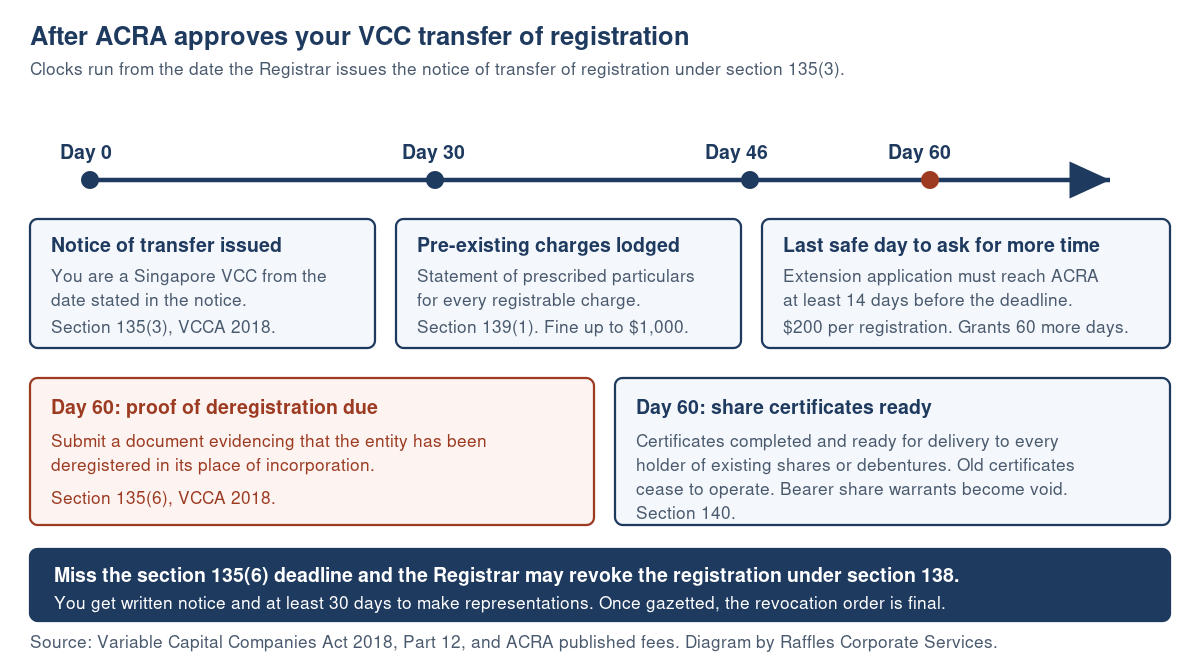
If you do nothing, section 138(1) empowers the Registrar to revoke the registration for failure to comply with section 135(6). There is process: written notice of intention, a period of at least 30 days to make written representations, and consideration of those representations. But once the revocation order is published in the Gazette it takes effect, the entity ceases to be a VCC, and section 138(6) makes the order final. Section 138(7) then preserves the liability of every officer and member regardless.
You would be left with an entity that is no longer a Singapore VCC and may or may not still exist in its original jurisdiction. That is a genuinely bad place to be.
What has to happen in the first 60 days anyway
Two further Part 12 obligations run on their own clocks from the date of registration, and both are easy to overlook while everyone is focused on the deregistration proof.
Pre-existing charges, within 30 days. Section 139(1) requires a statement of prescribed particulars to be lodged for registration within 30 days after the date of the VCC’s registration, for any charge that would have needed registration had the entity always been a Singapore VCC. Failure is an offence carrying a fine of up to $1,000 plus a default penalty. Helpfully, section 139(5) confirms that missing the deadline does not affect the continuity, operation or priority of the security itself, and section 139(6) allows the Court to extend time where the omission was accidental or inadvertent.
Share certificates, within 60 days. Section 140(1) requires the VCC to complete and have ready for delivery appropriate certificates for everyone registered as a holder of existing shares or debentures as at the date of registration. Once delivered, section 140(3) makes all prior certificates inoperative. And section 140(4) is worth flagging for older offshore structures: any bearer share warrant issued by the foreign entity before registration becomes void.
What goes wrong
The home jurisdiction will not deregister quickly enough. Start the outbound process in parallel with the Singapore application, not after approval. Ask your local counsel for a realistic timetable in weeks and assume it slips.
Nobody diarises the extension deadline. ACRA wants the extension request at least 14 days before the 60 days expire. That means the real deadline is day 46, not day 60. Put day 40 in the calendar.
The board is re-papered but not re-composed. Directors get appointed for Singapore residency and the manager connection requirement under section 48(1)(b) is missed, or is satisfied at registration and then lost when that director resigns. Section 48(5) makes such a resignation invalid, which protects the VCC but does not help the director who thought they had left.
Bearer instruments and unregistered holders surface late. Legacy offshore funds sometimes have share warrants or informally recorded holders. Section 140 forces the issue at registration and gives you 60 days to have proper certificates ready. Do the register reconciliation before you apply.
Assuming the tax and GST position moves automatically. Re-domiciliation changes where the fund is, which changes its Singapore tax and GST posture. Our note on GST remission for Singapore funds is a useful starting point, and the incentives landscape for managers is set out in our piece on the asset management hub package and carried interest exemption. Get specific advice before you commit.
Frequently asked questions
Does re-domiciling create a new fund with a new track record?
No. Section 137(2) expressly provides that registration does not create a new legal entity, does not affect the identity or continuity of the body corporate, and does not affect its property, rights or obligations. The fund’s performance history, contracts and legal proceedings continue uninterrupted.
What happens if I cannot deregister in my home jurisdiction within 60 days?
Apply to ACRA for an extension at least 14 days before the deadline. The fee is $200 per registration, processing is immediate, and each extension grants a further 60 days. Extensions can be applied for more than once. If you simply let the deadline pass, the Registrar may revoke your Singapore registration under section 138.
Can any foreign fund re-domicile into Singapore as a VCC?
Only if two things are true. Its home jurisdiction must permit outward transfer of registration, and it must meet the Singapore eligibility requirements, including a manager qualifying under section 46(2) and a board satisfying section 48(1). A fund whose domicile has no outward regime cannot use Part 12 at all.
Is this the same process as re-domiciling an ordinary company into Singapore?
No. Company re-domiciliation runs under the Companies Act 1967 through Bizfile. VCC transfer of registration runs under Part 12 of the Variable Capital Companies Act 2018 through the VCC Portal, with its own documents, its own $9,000 fee and its own deregistration deadline.
What happens to my existing sub-funds or share classes?
Section 137(1)(b) treats the foreign entity’s collective investment schemes as sub-funds of an umbrella VCC from the date of registration, with the Act’s sub-fund provisions applying subject to any adaptations in the regulations. ACRA charges $400 per sub-fund on top of the $9,000 registration fee.
Can I re-domicile out of Singapore again later?
A Singapore VCC’s options for leaving are narrower than the inward route suggests. Our article on outward redomiciliation for Singapore companies explains the general position for companies, and you should take advice specific to the VCC framework before assuming the door swings both ways.
Planning the move
Re-domiciliation is a project with three parallel workstreams: the outbound deregistration, the Singapore application, and the manager and governance changes that have to be in place before you file. Run them sequentially and the 60-day clock will beat you.
If you are earlier in the process, start with what a VCC is and who it suits, and compare the effort against simply setting up fresh, which our step-by-step VCC registration walkthrough covers. For the law itself, see Part 12 of the Variable Capital Companies Act 2018 and ACRA’s VCC legislation page. MAS sets out the policy framework on its variable capital companies page.
Raffles Corporate Services handles VCC transfers of registration, co-ordinates with offshore counsel on the deregistration side, and diarises the section 135(6) deadline so it does not become a section 138 problem. If you are considering moving a fund to Singapore, the earliest useful conversation is before you appoint the Singapore manager, not after.
The Editorial Team, Raffles Corporate Services
Need help with corporate secretarial or compliance matters?
If you would like help with your company's corporate secretarial, governance or compliance requirements, email [email protected] or WhatsApp +65 8501 7133.
Our team can assist with corporate secretarial, accounting and tax matters. Where legal advice is needed, advisers from our associated law firms can assist.