

A variable capital company must lodge its annual return within seven months after the end of its financial year, and only after its annual general meeting. Both conditions bind at the same time. Satisfying one does not buy you relief from the other.
Raffles Corporate Services works with a panel of experienced Singapore law firms who offer cost-effective and efficient legal service and advice. This article is general information only and is not legal advice.
That second condition is the one that ruins compliance calendars. Section 97(1) of the Variable Capital Companies Act 2018 does not say “within seven months”. It says the return must be lodged after the annual general meeting and within seven months after the end of the financial year. A VCC that has finished its audit, approved its accounts and is ready to file cannot file until the meeting has happened or the statutory alternative to a meeting has been completed.
So the annual return deadline is not a single date on a calendar. It is the later of two events, capped by a hard outer limit. Here is how to work out yours, and what moves it.
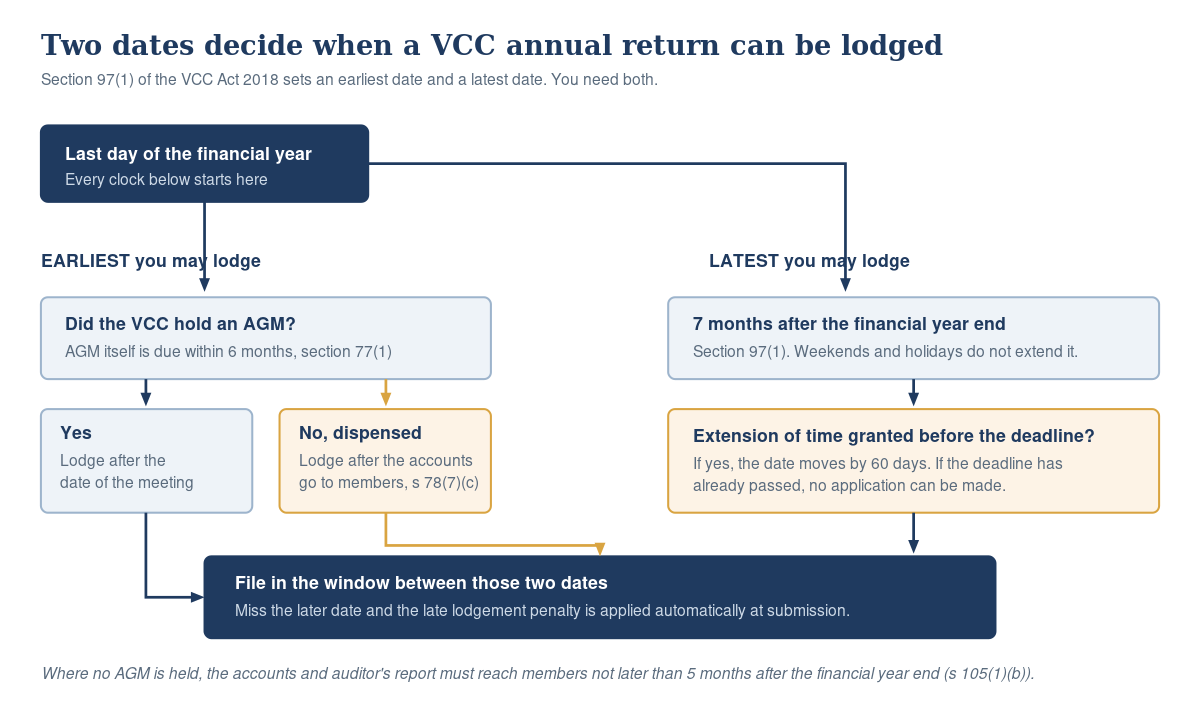
The two conditions, side by side
| Condition | What it requires | Source |
|---|---|---|
| The outer limit | Lodgement within 7 months after the end of the financial year | Section 97(1), VCC Act 2018 |
| The sequencing condition | Lodgement only after the annual general meeting has been held | Section 97(1), VCC Act 2018 |
| The substitute for a meeting | Where no AGM is held, lodgement only after the audited accounts and auditor’s report have been sent to everyone entitled to notice of general meetings | Section 78(7)(c), read with section 105(1) and (2) |
Read those three rows together and the practical instruction falls out. The earliest you may file is the day after the meeting, or the day after the documents go out. The latest you may file is the seven month date. If the meeting slips past the seven month date, you have no compliant filing window left at all: you are late on the annual return the moment you are late on the meeting, even though nobody has done anything wrong on the filing itself.
The AGM has its own deadline of six months after financial year end under section 77(1), which we work through in detail in our guide to VCC AGM due dates. One month is all the Act gives you between the two.
Where the clock starts, and what does not move it
Every deadline in this article runs from the last day of the financial year. Not from the date the auditor signs off. Not from the date the fund administrator strikes the final net asset value. Not from the date the board approves the accounts.
Section 98 of the VCC Act 2018 determines what the financial year is. The first financial year begins on the date of incorporation and ends on the date stated in the registration application. Each later financial year begins the day after the previous one ends and runs for twelve months, or at such other regular interval as the Registrar allows. A first financial year must not exceed 18 months unless the Registrar approves a longer period on application.
That matters at set-up more than most founders realise, because the financial year end you pick in the registration form fixes your entire annual cycle for as long as the VCC exists. Our note on choosing a VCC type and financial year end covers the trade-offs before the decision is made.
You cannot change the financial year end to escape a deadline
A VCC may notify the Registrar of a new financial year end under section 98(3). What section 98(5) then does is close the obvious loophole.
A notice specifying a new financial year end cannot be lodged after the section 77 period for holding the AGM has expired, after the section 97 period for lodging the annual return has expired, or after the section 105 period for sending the accounts to members has expired. In other words, once any of those clocks has run out for a given financial year, the year end for that year is fixed. Approval of the Registrar is also needed where the change would produce a financial year longer than 18 months, or where the year end was already changed within the previous five years.
Changing the year end is a legitimate planning step taken in good time. It is not a remedy for a deadline you have already missed. The ACRA process for a financial year end change is set out separately, and most of it reads across to a VCC.
The calendar, by financial year end
| Financial year end | Accounts to members if dispensing with the AGM | AGM due | Annual return due | If a 60 day extension of time is granted |
|---|---|---|---|---|
| 31 December | 31 May | 30 June | 31 July | Around 29 September |
| 31 March | 31 August | 30 September | 31 October | Around 30 December |
| 30 June | 30 November | 31 December | 31 January | Around 1 April |
| 30 September | 28 February | 31 March | 30 April | Around 29 June |
The five month column applies only to a VCC that dispenses with its AGM using the documents route. Section 105(1)(b) requires the audited financial statements, or consolidated financial statements and balance sheet, together with the auditor’s report, to be sent to everyone entitled to notice of general meetings not later than five months after the end of the financial year. That is a month tighter than the AGM deadline, which surprises VCCs that assume dispensing with the meeting buys time. It does the opposite.
Mid-month and month-end year ends
For a year end that falls on the last day of a month, count whole months and land on the last day of the seventh month. For a mid-month year end, count to the corresponding day: a 15 February year end produces an annual return due on 15 September. Where the corresponding day does not exist, take the last day of the month. Nothing in the Act extends a deadline that lands on a weekend or a public holiday, so if the seventh month date falls on a Sunday, treat the preceding working day as your deadline rather than hoping otherwise.
If your VCC does not hold an AGM
Section 78 allows a VCC to skip the annual general meeting in two situations: where the directors give members written notice at least 60 days before the last date on which the AGM must be held, or where the VCC has sent members the section 105 documents within the section 105 period.
Dispensing does not remove the annual return obligation and does not move its date. Section 78(7)(c) simply substitutes one trigger for another: the reference in section 97(1) to lodging the return after the AGM becomes a reference to lodging it after the documents have gone out to members.
There is a tail on this. Under section 78(4), members holding at least 10% of the paid-up voting shares may require an AGM to be held for a year in which one would otherwise not have been held, by notice given no later than 14 days before the date the AGM would have been due. If that happens after the annual return has already been lodged, section 97(5) requires the VCC to lodge a notice of the date the meeting was held within 14 days after that date. It is a small filing that is very easy to forget, because by then everyone has mentally closed the year.
What it costs when the date passes
| Consequence | Amount |
|---|---|
| Late lodgement penalty, filed up to three months after the deadline | $300 |
| Late lodgement penalty, filed more than three months after the deadline | $600 |
| Composition sum offered by ACRA, minimum, per breach | $500 |
| Fine on conviction under section 97(6), maximum | $10,000, plus a default penalty |
The late lodgement penalty applies automatically when the late return is submitted through the VCC portal. There is no assessment step and nothing to argue at that point. The band changes at three months, so eleven weeks late and fourteen weeks late are materially different numbers for identical carelessness.
Composition sums sit on top and are separate from the penalty. Because a late AGM so often produces a late annual return, a single delayed audit can generate two breaches and two composition sums. Persistent default carries a further consequence: directors convicted of three or more filing offences within five years face a five year disqualification. Our note on the penalties and enforcement action following a missed VCC AGM sets out the escalation ladder.
What goes wrong in practice
The audit timetable is set forwards rather than backwards. Managers book the audit when the administrator is ready. The deadline does not care. Work backwards from the seven month date: annual return, minus the AGM, minus the notice period for circulating accounts, minus audit completion, minus valuation sign-off. For a 31 December year end that usually means fieldwork finishing in April, not June.
One sub-fund holds up the whole umbrella. An umbrella VCC files one annual return covering audited financial statements for itself and every sub-fund. A single unresolved valuation on one illiquid position puts the entire structure into late filing. Track sub-fund audit progress individually. Where a sub-fund is being wound down, the interaction with the annual cycle is worth planning early, and our guide to winding up a VCC sub-fund explains what still has to be filed.
Somebody assumes dispensing with the AGM buys a month. It removes a meeting, not a deadline, and it pulls the accounts circulation date forward to five months.
The extension is applied for after the date has gone. ACRA does not accept an extension application once the deadline has passed. The application window closes on the deadline, not after it.
Nobody owns the date. In a typical VCC, the manager, the administrator, the auditor and the corporate secretary each hold one piece of the cycle, and the deadline falls between them. ACRA does send reminders, and our piece on the ACRA alerts companies miss explains how to route them to a human.
Frequently asked questions
When exactly is a VCC annual return due?
Within seven months after the end of the financial year, and only after the annual general meeting has been held. Section 97(1) of the Variable Capital Companies Act 2018 imposes both conditions together. A VCC with a 31 December financial year end has an AGM due by 30 June and an annual return due by 31 July.
Can a VCC file its annual return before holding the AGM?
No. Section 97(1) requires the return to be lodged after the annual general meeting. Where the VCC has properly dispensed with the meeting under section 78, the return may be lodged after the audited financial statements and auditor’s report have been sent to everyone entitled to notice of general meetings.
Does dispensing with the AGM give a VCC more time to file?
No. The annual return remains due within seven months of financial year end. Dispensing under the documents route actually tightens the schedule, because section 105(1)(b) requires the audited accounts to reach members not later than five months after the end of the financial year.
Can a VCC change its financial year end to move the annual return deadline?
Not once the deadline has passed. Section 98(5) prevents a VCC from specifying a new financial year end after the periods for holding the AGM, lodging the annual return or sending the accounts to members have expired. Registrar approval is also needed if the year end was changed within the previous five years.
What if the annual return deadline falls on a weekend?
The Act does not extend a deadline that lands on a Saturday, Sunday or public holiday. Treat the preceding working day as your effective deadline, and build in more margin than that, because payment or portal issues on the day are entirely your problem.
How late can a VCC be before the penalty increases?
The late lodgement penalty is $300 where the return is filed up to three months after the deadline and $600 where it is filed more than three months after. The penalty is applied automatically at submission, and ACRA may separately offer a composition sum of at least $500 for each breach.
Put the dates in the diary once
The VCC annual cycle is not complicated. It is unforgiving about order. Accounts, then meeting, then filing, all inside seven months, for the umbrella and every sub-fund at once. Nearly every late annual return we see was decided months earlier, when an audit timetable was agreed that left no room between the meeting and the filing.
Raffles Corporate Services maintains that calendar for VCCs and their sub-funds, works the audit milestones backwards from the statutory date, and files in good time. If you are not certain who currently owns your VCC’s annual return date, that is worth resolving in month two rather than month seven.
Once the dates are set, the mechanics are straightforward: see our walkthrough on the steps to file a VCC annual return, and if the timetable has already slipped, applying for an extension of time for a VCC annual return. The statutory source is the Variable Capital Companies Act 2018 on Singapore Statutes Online, and ACRA’s own page on VCC annual return deadlines and requirements carries the current fees.
The Editorial Team, Raffles Corporate Services
Need help with corporate secretarial or compliance matters?
If you would like help with your company's corporate secretarial, governance or compliance requirements, email [email protected] or WhatsApp +65 8501 7133.
Our team can assist with corporate secretarial, accounting and tax matters. Where legal advice is needed, advisers from our associated law firms can assist.