

A variable capital company must hold its annual general meeting within six months after the end of its financial year. Section 77(1) of the Variable Capital Companies Act 2018 says so, and every other date in the VCC’s compliance year is measured off that one.
Raffles Corporate Services works with a panel of experienced Singapore law firms who offer cost-effective and efficient legal service and advice. This article is general information only and is not legal advice.
The rule sounds simple enough to not need an article. In practice, VCC secretaries get it wrong for three reasons: they measure from the wrong starting point, they forget that the annual return has its own separate deadline, and they discover the 60-day dispensation notice window only after it has closed.
So here is the arithmetic, done properly, with worked examples.
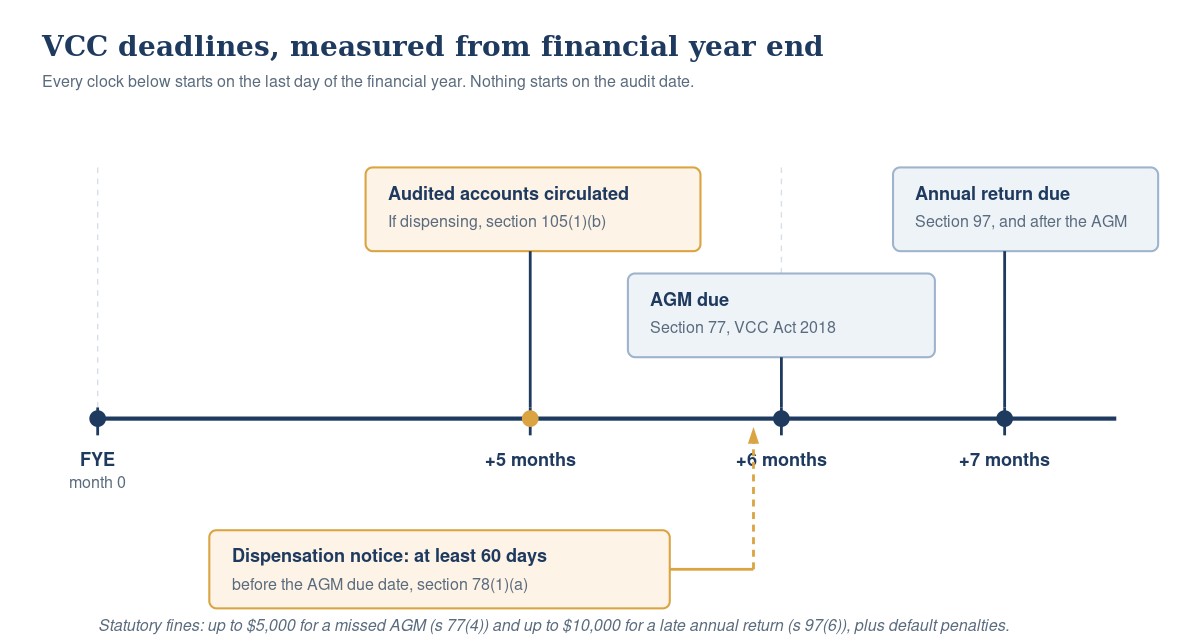
The four dates, and where each one comes from
| What | Deadline | Provision |
|---|---|---|
| Hold the AGM | Within 6 months after the end of the financial year | Section 77(1), VCC Act 2018 |
| Lodge the annual return | Within 7 months after the end of the financial year, and after the AGM | Section 97(1), VCC Act 2018 |
| Circulate audited accounts, if you are holding a meeting | At least 14 days before the meeting | Section 105(1)(a) |
| Circulate audited accounts, if you are dispensing under the documents route | Not later than 5 months after the end of the financial year | Section 105(1)(b) |
| Give the dispensation notice, if you are using the notice route | At least 60 days before the last date on which the AGM must be held | Section 78(1)(a) |
Note what the annual return deadline actually says. It is not simply “within seven months”. Section 97(1) requires the return to be lodged after the AGM and within seven months. If you hold the AGM on the last possible day, you still have a month to file. If you hold it late, you cannot cure the annual return by filing early, because the return has to follow the meeting.
The starting point is the financial year end, not the audit
Every clock here runs from the last day of the financial year. Nothing runs from the date the auditor signs, the date the board approves the accounts, or the date the administrator finalises the net asset value.
Section 98 of the VCC Act 2018 sets out how the financial year is determined. The first financial year starts on the date of incorporation and ends on the last day of the first financial year as stated in the registration application. Each subsequent financial year starts immediately after the previous one ends and runs for 12 months, or at such other regular interval as the Registrar allows.
One point worth knowing at set-up: section 98(2) provides that a VCC’s first financial year must not be longer than 18 months unless the Registrar approves otherwise on application. A long first period buys breathing room on the first audit, but it also compresses nothing later, because every subsequent year is 12 months.
The financial year end is a decision, not a default. If yours was chosen by whoever filled in the registration form, revisit it before it has driven two audit cycles. The considerations mirror those we set out for companies in changing your financial year end.
Worked examples
Read the “six months after” convention the ordinary way: a financial year ending on the last day of a month gives an AGM due date on the last day of the month six months later.
| Financial year end | AGM due by | Annual return due by | Accounts out by, if dispensing under the documents route | Dispensation notice by, if using the notice route |
|---|---|---|---|---|
| 31 December 2026 | 30 June 2027 | 31 July 2027 | 31 May 2027 | 1 May 2027 |
| 31 March 2027 | 30 September 2027 | 31 October 2027 | 31 August 2027 | 1 August 2027 |
| 30 June 2027 | 31 December 2027 | 31 January 2028 | 30 November 2027 | 1 November 2027 |
The dispensation notice column is the one that catches people. Sixty days before 30 June 2027 is 1 May 2027. Because section 78(1)(a) requires the notice to be given at least 60 days before the due date, a notice dated 2 May 2027 for a 30 June 2027 due date is short and does not work.
Give yourself a working margin. If your policy is to send dispensation notices by the end of the month before the 60-day date, you will never argue about whether the counting is inclusive.
Mid-month financial year ends
If your financial year ends on, say, 15 May 2027, the AGM is due by 15 November 2027 and the annual return by 15 December 2027. The five-month circulation date under section 105(1)(b) is 15 October 2027 and the 60-day notice date is 16 September 2027.
Mid-month year ends are legal and occasionally useful for a fund aligning to an offshore master. They are also a standing source of diary errors, because every downstream system wants to default to month-end. If you have one, put the four dates in writing at the start of each financial year.
If you cannot make the date: the extension of time
Section 77(2) of the VCC Act 2018 lets the Registrar extend the AGM period on application by the VCC, where the Registrar thinks there are special reasons to do so. Section 97(2) contains the equivalent power for the annual return.
ACRA’s stated position is that an extension of up to 60 days is available, at a fee of $200 per application. The current terms and the application route are set out on ACRA’s page on applying for an extension of time to hold a VCC AGM.
Three things to understand about extensions:
- Apply before the deadline, not after. An extension is a permission to be late in the future. Once the due date has passed, the breach has happened and the extension route is no longer the answer.
- An AGM extension moves the annual return too, in effect, because the return must follow the AGM. But check whether you also need the return period extended, because the two periods are set by separate provisions.
- “Special reasons” means reasons. A delayed audit because the auditor was appointed in month five is not a special reason so much as a self-inflicted one.
What it costs when the date passes
Section 77(4) of the VCC Act 2018 provides that where a VCC fails to hold its AGM within the required period, the VCC and every officer in default is guilty of an offence and liable on conviction to a fine not exceeding $5,000, and also to a default penalty. The Court may additionally order a general meeting to be called on the application of any member.
Section 97(6) attaches a fine not exceeding $10,000, and a default penalty, to a failure to lodge the annual return.
Those are the statutory maxima, and most cases are dealt with administratively rather than by prosecution. The cost that bites first is usually the composition or late lodgement charge, followed by the reputational cost: a VCC with a visible record of late filings is a harder conversation with a prime broker, a bank onboarding team or an institutional allocator running operational due diligence.
What goes wrong
Counting the six months from the wrong year. In the first year, the AGM is due six months after the first financial year end, which may be up to 18 months after incorporation. Funds occasionally diarise it six months after incorporation and then relax when nothing happens, only to miss the real date a year later.
Holding the AGM on time and filing the return late. These are two obligations with two deadlines and two separate offences. Holding a meeting on 30 June and filing nothing until September is a clean breach of section 97 regardless of how punctual the meeting was.
Dispensing with the AGM, then filing the annual return as though a meeting had occurred. The annual return requires a declaration about the AGM: held and when, exempt, or dispensed with. Declaring a meeting date that never existed is a false statement in a filing, which is a materially worse problem than a late return. The mechanics of dispensing properly are covered in our guide to holding AGMs for VCCs.
Sending the accounts on day 13. Section 105(1)(a) requires at least 14 days. Short notice is only cured if every person entitled to notice of general meetings agrees, and that agreement must be real and recorded.
Missing the reminder because nobody owns the inbox. ACRA sends alerts, and they go to the registered contacts, who may not be the people running the fund. See the ACRA alerts companies miss for how to fix the routing, and setting up Corppass for getting the right people access in the first place.
Assuming the fund’s other deadlines move with the AGM. They do not. Sub-fund registrations, officer change filings and tax deadlines run on their own clocks, as set out in VCC post-registration steps.
Frequently asked questions
When is my VCC’s AGM due?
Within six months after the end of its financial year, under section 77(1) of the Variable Capital Companies Act 2018. A 31 December year end means the AGM is due by 30 June. The clock runs from the financial year end, not from the date the audit is completed or the accounts are signed.
Is the annual return deadline the same as the AGM deadline?
No. Section 97(1) requires the annual return to be lodged after the AGM and within seven months after the financial year end. That is one month later than the AGM deadline, and the return cannot properly be filed before the meeting has been held or lawfully dispensed with.
How long before the AGM due date must a dispensation notice go out?
At least 60 days. Section 78(1)(a) measures the 60 days backwards from the last date on which the AGM must be held, so for a 30 June due date the notice must be given by 1 May. Send it earlier than the minimum to avoid arguments about counting.
Can I get more time to hold the AGM?
Yes. The Registrar may extend the period on application where there are special reasons, and ACRA’s published position allows an extension of up to 60 days at a fee of $200 per application. Apply before the deadline passes, because an extension cannot retrospectively cure a breach.
What is the penalty for a late VCC AGM?
Section 77(4) makes it an offence for the VCC and every officer in default, with a fine of up to $5,000 on conviction plus a default penalty. A late annual return carries a fine of up to $10,000 under section 97(6). In practice most cases are resolved administratively, but the record of lateness remains visible.
How long can a VCC’s first financial year be?
Up to 18 months, unless the Registrar approves a longer period on application, under section 98(2). That first year end then fixes the first AGM due date and the first annual return date, so choose it deliberately rather than accepting a default.
Put the four dates in the diary once
At the start of each financial year, write down four dates: the AGM due date, the annual return due date, the accounts circulation date, and, if you intend to dispense, the 60-day notice date. It takes five minutes and it removes the single most common cause of VCC penalties.
Raffles Corporate Services maintains that calendar for VCCs and their managers, drafts the dispensation notices in time, files the annual return with the AGM declaration made correctly, and applies for extensions before the deadline rather than after. If you are not certain what your VCC’s four dates are this year, ask us and we will work them out with you.
You can reach us through Raffles Corporate Services, read the provisions yourself at Singapore Statutes Online, or read more on Singapore corporate secretarial practice at Singapore Secretary Services.
The Editorial Team, Raffles Corporate Services
Need help with corporate secretarial or compliance matters?
If you would like help with your company's corporate secretarial, governance or compliance requirements, email [email protected] or WhatsApp +65 8501 7133.
Our team can assist with corporate secretarial, accounting and tax matters. Where legal advice is needed, advisers from our associated law firms can assist.