

Renaming an existing Singapore business takes two transactions, not one. You apply for the new name and pay $15, and then you file a separate update that puts the approved name onto the register. The second filing is free, and until it is done, nothing has changed.
Raffles Corporate Services works with a panel of experienced Singapore law firms who offer cost-effective and efficient legal service and advice. This article is general information only and is not legal advice.
That two-step shape is the source of most of the trouble. People get the approval email, read the word “approved”, change their signage, and carry on trading under a name that is not yet theirs. The approval is permission to file. It is not the change.
This article covers all four common structures: the private company, the LLP, the sole proprietorship and the partnership. They differ in who must approve the change internally, and converge at the Bizfile counter.
One thing to settle first. A new name faces the same scrutiny a brand new name would, so read how to choose a business name ACRA will actually approve, and check whether your name or activity code will send the application to another government agency, before you commit to a launch date.
The sequence
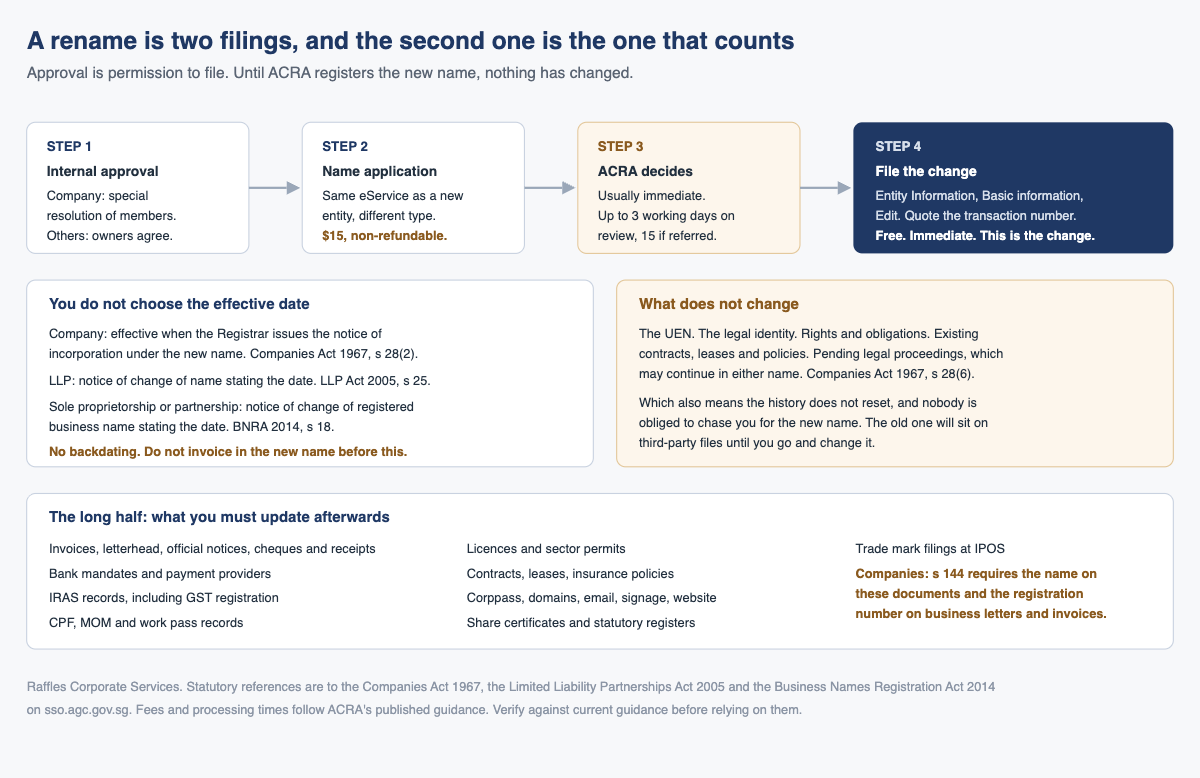
- Get the internal approval your structure requires. For a company, a special resolution. For the others, the partners or owners must agree, and the person filing must hold a qualifying role.
- Apply for the new name through the same Bizfile eService used for new entities, selecting the application type for a name change by an existing entity, conversion of company type or amalgamation. Pay $15. The form is walked through field by field in applying for a new business entity name in Bizfile.
- Wait for approval. Immediate in most cases, up to three working days where ACRA reviews the name, up to 15 working days where it goes to a referral authority.
- File the update. Entity Information, Basic information, Edit, then the option to update the entity name. Enter the transaction number from the name application. A local company also uploads the special resolution as a PDF.
- The change takes effect when ACRA registers it, not when you decided on it.
- Then update everyone else. The longest part, and nobody budgets for it.
What your structure requires before you can file
| Structure | Internal approval | Governing provision | What ACRA issues |
|---|---|---|---|
| Local company | Special resolution of the members | Companies Act 1967, s 28(1) | Notice of incorporation under the new name |
| Limited liability partnership | Partners’ agreement, then application by a partner or the individual manager | LLP Act 2005, s 25 | Notice of change of name stating the date |
| Sole proprietorship | The owner’s decision | BNRA 2014, s 18 | Notice of change of registered business name stating the date |
| Partnership | The partners’ decision, subject to the partnership agreement | BNRA 2014, s 18 | Notice of change of registered business name stating the date |
The special resolution, for companies
Section 28(1) of the Companies Act 1967 says a company may by special resolution resolve that its name be changed to a name by which it could be registered. A directors’ resolution is not enough. The members must pass it.
A special resolution needs a majority of not less than three-quarters of the members entitled to vote and voting, on at least 14 days’ written notice for a private company or 21 days for a public company, the notice specifying the intention to propose it as a special resolution. Shorter notice is possible where members holding not less than 95 per cent of the voting rights agree. Most private companies pass it as a written resolution instead of convening a meeting, which the Act permits.
One detail that costs people an afternoon: the resolution is uploaded to Bizfile as a PDF, and ACRA’s guidance requires the file name to contain no spaces, special characters or foreign language characters. Rename the file before you start the filing.
The fee, and what it does not include
| Item | Cost | Timing |
|---|---|---|
| Name application for the new name | $15, non-refundable | Immediate to three working days, or up to 15 working days if referred |
| Filing the name change against the entity | Free | Immediate |
| Certificate confirming incorporation under the new name (companies) | A prescribed fee applies, on application | On request |
The $15 is not refunded if the name is refused or if you withdraw the application. That rule bites harder here than on a new registration, because a rename is discretionary. You are spending the fee on a name you do not need in order to keep trading.
When the change actually takes effect
This is the question that matters for contracts, and the answer is not “the date we chose”.
For a company, section 28(2) of the Companies Act 1967 is explicit: the Registrar registers the company under the approved name and issues a notice of incorporation under it, and the change becomes effective upon the issue of that notice. There is no election. There is no backdating.
For an LLP, section 25 of the Limited Liability Partnerships Act 2005 works the same way, as does section 18 of the Business Names Registration Act 2014 for a sole proprietorship or partnership: the Registrar issues a notice of change stating the date. The register determines the date.
This is worth contrasting with other Bizfile updates. When you change a registered office address or a business activity, the form asks you for an effective date. The name change field does not, because the date is not yours to choose.
The practical rule: do not sign anything in the new name, invoice in the new name, or open anything in the new name until the register shows it.
Your UEN does not change, and neither does your legal identity
A change of name does not create a new entity. Section 28(6) of the Companies Act 1967 puts it beyond argument: a change of name does not affect the identity of the company, its rights or obligations, and does not render defective any legal proceedings by or against it. Proceedings that could have been continued or commenced in the old name may be continued or commenced in the new one.
Your UEN stays the same. Your contracts survive. Your bank account is the same account. Your tax reference is the same reference. What changes is the label, and the burden of propagating it.
That cuts both ways. Because the entity is legally unchanged, nobody is obliged to chase you for a new name. Suppliers, insurers and regulators will happily keep your old name on file for years, and the inconsistency will surface at the worst moment, usually during diligence.
When ACRA can make you change your name
Most people approach this as a voluntary exercise. It is not always voluntary.
Section 28(3) of the Companies Act 1967 lets the Registrar direct a company to change its name where the name should not have been registered, where it so nearly resembles the name of another company, corporation, LLP, limited partnership or registered business name as to be likely to be mistaken for it, or where its use has been restrained by an injunction under the Trade Marks Act 1998. The company then has six weeks from the direction, or any longer period the Registrar allows, unless the Minister annuls it.
Three consequences worth knowing:
- Failing to comply is an offence. The company and its officers are liable on conviction to a fine not exceeding $2,000 and to a default penalty.
- Any person may apply to the Registrar for such a direction. On the “so nearly resembles” ground, the application must reach the Registrar within 12 months from the date of the change of name.
- A company aggrieved by a direction may appeal to the Minister within 30 days, and the Minister’s decision is final.
Note that twelve month window if you have just adopted a name close to someone else’s. ACRA’s approval does not immunise you against a complaint, and it does not touch trade mark rights at all.
Everything you must update afterwards
The filing takes minutes. This takes weeks, and it is where the real cost of a rename sits.
| What | Why it is not optional | Watch out for |
|---|---|---|
| Invoices, letterhead, official notices, cheques, receipts | Companies Act 1967, s 144 requires the name on them, and the registration number on business letters, statements of account, invoices, official notices and publications | Templates in accounting software, quote generators, email footers |
| LLP invoices and official correspondence | LLP Act 2005, s 33 requires the name, registration number and a statement of limited liability | The daily fine that accrues on a continuing offence |
| Bank and payment providers | The mandate and account name must match the register | Expect fresh due diligence, not a field update |
| IRAS records, including GST registration | Filings and tax invoices must carry the correct name | Reissuing tax invoices mid-period |
| CPF, MOM and work pass records | Employer records key off the entity | Pass renewals in flight during the change |
| Licences and sector permits | Most licences name the licensee | Notification deadlines set by the regulator |
| Contracts, leases and insurance policies | Not void, but awkward at renewal | Landlord consents; policies indexed by name |
| Corppass, domains, email, signage, website | Operational continuity | Domains and handles may not be available |
| Share certificates and statutory registers | Members should hold certificates in the current name | Reissue rather than annotate |
| Trade mark filings at IPOS | The proprietor’s name should match | Enforcement is harder with a stale proprietor name |
Our note on multi-currency business bank accounts in Singapore is worth reading before you approach the bank, because the onboarding team will treat a name change as a trigger to refresh their file rather than as an administrative correction.
What goes wrong
Trading under the new name before it is registered. The single most common error. Invoices go out in a name that does not exist on the register, which is precisely the kind of discrepancy a bank’s compliance team notices.
Directors resolving instead of members. A board resolution does not satisfy section 28(1). The filing will be rejected, or worse, accepted on the strength of the wrong document, which is a problem discovered during due diligence years later.
The unsigned cheque problem. Section 144(2) of the Companies Act 1967 makes an officer who signs a bill of exchange, promissory note, cheque or other negotiable instrument on the company’s behalf without the company’s name properly stated personally liable to the holder for the amount due, unless the company pays it. Old stock of pre-printed instruments after a rename is not a cosmetic issue.
Assuming ACRA’s approval settles the trade mark question. It does not. ACRA registers names; IPOS registers marks; the two systems do not talk to each other. A name approved by ACRA can still be restrained by injunction, which then becomes a ground for the Registrar to direct you to change it again.
Forgetting the licences. The name changes, the licence still names the old entity, and the discrepancy is found at renewal or at inspection.
Renaming to solve a reputational problem. Because the UEN and the legal identity survive, so does the history. A rename does not reset anything.
Frequently asked questions
How much does it cost to change a business name in Singapore?
The name application costs $15 and is not refundable if ACRA refuses the name or you withdraw it. The subsequent filing that puts the approved name onto the register is free and processed immediately. A company that wants a certificate confirming its incorporation under the new name applies separately and pays the prescribed fee.
Do I need a shareholders’ resolution to change my company’s name?
Yes. Section 28(1) of the Companies Act 1967 requires a special resolution of the members, which means a three-quarters majority of those entitled to vote and voting, on at least 14 days’ notice for a private company. A directors’ resolution alone is not sufficient, and the resolution must be uploaded to Bizfile as a PDF.
When does the new name take effect?
When ACRA registers it. For a company, section 28(2) provides that the change becomes effective upon the issue of the notice of incorporation under the new name. LLPs and registered business names receive a notice of change stating the date. You cannot choose or backdate the effective date, so do not invoice in the new name before then.
Does my UEN change when I rename my company?
No. The UEN stays the same, and section 28(6) of the Companies Act 1967 confirms that a change of name does not affect the identity of the company, its rights or obligations, or any legal proceedings. Contracts, bank accounts and tax references survive the change. Only the label moves.
Can ACRA force me to change my company name?
Yes. Under section 28(3) of the Companies Act 1967 the Registrar may direct a change where a name should not have been registered, too nearly resembles another registered name, or has been restrained by an injunction under the Trade Marks Act 1998. The company has six weeks, or longer if allowed, and may appeal to the Minister within 30 days.
Does a name change affect my existing contracts?
No. The entity is the same legal person before and after. Contracts, leases and policies remain valid in the former name. In practice you should still notify counterparties and update documents at renewal, because unexplained name mismatches slow down payments, claims and due diligence.
The part that is worth delegating
The filing is the easy half. The hard half is the list: the bank, the tax records, the licences, the templates, the registers, the certificates, and the people who will keep using the old name unless someone tells them not to.
Raffles Corporate Services handles name changes end to end, from drafting the special resolution through to the post-change checklist, keeping the statutory registers and share certificates consistent at every step. If you are contemplating a rename, or you did one last year and are not certain everything followed, that is a short conversation.
Other changes tend to travel with a rename. Our guides to changing your company’s financial year end and to the Corporate Service Providers Act 2024 compliance regime cover the two we are asked about most often alongside one.
You can reach us through Raffles Corporate Services, or read more on Singapore corporate secretarial practice at Singapore Secretary Services.
— The Editorial Team, Raffles Corporate Services
Need help with corporate secretarial or compliance matters?
If you would like help with your company's corporate secretarial, governance or compliance requirements, email [email protected] or WhatsApp +65 8501 7133.
Our team can assist with corporate secretarial, accounting and tax matters. Where legal advice is needed, advisers from our associated law firms can assist.