
There are two ways to close a Singapore company. Strike it off, which is free, administrative and takes at least three months. Or wind it up, which involves a liquidator, real cost and a formal distribution of assets. Which one applies to you is not a preference. It is determined by whether the company owes anything and owns anything.
Raffles Corporate Services works with a panel of experienced Singapore law firms who offer cost-effective and efficient legal service and advice. This article is general information only and is not legal advice.
Most owners of a dormant or wound-down private company want the strike-off. It is the cheaper, faster route and for a genuinely clean company it is the right answer. The mistake is assuming you qualify because you would like to, and then making a declaration to ACRA that turns out to be untrue.
This article covers the choice itself: the test, the four winding up routes, and the cost and time difference. The practical loose ends that outlive the closure, including tax clearance, bank accounts, employees and record retention, are dealt with in closing a Singapore company: the loose ends nobody warns you about.
The short version of the test
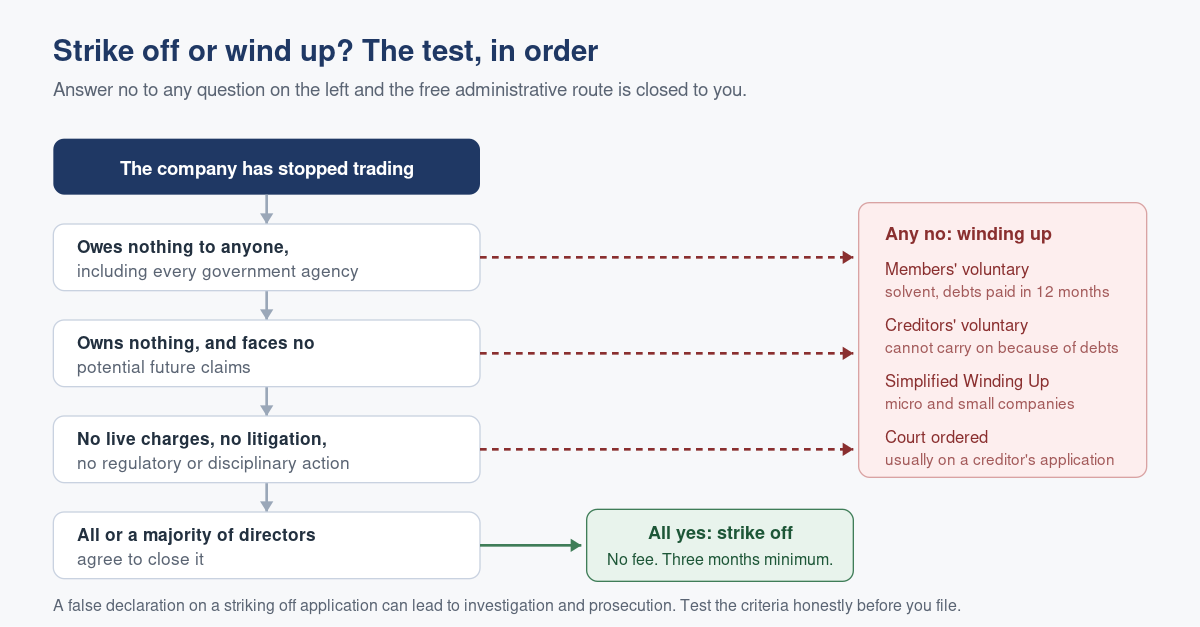
Striking off is for a company that has stopped trading, owes nothing and owns nothing. Winding up is for everything else.
Stated a little more carefully, a company is in strike-off territory only if all of the following are true at the same time:
- It has ceased trading, or never began trading after incorporation
- It has no outstanding debts, to anyone, including any government agency
- It has no live charges sitting in its charge register
- It is not a party to any legal proceedings, in Singapore or abroad
- It is not subject to any ongoing or pending regulatory or disciplinary action
- It holds no assets and faces no potential future claims
- All the directors, or at least a majority of them, agree to the closure
Fail any one of those and the strike-off route closes. What is left is winding up, or the intermediate answer of fixing the problem first and then striking off.
The eligibility test is where most of the real work sits, and it is covered in detail in the first part of our striking off series: striking off a Singapore company: do you actually qualify.
Striking off, in outline
Striking off is an administrative removal of the company’s name from ACRA’s register. It is made under Section 344A of the Companies Act 1967, and it can be filed by a company officer directly in Bizfile or by an appointed corporate service provider.
There is no filing fee. Approval of the application itself is usually immediate, or within 14 days where other directors have to endorse it. What takes time is the process that follows: at least three months from approval, running through a striking off letter, a first gazette notification, a 60 day window in which anyone can object, and a final gazette notification. On the date stated in the final gazette, the company ceases to exist.
The three months is a floor, not an estimate. An objection can add months, and an unresolved objection can cause the whole application to lapse.
Winding up, in outline
Winding up is the formal process for a company that has debts to settle or assets to distribute. A liquidator takes control, realises the assets, pays the creditors in the statutory order, distributes anything left to the members, and the company is then dissolved.
There are four routes, and they are not interchangeable. Which one you are in depends on solvency and on who initiates it.
| Route | When it applies | Who drives it |
|---|---|---|
| Members’ voluntary winding up | The directors can declare that the company will be able to pay its debts in full within 12 months of the start of the winding up | The members, by resolution, appointing a liquidator |
| Creditors’ voluntary winding up | The directors conclude the company cannot carry on because of its debts | The company initiates, but the creditors have the decisive say on the liquidator |
| Simplified Winding Up Programme | A micro or small company cannot pay its debts and wants a lower cost route, under the Simplified Insolvency Programme | The company applies, administered through the Official Receiver |
| Court ordered winding up | The Court orders it, typically on a creditor’s application because the company cannot pay its debts | The Court, which may appoint a liquidator or leave the Official Receiver to act |
The Simplified Winding Up Programme uses revenue thresholds to define micro and small companies. Those thresholds are set out by the Insolvency Office and are worth checking against the company’s actual figures before assuming you qualify.
The declaration of solvency is the pivot
The line between a members’ voluntary winding up and a creditors’ voluntary winding up is a declaration by the directors that the company will be able to pay its debts in full within 12 months. That declaration is not a formality. It is a statement directors make on their own responsibility, and getting it wrong where there was no reasonable basis for it exposes them personally.
If the directors cannot honestly make that declaration, the company is in creditors’ voluntary winding up, and the creditors, not the members, have the effective say on who the liquidator is.
Cost and time, side by side
| Striking off | Voluntary winding up | |
|---|---|---|
| ACRA filing fee | None | None for the notifications themselves |
| Professional cost | Corporate secretarial fee only | Liquidator’s fees, plus legal and accounting support |
| Minimum time | At least three months after approval | Typically many months, driven by asset realisation and creditor claims |
| Who runs it | The directors, through Bizfile | A licensed liquidator, who displaces the directors |
| Can it be reversed | Yes, by Court order within six years of being struck off | Once dissolved, restoration is a separate and harder exercise |
| Suits | Dormant or wound-down companies with nothing left | Companies with assets, debts, or disputes to resolve |
The cost gap between the two is the reason so many owners try to force a company into the strike-off box. Resist that. The declaration you make when you apply for striking off covers debts, assets, litigation and regulatory action, and a false declaration can lead to investigation and prosecution.
What goes wrong in practice
Applying with a live charge on the register. An old bank facility was repaid years ago and nobody filed the satisfaction. The charge is still sitting on ACRA’s register, so the company fails the strike-off criteria. The fix is to file the satisfaction of charge first, which needs a discharge letter from a lender you may not have spoken to in a decade.
Forgetting a tax credit. If the company is sitting on a tax credit when it is dissolved, that money does not follow the shareholders automatically. It transfers to the Insolvency Office, and the shareholders then have to go and claim it, with processing fees. Clear the credit before you close, not after.
Letting the addresses go stale. ACRA writes to the company’s registered office and to the officers’ residential addresses during the striking off process. If those addresses are out of date, you will not see the letter, and a strike-off can fail and drop the company back to “Live” status without you noticing for months.
Missing the 14 day endorsement window. Where a company has other position holders, the application has to be endorsed by all or a majority of directors within 14 days. If it is not, the application lapses and you start again. Directors who are overseas, uncontactable or simply not checking their Bizfile notifications are the usual cause. Where the owners themselves have gone silent, our note on the trapped nominee director’s exit covers the harder version of that problem.
Choosing strike-off when the company still owns something. A property, a shareholding in a subsidiary, a bank balance, intellectual property. If the company is struck off while still holding assets, those assets do not simply pass to the shareholders. That is an expensive mess to unwind later, and it is exactly what a winding up exists to prevent.
Frequently asked questions
Is striking off the same as winding up?
No. Striking off is an administrative removal of a dormant, debt-free and asset-free company from ACRA’s register, with no liquidator and no filing fee. Winding up is a formal insolvency or solvency process in which a liquidator realises the company’s assets, pays its creditors in statutory order and distributes any surplus before dissolution.
How long does it take to close a Singapore company?
A clean striking off takes at least three months from ACRA’s approval of the application, and longer if anyone objects. A voluntary winding up generally runs for many months, because the liquidator must realise assets, deal with creditor claims and hold the required meetings before the company can be dissolved.
Can we strike off a company that still has money in its bank account?
Not safely. The criteria require the company to own nothing and owe nothing. Distribute the cash properly, close the account, and only then apply. Money left in an account of a dissolved company is not simply available to the former shareholders.
What happens if we make a false declaration when applying to strike off?
Applying without meeting the criteria can amount to a false declaration, which can trigger an ACRA investigation and prosecution. It is not a technicality. If you are unsure whether the company genuinely has no debts or claims, verify before filing rather than after.
Can a struck-off company be brought back?
Yes, by applying to Court for a restoration order within six years of the strike-off. Once the Court order is filed with ACRA, the company’s status returns to “Live”. It is a real Court application with real cost, which is a good reason to get the closure right the first time.
Do we still need to file outstanding annual returns before striking off?
Outstanding annual returns do not by themselves prevent an application, provided the company meets all the striking off criteria. But if the application fails and the company remains live, the full compliance obligations continue to run, including the annual return.
Choosing the right route the first time
The expensive version of closing a company is the one where you file for striking off, discover at month four that a charge or a tax credit or an overseas claim disqualifies you, and start again from the beginning. The cheap version is the half hour spent testing the criteria honestly before anything is filed.
Raffles Corporate Services runs that test for owners closing Singapore companies, clears the blockers that would otherwise surface halfway through, and handles the Bizfile filings and the endorsement chase. Where a company genuinely needs a winding up rather than a strike-off, we will tell you that at the start rather than three months in.
Read on in part two, closing a Singapore company: the loose ends nobody warns you about, or start with the eligibility detail in striking off a Singapore company: do you actually qualify. ACRA’s own reference page on closing a local company sets out the filing channels, and the insolvency routes are administered under the Insolvency, Restructuring and Dissolution Act 2018.
— The Editorial Team, Raffles Corporate Services
Need help with this?
Raffles Corporate Services can handle the ACRA filings, compliance documentation and records for you, and where court proceedings or legal advice are needed, we work with a panel of experienced Singapore law firms who offer cost-effective and efficient legal service and advice.
Email: [email protected]
Call, SMS or WhatsApp: +65 8501 7133