
When a company repays a secured loan, the charge does not disappear by itself. Somebody has to file a satisfaction of charge in Bizfile. Until that filing is made, the charge stays on ACRA’s public register and your company still looks encumbered to every bank, buyer and auditor who searches it.
Raffles Corporate Services works with a panel of experienced Singapore law firms who offer cost-effective and efficient legal service and advice. This article is general information only and is not legal advice.
The filing is free and takes minutes. The problem is that it falls into a gap: the bank thinks the company’s corporate secretary will do it, the corporate secretary is waiting for the bank’s discharge letter, and the loan officer who closed the facility has moved on. Nothing happens for two years, and then it surfaces at exactly the wrong moment.
This guide covers who is actually entitled to file, what you need in front of you before you start, and the practical consequences of a stale charge that nobody cleared.
What a satisfaction of charge actually is
A registered charge is a public statement that a specific lender has security over your company’s assets. It sits on ACRA’s register of charges from the moment it is lodged and it stays there until it is removed.
A satisfaction of charge is the filing that removes it. In substance you are telling the Registrar that the secured debt has been paid off, in whole or in part, or that specific property has been released from the security. The Registrar then updates the register so that the charge no longer shows as live.
The Companies Act 1967 provides for entries of satisfaction and release to be made on the register once the Registrar is satisfied that the debt has been discharged or the property released. Section 133 is the operative provision.
Two points that business owners routinely get wrong:
Repayment is not the same as discharge on the register. Paying the final instalment extinguishes the debt between you and the lender. It does nothing to ACRA’s record. The register is a separate exercise.
A partial satisfaction is a real thing. If you have repaid part of a facility, or the lender has released one property out of several from a floating charge, that can be recorded too. You do not have to wait until the whole facility is cleared.
Who is allowed to file it
This is the part that causes most of the delay in practice, so it is worth being precise.
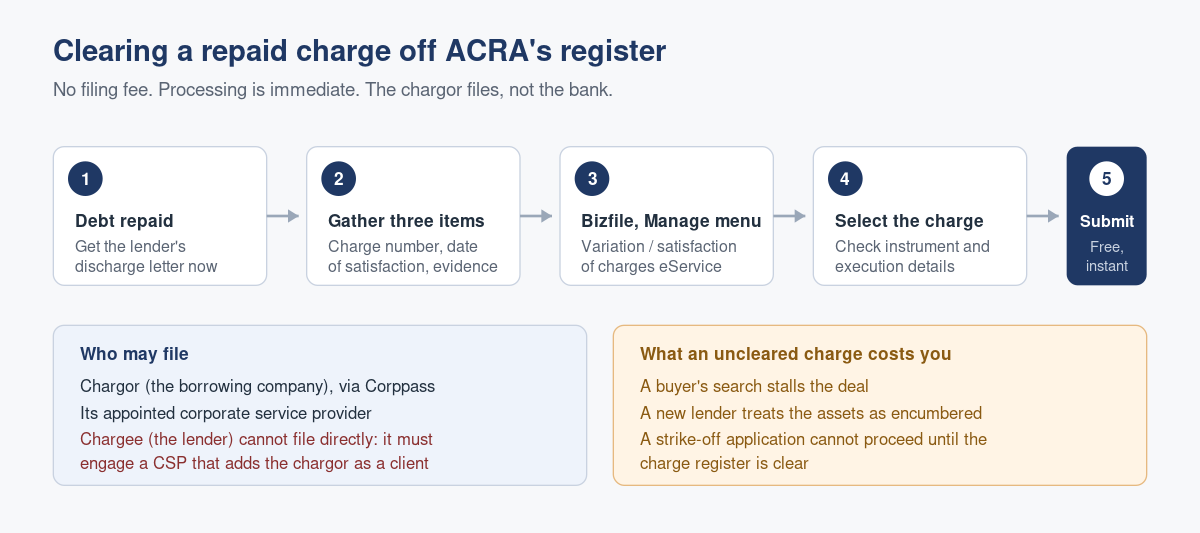
The filing is made by the chargor, meaning the company that gave the security and owes the debt. Not the bank. A company officer with Bizfile access can lodge it directly.
A company can also have its appointed corporate service provider file on its behalf, using the CSP’s own Bizfile profile, provided the CSP has added the company as a client first.
If you are the chargee, the lender holding the security, and you want the charge cleared, you cannot simply log in and do it. The route is to engage a corporate service provider who will add the chargor as a client and file in that capacity. Banks in Singapore generally do not do this; they issue a discharge letter and leave the filing to the borrower. That assumption is the single most common reason a satisfied charge sits on the register for years.
| Who you are | Can you file the satisfaction? | What you do |
|---|---|---|
| Director or company secretary of the chargor | Yes | File directly in Bizfile using Corppass |
| Corporate service provider appointed by the chargor | Yes | File under the CSP profile, after adding the company as a client |
| The lender (chargee) | Not directly | Engage a CSP, which must add the chargor as a client before filing |
| A shareholder with no office | No | Ask a director or the corporate secretary to file |
What you need before you start
Three things, and if any of them is missing the filing will stall halfway.
- The original charge number. Every registered charge carries a number assigned when it was first lodged. You will select it from a list in Bizfile, so you need to know which one you are clearing. If the company has several charges to the same lender, this matters.
- The date of satisfaction. The date the debt was discharged or the property released, not the date you happen to be filing. Take it from the lender’s discharge or redemption letter rather than from memory.
- Supporting evidence of the discharge. A discharge letter, redemption statement or deed of release from the lender. Ask for this at the point of final repayment, while the relationship manager still has the file open. Chasing it eighteen months later is a different exercise entirely.
You also need the charge to still be live on the register. If the charge was already removed, or was never registered under the company’s UEN in the first place, there is nothing to satisfy.
The filing, step by step
You will need Corppass access to the company. If nobody has set that up yet, that comes first, and our note on setting up Corppass for a new Singapore company walks through it.
- Log in to Bizfile as a Business User, which routes you through Corppass. Our guide to logging in to Bizfile as a business user covers the access problems that stop people at this step.
- Check the entity shown on the top menu bar. If you hold positions in more than one company, confirm you are in the right dashboard before you do anything else.
- If you are filing as a corporate service provider, switch to the Corporate Service Provider profile first, and select the correct firm if you belong to more than one.
- From the Manage menu, choose Local company or Foreign company, then the variation and satisfaction of charges eService.
- Select Satisfaction of Charges rather than variation, and start the transaction.
- Pick the charge number you are clearing.
- Check the charge, instrument and execution details that Bizfile displays back to you. This is your last chance to notice you have selected the wrong charge.
- Enter the satisfaction details, including the date of satisfaction, and attach your supporting document.
- Submit. There is no filing fee for a satisfaction of charge, and processing is immediate.
- Keep the confirmation notification. It is the evidence that the register has been cleared, and you will want it in the company’s file.
What goes wrong in practice
Nobody files, for years. This is the default failure. The loan is repaid, everyone moves on, and the charge remains on the public register. The company’s Business Profile and register of charges continue to show a live encumbrance over its assets. It costs nothing to leave it there, right up until it costs a great deal.
It surfaces during a transaction. A buyer’s lawyer runs a search, finds a live charge over the assets, and the deal stops while somebody tries to find a bank officer who can produce a discharge letter for a facility closed in 2019. That takes weeks, not hours, and it happens during the part of a transaction where delay is most expensive.
A new lender refuses to proceed. Banks assess security position from the register, not from your explanation. A live charge in favour of a previous lender will be treated as real until it is cleared. You may be told your assets are already encumbered and offered worse terms, or nothing at all.
It blocks a strike-off. A company cannot be struck off if it has charges sitting in its charge register. If you are closing a dormant company and discover a decade-old charge that was repaid and never cleared, the strike-off application waits until the satisfaction is filed and the supporting evidence is found. See our guide on striking off a Singapore company for where this sits in that process.
The evidence has evaporated. The discharge letter is the thing to secure early. Banks reorganise, relationship managers leave, and facility files get archived. The cost of asking for a discharge letter on the day of final repayment is zero. The cost of reconstructing one later is real.
How this connects to the rest of your charge obligations
Registration and satisfaction are two ends of the same record. A charge must be lodged with the Registrar within the statutory period after it is created, and a charge that is not registered in time can lose its priority against a liquidator and other creditors. Our article on registering company charges with ACRA under Section 131 covers the front end, and the deeper analysis of the release mechanics sits in satisfaction and release of a registered charge under Section 133.
Where more than one lender has taken security over the same assets, the order in which charges sit on the register matters commercially, and an uncleared charge distorts that picture. That problem is set out in our note on priority disputes between registered charges.
The company also keeps its own internal register of charges alongside ACRA’s. Both should say the same thing. When they do not, the ACRA record is what third parties will rely on.
Frequently asked questions
Does the bank file the satisfaction of charge, or do we?
You do. The filing is made by the chargor, meaning the borrowing company, or by its appointed corporate service provider. A lender that wants the charge cleared has to go through a corporate service provider that has added the borrower as a client. Most Singapore banks simply issue a discharge letter and expect the borrower to file.
Is there a deadline for filing a satisfaction of charge?
There is no filing window equivalent to the one that applies when you register a new charge, and the filing itself is free. The practical deadline is commercial rather than statutory: leave it too long and you will be scrambling for a discharge letter during a sale, a refinancing or a strike-off.
What does it cost to file?
Nothing. ACRA does not charge a fee for filing a satisfaction of charge, and the transaction processes immediately. If you use a corporate service provider, their professional fee is the only cost.
Can we file a satisfaction if we have only repaid part of the loan?
Yes. A satisfaction can be recorded for a charge that has been partially satisfied, or where specific property has been released from the security. You do not have to wait for the entire facility to be repaid, though you do need the lender’s confirmation of what has actually been released.
What if we cannot find the discharge letter?
Ask the lender to reissue it. Give them the facility reference, the charge number from ACRA’s register and the approximate repayment date. It is slower than keeping the original, but it is almost always obtainable. Start this early if a transaction or a strike-off depends on it.
Will an uncleared charge stop us from striking off the company?
Yes. A company applying to be struck off must have no charges in its charge register. An old satisfied charge that was never cleared will need to be dealt with before the application can proceed.
Clearing the register before it matters
The cheapest moment to file a satisfaction of charge is the week the loan is repaid. The most expensive moment is the week a buyer’s lawyer finds it.
If you are not certain what is currently sitting on your company’s charge register, that is a five minute check and worth doing now rather than at the point somebody else runs the search. Raffles Corporate Services maintains charge registers for companies across Singapore, files satisfactions as facilities close, and reconciles ACRA’s record against the company’s own before a transaction or a year end makes it urgent.
You can reach us through Raffles Corporate Services, or read more on Singapore corporate secretarial practice at Singapore Secretary Services. ACRA’s own reference material on managing company debt sets out the filing channels.
— The Editorial Team, Raffles Corporate Services
Need help with this?
Raffles Corporate Services can handle the ACRA filings, compliance documentation and records for you, and where court proceedings or legal advice are needed, we work with a panel of experienced Singapore law firms who offer cost-effective and efficient legal service and advice.
Email: [email protected]
Call, SMS or WhatsApp: +65 8501 7133