

Your company exists from the moment ACRA issues the UEN, and three obligations start on that same day: a registered office that is genuinely open, a Register of Registrable Controllers, and directors’ duties. Almost everything else in the first month is sequencing, not law.
Raffles Corporate Services works with a panel of experienced Singapore law firms who offer cost-effective and efficient legal service and advice. This article is general information only and is not legal advice.
That distinction matters, because the post-incorporation period is where new companies waste the most effort on the wrong things. People chase a rubber stamp they do not need and forget a register that carries a criminal penalty. They spend three weeks on a bank account and let the free Business Profile expire.
This article covers the first month. Its companion, the first year of compliance for a new Singapore company, covers the twelve months after that: the secretary and auditor appointments, the financial year end, the first AGM, the annual return and the tax filings.
What actually has a deadline
Most post-incorporation advice reads as an undifferentiated list. Some of these items are legal duties with a date attached, some are practical steps, and some are optional. Here is the separation.
| Item | Deadline | Type |
|---|---|---|
| Registered office open and accessible | From incorporation | Legal duty, section 142 |
| Register of Registrable Controllers set up | Same day as incorporation | Legal duty |
| Corppass account | Can apply one day after UEN issued | Practical, but blocks everything else |
| Free Business Profile download | Within 60 days of registration | Free copy expires |
| Share certificates for subscriber shares | Within 60 days of allotment | Legal duty, section 130AE |
| Auditor appointed (unless exempt) | Within 3 months of incorporation | Legal duty |
| Company secretary appointed | Within 6 months of incorporation | Legal duty |
| CPF Submission Number | Before your first payroll | Legal duty once you hire |
| Business licences and permits | Before you start the regulated activity | Legal duty, sector-specific |
| Corporate bank account | No deadline | Practical |
| GST registration | Only when the threshold is crossed | Conditional |
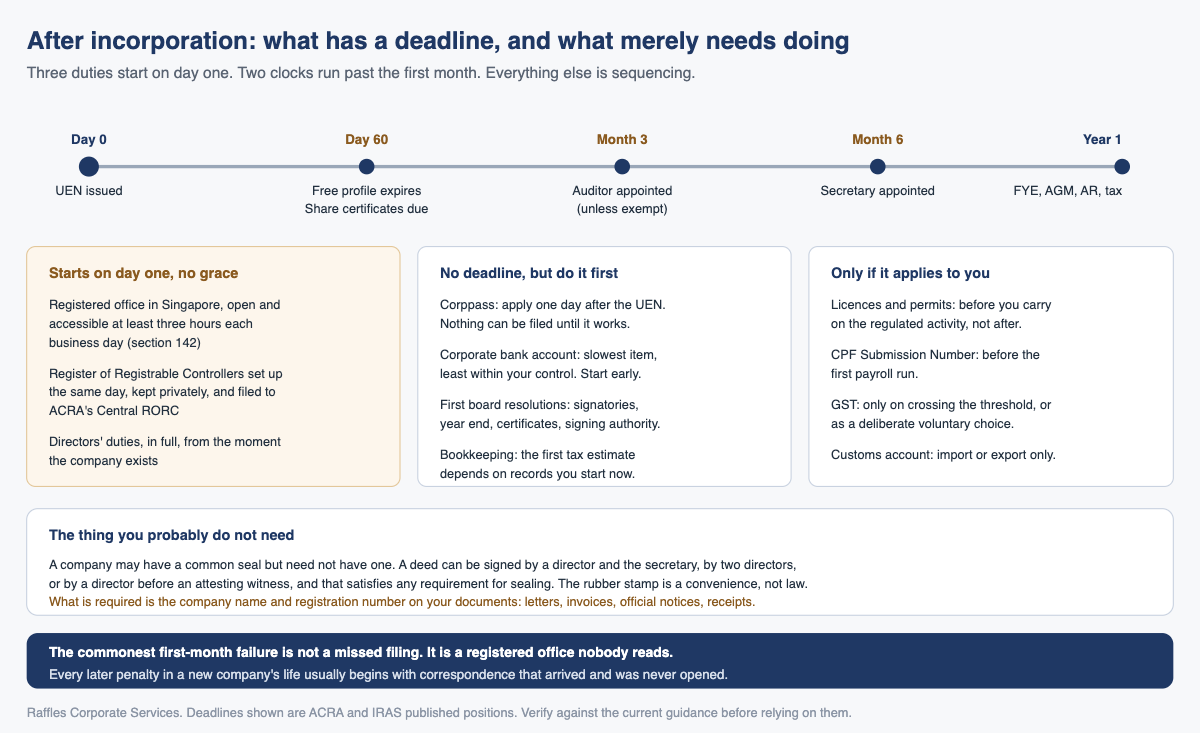
Download the free Business Profile before it expires
ACRA gives every newly registered entity a free Business Profile, and it includes the extracts you will be asked for repeatedly over the next few months: the incorporation details, the constitution, the share structure. The free copy is available for 60 days from registration. After that, you buy it like everybody else.
Download it in week one and save it somewhere your bankers and your accountant can reach. The number of companies that pay for a profile they were given free is not small.
While you are in Bizfile, get Corppass sorted. You can apply one day after the UEN is issued, and until it is working you cannot file anything, update anything or download anything. If nobody in the company has done this before, our guide on setting up Corppass for a new Singapore company walks through the administrator appointment and the first login.
You almost certainly do not need a company seal
This is the most persistent myth in Singapore post-incorporation practice, and it costs new companies both money and time.
A company may have a common seal, but it does not need one. Since the amendments that took effect in 2017, section 41B of the Companies Act 1967 allows a company to execute a document expressed as a deed without affixing any seal: by the signature of a director and the secretary, by two directors, or by one director in the presence of an attesting witness. Section 41C then provides that wherever a written law requires a document to be executed under common seal, signature in one of those ways satisfies the requirement.
So the engraved metal seal is optional. The rubber stamp with the company name on it is not a legal instrument at all. It is a convenience, and some banks and counterparties still ask for one out of habit.
Where the name genuinely must appear is in section 144: your company name in legible letters on business letters, statements of account, invoices, official notices, bills of exchange, cheques, orders, receipts and letters of credit, and your registration number on business letters, statements, invoices, official notices and publications. That is a document requirement, not a signage requirement. Put the UEN in your email footer and your invoice template on day one and it stops being a problem.
What the registered office does need
Section 142(1) requires a registered office in Singapore from the date of incorporation, open and accessible to the public for at least three hours during ordinary business hours on each business day excluding weekends and public holidays. Non-compliance is an offence carrying a fine of up to $5,000 plus a default penalty, for the company and every officer in default.
A locked unit that nobody attends is a breach. If you are working from home or from a co-working desk, this is the requirement that a registered office service exists to solve.
The registers you open on day one
Singapore’s statutory registers are split between what ACRA holds electronically and what you keep yourself. New companies routinely assume the first set makes the second unnecessary.
Held by ACRA, updated by you through Bizfile. The electronic registers of members, directors, secretaries, chief executive officers and auditors live with the Registrar. Under section 196A of the Companies Act 1967 the Registrar’s electronic register of members is the legal register for a private company, which means what is filed determines legal title to shares. You do not maintain a parallel book. You keep the filings current.
Kept by you. The Register of Registrable Controllers is a private register, and for companies incorporated from 16 June 2025 it must be set up on the same day you incorporate. Keep it as a physical or electronic register at your registered office or at your corporate service provider’s office, and file the same information with ACRA’s Central RORC. If a controller’s details change, you update your own register within seven days of being told, and file with the Central RORC within two business days after that.
The Registers of Nominee Directors and Nominee Shareholders follow the same pattern where they apply. If anyone in your structure holds shares or a directorship for someone else, read our note on nominee shareholder arrangements and beneficial ownership disclosure first, because the definition of a nominee is wider than most founders assume.
Share certificates: the 60-day duty nobody diarises
When the company was incorporated, shares were allotted to the subscribers. Section 130AE of the Companies Act 1967 requires the company to complete and have ready for delivery the share certificates within 60 days after the date of allotment, and within 30 days after a notice of transfer is lodged. It is a duty on the company, with a default penalty.
Nobody chases you for this. It surfaces eighteen months later when a shareholder wants to sell, an investor runs diligence, or a bank asks for evidence of ownership, and there is nothing in the file. Our explainer on section 130AE and share certificates sets out the signing formalities and what a valid certificate must contain. Issue them in month one, while the directors are available to sign.
The first board resolutions
Your first directors’ resolutions are not ceremonial. They are the evidence a bank, an auditor and eventually a buyer will ask to see. A sensible first set covers:
- Adoption of the constitution as registered, and confirmation of the registered office address.
- Fixing the first financial year end.
- Opening the corporate bank account, naming the bank, and authorising the signatories and their limits.
- Appointment of the company secretary, and of the auditor or a resolution recording that the company expects to qualify for audit exemption.
- Issue of share certificates to the subscribers.
- Authority for a named director to sign leases, employment contracts and licence applications up to a stated value.
Item 3 is the one banks actually read. Item 6 is the one that saves you convening a meeting every time somebody needs a signature.
Bank account, tax, CPF and licences
The bank account. You can apply immediately after registration. Expect the bank to want the persons who will sign, most directors physically present in Singapore, a board resolution, certified company documents, and identity checks on directors and beneficial owners. Onboarding is the slowest item in this article and the one least within your control, so start it first and expect weeks rather than days. If you will bill in more than one currency, our comparison of multi-currency business accounts is worth reading first.
Corporate tax. Your company is taxed in its own name at a flat rate of 17% on chargeable income. There is nothing to register: IRAS picks the company up from ACRA. What you do need in month one is a bookkeeping arrangement, because the first Estimated Chargeable Income filing is due three months after your first financial year end and you cannot estimate what you have not recorded.
GST. Registration becomes compulsory when taxable turnover exceeds $1 million at the end of a calendar year, or when you reasonably expect it to exceed $1 million in the next 12 months. Voluntary registration is possible and occasionally sensible, but it brings the GST InvoiceNow requirement/gst-invoicenow-requirement) with it for new voluntary registrants. Do not register on a vague instinct that it looks more established.
CPF. If you will hire, apply for a CPF Submission Number before the first payroll run. A director who draws a salary is an employee for CPF purposes if they are a Singapore citizen or permanent resident.
Licences. Check before you trade. The GoBusiness licence advisers will tell you what your activity needs. Import or export work additionally needs a Customs account before you can apply for trade permits.
Data protection. Every organisation must appoint a Data Protection Officer under the Personal Data Protection Act 2012. It can be an existing employee. Register the contact details and move on.
What goes wrong in the first month
The registered office is a formality on paper only. A company takes a service address, nobody monitors it, ACRA correspondence and a late filing notice sit unread, and the first anyone knows is a penalty. The office must be open and reachable, and somebody must read what arrives.
Corppass sits with one person who then leaves. The administrator resigns three months in, nobody else has access, and the company cannot file a change of officers without a fresh Corppass application. Appoint at least two administrators.
The RORC is treated as a filing rather than a register. Filing with the Central RORC does not discharge the duty to keep your own register. Both exist, and both are inspected.
Nobody fixes the financial year end deliberately. A date gets keyed into the incorporation form because the form asked, and the company inherits a year end nobody wanted. It is far easier to get right at the start than to change later. See choosing your company’s financial year end.
The three-month and six-month clocks are missed entirely. The auditor and secretary appointments are the two hard post-incorporation deadlines, and both fall outside this article’s window. Diarise them in month one. They are covered in the first year of compliance for a new Singapore company.
Frequently asked questions
Do I need a company stamp or seal in Singapore?
No. A company may have a common seal but is not required to have one. Under sections 41B and 41C of the Companies Act 1967, a document can be executed by a director and the secretary, by two directors, or by a director before a witness, and that satisfies any legal requirement for sealing.
How long do I have to download the free Business Profile?
Sixty days from registration. After that the free copy expires and you buy the profile at ACRA’s normal price. Download it in the first week and keep a copy where your bank and your accountant can reach it.
When must I set up the Register of Registrable Controllers?
On the same day you incorporate, if the company was incorporated on or after 16 June 2025. You keep the private register at your registered office or your corporate service provider’s office, and file the same information with ACRA’s Central RORC.
Can I start trading before the bank account is open?
Legally yes, subject to any licence your activity needs. Practically it is a poor idea. Receipts into a personal account create a director’s loan account that somebody has to unwind at year end, and it complicates the first set of financial statements.
Do I need to register for GST as a new company?
Not unless your taxable turnover exceeds $1 million at the end of a calendar year, or you reasonably expect it to exceed $1 million in the next 12 months. Voluntary registration is possible but brings ongoing filing and e-invoicing obligations, so treat it as a decision rather than a default.
When do I need a company secretary?
Within six months of incorporation. The auditor appointment comes sooner, within three months, unless the company is exempt from audit. Both deadlines run from the incorporation date, not from when you start trading.
Getting the first month right
The first 30 days set the file that everything else is built on. A company with a proper register, signed share certificates, a clean first set of resolutions and a diarised set of deadlines is straightforward to audit, straightforward to bank and straightforward to sell. A company without them is a tidying exercise every single year.
Raffles Corporate Services handles the post-incorporation pack for new Singapore companies: registers opened, controllers identified and filed, share certificates issued, first resolutions drafted, and the three-month, six-month and first-year deadlines put in a calendar that someone other than you watches. If you incorporated recently and are not certain what is outstanding, that is a short review. For the next twelve months, read the first year of compliance for a new Singapore company.
You can reach us through Raffles Corporate Services, or read more on Singapore corporate secretarial practice at Singapore Secretary Services.
— The Editorial Team, Raffles Corporate Services
Need help with corporate secretarial or compliance matters?
If you would like help with your company's corporate secretarial, governance or compliance requirements, email [email protected] or WhatsApp +65 8501 7133.
Our team can assist with corporate secretarial, accounting and tax matters. Where legal advice is needed, advisers from our associated law firms can assist.