

Two deadlines in your first year run from the incorporation date: an auditor within three months unless you are exempt, and a company secretary within six months. Everything else runs from your financial year end, which you chose at incorporation and which now drives your entire calendar.
Raffles Corporate Services works with a panel of experienced Singapore law firms who offer cost-effective and efficient legal service and advice. This article is general information only and is not legal advice.
That is the structural point most new directors miss. The first year is not one deadline after another in a straight line. It is two short clocks off the incorporation date, then a fan of obligations, some to ACRA and some to IRAS, all measured from a single date you may have picked without much thought.
This article maps the whole year. If you are still in month one, start with the first 30 days after incorporating a Singapore company and come back here.
The two clocks that run from incorporation
The auditor: three months. A company must appoint an auditor within three months of incorporation unless it is exempt from audit. Most new private companies are exempt, but exemption is a status to confirm rather than assume, and the safe practice is to record the position in a directors’ resolution inside the three-month window rather than let the date pass in silence.
The small company exemption applies to a private company that meets at least two of three criteria: total annual revenue of $10 million or less, total assets of $10 million or less, and 50 or fewer full-time employees at the end of the financial year. For a company less than two years old, you test those criteria in the current financial year rather than over the past two. A company that is part of a group must also sit inside a small group on the same tests, assessed on the consolidated figures.
The secretary: six months. Every company must appoint a company secretary within six months of incorporation, and the office cannot be left vacant for more than six months at any time. A sole director cannot also be the sole company secretary. Our guide on appointing a company secretary in Singapore covers the qualification requirements and the consent formalities.
Your financial year end drives everything else
Your first financial year runs from the date of incorporation to the year end you declared at registration. Under section 198 of the Companies Act 1967, that first period may not exceed 18 months unless the Registrar approves a longer one on application.
Two consequences follow, and they pull in opposite directions. A longer first period gives you more trading before the first set of accounts, which sounds efficient. But a first accounting period longer than 12 months is apportioned across two Years of Assessment for tax, and the start-up tax exemption runs for only the first three consecutive YAs. Stretching to 17 months spends two of those three years on one trading period. A shorter first period means an earlier first accounts cycle and an earlier first AGM, but it keeps your YAs aligned with your trading years.
You can change the year end, but the window closes. Our note on choosing your company’s financial year end covers the decision, and the piece on changing a Singapore company’s financial year end covers the mechanics if you have already got it wrong.
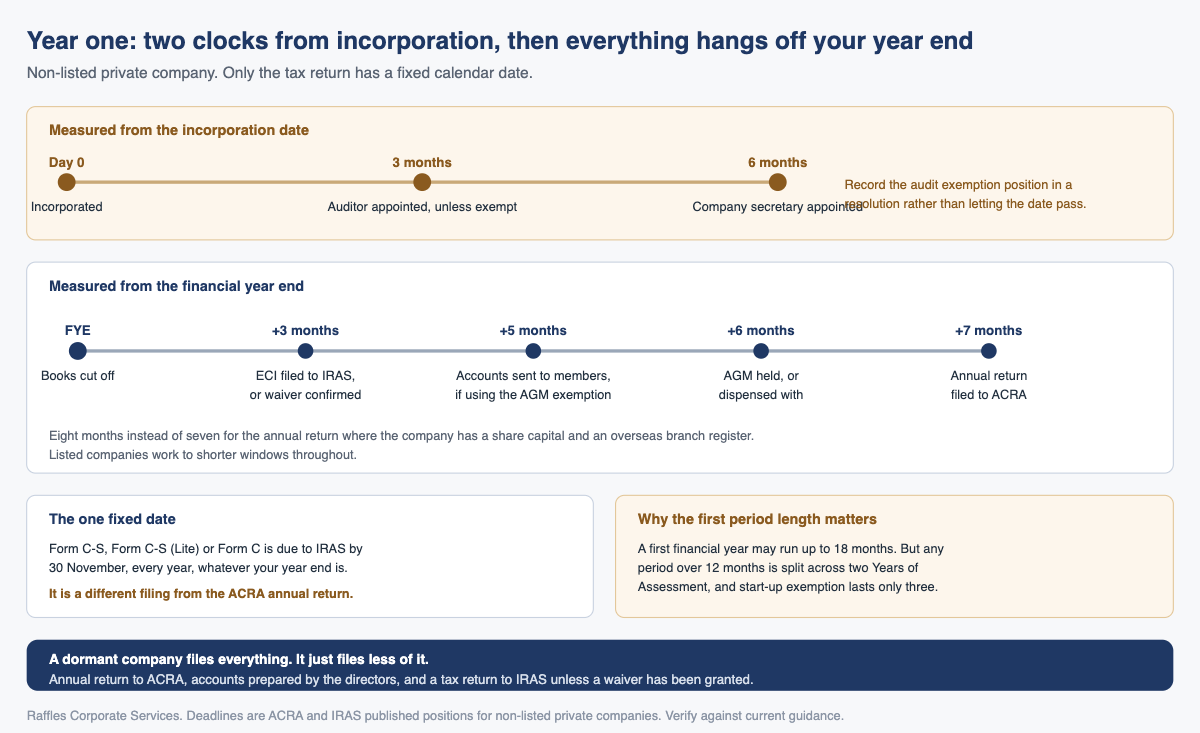
The obligations that run from your financial year end
| Obligation | Deadline from FYE | Owed to |
|---|---|---|
| Estimated Chargeable Income (ECI) | 3 months | IRAS |
| Financial statements sent to members | 5 months, if relying on the AGM exemption | Members |
| Annual general meeting, non-listed company | 6 months | Members |
| Annual return, non-listed company | 7 months | ACRA |
| Annual return, non-listed with share capital and overseas branch register | 8 months | ACRA |
| Form C-S, Form C-S (Lite) or Form C | 30 November each year | IRAS |
Note that the tax return deadline is the only fixed calendar date in the list. Everything else moves with your year end.
Financial statements
Directors must prepare financial statements that comply with the accounting standards and give a true and fair view, and lay them before the company in general meeting. This obligation does not disappear because the company is small, dormant or exempt from audit. Audit exemption removes the auditor’s report. It does not remove the accounts.
Whether those accounts are filed with the annual return depends on company type. A solvent exempt private company is not required to attach a financial statement set to its annual return, which is why many small companies never see their accounts become public. That is a filing relief, not a preparation relief.
The first AGM
A non-listed company must hold its AGM within six months after the financial year end. That is where the financial statements are laid before the shareholders and where they get to ask about the business.
Private companies have two routes out of it. A private company need not hold an AGM if it sends its financial statements to all members within five months after the financial year end. Separately, a private company may dispense with AGMs altogether if all members pass a resolution to that effect, handling the business by written resolution instead.
Neither route is a free pass. A member can require an AGM up to 14 days before the end of the sixth month, and the company must then hold one within the six-month period. A member or the auditor can also require a general meeting within 14 days of receiving the financial statements. And whichever route you take, you must declare the AGM position when you file the annual return: held, exempt, or dispensed with. If your directors and shareholders are in different countries, our guide to virtual and hybrid general meetings covers how to convene one properly.
The annual return
The annual return is an ACRA filing, not a tax filing, and the two are routinely confused. It contains the company’s name and registration number, company type, business activities, registered office address, the particulars of directors, secretary and members, share information, and financial statements where those are required.
A non-listed company files within seven months after the financial year end, and within eight months if it has a share capital and an overseas branch register. You must file even if the company is dormant, inactive, or has been granted a tax filing waiver by IRAS. The obligation attaches to being live on the register, and it is the directors’ legal duty. ACRA can grant a 60-day extension on application, for a fee. Late filing attracts penalties, and persistent failure can lead to prosecution, director disqualification and striking off.
The tax side of the first year
Estimated Chargeable Income. File your ECI within three months of the financial year end. A company qualifies for the ECI filing waiver if annual revenue is $5 million or less and the ECI is nil, in which case there is nothing to file for that Year of Assessment even though the filing status may still show as open. If you are required to file and do not, IRAS may issue a Notice of Assessment based on an estimate of your income, and that estimate is payable whether or not it reflects reality.
The corporate tax return. Form C-S, Form C-S (Lite) or Form C is due by 30 November each year. The return you file for a year of assessment is based on the accounts for the financial year ending in the preceding calendar year, which is why 30 November gives most companies close to a year after their accounts close.
The start-up exemption. A qualifying new company gets, for its first three consecutive Years of Assessment, 75% exemption on the first $100,000 of normal chargeable income and a further 50% on the next $100,000. From the fourth YA it moves to partial tax exemption. The exclusions matter: investment holding companies and property developers do not qualify, and the company must be incorporated in Singapore, tax resident for that YA, and have its total share capital beneficially held by no more than 20 shareholders who are all individuals, or with at least one individual holding at least 10% of the issued ordinary shares.
Corporate tax rate. A flat 17% on chargeable income, for local and foreign companies alike. Rebates are announced Budget by Budget and should be read from IRAS rather than assumed from last year’s figures.
A month-by-month calendar for a 31 December year end
This assumes a company incorporated in January with a first financial year end of 31 December, and uses the non-listed private company deadlines.
| Month | What happens |
|---|---|
| Month 1 | Registers opened, RORC filed, share certificates issued, Corppass working, bookkeeping started |
| Month 3 | Auditor appointed, or audit exemption position recorded in a directors’ resolution |
| Month 6 | Company secretary appointed |
| Month 12 (31 December) | Financial year end. Stop, cut off, and get the ledgers to the accountant |
| January to March | Accounts prepared |
| By 31 March | ECI filed, or the waiver conditions confirmed and documented |
| By 31 May | Financial statements sent to members, if relying on the AGM exemption |
| By 30 June | AGM held, or dispensation resolution passed and recorded |
| By 31 July | Annual return filed with ACRA |
| By 30 November | Form C-S, Form C-S (Lite) or Form C filed with IRAS |
Shift every date in the lower half of that table by the difference between 31 December and your actual year end, and the calendar is yours.
What goes wrong in year one
The annual return and the tax return are treated as the same thing. They are not. One goes to ACRA and is driven by your year end. One goes to IRAS and is due on 30 November. Filing one does nothing for the other, and a company that thinks its accountant “did the filing” often has only half of it done.
Audit exemption is assumed rather than tested. The criteria are tested at the financial year end, and a company that hires quickly or bills well can cross a threshold without noticing. By the time you discover an audit is required, the auditor should already have been appointed and observing the opening position.
The AGM exemption is used without the condition being met. Sending financial statements to all members within five months of the year end is what triggers the exemption. Sending them in month six and then claiming exemption does not work, and the AGM declaration in the annual return is where that becomes visible.
Nobody prepares accounts because the company “did nothing”. A dormant company still files an annual return, still needs financial statements prepared, and still files a tax return unless IRAS has granted a waiver. Dormancy reduces the work. It does not remove it.
The books are reconstructed in month thirteen. A year of bank statements handed over in one bundle costs several times what monthly bookkeeping would have cost, delays the accounts, delays the AGM, and frequently pushes the annual return past its deadline. Our note on when to move from DIY bookkeeping to professional support sets out where that stops being a saving.
Officer changes are not filed. Changes to directors, secretary, CEO or auditor must be notified to ACRA within 14 days. Late lodgement penalties apply per late transaction, so a company that lets several changes drift accumulates a bill rather than a single fee.
Frequently asked questions
When must a new Singapore company hold its first AGM?
Within six months after its first financial year end, if it is a non-listed company. A private company can avoid holding one by sending the financial statements to all members within five months after the year end, or by passing a members’ resolution to dispense with AGMs entirely.
When is the first annual return due?
Within seven months after the financial year end for a non-listed company, or eight months if the company has a share capital and an overseas branch register. The return is due even if the company is dormant or has a tax filing waiver from IRAS, because the obligation attaches to being live on the register.
Does a dormant company still have to file?
Yes. A dormant company files an annual return with ACRA, and files a tax return with IRAS unless IRAS has granted a waiver. Directors must still prepare financial statements. Dormancy affects how much work each of those takes, not whether they are required.
Do I need an auditor if my company is small?
Probably not. A private company is exempt from audit if it meets at least two of: revenue of $10 million or less, total assets of $10 million or less, and 50 or fewer employees. A company under two years old is tested on the current financial year. Group companies must also sit inside a small group.
What is the difference between ECI and the Form C-S?
ECI is an estimate of chargeable income filed within three months of your financial year end, which lets IRAS raise an early assessment. The Form C-S, Form C-S (Lite) or Form C is the actual return, due 30 November. You may be waived from ECI if revenue is $5 million or less and ECI is nil, but the annual return to IRAS still has to be filed.
What happens if I file the annual return late?
ACRA charges a late lodgement penalty, and continued default can lead to prosecution of the directors, disqualification and striking off of the company. An extension of 60 days can be applied for before the deadline, at a fee, but it has to be applied for in advance rather than explained afterwards.
Making year one boring
The companies that find their first year painless are not the ones with the simplest businesses. They are the ones where someone put six dates in a calendar in month one and then did the bookkeeping monthly.
Raffles Corporate Services runs the full first-year cycle for new Singapore companies: secretary appointment, audit exemption assessment, financial statements, AGM or dispensation, annual return, ECI and the corporate tax return, with deadlines tracked against your actual financial year end rather than a generic template. If you are approaching your first year end and are not sure what is due when, that is a short conversation. If you have only just incorporated, start with the first 30 days after incorporating a Singapore company.
You can reach us through Raffles Corporate Services, or read more on Singapore corporate secretarial practice at Singapore Secretary Services.
— The Editorial Team, Raffles Corporate Services
Need help with corporate secretarial or compliance matters?
If you would like help with your company's corporate secretarial, governance or compliance requirements, email [email protected] or WhatsApp +65 8501 7133.
Our team can assist with corporate secretarial, accounting and tax matters. Where legal advice is needed, advisers from our associated law firms can assist.