

Every change to a Singapore company’s officers or shareholders maps to one specific Bizfile transaction. Pick the right one, attach the right document, and the relevant statutory register updates automatically. Pick the wrong one and you file something that does not record what actually happened.
Raffles Corporate Services works with a panel of experienced Singapore law firms who offer cost-effective and efficient legal service and advice. This article is general information only and is not legal advice.
The confusion is understandable. Appointing a director and changing a director’s mobile number both sound like “updating the director”, but they are different transactions with different attachments. Issuing new shares and transferring existing shares both sound like “updating the shareholders”, and those are different again.
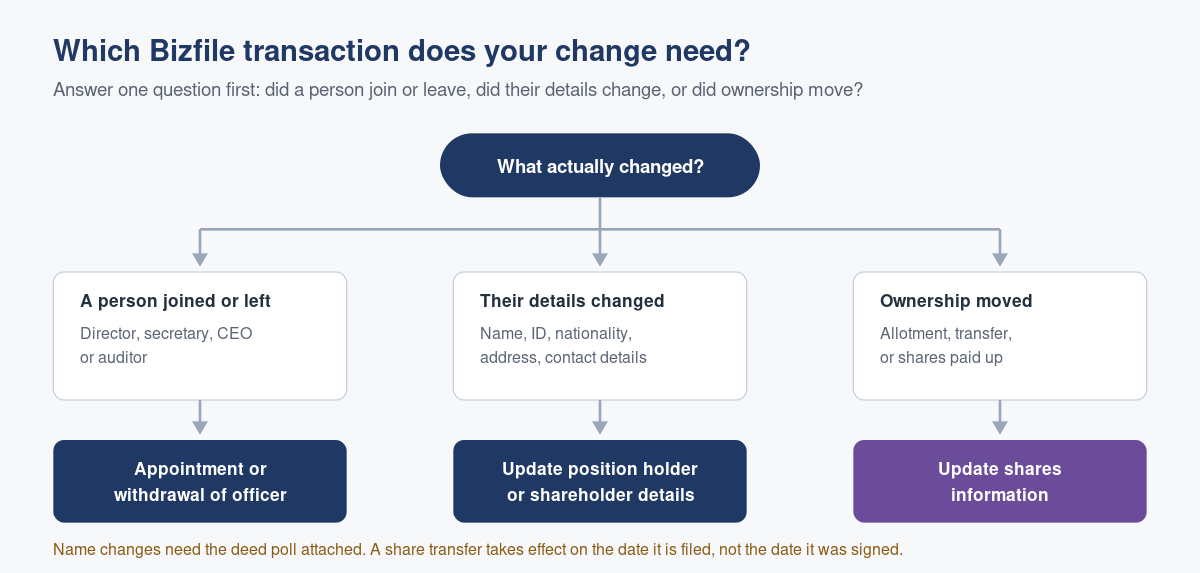
This is the routing map: change on the left, transaction on the right, and what you need to have ready before you start.
First, decide which of three things changed
Almost every filing question resolves once you answer this. There are three categories, and they behave differently.
A person joined or left. Someone was appointed as a director, secretary, chief executive officer or auditor, or they ceased to hold that position. This is an appointment or withdrawal of a position holder.
A person’s details changed but their role did not. Same director, new residential address, new passport number, new surname after marriage. This is an update of position holder particulars.
Ownership moved. New shares were issued, existing shares changed hands, or partly paid shares were paid up. This is a shares transaction, and it is the one with the most consequences attached.
Company-level changes, such as the registered office address, business activity, financial year end, constitution or company name, sit outside all three and use entity-level transactions.
The routing table
| What changed | Bizfile transaction | What you need ready |
|---|---|---|
| Director, secretary, CEO or auditor appointed | Appointment of position holder | Consent to act, the person’s identification and residential address, effective date |
| Director, secretary, CEO or auditor ceased | Withdrawal of position holder | Resignation letter or board or member resolution, effective date |
| Officer’s name changed | Update position holder details | Deed poll, attached to the filing |
| Officer’s ID, nationality, address, contact number or email changed | Update position holder details | The new particulars and the effective date |
| New shares issued | Update shares information (allotment) | Board and, where required, member approval, the allottee’s details, number and class of shares, consideration |
| Shares transferred | Update shares information (transfer) | Instrument of transfer, stamp duty position, board approval, updated shareholding |
| Shareholder’s name changed | Update shareholder information | Deed poll, attached to the filing |
| Shareholder’s ID, address, nationality or contact details changed | Update shareholder information | The new particulars |
| Partly paid shares paid up in full | Notice to update the electronic register of members and paid-up capital | Evidence of payment and the amount now paid up |
| Registered office address or office hours | Update entity information | The new address and effective date |
| Business activity | Update entity information | The new activity code and effective date |
| Constitution altered | Notice of resolution (special resolution) | The special resolution and the amended constitution, both attached |
| Company name | Notice of resolution, then update entity information | Name approval, the special resolution |
Two attachments catch people out. A name change, for an officer or a shareholder, needs the deed poll attached. And an alteration of constitution needs both the resolution and the full amended constitution, not just the amended clause.
Where the order of steps matters
Some of these are single-step filings. Others are the last step in a sequence, and doing them out of order produces a filing that is technically invalid even though Bizfile accepted it.
Constitution changes
- Convene a general meeting and pass a special resolution approving the change, or obtain a written resolution to the same effect.
- Produce the amended constitution as a single, clean, complete document.
- File the notice of resolution within 14 days of the resolution, attaching both the resolution and the amended constitution.
The filing does not amend the constitution. The resolution does. The filing records it.
Company name changes
- Apply for and obtain approval of the new name.
- Pass the special resolution.
- File the notice of resolution.
- Update the entity information to reflect the new name.
Share transfers
- Board approves the transfer, if the constitution requires board approval, which most private company constitutions do.
- Execute the instrument of transfer and deal with stamp duty.
- File the transfer in Bizfile.
- Issue the new share certificate and cancel the old one.
The critical point is step three. For a private Singapore company, the transferee becomes a member on the date the transfer is filed with ACRA, not the date the transfer form was signed. If a sale completes on 1 March 2026 and the transfer is filed on 20 May 2026, the buyer was not a member for those eleven weeks, whatever the sale agreement says. Dividends declared in that window, votes cast in that window and warranties tied to membership all sit on the wrong side of that line.
Two addresses, and why officers get them wrong
Every officer’s record carries a residential address and a contact address, and they do different jobs.
The residential address is where ACRA sends official correspondence. It is the one that must be genuine and current, because notices sent there are treated as served.
The contact address, sometimes called an alternate address, is what appears in the public record instead of the residential address. It exists so a director does not have to publish their home address to anyone who buys a company extract. It must be in the same country as the residential address, and it cannot be a post office box.
Directors who want privacy sometimes supply a contact address and then assume ACRA will write to it. It will not. If you move house and only update the contact address, you have made yourself harder to reach on exactly the correspondence you cannot afford to miss.
Singapore citizens and permanent residents do not report changes of name, address or identification to ACRA at all. Those go to ICA, and the officer registers follow. The register of members is the exception: a shareholder’s particulars still need a filing.
What goes wrong in practice
Filing a withdrawal when the position was never properly vacated. A director cannot simply stop being a director because they stopped attending. There has to be a valid resignation or removal, consistent with the constitution and the Companies Act 1967, and the company must still meet its minimum requirements afterwards. A private company needs at least one director ordinarily resident in Singapore, so filing the withdrawal of the only local director leaves the company in breach from the moment it takes effect.
Nobody holds the filing role. The Corppass e-service role that permits the transaction was assigned to someone who has since left. The change cannot be filed until access is fixed, and fixing access takes longer than the 14 days you have. Our guide to who should have Bizfile access and which roles to assign is the preventative version of this problem, and setting up Corppass for a new company covers doing it properly from the start.
Allotment filed without the approvals behind it. New shares are issued to an investor, the transaction is filed, and it later emerges that the directors had no current authority to allot, or that pre-emption rights in the constitution were never waived. The ACRA record then shows a state of affairs the company’s own constitution did not permit.
The controller register not updated alongside. A share transfer that moves someone above or below the 5% threshold changes your Register of Registrable Controllers as well. That register runs on a seven-day clock and a separate central filing, as set out in the registers every Singapore company must keep.
Everything filed late because the documents were not ready. File on the effective date and complete the paperwork around it. The deadlines and what missing them costs are covered in the 14-day update rule.
Check the filing landed
After any of these transactions, pull the free register download from Bizfile and read it. Not the acknowledgement email, the register itself. The failure mode worth guarding against is a transaction that was drafted, saved, discussed and never submitted, which leaves behind an internal record that looks exactly like a completed filing.
If you have never done that, what Bizfile actually is and what you can do in it and your first fifteen minutes in Bizfile will get you there in a few minutes.
Frequently asked questions
Do I need the outgoing director’s consent to file their cessation?
No, but you need a valid basis for the cessation: a resignation, a removal passed in the correct manner, or a disqualification. Filing a withdrawal without one does not end the person’s office, and the company remains answerable for a register that does not reflect the true position.
When does a share transfer take effect for ACRA’s purposes?
On the date the transfer is filed in Bizfile. The transferee becomes a member, and the transferor ceases to be one, on that filing date rather than on the date the instrument of transfer was signed. That gap matters for dividends, voting and completion accounts.
What do I attach when a director changes their name?
A deed poll. The same applies to a shareholder name change. Without the supporting deed poll the filing is incomplete, and a change of name evidenced only by a new passport will not satisfy the requirement.
Can I update a residential address and keep it off the public record?
Yes. Supply a contact address as well. ACRA displays the contact address publicly instead of the residential address. The contact address must be in the same country as the residential address and cannot be a post office box, and ACRA will still send official correspondence to the residential address.
Does appointing a new director remove the old one automatically?
No. Appointment and cessation are two separate transactions. If one director replaces another, you file both, and you check that the company still meets its minimum officer requirements at every point in the sequence.
When it is easier to hand this over
Individually, none of these filings is hard. Collectively, they are a sequence of small steps where the cost of a wrong turn is discovered months later by someone doing diligence on your company.
Raffles Corporate Services prepares the resolutions, files the transaction, updates the controller and nominee registers in step, and confirms the change against ACRA’s record afterwards. If you have a change coming up, the useful time to call is before the documents are signed rather than after.
You can read more on Singapore corporate secretarial practice at Singapore Secretary Services, or start with the underlying law in the Companies Act 1967.
— The Editorial Team, Raffles Corporate Services
Need help with corporate secretarial or compliance matters?
If you would like help with your company's corporate secretarial, governance or compliance requirements, email [email protected] or WhatsApp +65 8501 7133.
Our team can assist with corporate secretarial, accounting and tax matters. Where legal advice is needed, advisers from our associated law firms can assist.