
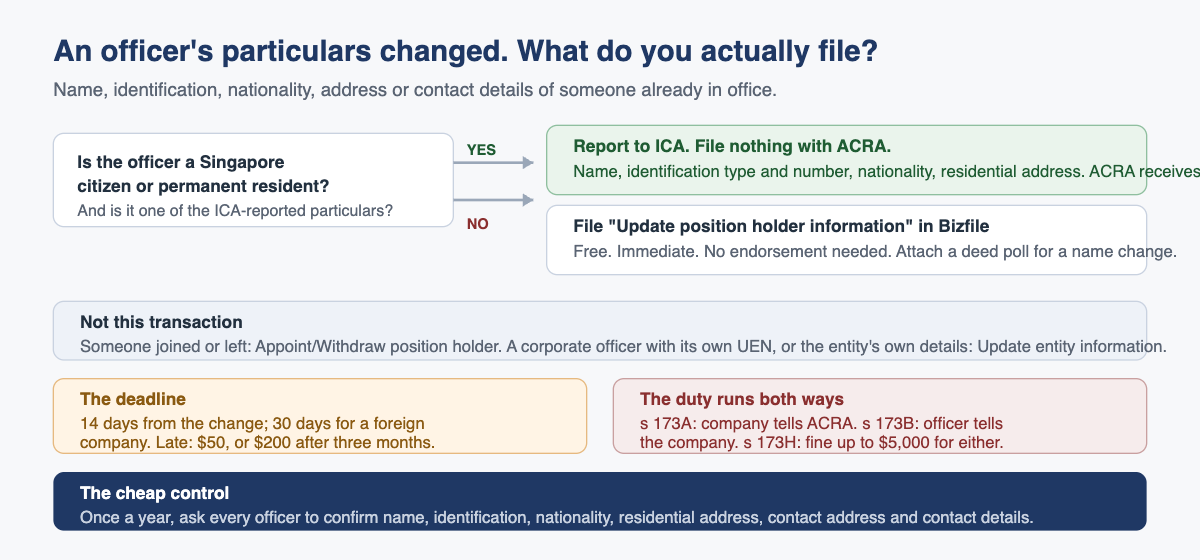
If an existing officer’s name, identification, nationality or address changes, the entity must tell ACRA within 14 days. The transaction is free and takes effect immediately. But if that officer is a Singapore citizen or permanent resident, you very likely have nothing to file at all: you report the change to ICA and ACRA receives it automatically.
That split is the single most useful thing to understand here, and it is the thing companies get wrong in both directions. Some file duplicate updates ACRA never needed. Others assume the automatic route covers everyone, leave a foreign director’s new address unreported for a year, and collect a penalty.
This is a different transaction from adding or removing someone. If a director has joined or left, you want our guide to appointing or withdrawing a position holder instead.
Which transaction do I actually need?
Three different Bizfile transactions look similar and are not interchangeable. Picking the wrong one is the most common reason an update goes nowhere.
| What has changed | Transaction to use |
|---|---|
| An existing officer’s own particulars: name, identification, nationality, residential or contact address, contact details | Update position holder information |
| Somebody has joined or left an office | Appoint/Withdraw position holder |
| The details of a corporate position holder that has its own UEN | Update entity information |
| The entity’s own registered office address, business activity or name | Update entity information |
| Share ownership | The relevant share transaction, not a position holder transaction |
A corporate position holder with a Singapore UEN is the one people get wrong. You do not edit its particulars through the position holder screen. Its details are pulled from its own ACRA record, so the fix is to update that record. If you are still working out which part of the system does what, start with our overview of what Bizfile actually is.
The ICA route: when you file nothing
For a Singapore citizen or permanent resident, changes to name, identification type, identification number, nationality and residential address are reported to the Immigration & Checkpoints Authority, not to ACRA. ICA passes the update through. You do not notify ACRA separately, and you should not try to.
The practical consequences are worth spelling out, because ACRA does not.
- A director who changes address through the ICA online change of address service has discharged the obligation. The ACRA register will follow.
- The update is not always instantaneous. If you are relying on the register showing the new address for a bank or a tender, check it rather than assume it.
- This route covers citizens and permanent residents only. It does not cover a director on an Employment Pass, a foreign director resident overseas, or a corporate officer.
- It covers the listed particulars. It does not cover contact details you gave ACRA, and it does not cover anything about the entity itself.
For everybody else, and for anything the ICA feed does not carry, you file.
What ACRA wants, and what evidence goes with it
The particulars ACRA holds for a company’s officers are set out in section 173 of the Companies Act 1967: full name and any former name, residential address, contact address, nationality, identification, and the dates of appointment and cessation.
| Particular that changed | What to prepare |
|---|---|
| Name | Supporting evidence of the change, typically a deed poll |
| Identification type or number | The new identification document details, for example a renewed passport |
| Nationality or citizenship | The new nationality details |
| Residential address | The new address; for citizens and PRs, report to ICA instead |
| Contact address | The address ACRA may use for correspondence, where the officer has given one |
| Contact information | Current telephone number and email |
The contact address, and why it goes stale
The contact address is a separate field from the residential address, introduced so that an officer’s home address need not be the one exposed on a purchased profile. It is a useful thing to have. It is also a field that goes stale independently of the residential address, because nothing updates it automatically and the ICA feed does not carry it. If your directors use one, put it on the annual check.
The steps, in order
- Log in to Bizfile as a business user through Corppass, on the correct entity profile.
- Open Update position holder information from the Manage menu, and start a new transaction or continue a saved draft.
- Select the position holder whose particulars have changed.
- Amend only the fields that have actually changed, and attach supporting evidence where it is required, such as a deed poll for a name change.
- Review and submit. There is no fee.
- Check the confirmation, and the notification in your Bizfile inbox. The update takes effect immediately, so if you do not see the change reflected, something did not go through.
Unlike an appointment or a withdrawal, a particulars update does not normally wait on anyone else’s endorsement. That is why it is immediate, and it is why there is no excuse for one sitting unfiled. Your Bizfile transaction history is the record that proves when you filed, which matters if a penalty is later disputed.
The deadline, and the two people who can be prosecuted
The deadline is 14 days from the date of the change for most entity types, and 30 days for a foreign company registered in Singapore under section 372 of the Companies Act 1967.
What ACRA’s guidance leaves out is that the obligation runs in two directions, and both carry an offence.
Section 173A(1)(c) obliges the company to furnish the change to the Registrar within 14 days. Section 173B obliges the officer, whether director, chief executive officer, secretary or auditor, to give the company the information it needs to do that, as soon as practicable and no later than 14 days after the change.
Section 173H sets the penalty for both. A company in default, and every officer of the company in default, is liable to a fine of up to $5,000 and a default penalty. An officer who fails to comply with section 173B is separately liable to a fine of up to $5,000 and a default penalty.
On top of the offence, the late lodgement penalty applies: $50 where the filing is within three months of the due date and $200 where it is more than three months late, per late transaction. See ACRA’s late lodgement penalty schedule.
So “nobody told the corporate secretary” is not a defence for the company, and it is not a defence for the director who did not tell them either.
How this differs from appointing or ceasing someone
| Update particulars | Appoint or withdraw | |
|---|---|---|
| What changes | Information about a person already in office | Whether the person holds the office at all |
| Endorsement | Not normally required | Usually required, within 14 days |
| Processing | Immediate | Immediate, or up to 14 days where endorsement is needed |
| Fee | Free | Free |
| Automatic ICA feed | Yes, for citizens and PRs, for the listed particulars | No |
| Evidence typically attached | Deed poll for a name change | Consent to act, kept at the registered office under section 173C |
There is also a route that runs without anybody filing. Under section 173F, where the Registrar has reasonable cause to believe an officer has died, or that a director has become disqualified, the Registrar may amend the register on their own initiative. That is a correction mechanism, not a substitute for filing, and a company that finds its register changed without its involvement should look closely at why.
What goes wrong in practice
The renewed passport. A foreign director renews their passport, the number changes, and nobody thinks of it as an ACRA matter. It is. Identification number is a recorded particular, and the register now identifies the director by a document that no longer exists. This surfaces at the worst moment, usually during bank or counterparty due diligence.
The director who moved and told nobody. Citizens and PRs are covered by the ICA feed. Employment Pass holders and overseas-resident directors are not. Their residential address change is a filing, and a missed one.
The married name. A name change by deed poll or marriage certificate needs supporting evidence attached to the filing. The register keeps former names too, so nothing is lost, but the update is not a self-declaration.
Editing the wrong record. Someone opens Update position holder information to change a corporate director’s registered address and cannot find the field. It is not there, because the corporate officer’s details come from its own entity record.
Assuming the annual return catches it. Filing the annual return does not fix a stale particular, and an inaccurate register is a separate default from a late return. If nobody is monitoring the alerts ACRA sends, the first sign of trouble is the penalty.
The cheap control is an annual particulars sweep: once a year, ask every officer to confirm name, identification, nationality, residential address, contact address and contact details, and file anything that has moved. Ten minutes a head, once a year.
Frequently asked questions
Do I need to tell ACRA when a Singaporean director moves house?
No. Report the change of address to ICA, which passes it to ACRA automatically. The same applies to a citizen’s or permanent resident’s name, identification type, identification number and nationality. Filing separately with ACRA is unnecessary. For a foreign director, you must file the change yourself.
How long do I have to update a director’s particulars?
Fourteen days from the date of the change for most entity types, and 30 days for a foreign company registered in Singapore. Late filing attracts a penalty of $50 within three months of the due date and $200 after that, per late transaction, and a default under section 173H of the Companies Act 1967.
What evidence does ACRA want for a name change?
Supporting documentation for the change itself, typically a deed poll. It is attached to the Bizfile transaction. The register retains the former name as well as the new one, so a name change does not erase the earlier record of who held the office.
Is there a fee for updating position holder information?
No. ACRA charges nothing for the transaction, and it is processed immediately rather than waiting on anyone’s endorsement. The only cost is the late lodgement penalty if the 14-day deadline has already passed, which is $50 within three months of the due date and $200 after that, charged for each late transaction rather than once per filing session.
My director’s particulars are wrong on the register. Who is liable?
Potentially both. Section 173A obliges the company to notify the Registrar within 14 days; section 173B obliges the officer to give the company the information within 14 days. Section 173H exposes the company, every officer in default, and the individual officer to a fine of up to $5,000 plus a default penalty.
Keeping the register true
A register that is wrong is not a paperwork problem until it is. It becomes a real one during a financing, a share transfer, an audit, a grant application or a dispute, and by then it is usually several years stale and the evidence for the correction is harder to assemble.
Raffles Corporate Services runs that sweep as part of the corporate secretarial service: we reconcile what ACRA holds against what you know about your own officers, file what has moved inside the 14-day window, and keep the supporting evidence with your statutory records where section 173C expects it. If you are not confident the register matches reality, that is a quick check and usually a quick fix. You can also read more on Singapore corporate secretarial practice at Singapore Secretary Services.
— The Editorial Team, Raffles Corporate Services