

Section 71 of the Companies Act 1967 lets a company alter its share capital in five ways: consolidate and divide, subdivide, convert paid-up shares into stock, reconvert stock into shares, and cancel shares that were never taken up or have been forfeited. Your constitution has to allow it, the members have to approve it, and you have to lodge a notice with ACRA. There is no filing fee.
What none of those five things do is bring new money into the company. That is the first thing to be clear about. Altering share capital reshapes what already exists. If you want new capital you are issuing shares, and if you want to hand capital back you are reducing it, which is a wholly different and considerably more demanding process.
The second thing worth knowing early: for a private company, an alteration does not take effect when the members vote. It takes effect when the Registrar updates the electronic register of members. The resolution is not the event. The register is.
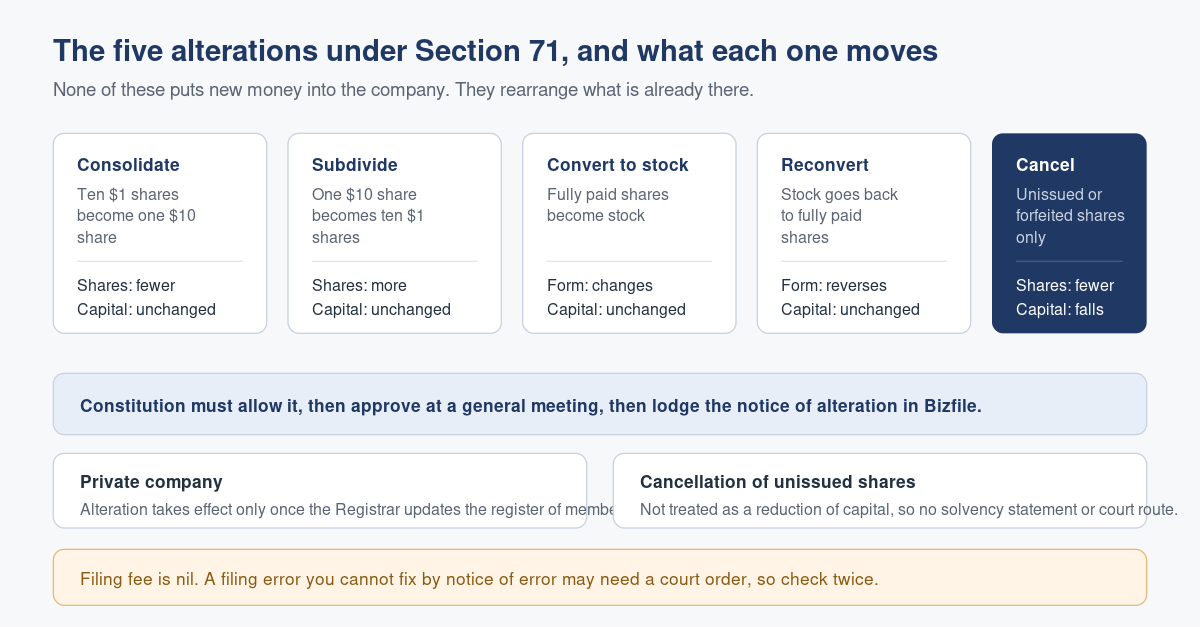
The five alterations, side by side
| Alteration | What happens | Number of shares | Share capital amount |
|---|---|---|---|
| Consolidate and divide | Shares are combined into a larger denomination, for example ten shares of $1 become one share of $10 | Falls | Unchanged |
| Subdivide | Shares are split into smaller denominations, for example one share of $10 becomes ten shares of $1 | Rises | Unchanged |
| Convert paid-up shares into stock | Fully paid shares are converted into stock, which is held as a value rather than as counted units | Not applicable once converted | Unchanged |
| Reconvert stock into shares | Stock is turned back into fully paid shares | Restored | Unchanged |
| Cancel unissued or forfeited shares | Shares that nobody took up, or that have been forfeited, are cancelled and the capital figure is reduced accordingly | Falls | Falls |
Only the last one moves the capital figure, and that is the one with the useful quirk, discussed below.
Consolidation and subdivision are the two used most often, typically ahead of an investment round or an employee share scheme. Their mechanics are covered in our guide to share consolidation and subdivision under Section 71, so this article concentrates on the process and the traps across all five.
The subdivision rule people miss
When shares are subdivided, the proportion between the amount paid and the amount unpaid on each new share must be the same as it was on the original share. You cannot use a subdivision to quietly convert partly paid shares into a mix of fully paid and unpaid ones. If your shares are partly paid, work out the arithmetic before the resolution, not after. Our note on updating paid-up share capital covers how those amounts are tracked and filed.
Cancellation is not a reduction of capital
This is the most commercially useful point in Section 71, and it is the one that most often gets over-lawyered.
Cancelling shares that have not been taken or agreed to be taken by anyone, or that have been forfeited, reduces the share capital figure. But it is expressly not treated as a reduction of share capital for the purposes of the Act. That means none of the reduction machinery applies: no solvency statement, no creditor objection period, no application to court.
The limit is precise, though. It applies to shares that were never issued, and to shares that have been forfeited. It does not let you cancel shares that a member holds. If you want to take shares out of a member’s hands you are in the territory of a buyback, a court-free reduction supported by a solvency statement, or a court-approved reduction, all of which are set out in our guide to reducing share capital by solvency statement or court order and the more focused note on the non-court solvency statement route.
Confusing the two is expensive. Cancelling issued shares as though they were unissued is not a filing error you fix by resubmitting.
What has to happen before you file
- Check the constitution. The power to alter share capital under Section 71 is conditional on the company being authorised by its constitution. Read the actual document, not the template you think it was based on. Older constitutions and adopted model articles differ.
- If the constitution does not allow it, amend the constitution first. That means a special resolution passed by at least 75 per cent of the votes of members entitled to vote, and the resolution has to be lodged with ACRA through the general lodgement eService. This is a separate filing from the alteration itself, and it comes first in sequence.
- Approve the alteration in general meeting. Section 71 requires the alteration to be made by the company in general meeting. A directors’ resolution on its own is not sufficient, whatever the company’s habits are.
- Work out the consequences before you vote. Fractional entitlements on a consolidation, the effect on any shareholders’ agreement thresholds, the effect on any share option or employee scheme, and the effect on classes of shares with different rights.
- Then lodge the notice of alteration in share capital through the Update shares information eService in Bizfile.
Filing, in short
Open the Update shares information eService, log in through Corppass as a business user, select the notice of alteration in share capital, complete the details of what has changed and submit. Company officers such as a director or company secretary can file directly, or a registered corporate service provider can file on the company’s behalf. There is no fee and the filing is processed immediately.
If Corppass access is the obstacle rather than the share law, start with logging in to Bizfile as a business user and assigning Corppass e-service roles.
The effective date is not the date of the resolution
For a private company, an alteration of share capital made on or after 3 January 2016 does not take effect until the Registrar updates the company’s electronic register of members. The Companies Act 1967 says so in terms, in Section 71.
In practice the gap is usually minutes, because the filing is processed immediately. But the principle matters whenever the sequence matters: a completion conditional on a subdivision, an option exercise priced off a post-consolidation share count, a closing accounts date. A transaction document that makes the alteration effective on the date of the members’ resolution is drafted on a false premise, and someone will notice at the worst time. For public companies the position is framed differently, so take advice rather than assuming.
What goes wrong in practice
Somebody cancels issued shares. A member holds shares nobody wants any more, and cancellation looks like the tidy answer. It is not available. Forfeiture has its own procedure, and unissued means unissued.
The constitution was never checked. The alteration is filed, and eighteen months later a due diligence exercise establishes that the company had no power to do it. Unwinding that is a legal exercise, not a filing one.
Fractions are ignored on a consolidation. Combining ten $1 shares into one $10 share works neatly when every holding divides by ten. Real cap tables rarely do. Decide in advance what happens to the remainder, put it in the resolution, and tell the affected shareholders before the vote rather than after.
The rest of the paperwork never catches up. The ACRA record is updated, and the share certificates, the register of members maintained by the company, the shareholders’ agreement schedule and the cap table in the investor’s data room all still show the old numbers. Four sources of truth, one of them correct.
A filing error is treated as minor. If you cannot correct it by filing a notice of error, the remaining route is an application to court for an order to amend the record. ACRA is direct about this, and it is the reason share transactions are the one part of corporate filing where a second pair of eyes genuinely earns its fee. The professional standards expected of the people who do this work are set out in our Corporate Service Providers Act 2024 compliance FAQ.
The alteration is used to solve the wrong problem. If what you actually need is more capital, a shareholder exit, a different ownership split, or simply a correction to a shareholder’s recorded particulars, no amount of consolidating and subdividing will get you there. The Companies Act 1967 deep-dive FAQ maps which instrument does what, and our note on updating shareholder information with ACRA covers the particulars side.
Frequently asked questions
Does altering share capital change how much money the company has?
No. Consolidation, subdivision, conversion to stock and reconversion leave the share capital amount untouched and simply change the form or number of shares. Cancelling unissued or forfeited shares reduces the recorded capital figure, but no money moves in either direction because those shares were never paid for.
Do I need a special resolution to alter share capital?
Not for the alteration itself, which Section 71 requires be made by the company in general meeting. You need a special resolution, passed by at least 75 per cent, if the constitution does not currently permit the alteration and has to be amended first. That constitutional amendment is lodged separately through the general lodgement eService.
Is cancelling shares the same as reducing share capital?
No. Cancelling shares that were never taken up or that have been forfeited is expressly not a reduction of share capital under the Act, so the solvency statement and court procedures do not apply. Cancelling shares a member actually holds is a different matter entirely and needs the reduction or buyback route.
How much does the filing cost and how long does it take?
There is no filing fee for the notice of alteration in share capital, and the filing is processed immediately. The cost of getting it wrong is the part to budget for: an error that cannot be fixed by a notice of error may require an application to court.
When does the alteration legally take effect for a private company?
Not when the members resolve. An alteration by a private company takes effect when the Registrar updates the company’s electronic register of members following your filing. Transaction documents that assume the resolution date is the effective date are drafted on a mistaken premise.
Can my corporate secretary file this for me?
Yes. A director or company secretary can file directly, and a registered corporate service provider can file on the company’s behalf. Given how difficult share filing errors are to reverse, having someone who does these regularly check the resolution and the arithmetic before submission is worth the fee.
Before you pass the resolution
The filing is free and takes minutes. The thinking in front of it is where the value sits: does the constitution allow this, is this actually the instrument that solves the problem, and what happens to the fractions, the option pool and the shareholder thresholds once the numbers change.
Raffles Corporate Services prepares and files share transactions for Singapore companies, checks the constitutional authority before the meeting rather than after it, and keeps the certificates, registers and cap table consistent with what ACRA holds. If you are contemplating a consolidation or subdivision ahead of a funding round, it is worth a conversation before the resolution is drafted.
You can reach us through Raffles Corporate Services, read the statutory text at Section 71 of the Companies Act 1967, or read more on Singapore corporate secretarial practice at Singapore Secretary Services.
— The Editorial Team, Raffles Corporate Services