
Most changes to a Singapore company must be filed with ACRA within 14 days of the change itself, not within 14 days of the paperwork being signed, the board meeting being minuted or your corporate secretary finding out. That distinction is where almost every late filing begins.
Fourteen days is a short window when the event happens quietly. A director resigns by email on a Friday. A shareholder pays up the balance on partly paid shares. The office moves. None of those feel like regulatory events at the time, and all of them start a clock.
Here is exactly what triggers the 14 days, which events run on a shorter clock instead, and what happens when the window closes on you.
Who the duty actually falls on
The obligation to report changes sits with the company’s directors and its company secretary. Not with your accountant, not with your lawyer, and not, in law, with whoever happens to have Bizfile access that week.
This matters because the practical arrangement in most SMEs is that a corporate service provider does the filing. That is sensible and efficient, but it does not move the legal duty. If the provider was never told a director resigned, the provider has not defaulted. The company has.
So the first control is not a filing system. It is a habit: when something changes, the person who knows tells the person who files, on the same day.
What starts the 14-day clock
| Trigger event | What has to be filed | Clock starts on |
|---|---|---|
| A director, secretary, CEO or auditor is appointed or ceases to hold office | Appointment or withdrawal of position holder | The effective date of the appointment or cessation |
| An officer’s particulars change (name, ID, nationality, residential or contact address, contact number, email) | Update of position holder details | The date the particular actually changed |
| Registered office address or office hours change | Update of entity information | The date of the change |
| Business activity changes | Update of entity information | The date the company starts or stops the activity |
| New shares are issued | Update of shares information | The date of allotment |
| Shares are transferred | Update of shares information | The transfer is effective on the date of filing, so file promptly |
| A shareholder’s particulars change | Update of shareholder information | The date the particular changed |
| Partly paid shares are paid up in full | Notice to update the electronic register of members and paid-up capital | The date of payment |
| The constitution is altered by special resolution | Notice of resolution, with the resolution and the amended constitution attached | The date the special resolution is passed |
| The company changes its name | Notice of resolution, then update of entity information | The date the resolution is passed |
There is one quirk worth flagging on share transfers. A person legally becomes or stops being a member on the date the transfer is filed, not on the date the transfer form was signed. So a transfer signed in January but filed in May means the transferee was not a member until May, whatever the parties intended. That has real consequences for dividends, voting and warranties given in a sale agreement.
The clocks that are not 14 days
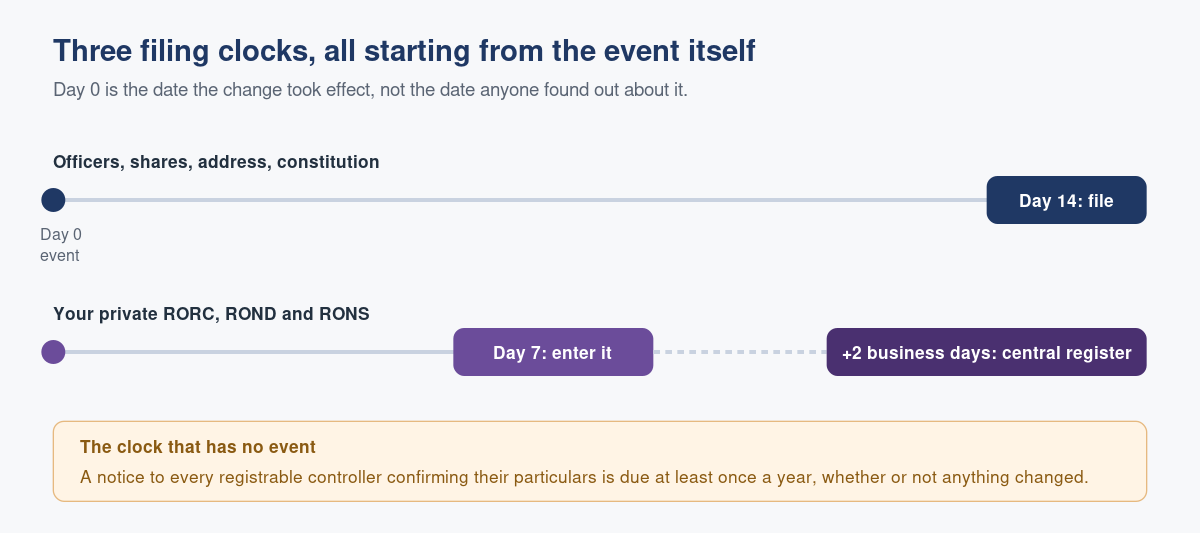
Three registers run on much tighter deadlines, and directors who have internalised “14 days” as the universal answer get caught by them.
Seven days: your private registers
A change to your Register of Registrable Controllers must be entered within seven days. So must a change to your Register of Nominee Directors or Register of Nominee Shareholders. For the controller register, the seven days runs from the point the controller confirms their particulars to you, not from the point you first suspected something had changed.
Two business days: the central registers
Once you have updated your own controller or nominee register, you have two business days to file the corresponding update to ACRA’s central register. Business days, not calendar days, so a change entered on a Thursday afternoon before a public holiday weekend needs attention before you leave.
The annual obligations that have no trigger event at all
Some duties do not wait for something to happen. The notice you must send to each registrable controller confirming their details is due at least once a year regardless of whether anything changed. Nothing prompts it and nothing visibly breaks if you skip it, which is precisely why it gets skipped.
The registers themselves, and which of them you keep yourself, are set out in the companion piece, the registers every Singapore company must keep.
What happens when you miss it
Late filings attract late lodgement penalties. Two features of that regime matter more than the headline amount.
The penalty is per transaction. It is not one charge for being generally behind. A company that lets four changes drift for a year pays on four filings, not one. This is why long-neglected entities produce unpleasantly large numbers when someone finally tidies them up.
The penalty is not the real cost. The real cost is what a stale record does at the moment you need the record to be right:
- A bank runs its periodic review, sees a director who left eighteen months ago still listed, and freezes onboarding on the new signatory until it is corrected.
- A buyer’s due diligence pulls the register of members and finds it does not match the cap table in your data room. Price does not usually go up after that.
- A grant application or tender requires the applicant’s shareholding to meet a local ownership condition, and the register says something different from your evidence.
- An overseas counterparty asks for a company extract and gets one that lists your previous registered office.
Beyond penalties, failing to keep required information and file it is an offence under the Companies Act 1967, and persistent default is treated as a matter of director conduct rather than administration. That is a different conversation from a late fee.
What goes wrong in practice
The resignation nobody forwarded. A director resigns by WhatsApp to a fellow director. It is never minuted, never sent to the corporate secretary, and surfaces at the next annual return.
The address change treated as an office admin task. The company moves, everyone updates their email signature, and nobody files the change of registered office. Official correspondence from ACRA and IRAS then goes to an address the company no longer occupies, which is how people miss notices that matter.
Waiting for the completion documents. A share transfer is agreed in principle, the parties wait for signed transfer forms, stamp duty and share certificates before anyone thinks about ACRA, and two months pass. File the change as soon as the event is effective and complete the paperwork around it.
Assuming ICA covers everything. Singapore citizens and permanent residents report changes of name, address or identification to ICA and the officer registers pick it up. The register of members does not work that way, so a shareholder who is a citizen still needs their particulars filed.
Assuming Bizfile access equals authority. The person with the right Corppass role is the only person who can actually file. If that person has left the company, you will discover it at the worst moment. Our guide to who should have Bizfile access and which Corppass roles to assign covers how to avoid that, and logging in to Bizfile as a business user covers the mechanics.
A simple control that works
You do not need a compliance system. You need one rule, applied by everyone who might cause a change:
- When an event happens, record the effective date the same day. Write it down before you decide what to do about it.
- Send it to whoever files, on the same day, even if the supporting documents are not ready.
- Ask for confirmation that the filing went through, not confirmation that it was received.
- Two weeks later, check the register. Pull the free copy from Bizfile and look at it.
Step four is the one that catches the failure mode nobody else catches, which is a filing that was prepared, discussed, and never actually submitted.
Frequently asked questions
Is the 14 days calendar days or working days?
Calendar days. The deadline does not extend because it lands on a weekend or public holiday, so a change that happens just before a long break has effectively fewer working days available than you think. Treat 14 days as ten working days in planning terms.
When exactly does the clock start for a director’s resignation?
On the effective date of the cessation, which is the date stated in the resignation, not the date the board accepted it or the date your corporate secretary was informed. If a resignation is dated the first of the month, the filing is due by the fifteenth.
Do I need to file if a Singapore citizen director changes address?
No. Singapore citizens and permanent residents report changes of name, address and identification to ICA, and the electronic registers for officers are updated from that. The exception is the register of members: a shareholder’s particulars still require a filing with ACRA.
What if I discover a change that happened months ago?
File it now. The penalty for a late filing is smaller than the consequences of an inaccurate register discovered by a bank, a buyer or a regulator. File the correct effective date, pay the penalty, and move on rather than trying to present the change as recent.
Does my corporate secretary become liable if they were never told?
The statutory duty to report changes sits with the company’s directors and secretary. A service provider who was not informed of an event cannot file it. In practice, responsibility follows information, which is why telling your filing agent on the day something happens is the whole control.
Never having to think about the clock
The companies that never miss a 14-day deadline are not more diligent than everyone else. They have simply removed the step where a human has to remember.
Raffles Corporate Services files ACRA changes for several hundred Singapore companies, inside the window, and reconciles what ACRA holds against what the company believes before every year end. If you suspect something has drifted, tell us the date it happened and we will tell you where you stand. For the wider legal background, our Companies Act 1967 deep-dive FAQ is a useful companion, and you can read more on Singapore corporate secretarial practice at Singapore Secretary Services.
— The Editorial Team, Raffles Corporate Services