
A Singapore private company must hold its annual general meeting within six months after its financial year end. A listed company has four months. That is section 175 of the Companies Act 1967, and the clock runs from your FYE, not from your incorporation date, not from your tax deadline, and not from when your accountant finishes.
Most directors know the six-month figure. Far fewer know that it is not six months of working time, because the meeting cannot happen until the financial statements exist and those statements have to reach the members before the meeting.
This guide covers how the deadline is calculated, what has to be finished before the meeting can validly happen, when you may skip the AGM altogether, and the two situations in which a single member can force one back onto your calendar.
How the due date is calculated
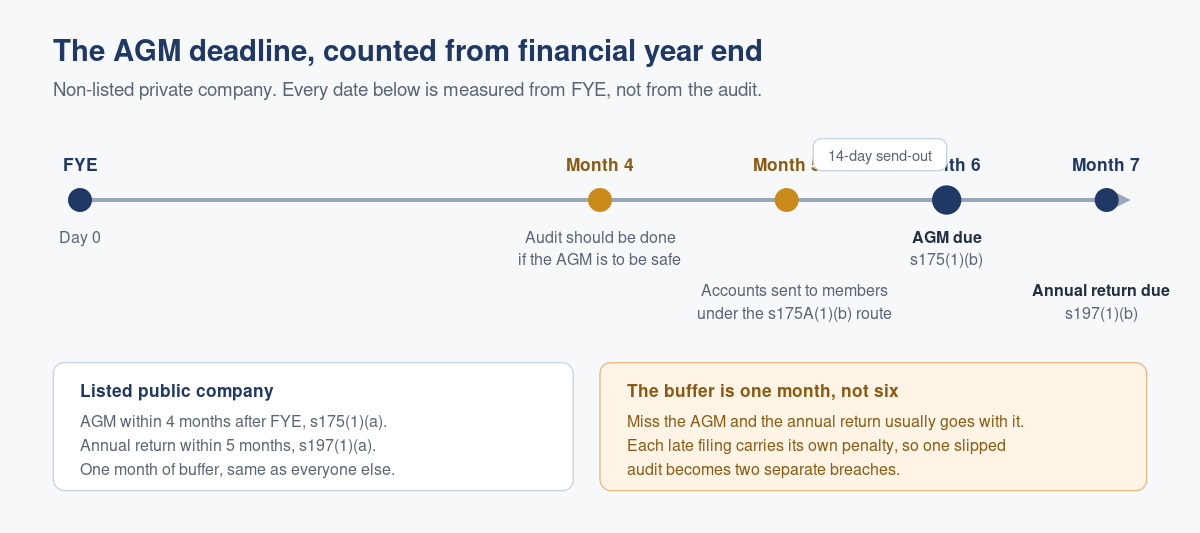
Your financial year end sets everything. Section 175(1) requires the AGM to be held after the end of each financial year, within four months for a listed public company and within six months for every other company.
So a company with a 31 December FYE holds its AGM by 30 June. A 31 March FYE gives a 30 September deadline. A 30 June FYE gives 31 December, which is the one that catches people, because the last fortnight of December is when nobody is contactable.
There is no grace period. If you cannot meet the date, the route is an application to the Registrar for more time under section 175(2), covered in applying for an extension of time to hold your AGM.
The deadlines that sit behind and in front of the AGM
The AGM is one date in a sequence. Miss it and you usually miss the next one too.
| Milestone | Deadline from FYE | Where it comes from |
|---|---|---|
| Financial statements sent to members, where the company is relying on the dispensation route | Within 5 months | Section 203(1)(b) |
| AGM, listed public company | Within 4 months | Section 175(1)(a) |
| AGM, every other company | Within 6 months | Section 175(1)(b) |
| Annual return, listed company | Within 5 months | Section 197(1)(a) |
| Annual return, every other company | Within 7 months | Section 197(1)(b) |
Read the last two rows together with the AGM rows and the design becomes obvious. A non-listed company gets one month between the AGM deadline and the annual return deadline. That single month is the entire buffer. If the AGM slips, the annual return slips, and the annual return carries its own penalties.
If your FYE is awkward for your business cycle, changing it is a filing in its own right and is worth doing properly rather than repeatedly. Our guide to changing your company’s financial year end sets out the process and the constraints ACRA applies.
What has to be ready before the meeting
The AGM is where the accounts are put in front of the members. That means the accounts have to exist, in final form, and be capable of being sent out ahead of the meeting.
In practice, three things must be true before you can hold a valid AGM:
- The financial statements are finalised. Prepared under the Accounting Standards, approved by the directors, and, where the company is not exempt from audit, audited with the auditor’s report attached.
- The members have received them. Section 203(1) requires the financial statements, with every document required to be attached and the auditor’s report, to be sent to everyone entitled to notice of general meetings not less than 14 days before the meeting. Members can agree to a shorter period, but that agreement has to come from all of them.
- Proper notice of the meeting has been given. Notice periods come from your constitution and from the Act, and the notice has to reach everyone entitled to receive it.
The 14-day document rule is the one that quietly eats your deadline. A 31 December FYE company aiming at 30 June has to have signed accounts in members’ hands by around 16 June. That is not a six-month runway. It is five and a half months, and the audit has to land inside it.
What happens at the meeting itself, and how to run it so the minutes hold up, is covered separately in our guide to running an AGM properly. If you are less sure why the meeting exists at all, start with what a Singapore AGM is actually for.
When a private company does not have to hold one at all
Section 175A gives private companies three ways out. Only one of them is a decision you make. The other two are conditions you either meet or you do not.
The members pass a resolution to dispense. A private company can resolve to dispense with holding AGMs. Section 175A(2) sets a high bar: the resolution only counts if it is passed by all of the members who, being entitled to do so, vote in person or by proxy. Unanimity, not a majority. Once passed, it carries forward into later years until it is revoked or the company converts to a public company. The mechanics are in our note on dispensing with AGMs.
The company sends its financial statements out within five months. If, at the end of the financial year, the company is private and has sent the section 203(1) documents to everyone entitled to notice of general meetings within five months after FYE, no AGM is required for that year. This is the quiet route most small companies actually use.
The company is a dormant relevant company exempt from preparing financial statements. Section 201A exempts the directors of a dormant relevant company from the requirements of section 201, and where that exemption applies for the year, section 175A(1)(c) removes the AGM requirement too. A “relevant company” for this purpose is one that is not listed and not a subsidiary of a listed company, and whose total assets at any time during the financial year do not exceed $500,000 in value, measured on a consolidated basis if it is an ultimate parent.
None of these three routes removes your annual return. You still file, and you still have to declare your AGM position when you do. See how to file your annual return on Bizfile for where that declaration sits in the form.
The two ways a member can force an AGM back onto the calendar
Skipping the AGM is a default position, not a permanent one. Two statutory safeguards let a member pull the meeting back.
Before the deadline, under section 175A(4). In a year where an AGM would have been required but for the dispensation, any member may require one to be held by giving notice to the company not later than 14 days before the date by which the AGM would otherwise have been due. For a non-listed company that is 14 days before the six-month mark. Once that notice arrives, section 175 applies as if the AGM had always been required, penalties included.
After the accounts go out, under section 203(4) and (4A). Where the company relied on the send-out route or on a dispensation resolution, any member or the auditor may, by notice given not later than 14 days after the documents were sent out, require a general meeting to be held to lay those documents before the company. The directors then have 14 days from the date of that notice to convene the meeting. Section 203(7) makes a director who defaults on that guilty of an offence, and lets the court order the meeting to be called.
Both windows are short, and both are triggered by a single member.
What goes wrong in practice
Three failure patterns account for most missed AGMs, and none of them is a legal problem.
The audit runs late and nobody re-plans. The accounts are with the auditor, the auditor has queries, and the queries sit with a finance person who is on leave. By the time the file moves, the 14-day send-out window has gone and the AGM date is unreachable. The fix is to diarise the audit completion date at FYE plus four months, not the AGM date at FYE plus six.
Nobody owns the date. The director assumes the corporate secretary is tracking it, the corporate secretary assumes the accountant will flag it, and the accountant is not tracking statutory deadlines at all. Deadlines with three owners have none.
The dispensation resolution was never actually unanimous. A company circulates a resolution to dispense with AGMs, most members sign, one never replies, and the company files on the assumption it is done. Section 175A(2) does not accommodate that. The resolution failed, the AGM requirement never went away, and the breach is discovered a year later when ACRA writes.
The consequence is the same in each case: the company and every officer in default commits an offence under section 175(4), which carries a fine of up to $5,000 and a default penalty that accrues while the breach continues. We set out how ACRA actually enforces that in what happens if you miss your AGM.
Frequently asked questions
When is my AGM due if my financial year ends on 31 December?
By 30 June of the following year, if your company is not listed. Section 175(1)(b) of the Companies Act 1967 gives non-listed companies six months after financial year end. Listed public companies get four months, so a 31 December FYE means an AGM by 30 April.
Does the six months start from my incorporation date?
No. It runs from the end of your financial year. A new company sets its first FYE when it incorporates, and that FYE, not the incorporation date, drives the AGM deadline. The first financial period can be longer or shorter than 12 months, which moves the first AGM accordingly.
Can I hold the AGM before the accounts are audited?
Not usefully. The purpose of the meeting is to lay the financial statements before the members, and where audit applies the auditor’s report has to accompany them. Holding a meeting without finalised accounts does not discharge the obligation and creates a second problem rather than solving the first.
We dispensed with AGMs two years ago. Do we need to do anything each year?
Yes. The dispensation removes the meeting, not the annual return, and you still declare your AGM position when you file. You also need to watch the member safeguard windows, because any member can require an AGM up to 14 days before the date it would otherwise have been due.
What if I miss the deadline by a week?
The offence under section 175(4) is committed once the deadline passes. ACRA may offer a composition sum rather than prosecute, and holding the meeting promptly and filing the annual return on time limits the damage, but a week late is still late. Apply for an extension before the due date instead, because you cannot apply after it.
Keeping the date off your desk
An AGM deadline is not difficult. It is just early, and it depends on someone else finishing work you cannot finish for them.
Raffles Corporate Services tracks AGM and annual return dates for several hundred Singapore companies, works backwards from the audit, and tells directors in month four rather than month six when something is not going to land. If you are not certain what your current AGM due date is, or whether your dispensation resolution was validly passed, that is a short conversation.
You can reach us through Raffles Corporate Services, or read more on Singapore corporate secretarial practice at Singapore Secretary Services. The statutory text is on Singapore Statutes Online, and ACRA sets out its own position on AGM due dates.
— The Editorial Team, Raffles Corporate Services