
You file your annual return through the “File annual returns” eService on Bizfile, logged in as a Business User via Corppass. The fee is $60, most of the form is pre-filled from last year, and your ACRA records update the moment payment goes through.
The filing itself is not hard. What catches companies out is everything that has to be true before you open the form. Bizfile will not let you correct a wrong shareholder, a lapsed secretary or an out-of-date registered address inside the annual return. Those are separate filings, and if you discover the problem at 11pm on the deadline, you have a problem.
So the useful version of this guide is not just the click path. It is the order of operations.
Who is allowed to file it
A company officer files the annual return: in practice a director or the company secretary. You can also appoint a registered corporate service provider to file on the company’s behalf, which is what most Singapore companies do.
Whoever files needs Corppass access to the entity with the right e-Service authorisation. That is a genuine bottleneck for newly incorporated companies, and it is not something you can sort out in an afternoon if nobody has ever set it up. If you are in that position, start with setting up Corppass for a new company and who should have Bizfile access before you think about the return itself.
Note the distinction that trips people up: you log in with your personal Singpass, but you are acting as a Business User through Corppass. The route is covered in detail in our guide to logging in to Bizfile as a business user.
What has to be correct before you start
The annual return is a snapshot of what ACRA already holds about your company. It is not the place to fix that information. Section 197 of the Companies Act 1967 requires the return to be lodged, and the separate duty to keep officer, shareholder and address details current runs alongside it, not inside it.
Your deadline depends on your company type and financial year end, and it is covered separately in our guide to annual return deadlines and requirements. If you want the wider picture of what actually goes into an annual return, start there instead.
Run these checks first:
| What to check | Why it matters | Where it gets fixed |
|---|---|---|
| Company type and status | Drives which declaration sections the form shows you | Not usually changeable at filing time |
| Registered office address | A stale address means you will not receive ACRA’s notices | Separate change of address filing |
| Business activity (SSIC) codes | Primary and secondary activities should reflect what you actually do | Update entity information eService |
| Directors, secretary, CEO, auditor | A vacancy or an uncleared cessation will show in the return | Appointment or cessation filings |
| Shareholders, share numbers, issued and paid-up capital | The most common source of mismatch | Return of allotment or share transfer filing |
| Registered charges | Discharged loans that were never released still appear | Charge satisfaction filing |
| Financial year end date | Everything downstream depends on it, and you cannot change it after the deadline has passed | FYE change filing, before the deadline |
Financial statements: XBRL, PDF or neither
Whether you attach accounts, and in what format, depends on your company type, solvency and whether you are dormant. Broadly, if your company must file a full set of financial statements in XBRL, you prepare and validate them first, then select them inside the annual return. If you are filing a full XBRL set, you do not also attach a PDF.
If you are not filing full XBRL but still have to lodge accounts, you attach a PDF of the complete financial statements. One small practical point that wastes more time than it should: keep the PDF filename to plain letters and numbers. No spaces, no ampersands, no dots beyond the extension, no non-English characters. Bizfile rejects the upload otherwise and the error message does not always tell you why.
Signatures on the directors’ statement
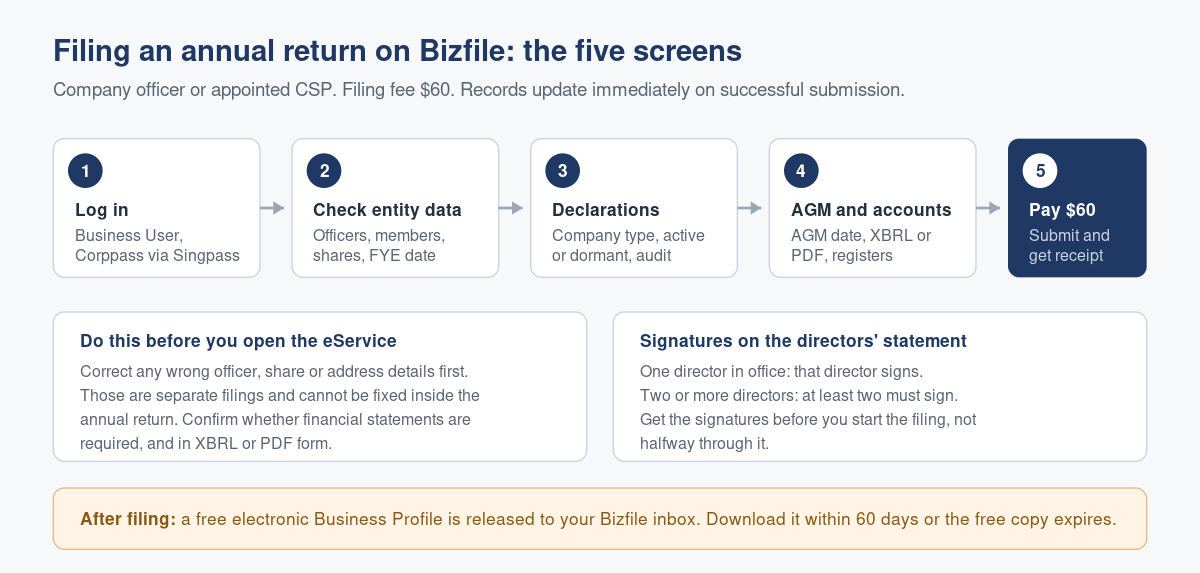
If the company has one director, that director signs. If it has two or more, at least two must sign. Collect those signatures before you begin, because the filing session is not a comfortable place to wait for someone to come back from holiday.
The steps, in order
- Log in to Bizfile and select Business User. You will authenticate with your Singpass ID and password or the Singpass app QR code, and Corppass picks you up from there.
- Confirm you are in the right entity. Check the entity name in the top menu bar. If you hold positions in several companies, switch profile first. Filing the right return against the wrong company is a mess to unwind.
- Open the “File annual returns” eService and click Start on the introduction page.
- Review the entity information screen. If anything is wrong, stop here. Go to the “Update entity information” eService under the Manage tab, correct it, then come back. Do not push on and hope.
- Click “Proceed to file” and confirm the financial year end date shown is the FYE you are reporting on.
- Select the company type and state the company’s status for the financial period, active or dormant. The form then reveals only the sections relevant to that combination.
- Complete the declarations for your company type. For an exempt private company you state solvency, then whether the company qualifies as a small company exempt from audit. For other private and public types the questions differ, but the shape is the same: solvency or listing status, then audit exemption, then a confirmation checkbox.
- Enter the AGM details. You must declare these whether you held an annual general meeting, were exempt from holding one, or dispensed with it. If you held one, give the date. If the company is exempt from holding an AGM, give the date the financial statements were sent to members.
- Attach or select the financial statements, in XBRL or as a PDF, as applicable to your company.
- Complete the register questions, including anything required in relation to nominee directors and nominee shareholders, then click Review and confirm.
- Read the review page properly. This is the last point at which a mistake is cheap.
- Tick the declaration, click Proceed to payment, choose a payment method and pay the $60 fee.
Your records update immediately on successful submission. There is no waiting period and no approval queue for a straightforward return.
What you get afterwards, and what you still owe
A notification lands in your Bizfile inbox with a link to a free electronic Business Profile. Download it. The free copy expires after 60 days, and people forget, then pay for the same document three months later when the bank asks for it.
Filing the annual return does not discharge your tax obligations. Corporate income tax filing with IRAS is a separate exercise on a separate timetable, and a dormant company still files a tax return unless IRAS has granted a waiver. The IRAS due dates page is the authority on that.
If your company has missed more than one financial year, file the overdue returns first, oldest to newest, through the same eService. You cannot skip to the current year.
What goes wrong in practice
The share register does not match. Shares were transferred on a handshake two years ago, nobody filed the transfer, and the return would now declare a shareholding the parties stopped treating as real long ago. Fix the underlying filing first, then file the return.
The secretary’s office is vacant. A company secretary resigned, the replacement was never appointed, and the return exposes it. The vacancy itself is a breach, separate from the return.
Nobody has Corppass. The director who set it up left. This is the single most common reason a small company misses its deadline, and it is entirely avoidable.
The accounts are not ready. The audit is running late or the bookkeeping is behind. This is the one case where the system offers a formal escape hatch, an extension of time, but only if you act before the deadline rather than after it.
If your deadline is close and the accounts are not going to be finished, read our note on applying for an extension of time to file an annual return now rather than later. If the deadline has already gone, the relevant reading is penalties and enforcement for late annual return filing.
Frequently asked questions
How much does it cost to file an annual return in Singapore?
The filing fee is $60, paid at the end of the Bizfile session. If you file after your deadline, a late lodgement penalty is added automatically on top of the $60. Applying for an extension of time is a separate $200 fee and does not replace the filing fee.
Can I file the annual return myself, or do I need a corporate secretary?
You can file it yourself if you are a director or the company secretary and you have Corppass access to the entity. Many companies still use a corporate service provider, mainly because the judgement calls around audit exemption, dormancy and XBRL are where the risk sits, not the data entry.
Do dormant companies have to file an annual return?
Yes. Every company on ACRA’s register with a “live” status files an annual return each year, whether it traded or not, and whether or not IRAS has waived its tax return. Dormancy changes which declarations and accounts you need, not whether you file.
What happens if the information in the form is wrong?
Correct it before you submit. The entity details are pre-filled from ACRA’s register, so an error there is an error in the register itself and has to be fixed through the relevant update, appointment or share filing. If an error slips through after submission, it is put right through a notice of error rather than by refiling.
How long does it take for ACRA to process the annual return?
There is no processing queue for a normal return. Your company’s records are updated immediately once payment succeeds, and the confirmation and free Business Profile link arrive in your Bizfile inbox.
Do I still need to file taxes after filing my annual return?
Yes. ACRA and IRAS are separate agencies with separate deadlines. The annual return keeps the public register accurate. Corporate income tax filing is a distinct obligation, and it still applies to dormant companies unless IRAS has granted a specific waiver.
Making the deadline a non-event
The companies that never have an annual return problem are not more diligent. They just do the boring part earlier: officer and share changes filed within their own 14-day windows, accounts closed a month after year end, and the return filed the week the accounts are signed rather than the week the deadline falls.
That sequencing is what Raffles Corporate Services does for several hundred Singapore companies. We reconcile ACRA’s register against your own records before the return goes anywhere near Bizfile, so the filing itself is a formality rather than a discovery exercise. If you are not sure your register is clean, that is a short conversation and usually a quick fix.
You can reach us through Raffles Corporate Services, or read more on Singapore corporate secretarial practice at Singapore Secretary Services.
— The Editorial Team, Raffles Corporate Services