
Nobody assigns your company a framework. The directors choose one, from the standards the Accounting Standards Committee has issued, and the choice has to hold up. Section 201(2) of the Companies Act 1967 requires financial statements that comply with the Accounting Standards and give a true and fair view.
Raffles Corporate Services works with a panel of experienced Singapore law firms who offer cost-effective and efficient legal service and advice. This article is general information only and is not legal advice.
That is the whole of the legal test, and it is why “our accountant has always done it this way” is not an answer. The framework is a live decision that has to be re-made whenever the company changes shape.
Part 1 of this guide set out what each framework actually is. This part deals with the practical questions: which one applies to you, how you move from one to another without creating a mess, what ACRA looks at when it reviews financial statements, and what happens if it does not like what it finds.
What the law actually requires of directors
The Accounting Standards Committee formulates accounting standards for companies, charities, co-operative societies and societies under the Accounting Standards Act 2007. Those standards, once issued, become the “Accounting Standards” the Companies Act refers to.
The duty then sits squarely on directors. Under section 201 of the Companies Act 1967, the financial statements laid before the company at its annual general meeting must comply with the Accounting Standards and give a true and fair view of the company’s financial position and performance. Section 201(5) applies the same test to a parent company’s consolidated financial statements and its own balance sheet.
The consequence of getting it wrong is personal. Under section 204(1) of the Companies Act 1967, a director who fails to comply with section 201(2) or (5) is guilty of an offence and liable on conviction to a fine not exceeding $250,000. Where the failure is committed with intent to defraud creditors, section 204(3) adds imprisonment of up to three years to the exposure.
There is a narrow defence in section 204(2), but it is narrower than people assume: it covers an omission that was not intentional, where the information left out was immaterial and did not affect the true and fair view. It does not rescue a company that picked the wrong framework.
So which framework applies to your company?
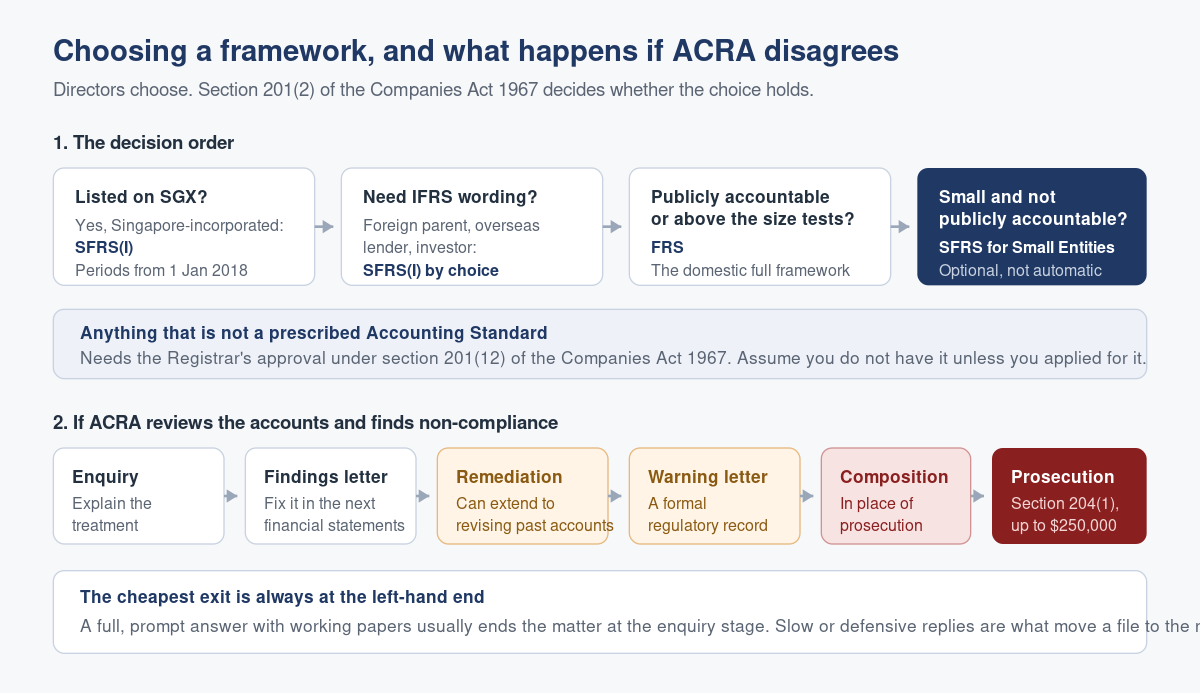
Work through it in this order. The first question that gives you a hard answer ends the enquiry.
| Question | If yes | If no |
|---|---|---|
| Are you a Singapore-incorporated company listed on the Singapore Exchange? | SFRS(I). This has been the requirement for annual reporting periods beginning on or after 1 January 2018. | Continue. |
| Do you need your accounts to state compliance with IFRS Accounting Standards, for a foreign parent, an overseas lender or an investor? | SFRS(I), by choice. Any company may elect it. | Continue. |
| Are you publicly accountable, or do you fail the size criteria for a small entity? | FRS, the domestic full framework. | Continue. |
| Are you a small, non-publicly-accountable entity that publishes general purpose financial statements? | SFRS for Small Entities is available to you. It is optional, not compulsory. | FRS. |
| Do you want to report under something that is not a prescribed Accounting Standard at all? | You need the Registrar’s approval under section 201(12) of the Companies Act 1967. | Stop. You are in the ordinary population. |
The small entity criteria
The SFRS for Small Entities is available to an entity that is not publicly accountable, that publishes general purpose financial statements for external users, and that meets at least two of three size criteria: total annual revenue of not more than $10 million, total gross assets of not more than $10 million, and not more than 50 employees.
“Publicly accountable” is the criterion that catches people. It is not about size. An entity whose debt or equity instruments are traded in a public market, or that holds assets in a fiduciary capacity for a broad group of outsiders as one of its primary businesses, is publicly accountable however small it is. A licensed fund manager, an insurance intermediary or a company with listed debt does not get to use the simplified framework merely because it has eight staff.
Note also that these criteria are not the audit exemption criteria, even though the numbers look similar. Reporting framework and audit are separate questions, and our note on the small company audit exemption test works through that test on its own terms.
The true and fair override, which almost nobody uses correctly
Section 201(13) allows a departure from a requirement of the Accounting Standards where complying with it would not give a true and fair view. It is not a general escape hatch. Section 201(14) requires the accounts to carry a statement from the auditor agreeing the departure was necessary, particulars of the departure, the reason and its effect, and enough further information to give a true and fair view. If your auditor is not already drafting that statement with you, you are not using the override. You are simply non-compliant.
How to change framework without creating a problem
Changing framework is a restatement exercise, not a formatting one. Run it in this order:
- Decide in the right year. Test eligibility before the financial year begins, not after year end. A change decided in March for a December year end means reworking twelve months of treatments retrospectively.
- Confirm eligibility in writing. Document the size figures and the publicly accountable assessment as at the relevant date. This is the file note that answers the question three years later.
- Minute the board decision. The directors approve the financial statements and are responsible for the framework those statements claim compliance with. That deserves a resolution, not an email.
- Identify every policy that changes. Goodwill, development costs, borrowing costs and investment property are the usual four. Quantify the effect before you commit.
- Restate the comparatives and the opening balances. A move onto SFRS(I) runs through the first-time adoption standard, SFRS(I) 1, with its own opening statement of financial position and mandatory reconciliations. A move onto or off the SFRS for Small Entities runs through that standard’s transition section.
- Tell your auditor early. A framework change discovered during fieldwork costs more than one planned in advance, and it can delay the AGM.
- Check the filing consequence. Your XBRL obligation is driven by size and public accountability, not by framework, so confirm which template you will file under. See our guide to filing financial statements in XBRL.
What the Financial Reporting Surveillance Programme actually looks at
ACRA reviews selected financial statements for compliance with the accounting standards under its Financial Reporting Surveillance Programme. The programme is not an audit and it is not a random spot check on bookkeeping. It is a review of the reporting judgments in accounts that have already been filed.
The areas that draw attention are the ones where a judgment can materially change the reported picture:
- Revenue recognition, particularly the timing of recognition and whether the company is acting as principal or agent.
- Impairment, of goodwill, of investments in subsidiaries, and of receivables.
- Fair value measurement, where the inputs are unobservable and the valuation has moved conveniently. Our note on the fair value hierarchy explains what a reviewer is testing.
- Consolidation and control, including entities that were left out of the group.
- Related party disclosure, which is the single most commonly thin disclosure in small company accounts. See key management personnel compensation disclosure.
- Going concern, where the basis of preparation does not match what the balance sheet is saying.
From 26 August 2025, ACRA extended its financial reporting surveillance beyond Singapore companies to other issuers listed on the Singapore Exchange, including business trusts, real estate investment trusts and foreign-incorporated companies. For those entities, a material non-compliance can be referred onward to the Monetary Authority of Singapore, for assessment against the Securities and Futures Act 2001, and to Singapore Exchange Regulation, for assessment against the Listing Rules.
What happens when ACRA finds your accounts defective
It escalates, and it escalates in a predictable order. Knowing the order is useful, because the cheapest exit is always at the top.
| Stage | What it looks like | What you should do |
|---|---|---|
| Enquiry | ACRA writes asking how a particular treatment was arrived at | Answer with the working papers, not with a summary. Involve the auditor who signed. |
| Findings letter | ACRA states where the accounts did not comply | Address the finding in the next set of financial statements, and say in writing how you will |
| Remediation | ACRA asks for corrective action, which can extend to revising past financial statements | Scope the restatement properly. It may touch tax filings and covenant calculations |
| Warning letter | A formal regulatory record against the company or its directors | Take advice. This is the last stage before money and court |
| Composition | ACRA offers a composition sum in place of prosecution | Understand what is being compounded, and what is not |
| Prosecution | Proceedings against directors under the Companies Act 1967 | Section 204(1) exposure is a fine of up to $250,000 per director |
The point of the ladder is that a well-handled enquiry usually ends at the enquiry. A defensive or slow response is what moves a file down it.
What goes wrong in practice
Nobody re-tests eligibility. The company adopted the SFRS for Small Entities in year one, grew past the thresholds in year four, and is still filing small entity accounts in year seven because the template was never revisited. The failure surfaces in due diligence, at the point where it is most expensive.
The framework is stated wrongly. Accounts that claim compliance with Singapore Financial Reporting Standards when they were prepared under the SFRS for Small Entities are wrong on their face, and the auditor who signed them has a problem too.
A restatement is treated as an accounting exercise only. Restating past financial statements can change taxable income, breach a banking covenant, and alter figures relied on in a share transaction. Work those consequences out before you restate.
Directors delegate the decision entirely. Section 201 puts the duty on directors. Outsourcing the preparation does not outsource the responsibility, which is the theme of our note on what the accounts can cost a director personally.
The change is made mid-transaction. Switch framework during a fundraising round and the investor’s diligence lands on half-restated comparatives. Our note on preparing your company for financing sets out what lenders expect instead.
Frequently asked questions
Can we simply choose whichever accounting framework we prefer?
Within limits, yes. Any company may apply a full framework. The SFRS for Small Entities is only available to entities that are not publicly accountable and that meet the size criteria. Reporting under anything that is not a prescribed Accounting Standard requires the Registrar’s approval under section 201(12) of the Companies Act 1967.
Does ACRA review every company’s financial statements?
No. ACRA selects financial statements for review under its surveillance programme rather than reviewing all of them. Selection is risk-based, so accounts with unusual movements, large judgment-driven balances or thin disclosure are likelier to be picked. A company that is never selected still carries the same statutory duty to comply.
What happens if we are told to revise financial statements that have already been filed?
You prepare corrected financial statements and deal with the consequences that flow from them. Those can include an amended tax position, revised covenant calculations and a correction to what has been lodged with ACRA. Scope the work fully before starting, because a partial restatement is worse than none.
Is the small entity framework a lower standard of care?
No. A company applying the SFRS for Small Entities is applying a prescribed Accounting Standard and must still give a true and fair view. The simplification is in measurement options and the volume of disclosure. The directors’ duty under section 201(2) of the Companies Act 1967, and the exposure under section 204, are identical.
How long does a framework change take?
Plan on a full reporting cycle. Eligibility testing and the board decision take days, but restating comparatives, reworking opening balances and getting the auditor comfortable takes months. Companies that decide in the first quarter of the financial year have a straightforward year. Companies that decide after year end do not.
Getting the decision on the record
Most framework problems are governance problems: a decision made once, by someone who has left, and never revisited while the company kept growing.
Raffles Corporate Services prepares financial statements under both the full frameworks and the SFRS for Small Entities, re-tests eligibility annually as part of the year end file, and keeps the board minute recording why the company reports the way it does. If you cannot readily say which framework your last accounts claimed compliance with, and why you were entitled to use it, have that conversation before your next year end rather than during your next transaction.
You can reach us through Raffles Corporate Services, or read more on Singapore corporate secretarial practice at Singapore Secretary Services.
— The Editorial Team, Raffles Corporate Services
Need help with this?
Raffles Corporate Services can handle the ACRA filings, compliance documentation and records for you, and where court proceedings or legal advice are needed, we work with a panel of experienced Singapore law firms who offer cost-effective and efficient legal service and advice.
Email: [email protected]
Call, SMS or WhatsApp: +65 8501 7133