
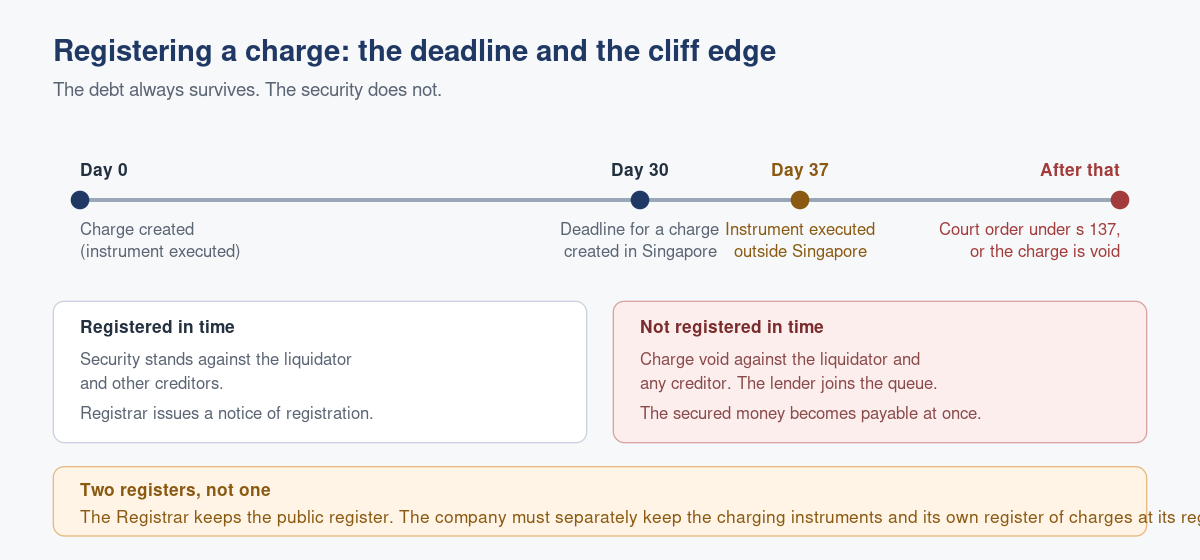
You have 30 days from the creation of a registrable charge to lodge the prescribed particulars with the Registrar. Miss it and the charge is void against the liquidator and against any creditor of the company, so far as it purports to confer security on the company’s property. The debt survives. The security does not.
Raffles Corporate Services works with a panel of experienced Singapore law firms who offer cost-effective and efficient legal service and advice. This article is general information only and is not legal advice.
That is why lenders’ lawyers treat the 30 day window with more anxiety than almost any other corporate deadline in Singapore. A bank can lend ten million dollars against a debenture, have the borrower fail to register it, and find itself in line with the trade creditors.
The obligation sits on the company. The consequence lands on the lender. That is why the lender’s solicitors normally do the filing, and why any person interested in the documents may lodge them.
What is a charge?
A charge is a security interest granted by a borrower, the chargor, over its property in favour of a lender, the chargee. If the borrower defaults, the chargee can look to the charged property ahead of the unsecured creditors. The Companies Act 1967 defines a charge to include a mortgage and any agreement to give or execute a charge or mortgage.
A fixed charge attaches to identified assets from creation: a piece of land, a named machine, a block of shares, a registered trade mark. The company cannot dispose of the asset free of the charge without consent. A floating charge hovers over a shifting class of assets such as inventory, receivables and cash, letting the company trade in the ordinary course, and crystallises on a defined event, typically default or the appointment of a receiver.
A fixed charge gives better priority and less flexibility. A floating charge gives the company room to operate and the lender a weaker position, because certain preferential debts, including employee wages, retrenchment benefits and provident fund contributions, must be paid out of floating charge assets ahead of the chargee’s claim. That distinction, and how it drives priority, is the subject of our companion piece on what a charge is and why registration decides priority.
Which charges must be registered?
Not every security interest is registrable. Section 131 of the Companies Act 1967 sets out a closed list, and the obligation applies to Singapore-registered companies, including re-domiciled and registered foreign companies in respect of their Singapore property. The categories are:
- a charge to secure any issue of debentures
- a charge on the uncalled share capital of a company
- a charge on shares of a subsidiary which are owned by the company
- a charge created or evidenced by an instrument which, if executed by an individual, would require registration as a bill of sale
- a charge on land wherever situated, or any interest in land, but not a charge for rent or another periodical sum issuing out of land
- a charge on the book debts of the company
- a floating charge on the undertaking or property of the company
- a charge on calls made but not paid
- a charge on a ship or aircraft, or any share in a ship or aircraft
- a charge on goodwill, a patent or patent licence, a trade mark or licence to use one, a copyright or copyright licence, or a registered design or licence to use one
Three exclusions are worth knowing: a charge on a negotiable instrument or on Government-issued debentures is not a charge on book debts; aircraft-related charges registrable under the International Interests in Aircraft Equipment Act 2009 are outside the regime to that extent; and so is a shipowner’s lien on sub-freights, sub-hires or bill of lading freight created on or after 1 October 2018. A charge registrable under Division 8 does not also need to be filed under any other written law, except in relation to land.
The deadlines
| Situation | Deadline | Basis |
|---|---|---|
| Charge created by the company in Singapore | 30 days after creation | Section 131(1) |
| Series of debentures | 30 days after execution of the covering instrument, or of the first debenture if there is none | Section 131(5) |
| Each subsequent issue within the series | 30 days after each issue | Section 131(6) |
| Company acquires property already subject to a registrable charge | 30 days after the acquisition is completed | Section 133(1) |
| Foreign company registers in Singapore having already created a registrable charge | 30 days after registration of the company in Singapore | Section 133(1) |
| Instrument, deed or statement executed or made outside Singapore | The relevant period, extended by 7 days, or such further period as the Registrar allows | Section 139 |
The section 139 extension is the origin of the commonly quoted 37 day figure for charges created overseas. It applies by force of the section, and the Registrar may allow further periods on application.
Pre-existing charges of a company that re-domiciles into Singapore must be registered within 30 days after re-domiciliation, wherever the instrument was executed, and no administrative extension is available: the route is a court order under section 363(3).
How to register
Registration is a Bizfile lodgement, and in almost every case the lender’s solicitors do it rather than the company. If you are unfamiliar with the platform, start with what Bizfile actually is and the Corppass business user login route.
- Fix the date of creation. This is the date the clock runs from and the single most common point of error. It is the date the instrument was executed, not the date on the cover email, not the drawdown date.
- Identify the correct transaction. Filing particulars of a charge or debenture is the standard one. Debentures issued in multiple tranches or series have their own filing, as does a statement lodged after acquiring property that is already charged.
- Lodge the prescribed particulars. The date of creation, the amount secured, a description sufficient to identify the property charged, and the name of the person entitled to the charge. For a series of debentures: the total amount secured by the series, the dates of the authorising resolutions and covering instrument, a general description of the property, and the names of any trustee for the debenture holders.
- Have the instrument ready. The Registrar may request the instrument creating or evidencing the charge, or a certified true copy, for inspection at no cost.
- Keep the notice of registration. The Registrar issues a notice of registration to the company, and it is conclusive evidence that the registration requirements have been complied with. A certificate confirming registration can be obtained on application and payment of the prescribed fee, and is likewise conclusive.
- Endorse the debentures. Where debentures in a series, or debenture stock certificates, are issued secured by a registered charge, the company must endorse on each a copy of the notice of registration, or a statement that registration has been effected and its date.
The company’s own register, which everyone forgets
Registration with the Registrar does not discharge the company’s internal obligations. Section 138 requires every company to keep at its registered office the instrument creating each registrable charge, or a copy, for as long as the charge remains in force, and for five years after the debt is satisfied in full or the property released, whichever is later. The company must also keep there a register of charges recording all charges specifically affecting its property and all floating charges over its undertaking or property, with a short description of the property, the amount of the charge and, other than for securities to bearer, the names of the persons entitled.
Both must be open to inspection by any creditor or member without fee. The register of charges must also be open to any other person on payment of a fee the company may fix, capped by the Act at $2 per inspection. Any person may apply for a copy of an instrument or debenture kept under the section, on payment of a fee capped at $1 per page or part page, to be furnished within three days. Failure to comply carries a fine not exceeding $2,000 and a default penalty for the company and every officer in default.
What goes wrong in practice
The 30 days are counted from the wrong date. Execution date, not drawdown date, not completion date. Where the instrument is undated or the dating is contested, assume the earliest defensible date.
Nobody files because everyone assumed someone else would. The statutory duty is on the company and every officer in default, and non-compliance is an offence carrying a fine not exceeding $1,000 and a default penalty. But the real loss falls on the chargee, whose security becomes void against the liquidator and other creditors. If you are the lender, do not rely on the borrower.
The deadline is missed and nobody realises there is a remedy. There is one, and it is judicial. Under section 137, the court may extend the time for registration, or rectify the register, where satisfied the omission or mis-statement was accidental, due to inadvertence or some other sufficient cause, is not of a nature to prejudice creditors or shareholders, or that it is just and equitable to grant relief. An application costs money, but it is far cheaper than unsecured status.
A second charge is taken to paper over the first one’s lateness. Section 131(10) blocks this. A registrable charge created within 30 days of an earlier unregistered charge, over the same property and for the same debt, has no validity to that extent unless the court is satisfied it was given in good faith to correct a material error.
Satisfaction is never filed. When the debt is paid or the property released, the company may lodge a statement of satisfaction, endorsed by the chargee. Companies often do not bother. Two years later a buyer’s due diligence shows a bank still holding a debenture over the business, and the deal stalls while everyone hunts for a discharge letter.
Priority is assumed rather than checked. Registration is not the same as priority. See priority disputes between registered charges in Singapore.
Frequently asked questions
What happens if a charge is not registered within 30 days?
The charge is void against the liquidator and against any creditor of the company, so far as it confers security on the company’s property. The underlying debt is unaffected and in fact becomes immediately payable. The company and every officer in default also commit an offence carrying a fine not exceeding $1,000 and a default penalty.
Can ACRA extend the 30 day deadline?
Not for a charge created in Singapore. That requires a court order under section 137 of the Companies Act 1967, and registration within the period the court allows. Where the instrument was executed or made outside Singapore, the period is extended by seven days by force of section 139, and the Registrar may allow further periods.
Who is responsible for lodging the particulars?
The statutory duty falls on the company, and default is an offence for the company and every officer in default. But any person interested in the documents may lodge them, and in practice the chargee’s solicitors do. Someone other than the company who registers may recover the fees properly paid from the company.
Do we still need to keep our own register of charges?
Yes. Section 138 requires the company to keep the charging instruments and a register of charges at its registered office, open to inspection by creditors and members without fee. This is a standalone obligation with its own penalty of up to $2,000 and a default penalty, and the Registrar’s register does not satisfy it.
What do we file when the loan is repaid?
A statement of satisfaction, in whole or in part, or of release of the charged property, endorsed with a statement by the chargee confirming it. The Registrar enters the particulars in the register. Doing this promptly avoids the discharge scramble that otherwise surfaces during a sale or refinancing.
Keeping the charge register clean
Registering the charge is a single day’s work. Keeping the picture accurate over the following decade is the neglected part: satisfactions unfiled, variations unrecorded, the internal register quietly diverging from what the Registrar holds.
Raffles Corporate Services maintains registers of charges, files particulars, variations and satisfactions inside their statutory windows, and reconciles the company’s register against the Registrar’s before any financing or sale starts. If you are not certain what your company shows as charged, and to whom, that is a short check.
You can reach us through Raffles Corporate Services, or read more at Singapore Secretary Services. The governing provisions are sections 131 to 141 of the Companies Act 1967. If enforcement has already started, read our companion guides on receivership and on what happens when a company cannot repay its debts.
— The Editorial Team, Raffles Corporate Services
Need help with this?
Raffles Corporate Services can handle the ACRA filings, compliance documentation and records for you, and where court proceedings or legal advice are needed, we work with a panel of experienced Singapore law firms who offer cost-effective and efficient legal service and advice.
Email: [email protected]
Call, SMS or WhatsApp: +65 8501 7133