
If your company or LLP has applied to be struck off, the other directors or partners have 14 days from submission to endorse the application in Bizfile. Nobody endorses, the application is rejected, and you start again from the beginning. The endorsement itself is free and takes effect immediately.
Raffles Corporate Services works with a panel of experienced Singapore law firms who offer cost-effective and efficient legal service and advice. This article is general information only and is not legal advice.
It sounds trivial. It is the most common reason a straightforward closure takes four months instead of one, because the endorsement request lands in the Bizfile dashboard of a co-director who has not logged in since incorporation, has no working Corppass, and is not expecting an email.
What the endorsement is for
Striking off on the company’s own application is governed by section 344A of the Companies Act 1967. Subsection (2) is the provision that makes endorsement necessary: an application to strike the company’s name off the register is to be made on the company’s behalf by its directors or by a majority of them.
That is the whole logic. One director can key the application into Bizfile, but one director cannot decide to dissolve a company. The endorsement step is how ACRA collects evidence that the statutory majority supports the application, from the directors themselves rather than from whoever happened to be at the keyboard.
So endorsement is not a formality. A director who endorses is confirming the company should be dissolved, and is expected to have satisfied themselves first that it genuinely meets the striking off criteria.
Who has to endorse
Which position holders are asked depends on the entity type.
| Entity type | Who is asked to endorse |
|---|---|
| Local company | Directors |
| Limited liability partnership | Partners, both individual and corporate |
| Accounting LLP | Partners, including partners under section 18A(3)(c) of the Accountants Act 2004 |
| Public accounting corporation | Directors, including directors under section 17(3)(d) of the Accountants Act 2004 |
Two situations do not generate an endorsement request. The position holder who submitted the application is not asked to endorse their own submission, which makes sense: submitting it is the consent. And where a corporate service provider filed the application on the entity’s behalf, the Bizfile endorsement step is not run.
That second point is a caution, not a relief. Section 344A(2) does not stop applying because a service provider did the keying. Where a provider files and no directors endorse electronically, the provider needs a properly passed directors’ resolution on file authorising the application. That resolution is what an objector, a liquidator or a court will ask to see later, and “our secretary filed it” is not an answer.
How to endorse, step by step
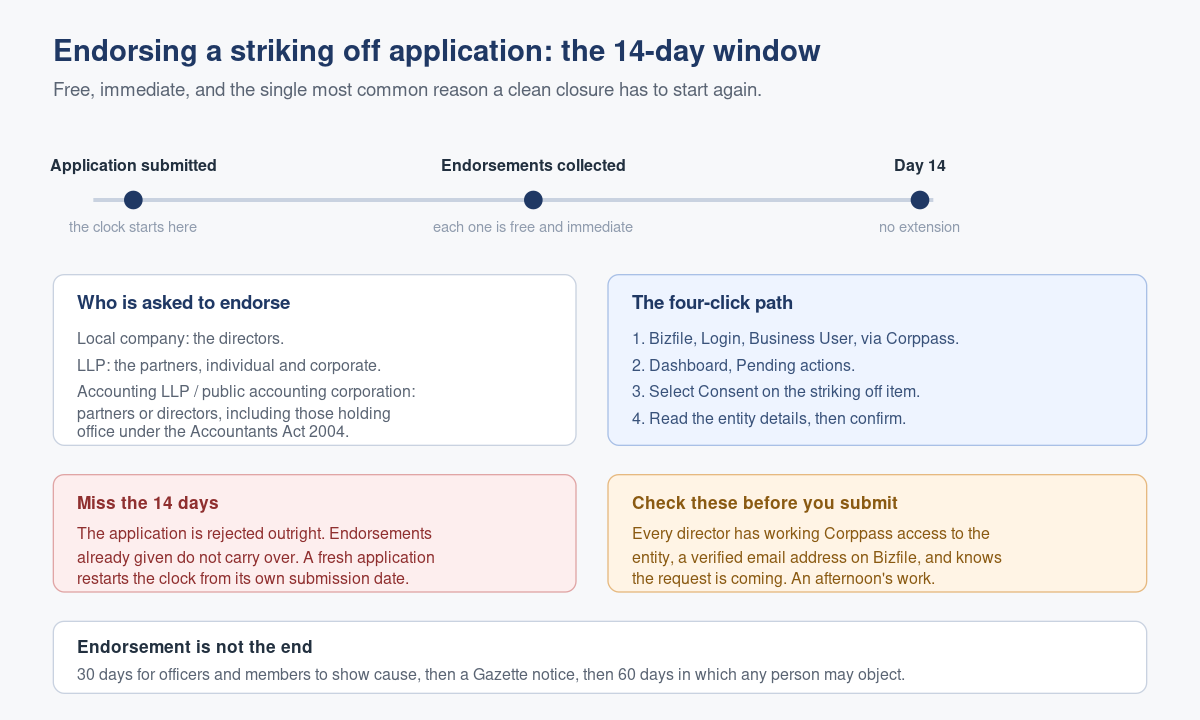
You will need Corppass access to the entity. If the director has never had it, that has to be sorted out first, and it is not a five-minute job. Our guide to setting up Corppass for a Singapore company covers the sequence, and who should have Bizfile access covers the roles to assign.
- Go to Bizfile and select Login, then Business User. You will be routed through Corppass. The route matters: this is not a Singpass individual login. Our note on logging in as a business user explains the difference, and logging in as an individual explains when the other route applies.
- On your dashboard, look under Pending actions. The striking off application will be listed there.
- Select Consent against that application.
- Read the transaction information and the entity details properly before you confirm. This is the last point at which a director can notice that the wrong entity is being dissolved, or that the application was filed on a basis they do not accept.
- Confirm. Bizfile displays a confirmation message. There is no fee and no waiting period.
If a director cannot find the item under Pending actions, the usual cause is that they are looking at the wrong entity profile. A director who holds positions in several companies has to switch profile first. The second most common cause is an unverified email address on the Bizfile account, which quietly blocks transactions.
The 14 days, and what happens when they run out
The clock starts on submission, not on the day the director notices. If the required endorsements are not in within 14 days, the application is rejected. There is no extension, no partial credit for the directors who did endorse, and no way to revive that particular application. A fresh application has to be submitted, and the 14 days start again from the new submission.
What that costs is time, not money, but the time compounds. Every week of delay is another week of the entity remaining live on the register, with the obligations that go with being live: annual returns falling due, a registered office to maintain, and officers who remain officers.
| Outcome | What happens next |
|---|---|
| All required endorsements within 14 days | The application proceeds to ACRA’s review |
| Some endorsements, but not the required set, by day 14 | The application is rejected. Submit a fresh one |
| No endorsements by day 14 | The application is rejected. Submit a fresh one |
| A director declines to endorse | The application cannot proceed on that submission. Resolve the disagreement first |
That last row is the one worth naming. Endorsement is a decision, not a signature. A director who does not believe the company should be dissolved, or who is worried about a liability that has not been dealt with, is entitled to withhold consent and should. The right response to that is a board conversation, not another submission.
What goes wrong in practice
The dormant co-director. The company has two directors. One runs the business, one was added years ago and has not thought about the company since. The endorsement request sits in a dashboard they will never open. Nobody told them it was coming.
No Corppass, discovered on day 12. Corppass access has to be granted by the entity’s Corppass administrator, and if the administrator is the person who left, that is its own recovery exercise. Check every director’s access before you submit, not after.
An unverified email address. Bizfile blocks transactions where the user’s email has not been verified, and the error message does not say so in plain terms. Verifying is quick but involves logging in through Singpass rather than Corppass, which is counterintuitive enough that people give up.
The overseas director on holiday. Fourteen days sounds generous until it covers a stretch of travel. If a director is going to be out of contact, either submit after they return or warn them before you submit.
Endorsing without reading. A director who clicks consent on the wrong entity, or on an application filed on a basis they have not checked, has consented to the dissolution of a company. Directors’ obligations do not pause because the company is closing: see our Companies Act 1967 deep-dive FAQ for the everyday version of that duty.
Uncontactable owners behind the directors. Where the shareholders have gone quiet and a nominee or resident director is left holding the entity, the endorsement question becomes the smallest part of a larger problem. Our note on the trapped nominee director’s exit deals with that scenario directly.
Endorsement is the start, not the end
Getting the endorsements in does not mean the company is closed. Once ACRA is satisfied with the application, it writes to the company and to its directors, secretaries and members, giving 30 days for anyone to show cause why the name should not be struck off. If nobody does, a notice goes into the Gazette and the Registrar cannot strike the name off until 60 days after that notice, during which any person may object on the ground that there is reasonable cause why the company should not be struck off.
Only when that period passes without sufficient cause being shown does the Registrar strike the name off and publish a further notice in the Gazette. On that publication the company is dissolved.
Two things survive dissolution. The liability of every officer and member continues and can still be enforced as if the company had not been dissolved. And under section 344H of the Companies Act 1967, a person who was an officer of the company immediately before dissolution must ensure the company’s books and papers are kept for at least five years afterwards, with a fine of up to $2,000 for failing to do so. That duty is personal. It does not sit with a company that no longer exists.
An application can also be withdrawn by written notice to the Registrar at any time before the name is struck off, which is the right move if something surfaces mid-process. Our companion pieces cover making the striking off application itself, what happens after it is submitted and withdrawing an application.
Frequently asked questions
How long do directors have to endorse a striking off application?
Fourteen days from the date the application is submitted in Bizfile. If the required endorsements are not obtained within that period, the application is rejected and a fresh application has to be submitted. There is no extension and no partial acceptance, so check every director’s Corppass access before you file rather than after.
Does it cost anything to endorse a striking off application?
No. Endorsement is free and takes effect immediately once the position holder confirms it in Bizfile. The cost of getting it wrong is time: a rejected application means starting the whole submission again, with a new 14-day window and the entity remaining live on the register in the meantime.
Who has to endorse for a local company, and who for an LLP?
For a local company, the directors. For a limited liability partnership, the partners, both individual and corporate. For an accounting LLP or a public accounting corporation, the partners or directors respectively, including those holding office under the relevant provisions of the Accountants Act 2004. The position holder who submitted the application is not asked to endorse it separately.
What if one director refuses to endorse?
The application cannot proceed on that submission, and it will be rejected at the end of the 14 days. That is the correct outcome. Section 344A(2) of the Companies Act 1967 requires the application to be made by the directors or a majority of them, so a genuine disagreement about whether the company should be dissolved has to be resolved at board level first.
Can a corporate service provider endorse on the directors’ behalf?
No. Endorsement is a position holder’s act. Where a corporate service provider files the striking off application, the Bizfile endorsement step is not run, but the statutory requirement that the application be made by the directors or a majority of them still applies, so the provider should hold a properly passed directors’ resolution authorising it.
Is the company struck off once everyone has endorsed?
No. Endorsement only completes the application. ACRA then writes to the company, its directors, secretaries and members allowing 30 days to show cause, publishes a Gazette notice, and cannot strike the name off until 60 days after that notice, during which any person may object. The company is dissolved when the Registrar publishes the final notice in the Gazette.
The version of this that never goes wrong
The companies that close cleanly do one thing differently: before anything is submitted, they confirm that every director who will be asked to endorse has working Corppass access, a verified email address, and a diary note telling them the request is coming. That takes an afternoon and removes the entire failure mode.
Raffles Corporate Services runs closures for Singapore companies and LLPs end to end: checking the entity qualifies before anything is filed, preparing the directors’ resolution, submitting, chasing the endorsements inside the 14 days, and monitoring the Gazette notices through to dissolution.
You can reach us through Raffles Corporate Services, or read more on Singapore corporate secretarial practice at Singapore Secretary Services.
— The Editorial Team, Raffles Corporate Services
Need help with this?
Raffles Corporate Services can handle the ACRA filings, compliance documentation and records for you, and where court proceedings or legal advice are needed, we work with a panel of experienced Singapore law firms who offer cost-effective and efficient legal service and advice.
Email: [email protected]
Call, SMS or WhatsApp: +65 8501 7133