

An IRAS “Voluntary Disclosure Opportunity” letter is a warning, not yet an audit. IRAS is telling you it has data linking you or your companies to risks such as late GST registration, income split across related businesses or undeclared sales, and it is inviting you to correct any problem before a stated deadline. A complete and accurate disclosure made within that window can still qualify for IRAS’s reduced penalties. After the deadline, IRAS may audit and raise assessments, and the reduced-penalty route for those issues may be lost. The right response is a proper review of the last five years, followed by either a disclosure or a documented conclusion that nothing is wrong.
This may be your last chance to deal with it before an audit, an investigation or prosecution. If past declarations were deliberately wrong, IRAS treats it as tax evasion, which is a criminal offence. IRAS says a voluntary disclosure that meets all its conditions may be settled by compounding at a reduced penalty instead of prosecution. Once IRAS starts an audit or investigation into the matter, that route closes for it. Ignoring the letter, missing the deadline or making a partial disclosure throws the opportunity away. It has to be handled properly: completely, on time and with professional advice. No adviser can guarantee the outcome, but acting now is the best position you can be in.
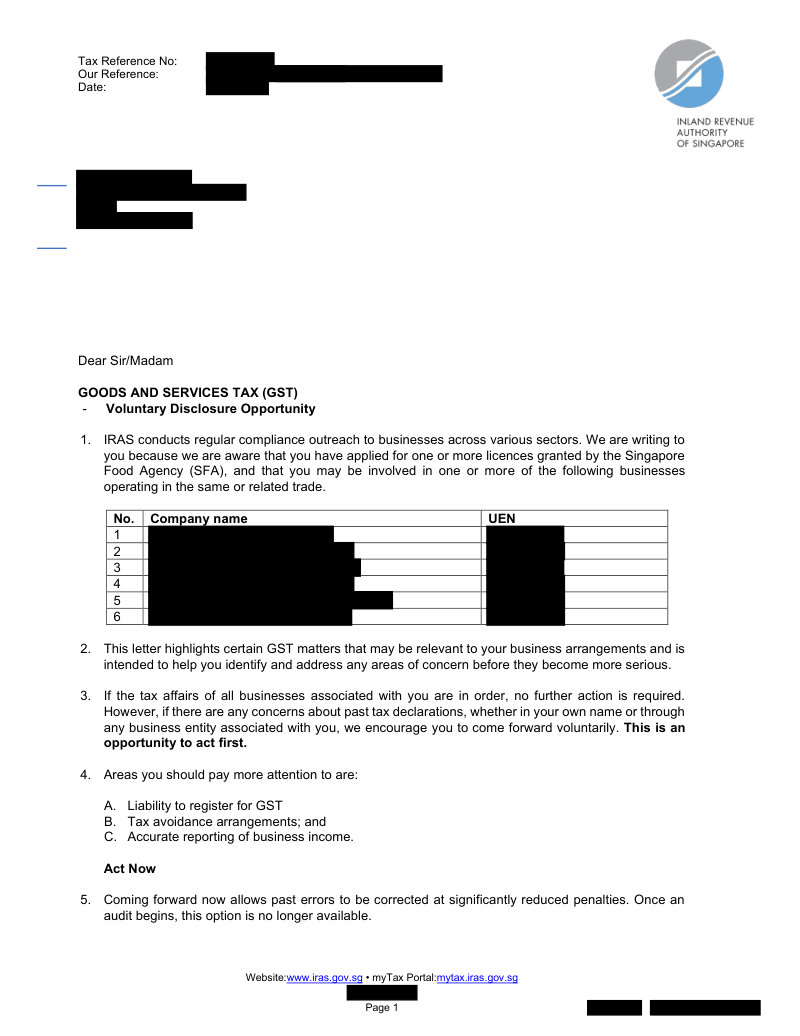
What is an IRAS Voluntary Disclosure Opportunity letter?
IRAS runs targeted compliance outreach. It picks a group of taxpayers that its data suggests carry a higher risk, and writes to them asking them to check their past declarations and come forward if anything is wrong. The recent letters we have reviewed came from the GST Division and were sent to companies and to an individual who had applied for Singapore Food Agency licences. One letter, addressed to an individual, listed several companies said to be associated with that person, all in the same or a related trade.
The letters ask the recipient to pay particular attention to three areas:
- Liability to register for GST, including where several related businesses each stay below the S$1 million threshold
- Tax avoidance arrangements, such as splitting income across related entities or routing it through third parties
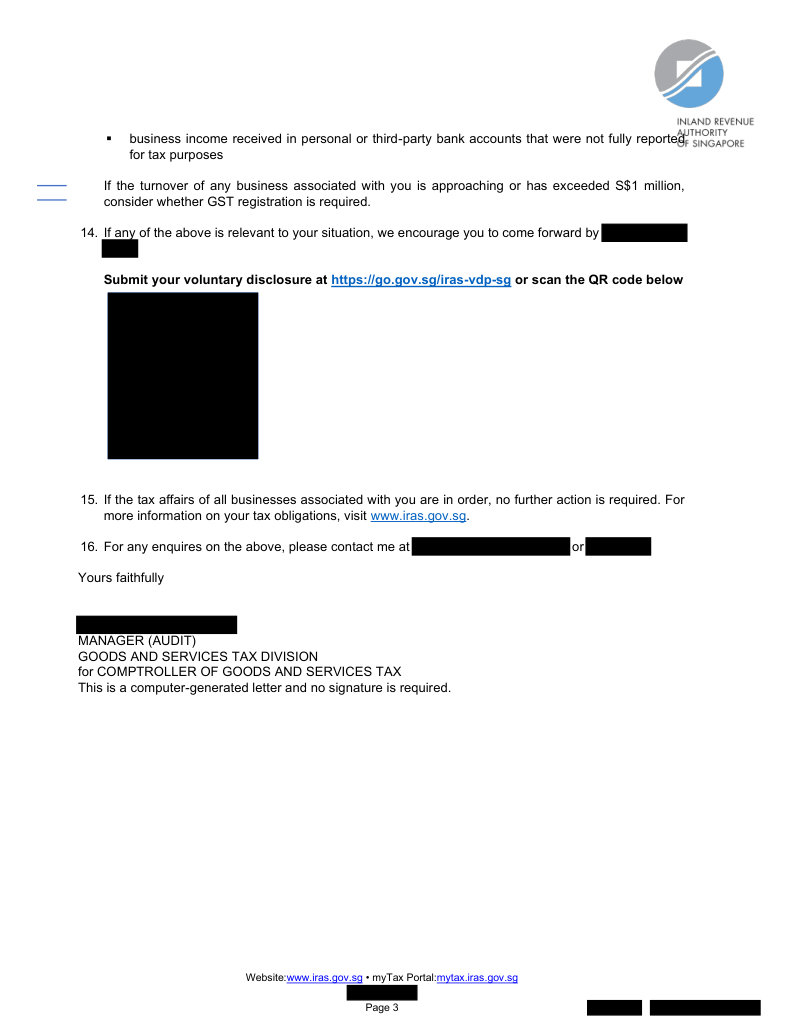
- Accurate reporting of business income, including cash sales and income paid into personal or third-party bank accounts
They also give a deadline (about seven weeks after the letter in the examples we reviewed), point to an online disclosure form at go.gov.sg/iras-vdp-sg, and say that once the opportunity expires IRAS may raise assessments. If your tax affairs are in order, the letter says no further action is required.
Does a disclosure made after this letter still count as voluntary?
Yes, if it is made in time and meets the other conditions. IRAS’s e-Tax Guide on the Voluntary Disclosure Programme (13th edition, 30 January 2026) says that disclosures prompted by IRAS’s periodic programmes, including mass mailers, qualify under the programme if they are made within the programme’s time frame and satisfy the usual conditions.
Those conditions are strict. The disclosure must be accurate and complete, you must cooperate fully with IRAS to correct the errors, and you must pay, or agree and keep to a payment arrangement for, the tax and any penalty. IRAS’s own examples of non-qualifying disclosures include a taxpayer who came forward but did not supply complete documents by the agreed date, and one who disclosed but then ignored IRAS’s follow-up questions. A rushed, partial disclosure can therefore cost you the benefit you were trying to secure.
The window is the important point. Once IRAS sends a query on a matter, or notifies an audit or investigation of it, a later disclosure on that same matter no longer counts as self-initiated.
What penalties are at stake?
| Situation | GST penalty position (IRAS published treatment) |
|---|---|
| Qualifying voluntary disclosure within one year of the return’s filing deadline | No penalty |
| Qualifying voluntary disclosure after that one-year grace period | Flat 5% of the GST undercharged |
| Late GST registrant who comes forward and registers voluntarily | IRAS says it is prepared not to impose a penalty, but the GST due from the date the business should have registered still has to be accounted for |
| Errors found by IRAS, or a disclosure that does not qualify | Penalty of up to 200% of the tax undercharged |
| Wilful evasion | Prosecution, with a penalty of up to 400% of the tax undercharged, a fine of up to S$50,000 and/or up to 7 years’ imprisonment |
| Wilful evasion that is voluntarily disclosed and qualifies | IRAS may compound the offence at a reduced 200% penalty instead of prosecuting |
Income tax follows a similar structure, except that the post-grace-period penalty is 5% for each year the error was late in being corrected. The figures are taken from IRAS’s GST voluntary disclosure page and the e-Tax Guide. The letters also cite real cases: a business partner jailed and fined for failing to register for GST and evading income tax, and a tax agent fined for helping a client stay below the GST registration threshold.
Why IRAS treats related businesses as one
A business must register for GST if its taxable turnover exceeded S$1 million at the end of a calendar year, or is expected to exceed S$1 million in the next 12 months. Where one trade is run through several companies or sole proprietorships that share owners, staff, premises, suppliers or customers, each entity may report less than S$1 million while the combined trade is well above it.
IRAS states on its GST registration page that where the purpose or effect of splitting a business into multiple entities is to avoid GST registration, it may disregard the arrangement and register the entire business from the date it became liable. That means GST on several years of past sales, usually without the ability to recover it from customers who were never charged GST.
Not every group of related companies is an avoidance arrangement. Separate businesses with genuine commercial reasons, their own customers, staff, premises and records can be legitimate. The review needs to show which description fits your facts, with evidence.
Is the letter genuine?
Treat any unexpected tax letter with care. IRAS says confidential notices are available in myTax Portal, that its emails come only from addresses ending in @iras.gov.sg, and that its links use iras.gov.sg or go.gov.sg. It does not use WhatsApp for tax matters. Log in to myTax Portal yourself, or call the IRAS hotline on 1800 356 8300, rather than using contact details from a message you are unsure about. Never pay tax into a third party’s bank account.
How Raffles Corporate Services handles these letters
We help businesses respond to IRAS compliance letters, from the first read of the letter to the final payment arrangement. A typical engagement runs as follows.
- Read the letter and map the exposure. We identify every entity and individual named or implied, the tax types involved, the periods to review and the deadline. If the letter names associated companies, we review them together, because IRAS will.
- Collect the records. Bank statements for business and relevant personal accounts, sales records and point-of-sale data, invoices, supplier statements, GST returns, financial statements and tax computations for the last five years.
- Carry out a GST and income review. We reconcile bank deposits to declared sales, identify cash takings and income received in other accounts, test the S$1 million registration threshold for each entity and for the combined trade, review input tax claims and look at how the related entities actually operate.
- Quantify and advise on the options. We calculate the GST and income tax that may be under-declared for each period, the penalty position if it is disclosed now, and what the evidence says about whether the issue is an error, negligence or something more serious.
- Prepare the disclosure. Depending on the facts, this may be the online voluntary disclosure form named in the letter, GST F7 returns for registered businesses, a late GST registration, or a corrected corporate tax position. We set out how the errors arose and the controls being put in place, which IRAS requires as part of a complete disclosure.
- Correspond with IRAS. We handle IRAS’s follow-up questions and document requests, ask for more time where it is genuinely needed before the deadline passes, and help agree an instalment arrangement if the tax cannot be paid at once.
- Fix the system going forward. GST registration and filing, proper bookkeeping, sales recording and separation of business and personal bank accounts, so the same issue does not recur.
If the review finds nothing to disclose, we record the work done and the conclusion. That file is useful if IRAS asks questions later.
See our GST registration and filing services for ongoing support once the past position has been corrected.
When you need a lawyer as well
If the facts point to deliberate under-declaration, the stakes change. IRAS has a separate route for voluntary disclosures involving wilful evasion (by email to [email protected]), and such a disclosure may lead to compounding instead of prosecution. Before making that kind of disclosure, the individuals involved should take legal advice on their own position.
Legal advice is also needed if IRAS’s Investigation and Forensics Division visits your premises, asks you or your staff to attend an interview, seizes records, or if a summons or charge follows. Raffles Corporate Services is not a law firm. In those matters we refer you to a firm on our panel of Singapore law firms that handles tax investigations and prosecutions, and we continue to support the accounting and tax reconstruction that the lawyers need.
An example
Example only, not a client case. A family runs a catering supply business through four companies registered at the same address. Each company reports turnover of S$600,000 to S$900,000 and none is GST-registered. They share a central kitchen, delivery vans and two key customers. One family member receives a Voluntary Disclosure Opportunity letter listing all four companies.
A review would first establish whether the four companies are in substance one business. If they are, the combined turnover passed S$1 million several years ago, and the family should consider disclosing and registering before the deadline. GST would then be calculated from the date the combined business should have registered. If the review shows that the companies genuinely operate separately, with their own customers, staff and records, the evidence supporting that conclusion should be documented and kept ready in case IRAS asks.
What not to do
- Do not ignore the letter on the assumption that it is routine. The deadline is the point at which the reduced-penalty route for these issues may close.
- Do not disclose a rough number in a hurry and leave the rest for later. An incomplete disclosure may not qualify.
- Do not create, backdate or alter records, move turnover between entities now, or close companies to make the problem disappear. Each of these can turn a tax matter into a criminal one.
- Do not let different family members or companies respond separately with inconsistent figures.
Guides to the issues these letters raise
- When IRAS treats related businesses as one for GST registration
- Late GST registration: what you owe and how to come forward
- Business income paid into a personal bank account
- Voluntary disclosure of tax evasion and compounding
- What happens in an IRAS tax investigation
- How to check an IRAS letter is genuine
- Objecting to an IRAS estimated assessment
- When IRAS appoints your bank as its agent
- Why voluntary disclosures to IRAS fail
Other IRAS letters that need the same urgency
The same approach applies to an IRAS query or review letter on a particular return, to a notice that IRAS is auditing your company, and to court summonses for unfiled returns. For errors you find yourself before IRAS writes, see our guides to correcting past GST errors and the IRAS Voluntary Disclosure Programme.
Frequently asked questions
Do I have to reply if my tax affairs are in order?
The letter says no further action is required in that case. We still recommend a documented review before the deadline, so the conclusion rests on evidence rather than assumption.
Will coming forward trigger an audit?
IRAS may check a disclosure and ask follow-up questions. The difference is the penalty treatment: a complete and timely disclosure qualifies for reduced penalties, while the same errors found by IRAS later may attract a penalty of up to 200% of the tax, or more if they are wilful.
Can the directors or owners be personally affected?
The letters state that where IRAS audits a business it may estimate tax owed by the business or by the individual, using bank records, third-party data and industry benchmarks, and that tax assessed must be paid even while an objection or appeal is pending. Income received in a personal account can be taxed in the individual’s hands, and individuals who take part in wilful evasion can be prosecuted.
What if we cannot finish the review before the deadline?
Contact IRAS before the deadline, explain the reason and ask for more time. Under the e-Tax Guide, additional time for supplying disclosure information should not exceed three months from the disclosure, and everything must then be submitted by the agreed date.
Can we pay by instalments?
IRAS’s programme allows payment arrangements to be agreed, but they must be honoured until fully paid. A disclosure loses its reduced-penalty treatment if the agreed payments are not made.
For more guides on tax compliance and disputes, see our corporate tax and GST hub.
Received an IRAS Voluntary Disclosure Opportunity letter?
If your company, or you as a director or shareholder, has received an IRAS letter asking you to review your GST registration, related businesses or declared income, contact the Raffles Corporate Services team at [email protected] or on WhatsApp at +65 8501 7133 or +65 9018 0072. Send us the letter and tell us the deadline. We will review the records, quantify the position and prepare and handle the correspondence with IRAS. Where your matter needs a lawyer, we will refer you to a firm on our panel of Singapore law firms that regularly handles tax investigations and prosecutions. Raffles Corporate Services is a corporate services provider, not a law firm, and this article is general information, not legal or tax advice for your specific situation.
Kevin Yeo, Raffles Corporate Services