
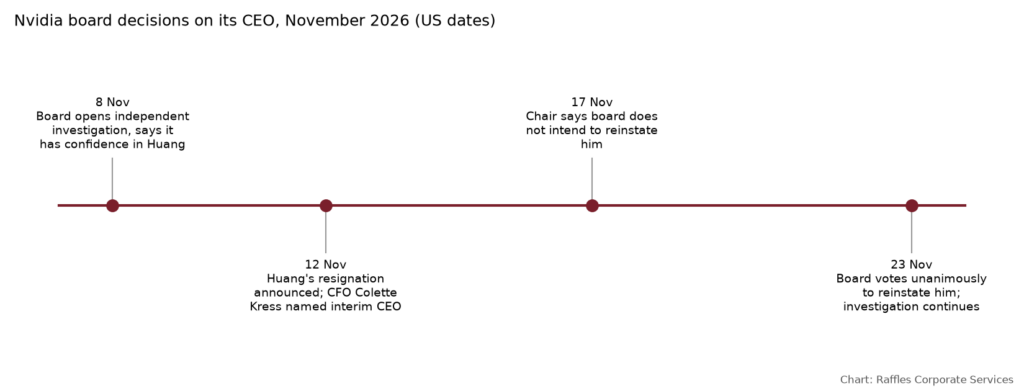
In the space of 11 days, the board of the world’s most closely watched chipmaker accepted its founder’s resignation, told the market it did not intend to bring him back, and then voted unanimously to reinstate him. Whatever one thinks of Jensen Huang as a leader, the way the Nvidia board reached those decisions is a corporate governance case study every director should read.
Raffles Corporate Services works with a panel of experienced Singapore law firms who offer cost-effective and efficient legal service and advice. This article is general information only and is not legal advice.
This piece is about the board’s process, not Mr Huang’s private life. The personal allegations remain allegations, and the board’s investigation has not concluded. China has denied the espionage claims, according to Reuters.
What happened
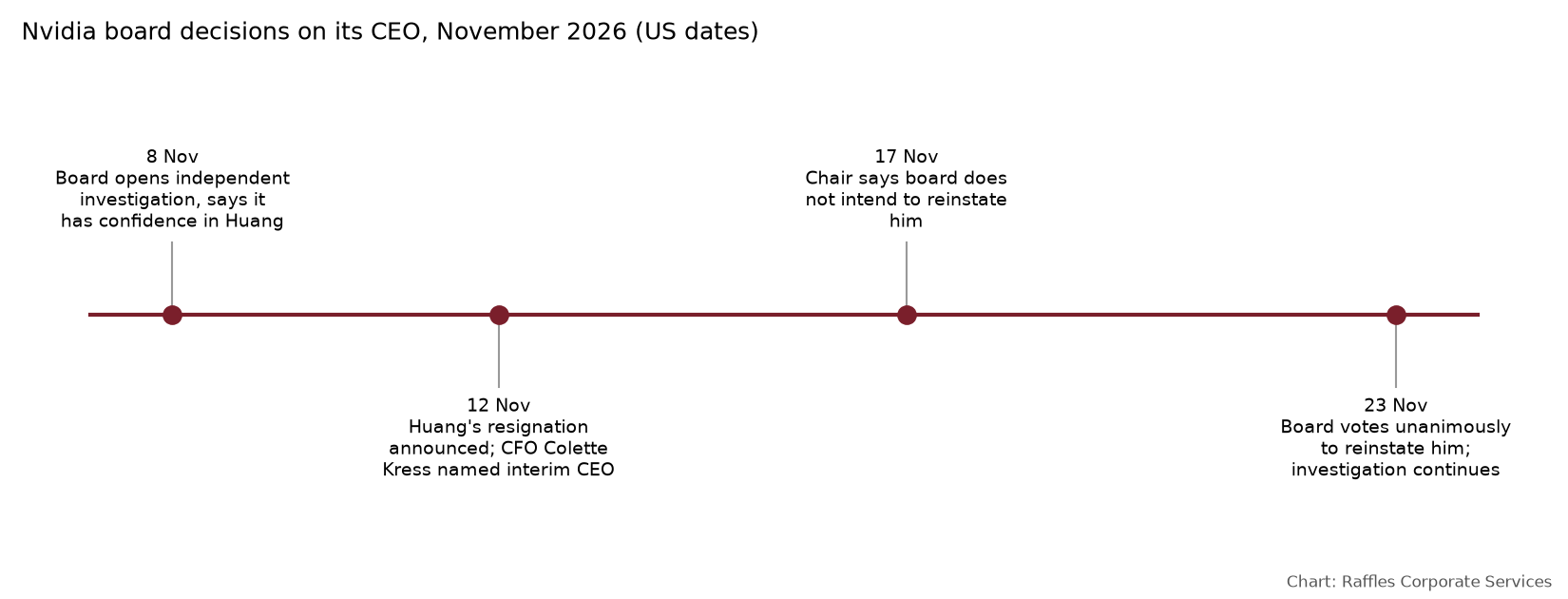
On 8 November 2026, Nvidia’s board said it was opening an independent investigation after reports that Mr Huang had been the target of a foreign intelligence effort. The same statement said the board had confidence in him.
Four days later, on 12 November, Nvidia announced that Mr Huang had resigned as president, chief executive and director. This followed reports of extramarital affairs, including, according to CNBC, one with a former executive of a Singapore-based company who is suspected of spying for China. The day before, a source told Reuters that the board had met to decide whether to remove him. Chief financial officer Colette Kress became interim CEO, and long-serving director Harvey Jones became Nvidia’s first board chair.
On 17 November, Mr Huang said publicly that he would return if the board wanted him. The same day, Mr Jones told analysts on the earnings call that Mr Huang had resigned after “disclosure of personal behavior inconsistent with the company’s code of conduct”, and that the board had unanimously accepted the resignation and “does not intend to reinstate Jensen as CEO”.
On 23 November, the board reversed course. Its statement said it had voted unanimously to reinstate Mr Huang after meetings that left it “satisfied with respect to Mr. Huang’s candor and ability to lead”, and that it had received “input from senior levels of the United States government”. CNBC, citing people familiar with the board’s thinking, reported that assurances from President Donald Trump sealed the decision, alongside a share price fall of more than 25% over the previous week and doubts among some investors and staff about the interim leadership. The investigation, the board said, will “proceed to conclusion”.
Nvidia board corporate governance: where it fell short
It decided before it knew. The board set up an independent investigation for a reason. Reinstating the CEO while that work is unfinished puts the conclusion ahead of the evidence. As one analyst told CNBC, an adverse finding would “reopen the leadership question”.
It let the pressure in the room show. A board can and should listen to regulators, and national security questions are a legitimate concern for any chip company. But the board’s own statement makes government input part of its reasoning, and Mr Trump told CNBC: “I made the deal.” Reuters reported that governance experts said the about-face “raises questions about its independence”. Independence is not only about who sits on the board. It is about whether the board is seen to reach its own judgment.
It invoked its code of conduct, then went quiet on it. On 17 November the chair tied the resignation to conduct inconsistent with the company’s code. Six days later, the reinstatement statement did not address that point at all. The code may not have changed, but the market can be forgiven for wondering whether it applies equally to everyone. One investment chief told Reuters that certain executives “are going to be held to different standards if you are perceived to be a one of one”.
Its succession planning looked thin. Reuters reported that Mr Huang had no obvious successor and dozens of direct reports. When he left, the share price fell sharply and, CNBC reported, some investors and staff quickly questioned the interim leadership. A company of this size should not be so dependent on one person that his absence for a week reads as an existential threat. That is a key-person risk the board owned long before November.
Its public messages contradicted each other. In 15 days the market heard confidence in the CEO, his resignation, a firm statement that he would not return, and then his return. Each may have been accurate when made. Together, they make it harder for shareholders to rely on what the board says next.
The case for the board
It would be unfair to stop there.
First, the board listened. A petition for Mr Huang’s return drew more than 180,000 signatures, according to Reuters, and staff cheered his return to headquarters. Changing course in response to shareholders and staff is better than defending a decision out of pride.
Second, the vote was unanimous, and the board says it met Mr Huang several times and satisfied itself on his candour before deciding.
Third, the independent investigation continues under independent directors and outside counsel. The board has also set up a National Security and Export Control Committee of independent directors and has begun a search for a new Chief Compliance Officer who will report to its Nominating and Corporate Governance Committee.
Fourth, continuity has value. Reuters reported that the shares closed 31.5% higher on the day of the announcement, and that some customers in China had cancelled or hesitated to place orders after Mr Huang left. Ms Kress also kept the company running through a results announcement in its most difficult week. Stability is a legitimate board objective.
The fair verdict, then, is that the outcome may prove right while the process was not. Good governance is judged on both.
How Singapore’s rules frame the same questions
Nvidia is a US company listed on Nasdaq, so Singapore’s Companies Act and Code of Corporate Governance do not govern it. The episode still maps neatly onto Singapore standards.
Section 157(1) of the Companies Act 1967 requires a director to “at all times act honestly and use reasonable diligence in the discharge of the duties of his or her office”. Reasonable diligence is where Nvidia’s sequence is weakest. A diligent board usually waits for the facts it has commissioned before an irreversible decision.
The Code of Corporate Governance 2018 is more specific. Principle 1 says the board is collectively responsible for the long-term success of the company. Provision 1.1 describes directors as “fiduciaries who act objectively in the best interests of the company” and expects the board to put in place a code of conduct and ethics and set an appropriate “tone-from-the-top”. Applying the code firmly one week and silently the next does not set that tone.
Principle 2 calls for “an appropriate level of independence and diversity of thought” so the board can decide in the company’s best interests. Principle 3 states that “no one individual has unfettered powers of decision-making”. Principle 4 requires a “formal and transparent process” for appointing and reappointing directors, and Provision 4.1(a) asks the Nominating Committee to make recommendations to the board on the review of succession plans, “in particular the appointment and/or replacement of the Chairman, the CEO and key management personnel”. Principle 9 makes the board responsible for the governance of risk, which plainly includes key-person risk.
The Code applies to listed companies in Singapore on a comply-or-explain basis. It is also under review: on 27 October 2026, the Corporate Governance Advisory Committee and SGX RegCo opened a public consultation on proposed changes to the Code and the Listing Rules.
Lessons for Singapore SMEs and private companies
Most of our clients are not listed. The lessons apply more sharply, because a private company is usually even more dependent on its founder.
- Write a succession plan before you need one. Name who steps in for 30 days, who steps in for a year, and who decides.
- Agree how the board will handle an allegation against the CEO. Decide who investigates and when the board will rule, before any crisis.
- Finish the investigation before the irreversible step. If you must act quickly, use interim measures such as leave, and keep the final decision for when the facts are in.
- Minute the reasons, not just the result. Under s157, a board that can show what it considered and why is in a far stronger position than one that can only show a vote.
- Treat outside pressure as information, not instruction. Shareholders and regulators deserve a hearing, but the decision belongs to the directors.
A takeaway for boards and company secretaries
Nvidia’s board may yet be proved right to bring Jensen Huang back. But it got there by reversing itself under public and political pressure, before its own investigation had finished. For Singapore boards, the lesson is that process is a form of protection. For company secretaries, it is a reminder that the quiet work of minutes, board papers, succession plans and clear escalation procedures is what holds a board steady when the pressure comes.
If your board would like help putting a succession plan, a conduct escalation process or better board minutes in place, speak to Raffles Corporate Services.
Frequently asked questions
Why did Nvidia’s board reinstate Jensen Huang?
Nvidia’s board said on 23 November 2026 that it voted unanimously to reinstate Jensen Huang after meetings that left it satisfied with his candour and ability to lead, and after input from senior levels of the US government. CNBC reported that a sharp share price fall and doubts about the interim leadership also played a part.
What was wrong with the board’s process?
The board reversed its stated position within a week, reinstated the CEO before its own independent investigation had finished, and cited outside government input in its reasoning. Reuters also reported that Mr Huang had no obvious successor, which left the company exposed when he left.
Were there positives in how Nvidia’s board acted?
Yes. The board listened to shareholders and staff, voted unanimously, kept the investigation running under independent directors and outside counsel, set up new oversight structures, and restored continuity after a period of market instability.
What do Singapore rules say about director duties and succession?
Section 157(1) of the Companies Act 1967 requires directors to act honestly and use reasonable diligence. The Code of Corporate Governance 2018 asks listed company boards to act objectively in the company’s best interests, maintain an appropriate level of independence, and have the Nominating Committee make recommendations on succession plans for the CEO and key management personnel.
What should a Singapore SME board take from this?
Put a written succession plan in place, agree in advance how the board will handle an allegation against the CEO, finish any investigation before an irreversible decision, and minute the reasons for each decision.
This article is general information and commentary, not legal advice. Facts are as reported up to 25 November 2026 and may change as investigations continue. For advice on your company’s position, please consult a qualified professional.
Need help with this?
Raffles Corporate Services can handle the ACRA filings, compliance documentation and records for you, and where court proceedings or legal advice are needed, we work with a panel of experienced Singapore law firms who offer cost-effective and efficient legal service and advice.
Email: [email protected]
Call, SMS or WhatsApp: +65 8501 7133