
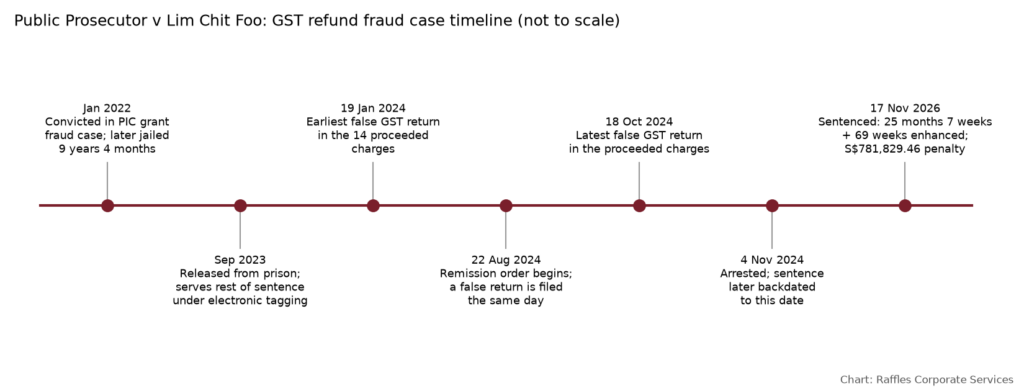
The short answer: On 17 November 2026, Lim Chit Foo, 43, was sentenced to 25 months and seven weeks’ jail, a further 69 weeks for reoffending while under a remission order, and a mandatory penalty of S$781,829.46. He had used nine companies, paid nominee directors and the Singpass logins they handed over to claim about S$588,000 in GST refunds that the companies were not entitled to. For anyone who sits on a board, the lesson is plain. A directorship is not a favour you rent out, and your Singpass is not a password you share.
Raffles Corporate Services works with a panel of experienced Singapore law firms who offer cost-effective and efficient legal service and advice. This article is general information only and is not legal advice.
The case was brought under tax and anti-money laundering law, not the Companies Act. But nominee directorships made this GST refund fraud possible, which is why it matters to every company owner.
What happened in the Lim Chit Foo GST refund fraud case?
After investigations by the Inland Revenue Authority of Singapore (IRAS) and the Commercial Affairs Department, Mr Lim pleaded guilty to 15 charges, the District Court’s published judgment shows. Fourteen were under section 62(1)(b) of the Goods and Services Tax Act 1993 for wilfully making false entries in the GST returns of various companies to help them evade tax. The fifteenth was a money laundering charge. Another 29 GST charges were taken into consideration for sentencing.
The proceeded charges involved S$260,609.82 in GST. The charges taken into consideration involved a further S$327,537.32.
Companies were registered for GST using false invoices and documents suggesting their taxable supplies would exceed S$1 million in the next 12 months. Their GST returns then declared more input tax than output tax, so that each company could claim a refund of the difference. The refunds were paid into company bank accounts that Mr Lim controlled.
To run the companies, Mr Lim used third parties to recruit people whom he paid to serve as nominee directors and to give up their Singpass credentials, the judgment records. Lianhe Zaobao reported that three recruiters found 10 nominee directors for the nine companies, that their particulars were used to open the corporate bank accounts, and that SIM cards registered to intermediaries were placed in multi-SIM adaptors so that he could receive the one-time passwords needed to log in.
The money laundering charge related to one refund of S$16,260.75 paid in July 2024. According to the judgment, S$16,260 was moved to a third-party bank account that his cousin had arranged, and S$9,000 was withdrawn on Mr Lim’s instructions. He has since repaid that S$9,000.
Mr Lim was not a first-time offender. In 2022 he was sentenced to nine years and four months’ jail over a scheme involving more than S$11.8 million in Productivity and Innovation Credit claims, which The Straits Times reported used more than 200 shell companies. The judgment notes that one of the false returns was filed on 22 August 2024, the very day his remission order took effect.
His sentence is backdated to 4 November 2024, the date of his arrest. IRAS says he also faces two charges under the Employment of Foreign Manpower Act. Those proceedings are ongoing, and the charges remain allegations.
Why was he charged, and what does the law say?
Section 62(1)(b) of the GST Act makes it an offence to wilfully make a false entry in a GST return with intent to evade tax, or to help someone else do so. Section 62(5) extends this to obtaining a refund. The court noted that the offence carries a fine of up to S$10,000, jail of up to seven years, or both, plus a mandatory penalty of three times the tax undercharged. That is where the S$781,829.46 comes from.
The money laundering charge was under section 51(1)(a) of the Corruption, Drug Trafficking and Other Serious Crimes (Confiscation of Benefits) Act 1992, which carries a fine of up to S$500,000, jail of up to 10 years, or both.
Where do nominee directors stand under Singapore law?
Nominee directors are not illegal. Section 145 of the Companies Act 1967 requires every company to have at least one director who is ordinarily resident in Singapore, and many foreign-owned companies meet that rule through a professional nominee. What the law no longer tolerates is the casual, cash-for-a-name arrangement.
Nominees by way of business must go through a registered provider. Since 9 June 2025, section 145A of the Companies Act says a person must not act as a nominee director by way of business unless the appointment is arranged by a corporate service provider registered with ACRA. The fine is up to S$10,000. Under section 16 of the Corporate Service Providers Act 2024, the provider must first be satisfied that the person is fit and proper, or face a fine of up to S$100,000.
Nominee status is now on the record. Since 16 June 2025, companies must file the information in their register of nominee directors with ACRA. ACRA says the nominee status of a director is publicly visible on the company’s business profile, while the nominator’s particulars are available only to public agencies. Maximum fines for register offences rose from S$5,000 to S$25,000.
Lending your Singpass is a crime in its own right. Section 8A of the Computer Misuse Act 1993, in force since 8 February 2024, makes it an offence to disclose your Singpass password or access code knowing, or having reasonable grounds to believe, that it will be used to commit an offence. The penalty is a fine of up to S$10,000, jail of up to three years, or both. If you hand it over for any gain, the law presumes you had reasonable grounds to believe it. Since 30 December 2025, where the credentials were meant for or used in a scam, the court can also order up to 12 strokes of the cane.
Above all of this sits section 157(1) of the Companies Act, which requires every director to act honestly and use reasonable diligence. Nothing in it exempts a nominee. Since 6 May 2026, a breach of section 157 carries a fine of up to S$20,000, up from S$5,000, jail of up to 12 months, or both. ACRA says the same changes mean a conviction for a money laundering offence under the Confiscation of Benefits Act now disqualifies a person from acting as a director. We looked at how the courts sentence nominee directors in an earlier piece on Public Prosecutor v Zheng Jia.
The published judgment and IRAS’s release do not say whether any action has been taken against the individuals who lent their names, and this article makes no suggestion about any of them.
What should the companies and directors have done?
A genuine nominee arrangement looks very different from the one in this case. The nominee is appointed through a registered corporate service provider after a fit and proper check. The arrangement is disclosed to ACRA. The nominee can see the books and the bank statements, and is told about filings before they are made.
No director should ever give away a Singpass login. Companies that need staff or advisers to file with IRAS or ACRA can authorise them through Corppass, where each person logs in with their own Singpass and is given only the access they need. Our guide to the offences of lending a company bank account or Singpass explains how Corppass works.
GST registration should rest on real forecasts backed by real contracts. A director whose company suddenly claims refund after refund on modest trade should ask why before the return goes in, not after IRAS does.
Were there any positives?
Yes. IRAS and the Commercial Affairs Department investigated together, and Mr Lim was arrested on 4 November 2024, less than three weeks after the last false return in the proceeded charges. IRAS says it runs risk-based audits supported by data analytics to spot unusual refund claims. The Straits Times noted that the court documents did not say how the offences came to light.
The court’s approach was also measured. The judge gave Mr Lim credit for indicating an early guilty plea, for S$40,000 in voluntary restitution and for co-operating with the authorities, and assessed the harm on each GST charge as at the lower end of slight. IRAS takes a similar line outside the courtroom: it treats the voluntary disclosure of past tax mistakes as a mitigating factor.
What directors should do
- Never accept payment simply to be named as a director of a company you do not oversee.
- If you need a resident nominee, use an ACRA-registered corporate service provider and make sure the arrangement is disclosed to ACRA.
- Never share your Singpass password, OTP or device. Use Corppass to authorise anyone filing for the company.
- Keep sight of the company’s bank accounts and know who the signatories are.
- Review every GST and tax return before it is filed, and question any unusual refund.
- Keep your registers of controllers and nominee directors up to date and filed.
- If you find a past error, make a voluntary disclosure to IRAS early.
Frequently asked questions
What was Lim Chit Foo sentenced to?
On 17 November 2026, the District Court sentenced him to 25 months and seven weeks’ jail, an enhanced sentence of 69 weeks under the Prisons Act for reoffending while under a remission order, and a mandatory penalty of S$781,829.46. The sentence is backdated to 4 November 2024.
How did the GST refund scheme work?
Companies were registered for GST on false documents, then filed returns declaring more input tax than output tax to claim refunds into bank accounts he controlled. Paid nominee directors gave up their Singpass credentials so the returns could be filed.
Is it legal to have a nominee director in Singapore?
Yes. Since 9 June 2025, a person who acts as a nominee director by way of business must have the appointment arranged by an ACRA-registered corporate service provider, which must first be satisfied that the person is fit and proper. Nominee status must also be filed with ACRA, and it appears on the company’s business profile.
Can I get into trouble for lending my Singpass?
Yes. Under section 8A of the Computer Misuse Act 1993, disclosing your Singpass credentials knowing or having reasonable grounds to believe they will be used for an offence is punishable by a fine of up to S$10,000, jail of up to three years, or both. Doing it for payment raises a legal presumption against you.
Does a nominee director have the same duties as other directors?
Yes. Section 157(1) of the Companies Act 1967 requires every director to act honestly and use reasonable diligence, and it makes no exception for nominees. Since 6 May 2026, a breach is punishable by a fine of up to S$20,000, jail of up to 12 months, or both.
This article is general information on Singapore law and the published court record as at 26 November 2026. It is not legal advice. For advice on your own company’s position, please speak to a qualified professional.
If you need a resident nominee director arranged properly, or help keeping your registers, filings and GST obligations in order, speak to Raffles Corporate Services.
Need help with this?
Raffles Corporate Services can handle the ACRA filings, compliance documentation and records for you, and where court proceedings or legal advice are needed, we work with a panel of experienced Singapore law firms who offer cost-effective and efficient legal service and advice.
Email: [email protected]
Call, SMS or WhatsApp: +65 8501 7133