
Quick answer
Raffles Corporate Services works with a panel of experienced Singapore law firms who offer cost-effective and efficient legal service and advice. This article is general information only and is not legal advice.
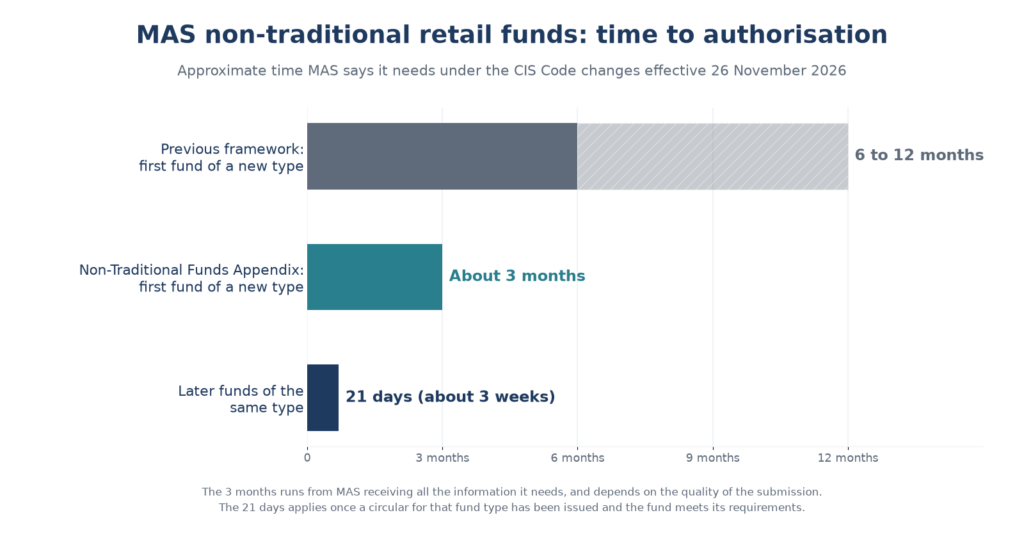
MAS non-traditional retail funds can now be authorised much faster. On 26 November 2026, MAS added a Non-Traditional Funds Appendix (Appendix 8) to the Code on Collective Investment Schemes, with immediate effect. It lets new types of retail funds depart from the usual investment limits, subject to safeguards that MAS designs for each fund type. MAS expects to set those safeguards in about three months, instead of six to twelve months before. Later funds of the same type should be authorised in 21 days. Custody and liquidity standards, the dealing and valuation requirements and MAS’s fair dealing expectations all continue to apply, and private market funds are not covered.
Key takeaways
- MAS non-traditional retail funds are funds with innovative features that fall outside the existing investment guidelines in the CIS Code.
- The new Appendix 8 took effect on 26 November 2026. The first fund type written into it is the futures-based single-commodity fund.
- For each new fund type, MAS issues a circular setting modified investment limits, alternative safeguards and enhanced disclosures.
- Funds under the Appendix must say on the front page of the prospectus and product highlights sheet, and in marketing materials, that they are non-traditional funds.
- MAS expects these funds to be complex products, so enhanced distribution safeguards apply.
- Retail access to private market funds is a separate track. MAS consulted on it in March 2025 and has yet to publish its response.
Contents
- What did MAS change on 26 November 2026?
- What counts as a non-traditional retail fund?
- How quickly will MAS now authorise a non-traditional fund?
- Which fund types are covered so far?
- What must a fund manager do to launch one?
- Which investor safeguards still apply?
- What about retail access to private market funds?
- What else changed in the CIS Code?
- What does this mean for Singapore fund managers?
- Checklist before you approach MAS
- How Raffles Corporate Services can help
- Frequently asked questions
What did MAS change on 26 November 2026?
MAS introduced a new Appendix to the CIS Code for funds that do not fit the existing investment rules, and cut the time it expects to take to approve them.
In its media release of 26 November 2026, MAS said the changes are meant to give non-traditional retail funds a faster time to market. They respond to investor demand and to industry interest in offering retail funds with a wider range of investment objectives. MAS also said that fundamental safeguards for retail customers, such as custody and liquidity standards, will continue to be maintained.
The changes are now in the revised CIS Code, last revised and effective on 26 November 2026. A new Part IV applies to non-traditional funds, and it contains Appendix 8, titled “Investment: Non-Traditional Funds”.
MAS set out its reasoning in a response to feedback paper published on the same day. It follows a consultation that ran from 9 July to 10 August 2026. MAS listed nine respondents in the paper, including industry bodies and fund managers, and noted that three others asked for both their identities and submissions to be kept confidential.
One change came straight from that feedback. MAS first proposed calling the new section the “Alternative Funds Appendix”. Respondents warned that investors might read “alternative” as private markets or hedge funds, so MAS renamed it the Non-traditional Funds Appendix.
What counts as a non-traditional retail fund?
A non-traditional retail fund is a fund authorised for retail offer whose features fall outside the scope of the existing investment guidelines in the CIS Code.
The CIS Code has two layers. The Chapters set out the fundamental requirements on management, operation and marketing, which give effect to the principles of the International Organisation of Securities Commissions (IOSCO). The Appendices add investment guidelines and borrowing limits, such as the diversification rules in Appendix 1.
MAS’s July 2026 consultation paper explained the problem. Some fund types that industry wanted to offer could not meet Appendix 1, often because they make heavy use of derivatives or have undiversified exposures. Until the Code was amended, they could not be offered to retail investors.
Appendix 8 now applies where MAS has, under Chapter 4.4(b) of the Code, expressly modified the Appendix 1 investment guidelines and borrowing limits for a scheme or a type of scheme. Chapter 4.4(b) lists what MAS weighs when it does this:
- compliance with the Securities and Futures Act 2001 (SFA), the Code and other guidelines or circulars that reflect IOSCO standards;
- the listing and offer history of the scheme or type of scheme; and
- the measures the manager will put in place to mitigate the risks of the new structure and of deviating from the Appendix, such as investment controls, enhanced disclosures and distribution arrangements.
MAS said in its response paper that it is open to fund types that have not been offered elsewhere. A track record in other markets helps, but it is not a precondition.
How quickly will MAS now authorise a non-traditional fund?
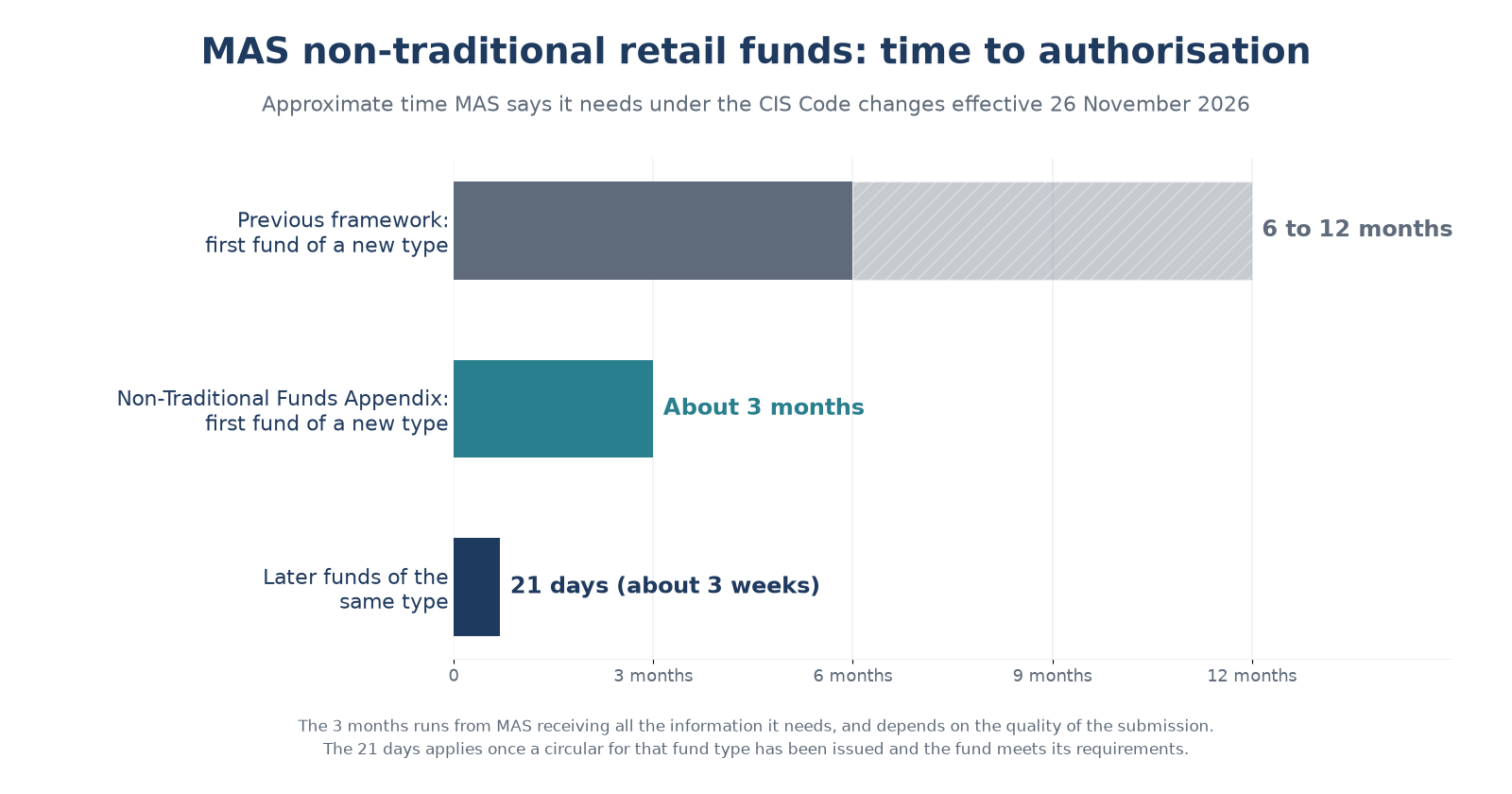
About three months for the first fund of a new type, against six to twelve months under the previous framework, and 21 days for later funds of the same type.
The media release gives the headline comparison. When industry proposes a new type of non-traditional fund, MAS will work with them to develop safeguards, such as enhanced disclosures. That process “would now take about three months, instead of six to twelve months under the previous framework”. Subsequent funds of the same type will take three weeks.
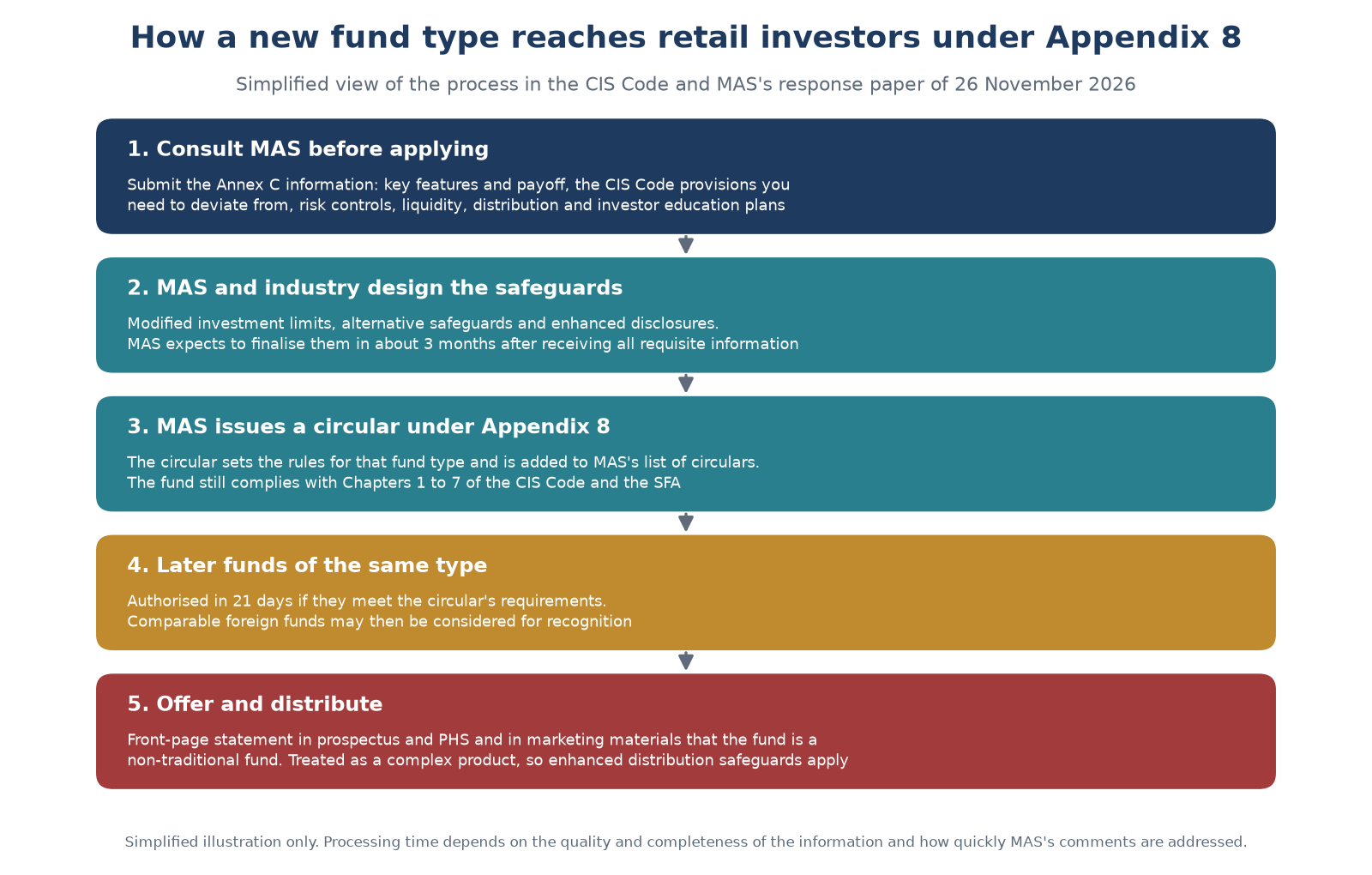
The response paper is more precise. MAS expects to finalise the requirements for a new fund type in about three months after receiving all requisite information. It will publish them in a circular and keep a list of circulars issued under the Appendix. After the circular is issued, funds of the same type will take 21 days to be authorised if they meet its requirements. The consultation paper notes that 21 days matches MAS’s processing time for funds without novel features.
The three months is not a guarantee. MAS says processing time depends on the quality and completeness of the information, and on whether its comments are addressed fully and on time.
Which fund types are covered so far?
Appendix 8 already sets rules for futures-based single-commodity funds. The list of circulars under Appendix 8 was empty on 26 November 2026.
The consultation used two examples: futures-based single-commodity funds and a wider range of single-country government bond funds. MAS dealt with them differently.
Futures-based single-commodity funds
These are written straight into paragraph 3 of Appendix 8. The main rules are:
| Requirement | What Appendix 8 says |
|---|---|
| Permitted commodities | Gold, silver, platinum, crude oil and iron ore |
| Minimum exposure | At least 90% of net asset value (NAV) to one permitted commodity |
| The rest of the fund | Up to 10% of NAV, only in eligible deposits or units of commodity ETFs of the same commodity |
| Instruments | Futures listed and traded on an organised exchange |
| Derivatives exposure | Global exposure of no more than 100% of NAV, using the commitment approach |
| Index | Must track a well-recognised futures price index of the commodity |
| Name | Must refer to the type of commodity futures held and contain the term “futures” or a form of it |
| Prospectus | Clear disclosure of futures risks (including rolling, volatility, leverage and liquidity), single-commodity concentration risk and the roll methodology, with examples of contango and backwardation where appropriate |
The usual Appendix 1 rules on spreading the underlying commodities of derivatives do not apply to these funds. Several requirements of Appendix 5 (Index Funds) do apply.
MAS dropped one proposal after feedback. It had planned to bar these funds from using “ETF” in their names. It will now allow the term, provided the name makes clear which commodity futures the fund holds, so investors can tell it apart from a traditional ETF holding physical commodities.
Single-country government bond funds
These stay in the traditional framework. MAS amended Appendix 1 instead, because the fund type remains largely in line with traditional funds. The 10% single entity limit does not apply to public debt instruments from a government, government agency or supranational whose public debt instruments are in a well-recognised international index. The fund must hold at least six different issuances, each no more than 30% of NAV.
A fund that invests most, if not all, of its assets in one government’s debt must carry a prominent risk statement in its prospectus. The response paper says these changes replace the earlier modified rules in MAS Circular CFC 02/2020.
What must a fund manager do to launch one?
Consult MAS before you apply for authorisation and give it the full information set in Annex C of the response paper.
Chapter 4.4(a) of the Code already says that the manager, or the VCC where the fund is a VCC or one of its sub-funds, should consult MAS before applying where a scheme has a novel structure, risk or investment policy, or does not meet the core investment guidelines. For a new fund type, the response paper says issuers must submit the information in Annex C. In summary:
- The scheme. Its investment objective and focus, the manager’s investment approach, and the payoff structure with illustrative examples.
- The deviations. Which CIS Code provisions the fund needs to depart from, and why.
- Risk controls. Investment controls, enhanced disclosures and distribution arrangements. These must cover liquidity to meet redemptions, distribution plans (distributor selection criteria, distributor training, and measures against sales outside the target customer segment) and investor education plans.
- Overseas history, if any. Where similar funds are offered to retail investors and with which approvals, for how many years, their assets under management, and any adverse incidents in the past two years, including regulatory investigations, lawsuits and reported complaints.
The quality of this pack drives the timeline, because MAS’s three months only starts once it has everything it needs. Fund managers should also decide early whether the product is genuinely non-traditional. MAS said a new fund type that stays largely in line with traditional funds may be dealt with by amending the existing Appendices instead, as happened with single-country government bond funds.
Which investor safeguards still apply?
All of the CIS Code’s fundamental requirements still apply. Only the Appendix 1 investment limits are modified, and only as far as MAS allows for each fund type.
Part IV of the revised Code says that managers, trustees, VCCs, VCC directors and VCC custodians of funds offered under it must comply with Chapters 1 to 7. The Appendix 1 investment guidelines and borrowing limits also apply unless MAS states otherwise. The response paper adds that these funds must meet the SFA and its subsidiary legislation, including requirements on dealing, valuation and liquidity risk management.
Custody and segregation of assets
The media release names custody as a safeguard that stays in place. The IOSCO principles MAS relies on include proper segregation and protection of investors’ money and fund assets. Under the Code, a unit trust’s trustee should be independent of the manager. For a VCC, the custodian should be independent of the VCC and the manager, and should not reuse VCC property without the VCC’s prior consent.
Liquidity, dealing and redemptions
Liquidity standards also remain. The manager should assess and adopt the liquidity risk management practices in MAS’s guidelines for fund management companies, in proportion to its operations and the funds it manages. A fund should deal at least once a month. Redemption proceeds should generally be paid within seven business days of a valid request (property funds and hedge funds have their own timelines), and dealing may be suspended only in exceptional circumstances in the best interest of participants. Annex C asks managers to show how a new fund will have enough liquidity to meet redemptions.
Fair dealing and distribution
MAS expects fund managers and distributors to keep focusing on fair dealing outcomes when designing and distributing these products. It also expects funds under the Appendix to involve non-traditional features such as heavy use of derivatives. They will therefore be classified as complex products, and the enhanced distribution safeguards under the complex products regime will apply.
Disclosure and investor education
Every fund under Appendix 8 must carry a clear and prominent statement that it is offered under the Appendix as a non-traditional fund. The statement goes on the front page of its prospectus and product highlights sheet, and in its marketing materials. The media release says financial institutions must provide clear and useful investor education materials to support informed decisions. Investor education plans are part of the information MAS asks for before it assesses a new fund type.
What about retail access to private market funds?
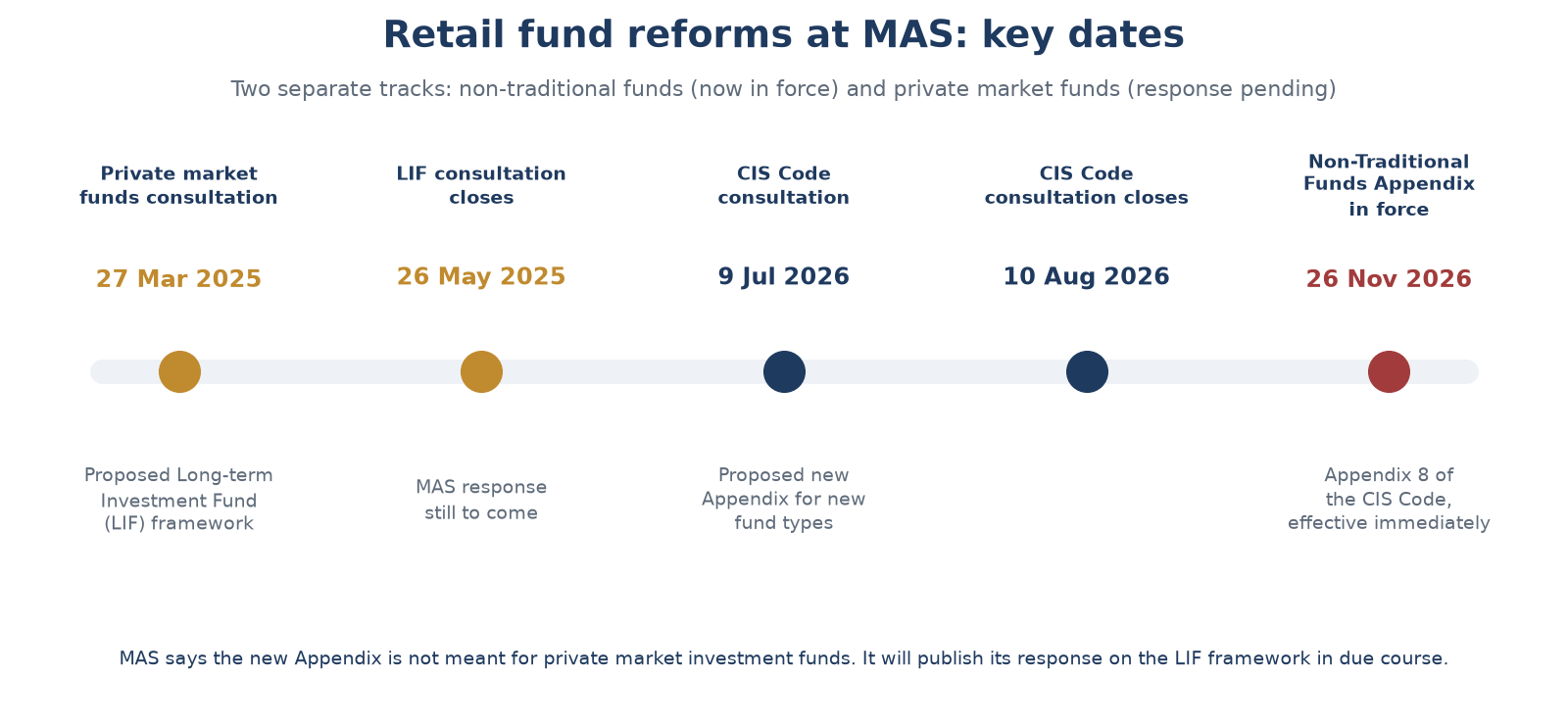
Private market funds are outside the new Appendix. MAS is handling them under a separate proposed framework and will publish its response to feedback in due course.
MAS was direct about this in its response paper. Several respondents asked whether the Appendix could take in funds investing in private market assets. MAS said it is not intended to, because those funds would not be able to meet certain requirements in the existing Chapters of the CIS Code.
The separate track began on 27 March 2025, when MAS proposed a regulatory framework for retail private market investment funds. The consultation paper proposed a Long-term Investment Fund (LIF) framework with two possible structures:
- a Direct Fund, which makes private market investments itself and gives investors more visibility of the underlying assets; and
- a long-term investment fund-of-funds (LIFF), which mainly invests in other private market investment funds.
MAS sought views on which assets should be allowed, such as private equity, private credit, infrastructure and, for LIFFs, real estate funds. It also asked whether to start with lower-risk assets. Comments closed on 26 May 2025. As of 26 November 2026, MAS says it will publish its response in due course, so the LIF framework is still a proposal. A manager planning a retail private credit or private equity fund should not plan around Appendix 8.
What else changed in the CIS Code?
Three related changes came with the new Appendix.
- More flexibility in existing Appendices. MAS can now amend investment requirements in the existing Appendices for new fund types that stay close to traditional funds. Chapter 4.4(b) sets out the factors it will weigh.
- Comparable foreign funds. MAS will recognise foreign funds comparable to new products it authorises, including those under Appendix 8. For a new fund type, it will first put safeguards in the CIS Code for an authorised fund before considering a comparable foreign fund for recognition. MAS will publish a list of extra information needed with such recognition applications.
- Investment-linked policy (ILP) sub-funds. The revised framework will also apply to ILP sub-funds where relevant. That will come later, after amendments to MAS Notice 307.
What does this mean for Singapore fund managers?
It gives retail fund managers a shorter, more predictable route for new products, but the time saved is in MAS’s design work, not in the standards a fund must meet.
The biggest change is for the first manager to bring a new fund type. Before, that manager faced six to twelve months of bespoke work with MAS. Now MAS expects about three months, and every later fund of the same type benefits from the published circular and the 21-day timeline. The first manager still does most of the design work, and other managers can then follow within 21 days.
Appendix 8 only applies to funds authorised for offer to retail investors, so it assumes a manager that can run retail funds. If you are still deciding how to set up, our guide on how to get a fund management licence in Singapore compares the A/I LFMC and Retail LFMC routes, VCC set-up, timelines and MAS requirements.
A new fund type will usually also mean new corporate work: a VCC or sub-fund, new directors or a custodian, updated constitutional documents and board approvals. That work has to be ready when the fund is authorised, so it helps to run it alongside the MAS engagement rather than after it.
Checklist before you approach MAS
- Confirm the product truly cannot meet Appendix 1, and list the exact provisions it needs to depart from.
- Check whether it is really a private market fund. If so, Appendix 8 is the wrong route for now.
- Gather the overseas track record: jurisdictions, approvals, years on offer, assets under management and any adverse incidents in the past two years.
- Draft the risk controls: investment limits, liquidity to meet redemptions and valuation approach.
- Prepare the distribution plan: distributor selection, distributor training and controls against sales outside the target segment.
- Write the investor education plan and the materials you will give retail investors.
- Plan the prospectus and product highlights sheet, including the front-page non-traditional fund statement and complex product treatment.
- Line up the fund vehicle, trustee or VCC custodian, and board approvals so the fund can launch once authorised.
How Raffles Corporate Services can help
Raffles Corporate Services handles the corporate side of a new fund, and RLC Law Corporation, the law firm we work with, handles the legal side.
We can incorporate your fund management company and VCC with ACRA, set up sub-funds, act as company secretary, and keep registers, board resolutions, AGMs and annual returns up to date. RLC Law Corporation can advise on the regulatory route, fund documents and your engagement with MAS. For more on fund vehicles, see our VCC and family office guides.
To discuss a new retail fund or VCC set-up, email [email protected].
Frequently asked questions
What are MAS non-traditional retail funds?
Retail funds with innovative features that fall outside the existing investment guidelines in the Code on Collective Investment Schemes. Since 26 November 2026, MAS can authorise them under the new Non-Traditional Funds Appendix (Appendix 8), with modified investment limits and alternative safeguards for each fund type.
When did the Non-Traditional Funds Appendix take effect?
On 26 November 2026. MAS said the amendments to the CIS Code took effect immediately, and the revised Code is effective from that date.
How long does MAS take to approve a new type of non-traditional fund?
About three months after MAS receives all the information it needs, compared with six to twelve months under the previous framework. Once MAS has issued a circular for that fund type, later funds of the same type take 21 days if they meet its requirements.
Which fund types are allowed under Appendix 8 so far?
Futures-based single-commodity funds, which Appendix 8 itself regulates. They may only invest in exchange-traded futures on gold, silver, platinum, crude oil or iron ore, with at least 90% of NAV exposed to one of those commodities. No circulars had been issued under Appendix 8 as of 26 November 2026.
Can private equity or private credit funds use the new Appendix?
No. MAS said the Appendix is not intended for private market investment funds, because they cannot meet certain requirements in the existing Chapters of the CIS Code. Retail access to them is being considered under a separate, proposed Long-term Investment Fund framework that MAS consulted on from 27 March to 26 May 2025. MAS has not yet published its response.
What safeguards still apply to non-traditional funds?
All of the CIS Code Chapters and the SFA still apply, including custody, dealing, valuation and liquidity risk management. Funds must state on their prospectus, product highlights sheet and marketing materials that they are non-traditional funds. They are treated as complex products, and MAS expects fair dealing and clear investor education.
What information must a fund manager give MAS?
The information in Annex C of MAS’s response paper: the fund’s key features and payoff, the CIS Code provisions it needs to depart from and why, risk controls including liquidity, distribution and investor education plans, and the history of similar funds in other jurisdictions.
This guide is general information and not legal or regulatory advice. MAS requirements change, so check the current CIS Code and circulars or speak to us before you act.
Last updated 27 November 2026
Need help with this?
Raffles Corporate Services can handle the ACRA filings, compliance documentation and records for you, and where court proceedings or legal advice are needed, we work with a panel of experienced Singapore law firms who offer cost-effective and efficient legal service and advice.
Email: [email protected]
Call, SMS or WhatsApp: +65 8501 7133