
The Companies Act 1967 names roughly a dozen things a Singapore director must personally do or cause to be done: keep accounting records, prepare financial statements, hold an AGM, file the annual return, keep the registers current, declare interests, and act honestly with reasonable diligence. Each one carries its own offence.
That last point is the part directors underestimate. These are not obligations of the company that the company alone answers for. Most of them are drafted to catch “every officer of the company who is in default”, which means the director, by name, in his or her own capacity. The company has no assets to protect you and no liability to absorb on your behalf.
Below is the full list, what triggers each one, and the maximum penalty as the Act currently states it.
What “statutory duty” means, and how it differs from the rest
A statutory duty is one written into the Companies Act 1967 with a section number, a deadline or standard, and an offence attached. You either did the thing by the date or you did not. Intention is largely irrelevant, and “I left it to the secretary” is not a defence, because the Act puts the duty on you.
That is a different creature from the fiduciary duties, which come from equity and ask whether you acted in good faith and for the right reason. Both sets apply to you at the same time. Section 157(4) makes that explicit: the statutory duty in section 157 is in addition to, and not in derogation of, any other rule of law about the duties of directors. Our companion guide to a director’s fiduciary duties covers the other half.
The duties below apply to every director equally. There is no lighter category for a non-executive, a nominee or a founder who has stopped turning up. A person who was never formally appointed can still be caught, as we explain in our note on shadow directors.
The duties, the deadlines and the maximum penalties
| Duty | Provision | What it actually requires | Maximum penalty on conviction |
|---|---|---|---|
| Keep accounting records | Section 199(1) and (2) | Records sufficient to explain transactions and financial position, kept so they can be properly audited, retained at least 5 years from the end of the financial year in which the transactions were completed | Fine up to $10,000 or imprisonment up to 12 months, and a default penalty |
| Maintain internal accounting controls | Section 199(2A) | Public companies and their subsidiaries only: a control system giving reasonable assurance that assets are safeguarded and transactions properly authorised | As above |
| Prepare and lay financial statements | Section 201(1) and (2) | Directors must lay financial statements before the AGM that comply with the Accounting Standards and give a true and fair view | Fine up to $250,000 under section 204(1) |
| Other breaches in the accounts Division | Section 204(1A) | Failing to comply, or failing to take all reasonable steps to secure the company’s compliance, with the other financial reporting provisions | Fine up to $10,000 or imprisonment up to 2 years |
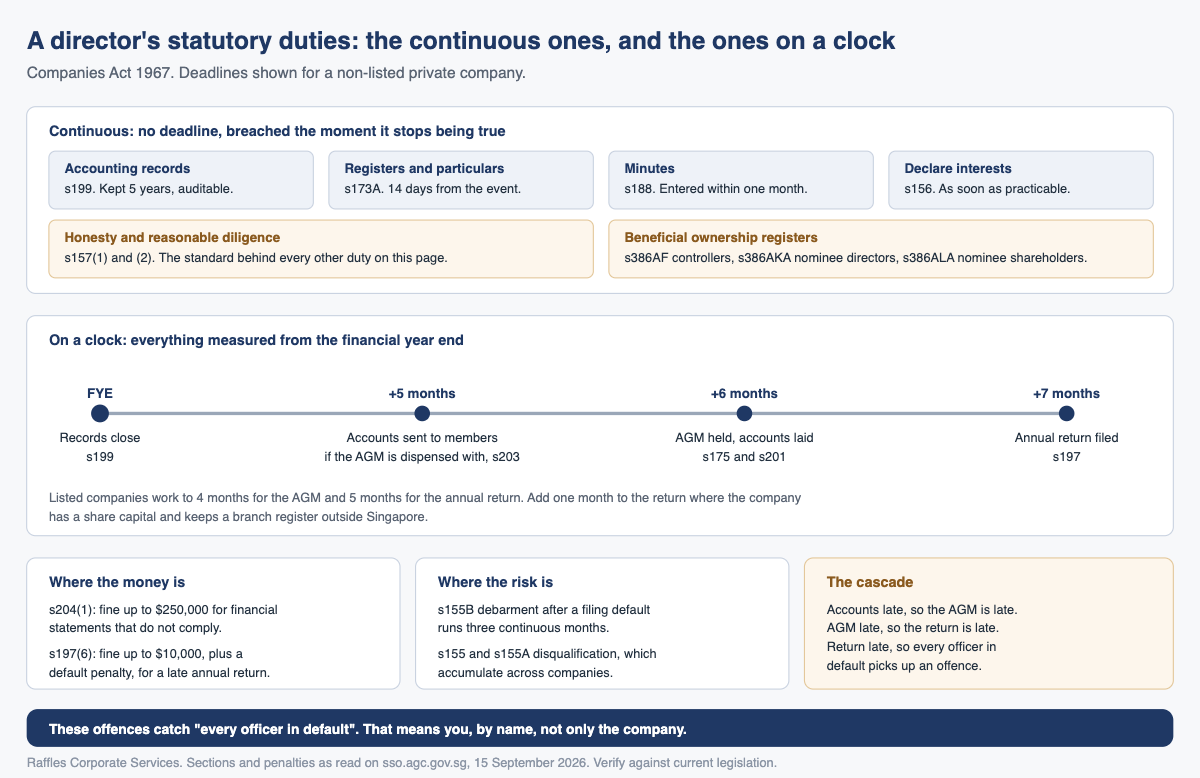
| Send the accounts to members | Section 203(1) | At least 14 days before the meeting, or within 5 months after the financial year end where the AGM has been dispensed with | Fine up to $5,000 and a default penalty |
| Hold the AGM | Section 175(1) | Within 4 months after the financial year end for a listed public company, within 6 months for any other company | Fine up to $5,000 and a default penalty |
| File the annual return | Section 197(1) | Within 5 months after the financial year end for a listed company, within 7 months for any other company (6 and 8 months where the company keeps an overseas branch register) | Fine up to $10,000 and a default penalty |
| Keep officer information current | Section 173A | Notify the Registrar within 14 days of an appointment, a cessation, a change in particulars, or the company becoming aware a director has ceased to be qualified | Late lodgement penalties, charged per transaction |
| Keep the register of directors’ and CEO’s shareholdings | Section 164 | A register of each director’s shares, debentures, options and share contracts in the company and related corporations | Fine up to $15,000 or imprisonment up to 3 years, plus $1,000 for every day a continuing offence runs after conviction |
| Notify your own shareholdings | Section 165 | The director’s personal duty to tell the company, in writing, within 2 business days of acquiring or changing a relevant interest | As for section 164 |
| Keep minutes | Section 188(1) | Minutes of general meetings and directors’ meetings entered in the minute books within one month of the meeting and signed by the chairperson | Offence under section 188 |
| Declare interests | Section 156 | Disclose any direct or indirect interest in a transaction, and any conflicting office or property | Fine up to $5,000 or imprisonment up to 12 months |
| Act honestly and with reasonable diligence | Section 157(1) and (2) | The general standard, plus the bar on misusing your position or company information | Liability to the company for profits or damage, plus a fine up to $5,000 or imprisonment up to 12 months |
Two further registers sit outside the classic list but bite just as hard. Section 386AF requires a register of registrable controllers, section 386AKA a register of nominee directors, and section 386ALA a register of nominee shareholders. These are the beneficial ownership registers, and they are the ones ACRA has been most active on lately. If your company uses a nominee arrangement, read our guide to nominee shareholder arrangements and beneficial ownership before assuming the standard registers are enough.
The three duties most private companies actually trip on
Accounting records, not “the accountant’s file”
Section 199 does not ask whether you have a set of accounts. It asks whether the underlying records sufficiently explain the transactions and the financial position, and whether they are in a state that permits a proper audit. A shoebox of invoices and a bank feed do not do that. Neither does a bookkeeping file that was reconstructed eleven months after the year end.
The five-year retention period runs from the end of the financial year in which the transactions were completed, not from the date you last looked at the file. Directors who have sold a business or closed a company routinely bin the records too early.
The AGM, and the exemptions that are not exemptions
A non-listed company must hold its AGM within six months after the financial year end. Section 175A gives private companies three ways out: a unanimous resolution to dispense with AGMs, sending the accounts to every person entitled to notice within five months after the year end, or being a dormant relevant company whose directors are exempt from section 201 under section 201A.
None of those is a way out of the underlying work. You still prepare the accounts. You still file the annual return, and you still declare the AGM position when you do. A member can force a meeting anyway, by notice given not later than 14 days before the six-month deadline. ACRA’s published position is that the minimum composition sum is $500 for each breach, with prosecution and a fine of up to $5,000 per charge where composition is refused or the breaches repeat.
The 14-day register window
Section 173A gives you 14 days from the event, not 14 days from the board meeting at which someone finally documents it. That window covers appointments, cessations, changes to residential or contact addresses, and the company becoming aware that a director has ceased to be qualified. Late filings attract ACRA’s late lodgement penalties, charged per transaction, so a company that lets a year of changes accumulate pays for every one of them.
What goes wrong: the cascade
Almost nobody sets out to breach the Companies Act. What happens is a sequence, and it always starts in the same place.
The accounts are late. Because the accounts are late, the AGM cannot be held on time, or the five-month circulation deadline is missed. Because the AGM is late, the annual return is late. Because the annual return is late, the company picks up a late lodgement penalty, and the directors pick up an offence each.
Then it stops being about money. A director who accumulates three or more relevant convictions or orders within five years can be disqualified under section 155. The Registrar can debar a director or secretary under section 155B where a filing default has run three continuous months, and a debarred person cannot take up a new directorship anywhere until the order is lifted. A director of three or more companies struck off within a five-year window can be disqualified under section 155A, with no wrongdoing needed at all.
The cheapest point to break that chain is the first one. Close the books on time. Everything downstream is administrative. Our guide to the first year of compliance for a new Singapore company sets out the sequence, and the ACRA alerts companies miss explains why the warning usually arrives and goes unread.
Where a breach has already been prosecuted, the consequences reach further than the fine: see our companion note on a director’s personal liability, and on the separate question of conflicts of interest and related party transactions.
Frequently asked questions
Can a director be personally fined for the company’s late annual return?
Yes. Section 197(6) makes the company and every officer in default guilty of an offence, with a fine of up to $10,000 and a default penalty. The offence attaches to the director personally, not only to the company, and paying the company’s late lodgement penalty does not extinguish it.
Does a dormant company still have director duties?
Yes. A dormant company still files an annual return, still keeps accounting records, and its directors still keep the registers current. Section 201A may exempt the directors of a dormant relevant company from preparing financial statements for a financial year, but it exempts nothing else. Dormancy reduces the volume of work, not the number of duties.
I am a non-executive director and not involved in operations. Do these apply to me?
All of them. The Companies Act 1967 does not create a lighter category of director. Section 157(1) requires every director to act honestly and use reasonable diligence, and the filing offences catch every officer in default. A non-executive who never asks to see the accounts is exposed, not protected.
What is a default penalty?
It is a further sum that runs for each day the offence continues after conviction, in addition to the fine for the offence itself. It is why letting a breach sit unremedied after being caught costs materially more than fixing it. The daily amount depends on the provision breached.
How long must a Singapore company keep its accounting records?
At least five years from the end of the financial year in which the transactions or operations they relate to were completed, under section 199(2). The records must be kept at the registered office or another place the directors think fit, and must be open to inspection by the directors at all times.
The part that is genuinely easy to get right
Statutory duties are unglamorous and entirely mechanical. That is good news: a duty with a date attached can be diarised, and a duty that can be diarised will not catch you out.
Raffles Corporate Services runs the statutory calendar for several hundred Singapore companies: registers kept current inside the 14-day window, AGM and annual return dates worked back from the financial year end, and the accounts chased early enough that the filing deadline is never the constraint. If you are not certain when your company’s AGM and annual return are actually due, that is a five-minute answer.
You can reach us through Raffles Corporate Services, or read more on Singapore corporate secretarial practice at Singapore Secretary Services.
— The Editorial Team, Raffles Corporate Services