

Climate reporting in Singapore is now a phased statutory expectation, not a marketing exercise, and the capability it demands is measurement, disclosure and assurance readiness. ACRA has published a Sustainability Reporting Body of Knowledge to standardise the training. This is what it means for your company.
Raffles Corporate Services works with a panel of experienced Singapore law firms who offer cost-effective and efficient legal service and advice. This article is general information only and is not legal advice.
Most directors we speak to have worked out that something is coming. Fewer have worked out that the hard part is not writing the report. The hard part is producing a greenhouse gas number that somebody outside your company can test and agree with, on a schedule, every year, using data your operations team does not currently collect.
That is a capability problem, and it takes longer to fix than a reporting deadline gives you.
What the Body of Knowledge is, and why ACRA built it
The Sustainability Reporting Body of Knowledge, usually shortened to the SR BOK, is a framework of the knowledge areas a competent sustainability report preparer needs. ACRA developed it to guide training providers, so that a course sold as sustainability reporting training covers a consistent depth of material rather than whatever the provider happens to know.
It covers the international reference points a Singapore preparer will be working against:
- IFRS S1, General Requirements for Disclosure of Sustainability-related Financial Information, issued by the International Sustainability Standards Board.
- IFRS S2, Climate-related Disclosures.
- The Greenhouse Gas Protocol, which is the accounting framework behind the emissions numbers themselves.
More than fifty industry stakeholders validated it, including company preparers, assurance providers, professional bodies and training providers. You can request a copy from ACRA directly.
There is a companion piece aimed at the other side of the table, the Sustainability Assurance Body of Knowledge, which sets out the competencies an assurance provider needs. That one matters to you indirectly: it tells you what the person reviewing your numbers will be trained to look for.
Do you actually have to build this, and by when?
Singapore’s roadmap is climate first and phased. The short version is that listed companies are already inside it and large non-listed companies are not, yet.
| Who you are | When climate reporting bites |
|---|---|
| Any company listed on SGX | Scope 1 and Scope 2 emissions, for financial years starting on or after 1 January 2025 |
| Straits Times Index constituent | Full ISSB-based climate disclosures from FY2025, Scope 3 emissions from FY2026 |
| Non-STI listed, market capitalisation $1 billion and above | Full ISSB-based climate disclosures from FY2028 |
| Non-STI listed, market capitalisation under $1 billion | Full ISSB-based climate disclosures from FY2030 |
| Large non-listed company | ISSB-based climate disclosures from FY2030, unless exempted |
| Everyone else | No direct obligation, but see below |
A large non-listed company is one that meets both limbs: annual revenue of $1 billion and above, and total assets of $500 million and above. An exemption is available where a parent company already prepares climate or sustainability reports on ISSB-based local standards or equivalent standards, and your activities are inside that publicly available parent report.
The part that catches private companies
If you are a private Singapore company with no listing and no billion dollars of revenue, you are not on the timetable. You will still be asked for the data.
Scope 3 covers value chain emissions. When a listed customer or a bank has to report its Scope 3 number, the only way it can get one is by asking its suppliers, and you are a supplier. That request arrives on a commercial timeline, not a regulatory one, and “we do not measure that” is an answer with consequences at contract renewal.
This is the reason to build a basic measurement capability early even where nothing compels you to. Our note on the corporate secretary’s role in ESG and sustainability reporting covers how the governance side of that lands inside a smaller company.
The four capabilities, in the order you need them
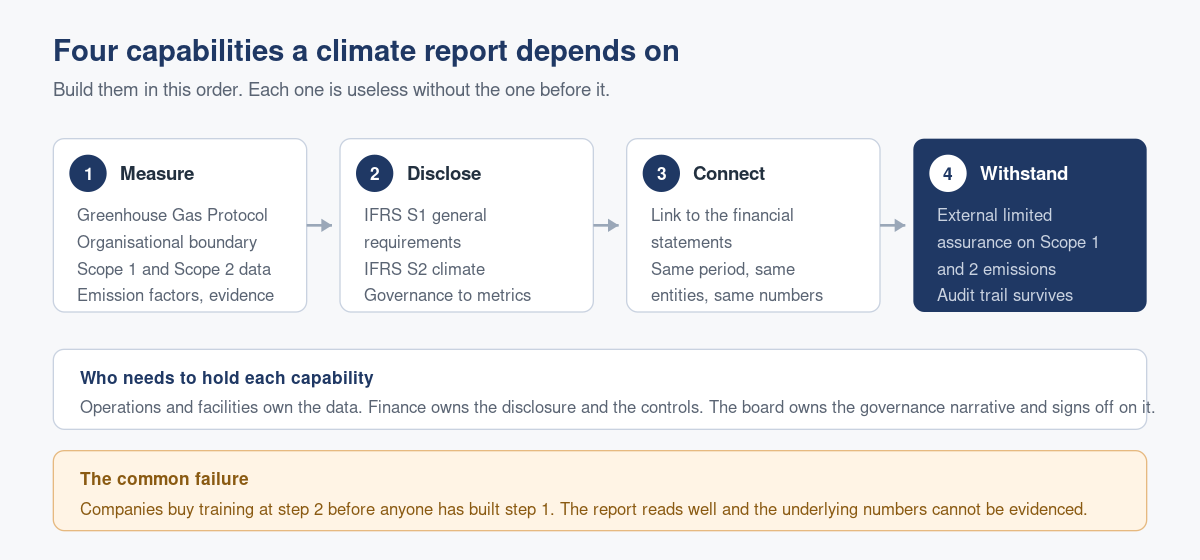
1. Measure
Greenhouse gas accounting under the GHG Protocol. Somebody has to decide the organisational boundary, that is, which entities and facilities are inside the number. Somebody has to collect utility bills, fuel purchases and refrigerant records. Somebody has to choose emission factors and be able to say why.
This is the least glamorous capability and the one that everything else rests on. It usually sits with operations or facilities, not finance, which is exactly why it gets neglected.
2. Disclose
IFRS S2 asks for four things: how you govern climate-related risks and opportunities, how they affect your strategy and business model, how you identify and manage them, and what metrics and targets you use to track progress. IFRS S1 sets the general requirements that sit over all of it.
The skill here is closer to financial reporting than to environmental science. It is about materiality judgements, consistency between periods, and not writing a commitment you cannot evidence.
3. Connect
The disclosure has to line up with the financial statements. Same reporting period, same group of entities, and no climate risk described as significant in the sustainability section that has left no trace anywhere in the accounts.
Auditors and regulators read both documents. Inconsistency between them is the easiest finding in the world to raise, and our note on directors’ responsibilities for financial reporting explains why the board carries that one personally.
4. Withstand assurance
External limited assurance on Scope 1 and 2 emissions is coming, from FY2029 for listed companies and from FY2032 for large non-listed companies. The assurance provider must be either an audit firm registered with ACRA or a testing, inspection and certification firm accredited by the Singapore Accreditation Council.
Limited assurance is a lower bar than a financial statement audit, but it is still someone external asking to see your workings. If your emissions number lives in one spreadsheet on one person’s laptop with no source documents behind it, that engagement will not go well. The instincts are the same ones covered in preparing for your first statutory audit, applied to a different dataset.
How the training is funded
ACRA has partnered with the Skills and Workforce Development Agency to curate courses aligned to the SR BOK under the SkillsFuture Green Workplace programme. Course fees are subsidised by up to 90 per cent, and the courses are modular and stackable, so you can send one person for the measurement module without committing to a full qualification.
There is also a Sustainability Reporting Grant, offered by the Economic Development Board and Enterprise Singapore, aimed at companies preparing for ISSB-based climate disclosures before mandatory compliance begins.
| Support | What it covers | Where it comes from |
|---|---|---|
| SkillsFuture Green Workplace courses | Training aligned to the SR BOK, subsidised up to 90 per cent | ACRA with the Skills and Workforce Development Agency |
| Sustainability Reporting Grant | Preparation costs for ISSB-based climate disclosures | EDB and Enterprise Singapore |
| SR BOK and SA BOK | The knowledge frameworks themselves, on request | ACRA |
Companies pursuing broader green capability work should also look at the Enterprise Sustainability Programme, which sits alongside this and funds a wider set of activities.
What goes wrong in practice
The training is bought at the wrong layer. A company sends its finance manager on an IFRS S2 course, and nobody teaches the facilities team how to record fuel consumption. The report then describes a governance process for numbers that cannot be substantiated. Train the measurement layer first.
One person holds the whole capability. Sustainability reporting is often given to a single motivated employee. When that person leaves, the methodology, the boundary decisions and the emission factor choices leave with them, and the following year’s report is not comparable. Document the method, not just the result.
Targets get published before anyone models them. A net zero commitment in an annual report is a public statement by the board. Setting one without a costed pathway is how companies end up quietly restating, which is far more damaging than having set a modest target in the first place.
Nobody keeps the source data. Assurance providers ask for evidence, and the retention question catches companies out. Our note on how long you must keep accounting records covers the statutory baseline; emissions source data deserves the same discipline even though the obligation arises differently.
The timeline is assumed to be fixed. It has already moved once. Building capability on the assumption that your phase-in date will slip again is a bet, and it is a bet where losing means a rushed first report with an assurance engagement immediately behind it.
Frequently asked questions
What is the Sustainability Reporting Body of Knowledge?
It is a framework published by ACRA setting out the knowledge areas a competent sustainability report preparer needs. It covers IFRS S1, IFRS S2 and the Greenhouse Gas Protocol, and it exists so that training programmes from different providers cover comparable ground. It was validated by more than fifty industry stakeholders and is available from ACRA on request.
Does my private company have to report climate disclosures?
Not unless you meet the large non-listed company test, which requires annual revenue of $1 billion and above and total assets of $500 million and above. Smaller private companies have no direct obligation. Many are nevertheless asked for emissions data by listed customers, banks or parent companies that need it for their own reporting.
Who in my company should be trained first?
The person who will collect the data, usually in operations or facilities, rather than the person who will write the report. Emissions figures are only as good as the underlying records of fuel, electricity and refrigerant use. Finance can be trained on the disclosure standards afterwards, once there is something real to disclose.
Is the training subsidised?
Yes. ACRA has worked with the Skills and Workforce Development Agency to curate SR BOK-aligned courses under the SkillsFuture Green Workplace programme, with fees subsidised by up to 90 per cent. Courses are modular and stackable. A separate Sustainability Reporting Grant from EDB and Enterprise Singapore supports preparation costs ahead of mandatory compliance.
What is limited assurance, and when will I need it?
Limited assurance is an external check on your Scope 1 and 2 emissions figures, less extensive than a full audit but still requiring evidence for your numbers. It applies from FY2029 for listed companies and from FY2032 for large non-listed companies. The provider must be an ACRA-registered audit firm or a firm accredited by the Singapore Accreditation Council.
Do I need an external consultant?
Not necessarily, and not permanently. External help is most useful for the first measurement exercise, where boundary and emission factor decisions get set. After that, the value is in keeping the capability in-house so the method stays consistent year to year and somebody internal can answer the assurance provider’s questions.
Start with the number, not the narrative
The companies that handle this well are not the ones with the best sustainability language. They are the ones that can produce an emissions figure with an audit trail behind it, on request, in a week. Everything else is built on that.
If your company is heading towards a phase-in date, or towards a customer who is, Raffles Corporate Services can help you work out which obligations actually apply to your entity, what the board needs to be able to say it has considered, and how the reporting fits alongside your statutory accounts and your existing audit cycle. That conversation is usually shorter and less alarming than directors expect.
For the wider regulatory picture, see our overview of the Singapore sustainability reporting roadmap and our analysis of ACRA’s draft sustainability disclosure standards. ACRA’s own sustainability reporting and assurance requirements page carries the current timeline and the assurance dates, and the Sustainability Reporting Grant is administered by the Economic Development Board.
The Editorial Team, Raffles Corporate Services
Need help with corporate secretarial or compliance matters?
If you would like help with your company's corporate secretarial, governance or compliance requirements, email [email protected] or WhatsApp +65 8501 7133.
Our team can assist with corporate secretarial, accounting and tax matters. Where legal advice is needed, advisers from our associated law firms can assist.