

Every company listed on SGX must report Scope 1 and Scope 2 greenhouse gas emissions for financial years starting on or after 1 January 2025. Fuller ISSB-aligned climate disclosures phase in by tier through to FY2030, and external assurance follows behind that.
Raffles Corporate Services works with a panel of experienced Singapore law firms who offer cost-effective and efficient legal service and advice. This article is general information only and is not legal advice.
Climate reporting in Singapore stopped being a voluntary communications exercise some time ago. It is now a scheduled disclosure obligation with a defined population, a defined content set and, eventually, an external check on the numbers.
What follows is the obligation landscape as it stands: who is inside it, what “climate-related disclosures” actually means in practice, and the two or three things that reliably go wrong the first time a company produces one.
Who has to make climate-related disclosures?
The population is defined two ways: by listing status and tier, and by size for companies that are not listed.
Listed companies. Every company listed on the Singapore Exchange is in scope. Which disclosures you make, and from when, depends on your tier:
- Tier 1, Straits Times Index constituents.
- Tier 2, non-STI listed companies with a market capitalisation of $1 billion and above.
- Tier 3, non-STI listed companies with a market capitalisation below $1 billion.
Large non-listed companies. A non-listed company is caught only if it meets both limbs of the test: annual revenue of $1 billion and above, and total assets of $500 million and above. Meeting one limb is not enough.
There is an exemption. A large non-listed company may be excused where its immediate, intermediate or ultimate parent (local or foreign) is already preparing climate or sustainability reports using ISSB-based local reporting standards or equivalent standards, and that company’s activities are included in the parent’s report, which is publicly available. ACRA has said it will issue guidance on what counts as equivalent standards, which is a sensible acknowledgement that the international position keeps moving.
The phase-in, by financial year
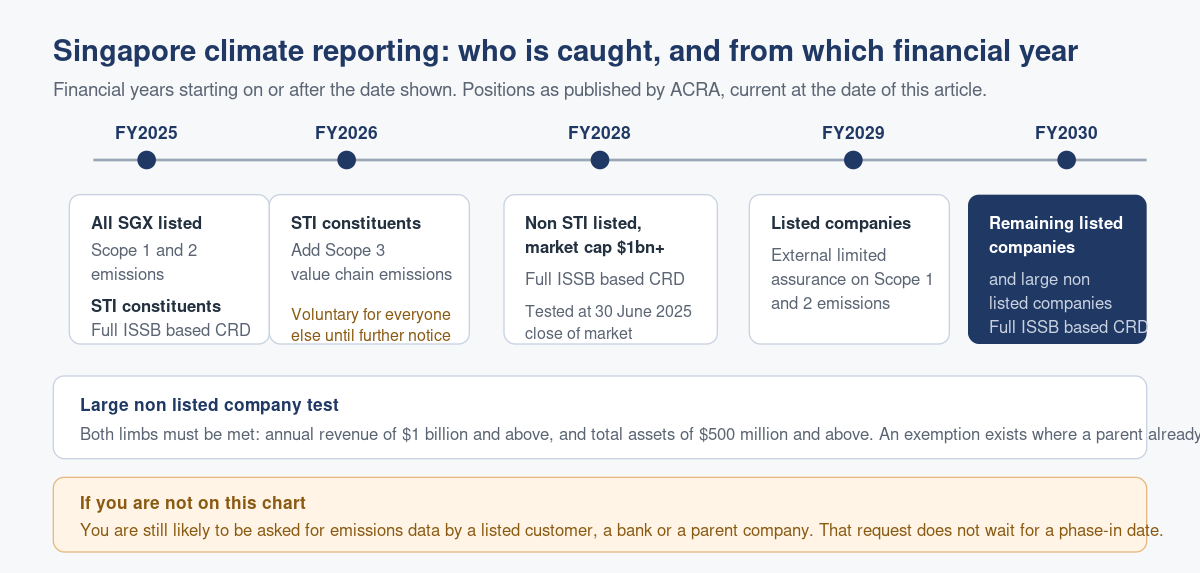
| Financial year starting on or after | What is required, and of whom |
|---|---|
| 1 January 2025 | All SGX-listed companies report Scope 1 and Scope 2 emissions. STI constituents also report the other ISSB-based climate-related disclosures. |
| 1 January 2026 | STI constituents add Scope 3 emissions. |
| 1 January 2028 | Non-STI listed companies with market capitalisation of $1 billion and above report the other ISSB-based climate-related disclosures. |
| 1 January 2029 | External limited assurance on Scope 1 and Scope 2 emissions begins for listed companies. |
| 1 January 2030 | Non-STI listed companies below $1 billion, and large non-listed companies, report ISSB-based climate-related disclosures. |
| 1 January 2032 | External limited assurance on Scope 1 and Scope 2 emissions begins for large non-listed companies. |
Scope 3 reporting remains voluntary for everyone other than STI constituents until further notice.
The market capitalisation test is a snapshot, not a rolling measure
This is the detail that catches finance teams. For the Tier 2 population, market capitalisation is tested at the close of market on 30 June 2025. If your company was above $1 billion on that date, the FY2028 obligation attaches, and it stays attached even if your market capitalisation later falls below $1 billion.
For companies listing after 30 June 2025 with a market capitalisation of $1 billion and above at the close of market on the listing date, the obligation applies from the later of FY2028 or the first full financial year after listing. Again, a subsequent fall below the threshold does not release you.
Plan on the basis that once you are in, you are in.
What “climate-related disclosures” actually contains
Two distinct things are being asked for, and they require different work.
Greenhouse gas emissions
| Scope | What it captures | Practical source of data |
|---|---|---|
| Scope 1 | Direct emissions from sources you own or control | Fuel purchases, company vehicles, on-site combustion, refrigerant losses |
| Scope 2 | Indirect emissions from the generation of purchased energy you consume | Electricity bills, purchased steam, cooling and heating |
| Scope 3 | All other indirect emissions in your value chain | Suppliers, logistics providers, business travel, use of sold products |
Scope 1 and 2 are essentially an exercise in collecting invoices and applying emission factors. Scope 3 is not, which is why it is being phased in separately and why it remains voluntary for most of the market.
The rest of the ISSB-based disclosures
Beyond emissions, the standards ask you to explain how the business handles climate-related risks and opportunities across four areas:
- Governance: who on the board and in management is responsible, how often they consider it, and what information reaches them.
- Strategy: how climate-related risks and opportunities affect the business model, and over what time horizons.
- Risk management: how you identify, assess and prioritise those risks, and how that process connects to your overall risk management.
- Metrics and targets: what you measure, what you are aiming at, and progress against it.
The specific requirements sit in the ISSB standards, IFRS S1 General Requirements for Disclosure of Sustainability-related Financial Information and IFRS S2 Climate-related Disclosures. ACRA is developing local sustainability disclosure standards based on them, and our note on ACRA’s draft sustainability disclosure standards covers where that work has reached.
Assurance: the deadline behind the deadline
Reporting dates get the attention. Assurance dates are the ones that change how you have to work.
External limited assurance on Scope 1 and Scope 2 emissions applies from FY2029 for listed companies and from FY2032 for large non-listed companies. The provider must come from one of two pools: audit firms registered with ACRA, or testing, inspection and certification firms accredited by the Singapore Accreditation Council.
Limited assurance is a lower level of comfort than a statutory audit, and the conclusion is expressed negatively. It still means someone external will ask where a figure came from and expect a document in reply. If your first reported year is FY2025 and your first assured year is FY2029, you have four reporting cycles to build records that survive that question. Companies that treat the early years as a dress rehearsal for the assurance engagement do far better than companies that treat them as a publication exercise.
The distinction between assurance levels is the same one we set out in audit, review or compilation: what level of assurance do you need, applied to non-financial data.
What goes wrong in practice
The organisational boundary is never written down. Which subsidiaries, joint ventures and leased sites are inside the emissions number? If nobody records the decision and the reasoning, next year’s preparer will make a different call and your comparatives will silently break.
Emission factors change and nobody restates. Factors get updated. A year-on-year “reduction” that is actually a change in factor, presented without explanation, is the kind of thing an assurance provider finds quickly and a journalist finds eventually.
The climate narrative and the financial statements disagree. The sustainability section describes a material transition risk to a product line, and the financial statements carry that line at full value with no impairment discussion. Both documents are signed by the same board. Directors carry personal responsibility for financial reporting, as we set out in our note on directors’ responsibilities for financial reporting in Singapore, and consistency between the two documents is part of that.
Targets are published without a pathway. A public emissions target is a board statement. Publishing one without an internal model of how it will be met creates a commitment you will have to explain, revise or quietly drop, each of which is worse than a modest target that holds.
Private suppliers assume they are out of scope and get asked anyway. Scope 3 pushes data requests down the supply chain. A private Singapore company with no reporting obligation of its own can still lose a tender because it cannot produce an emissions figure. Directors of smaller companies should read the roadmap as commercial intelligence, not just regulation. Related cost pressures run the same way: see our guide to the Singapore carbon tax and the Carbon Pricing Act.
Frequently asked questions
Which Singapore companies must report climate-related disclosures?
All companies listed on SGX are in scope, starting with Scope 1 and Scope 2 emissions for financial years beginning on or after 1 January 2025. Large non-listed companies are brought in later, and only where they meet both limbs of the size test: annual revenue of $1 billion and above, and total assets of $500 million and above.
What is the difference between Scope 1, 2 and 3 emissions?
Scope 1 covers direct emissions from sources the company owns or controls, such as fuel burned on site or in company vehicles. Scope 2 covers indirect emissions from generating the energy the company purchases and consumes, mainly electricity. Scope 3 covers all other indirect emissions in the value chain, including suppliers, logistics and the use of sold products.
Does a large non-listed company with a foreign parent still have to report?
Possibly not. An exemption applies where the immediate, intermediate or ultimate parent already prepares climate or sustainability reports using ISSB-based local standards or equivalent standards, and the Singapore company’s activities are covered in that parent report, which must be publicly available. ACRA has indicated it will issue guidance on what counts as equivalent.
When does external assurance on emissions start?
External limited assurance on Scope 1 and Scope 2 emissions applies from FY2029 for listed companies and from FY2032 for large non-listed companies. The assurance provider must be either an audit firm registered with ACRA or a testing, inspection and certification firm accredited by the Singapore Accreditation Council.
What happens if my market capitalisation falls below $1 billion after the test date?
The obligation stays. For non-STI listed companies, market capitalisation is tested at the close of market on 30 June 2025, and a company above $1 billion on that date reports from FY2028 even if it later falls below the threshold. Companies listing after that date are tested at their listing date.
Is Scope 3 reporting mandatory?
Only for Straits Times Index constituents, from financial years beginning on or after 1 January 2026. For all other listed companies and for large non-listed companies, Scope 3 reporting remains voluntary until further notice. Many companies nonetheless start estimating it early, because their listed customers need the data.
The work starts well before your reporting date
The gap between a company that files a credible climate disclosure and one that files a defensive one is almost always decided two or three years earlier, in whether anyone bothered to set up the data collection properly.
Raffles Corporate Services helps Singapore companies work out exactly which limb of the roadmap catches them, what the board has to be able to demonstrate it considered, and how the climate disclosure sits alongside the statutory accounts, the audit and the annual return. If you are not sure whether you are in scope at all, that is a short answer and worth getting early.
For the surrounding framework, see our Singapore sustainability reporting roadmap and the practical governance angle in the corporate secretary’s role in ESG and sustainability reporting. The authoritative timeline sits on ACRA’s sustainability reporting and assurance requirements page, and ACRA’s news announcements carry any further changes to it.
The Editorial Team, Raffles Corporate Services
Need help with corporate secretarial or compliance matters?
If you would like help with your company's corporate secretarial, governance or compliance requirements, email [email protected] or WhatsApp +65 8501 7133.
Our team can assist with corporate secretarial, accounting and tax matters. Where legal advice is needed, advisers from our associated law firms can assist.