
Quick answer
Raffles Corporate Services works with a panel of experienced Singapore law firms who offer cost-effective and efficient legal service and advice. This article is general information only and is not legal advice.
There is no Nvidia “ban” announced by any government. What has happened is a new US export control rule, plus press reports of a company pause. On 16 November 2026 the US Commerce Department’s Bureau of Industry and Security (BIS) announced a rule, in force from 19 November 2026, that requires a US licence to export, re-export or transfer advanced AI chips and related items to or within Singapore, Malaysia, Thailand, Indonesia and Brazil. On 26 November the Financial Times and other outlets reported that Nvidia had told server partners such as Dell and Supermicro to pause shipments to four of those countries while it works out how to comply. Nvidia has not commented publicly, and Singapore says it has not confirmed the pause. Singapore does not enforce US export controls. Even so, US chip export controls reach Singapore companies through suppliers, contracts, banks and the US Entity List, and Singapore’s own laws on strategic goods, false declarations and fraud apply in full.
Key takeaways
- The US rule is a licence requirement reviewed case by case, not a ban. Buyers headquartered in the US, or with a US ultimate parent, are excluded if the exporter files monthly reports with BIS.
- A separate control targets data centres anywhere that give significant remote computing power to companies headquartered in Macau or in a US list of countries of concern (Country Group D:5).
- Data centres already serving such customers must obtain a licence within 90 days of 19 November 2026 to carry on.
- Singapore’s government says it does not enforce America’s export controls, but it expects companies here to take them into account and it prosecutes false declarations and fraud under Singapore law.
- Ask two separate questions about every product: does the US licence rule catch it, and is it on Singapore’s Strategic Goods Control List?
- Boards should map their exposure, name a compliance owner, check who really owns their customers, fix their contracts and minute their decisions.
Contents
- What actually happened?
- Does Singapore enforce US export controls?
- How do US chip export controls still reach a Singapore company?
- Which Singapore laws apply to chip and server deals?
- What should Singapore companies look out for?
- How should you check customers and end users?
- Which contract clauses should you review?
- What does each type of business need to watch?
- What should the board do?
- When should you get legal advice?
- How Raffles Corporate Services can help
- Frequently asked questions
What actually happened?
Two separate things are being reported together: a US government rule, and a reported pause by a company.
The US rule
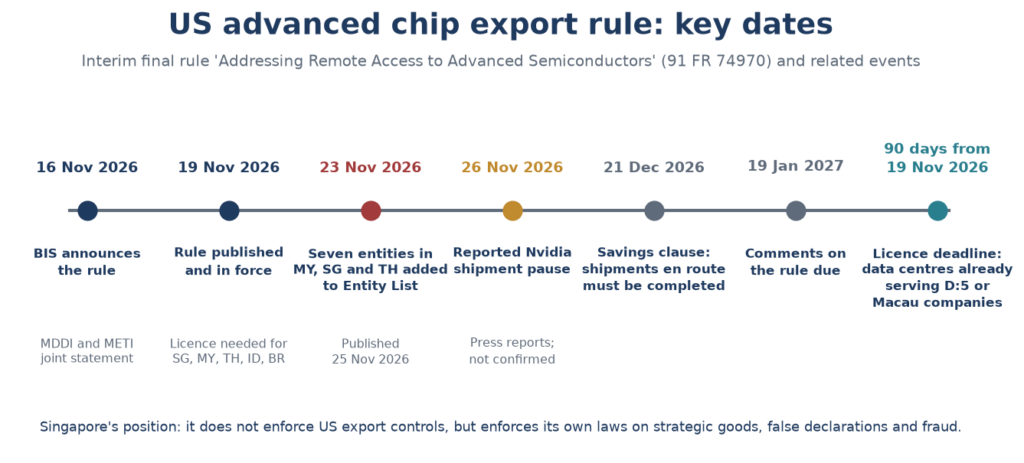
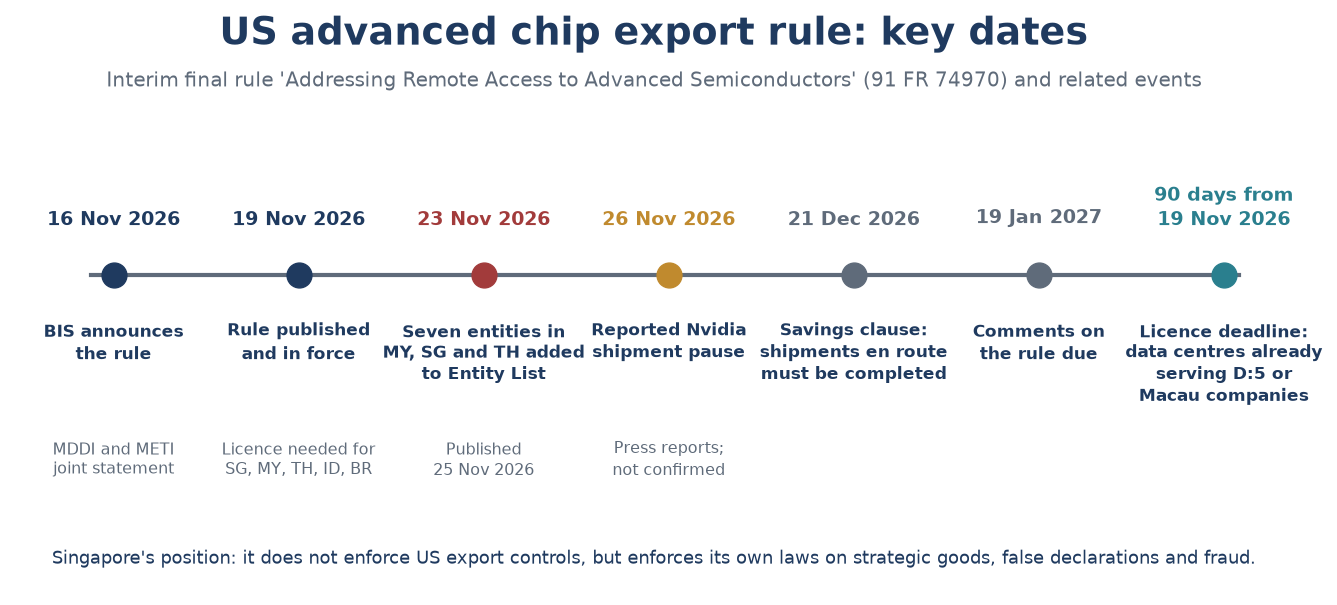
BIS announced the rule in a press release dated 16 November 2026. It was published in the Federal Register on 19 November 2026 as an interim final rule, Addressing Remote Access to Advanced Semiconductors (91 FR 74970), effective the same day. Comments are due by 19 January 2027. The rule uses the term “Super Intelligence” (SI) where earlier rules said “AI”.
The rule does four main things:
- A licence for five countries. A licence is now needed to export, re-export or transfer within the country advanced SI chips and related items to or within Indonesia, Malaysia, Singapore, Thailand and Brazil. BIS says these countries present a higher than normal risk of diversion. Applications are reviewed case by case. BIS says destinations will be judged on the effectiveness of their export control regimes and how they work with BIS on enforcement.
- An exclusion for US-headquartered buyers. The licence requirement does not apply where the ultimate consignee or end user is headquartered in the United States, or has a US ultimate parent, provided the exporter files monthly reports with BIS.
- A remote access control. A licence is needed if the exporter knows the items will be used in a data centre, anywhere in the world, that will give more than 12,000,000 “aggregate TPP” (a measure of total processing performance) of computing power to companies headquartered in Macau or a Country Group D:5 destination, or whose ultimate parent is. There is an exception for commercial recommender systems, such as those used by online retailers.
- A 90-day window. A data centre that was already providing significant computing power to such customers before the rule was published must obtain a licence within 90 days of the effective date if it wants to continue, or face future export restrictions.
The rule also formally rescinds the 2025 AI Diffusion Rule, and has a savings clause for shipments already en route on 19 November 2026, provided they are completed by 21 December 2026.
The reported Nvidia pause
On 26 November 2026 the Financial Times reported, citing people familiar with the matter, that Nvidia had told manufacturing partners such as Dell and Supermicro to stop shipping servers containing its chips to Malaysia, Singapore, Thailand and Indonesia. The report said it was unclear whether the halt would be temporary while Nvidia and its partners work through the new compliance requirements. The Wall Street Journal and Nikkei Asia carried similar reports. Nvidia has not commented publicly on the reports. Until Nvidia or its partners confirm it, the pause should be treated as reported, not established.
On 27 November 2026, asked about the reports at the SPH Asia Future Summit, Deputy Prime Minister Gan Kim Yong said, according to the official transcript: “We have not confirmed it. We are in the process of engaging our businesses, to reach out to them, to see what is the impact on their businesses.”
Singapore’s response to the rule
In a joint statement on 16 November 2026, the Ministry of Digital Development and Information (MDDI) and the Ministry of Energy, Trade and Industry (METI) said they were studying the measure, engaging affected companies, and engaging US authorities on its scope and implementation and on how to facilitate trusted access for Singapore companies. On 17 November, Minister Josephine Teo and US Under Secretary of Commerce Jeffrey Kessler agreed to follow up on practical arrangements for continued trusted access, and BIS said it intends to hold industry briefings.
Does Singapore enforce US export controls?
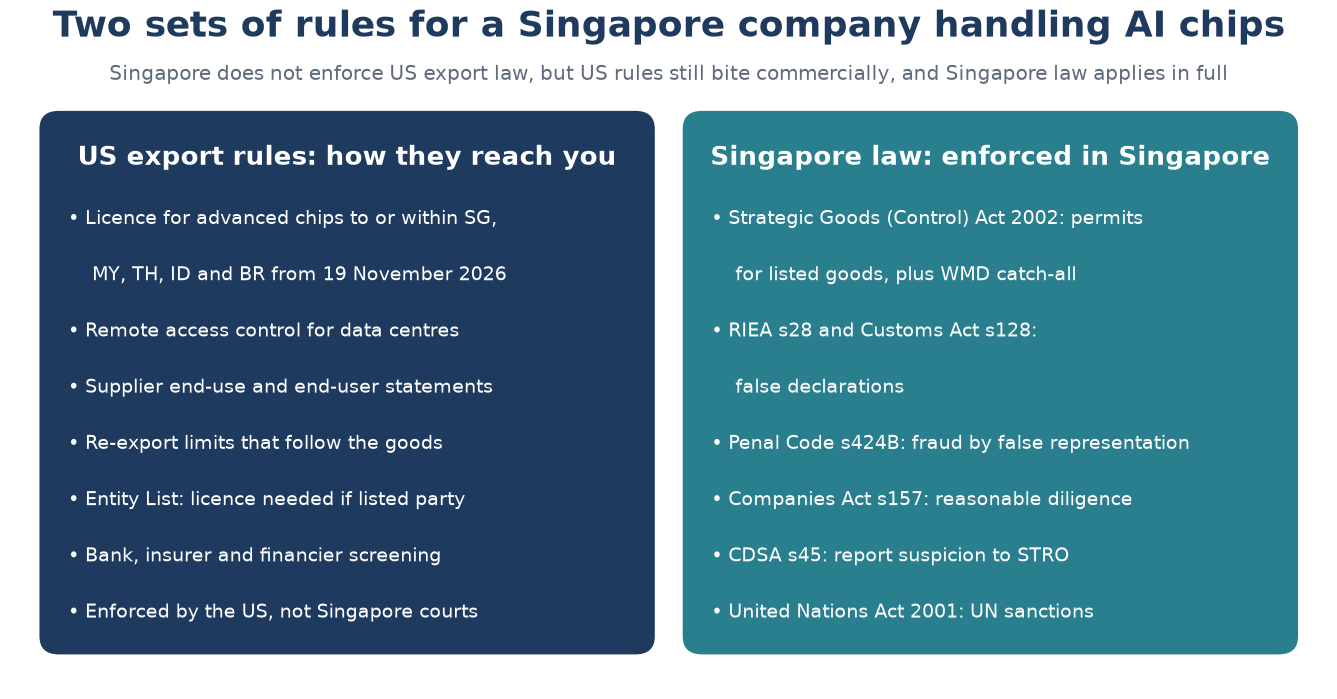
No. Singapore does not enforce US export law. It does enforce its own laws, and it expects companies here to take foreign export controls into account.
Prime Minister Lawrence Wong put it plainly on 24 November 2026, in the transcript published by the Prime Minister’s Office: “We do not enforce America’s export controls. But we do not want Singapore to be used and abused as a conduit by companies who circumvent America’s export controls.” He added that Singapore facilitates checks by the US to enforce its own laws, and will take firm action against companies caught breaching Singapore laws.
The Ministry of Home Affairs said the same on 12 November 2026: Singapore does not enforce unilateral export controls imposed by other countries, but expects all companies operating here to take such regulations into account in their international business. DPM Gan said on 27 November that Singapore is reviewing how to strengthen its regulations and monitoring so that it does not become a conduit for illegal transactions.
So the honest answer for a Singapore company is in two parts. A US rule cannot be prosecuted in a Singapore court. But lying to a supplier or to Singapore Customs to get around a US rule can be a Singapore offence, and the commercial consequences of the US rule land on Singapore companies regardless.
How do US chip export controls still reach a Singapore company?
Through the goods, the supply chain, the contracts and the money, not through Singapore’s courts.
- The rules travel with the goods. Under the US Export Administration Regulations (EAR), US-origin items remain subject to US control when they are re-exported from one foreign country to another, or transferred within a country. Foreign-made items can also be caught: by the de minimis rules, where they contain more than a set share of controlled US content, and by the foreign direct product rules. The new rule says BIS keeps jurisdiction over a covered chip after it is built into a foreign-made GPU board or server, and that re-exporters may not rely on de minimis where there is knowledge of a prohibited data centre end use.
- Supplier paperwork. The new rule expects exporters to obtain enough information from a foreign data centre about its “know your customer” checks, including whether customers are owned or controlled from D:5 destinations or Macau. If the data centre declines or cannot provide that information, the rule text treats it as a red flag that presumptively gives the exporter “knowledge”. Expect US suppliers and distributors to ask for more end-use and end-user statements, and to refuse orders where answers are thin.
- Notices that follow the equipment. Where an exporter ships without a licence because it has no knowledge of a prohibited end use, the rule requires it to tell the recipient that BIS authorisation is needed if the equipment is later used to give the covered level of computing power to D:5 or Macau companies. A later change of use by a data centre operator counts as a transfer that needs authorisation.
- The Entity List. BIS can add foreign companies to its Entity List, after which a licence is needed for transactions involving items subject to the EAR where the listed party is involved. On 23 November 2026 BIS added seven entities in Malaysia, Singapore and Thailand, three of them under Singapore, citing the risk of diversion of advanced computing commodities, with a licence requirement for all items subject to the EAR and a presumption of denial. A customer can become very hard to supply overnight.
- Banks, insurers and financiers. Lenders and insurers apply their own sanctions and export control screening. Expect more questions about ownership, customers and end use before any chip or data centre financing.
- Country consequences. BIS says it will monitor for countries that tolerate evasion and may consider consequences, including Entity List designations for foreign persons involved.
Which Singapore laws apply to chip and server deals?
Singapore law applies to every Singapore company, whatever the US position. These are the main ones to know.
Strategic Goods (Control) Act 2002
The Strategic Goods (Control) Act 2002 (SGCA), administered by Singapore Customs, regulates the export, transhipment, transit, intangible transfer of technology, and brokering of strategic goods and strategic goods technology. According to Singapore Customs, it covers items on the Strategic Goods Control List, plus a “catch-all” for any goods or technology intended, or likely, to be used for weapons of mass destruction, even if not listed. A permit is needed for each controlled transfer, and Customs asks applicants to apply at least five working days before shipment for an individual permit, or seven working days before transmission for technology. Brokering certain listed categories needs registration at least 14 working days in advance.
A new list, the Strategic Goods (Control) Order 2026, takes effect on 1 December 2026, so companies should recheck their products against it. Whether a particular GPU or server is on Singapore’s list is a classification question about its technical specification. It is not answered by the US rule. If you are unsure, use Singapore Customs’ determination process rather than assume either way. On a first conviction for key SGCA offences, Singapore Customs says the penalty is a fine of up to S$100,000 or three times the value of the goods, whichever is higher, or up to two years’ imprisonment, or both.
Regulation of Imports and Exports Act 1995 and Customs Act 1960
Under section 28 of the Regulation of Imports and Exports Act 1995, it is an offence to make a declaration or produce a document that is false in a material particular, unless the person proves they took all reasonable steps to check it. The penalty is a fine of up to S$10,000, up to two years’ imprisonment, or both. A person who signs such a document is deemed to be cognisant of everything in it.
Section 128 of the Customs Act 1960 makes it an offence to make or sign a declaration or document required by the Act that is untrue, incorrect or incomplete. It is no defence that it was done inadvertently, or that the signer did not understand the document. Every TradeNet declaration should be checked before it is filed.
Penal Code 1871: fraud by false representation
Under section 424B of the Penal Code 1871, it is an offence to fraudulently or dishonestly make a false representation, punishable by up to 20 years’ imprisonment, a fine, or both.
This is the offence at the centre of the Singapore server fraud case. On 27 February 2025 the Singapore Police Force (SPF) announced that three men would be charged with fraud by false representation on suppliers of servers, after a joint operation with Singapore Customs. In July 2026 the SPF said the charges allege that the accused falsely represented to server suppliers that a group company would be the end user of the servers, and that four companies also face fraud charges, the first time companies were prosecuted in these investigations. One of the charges listed is abetting a director of another company to omit to exercise reasonable diligence under the Companies Act. By 13 November 2026, five individuals and six companies had been charged, including money laundering charges against companies alleged to have acquired servers from a charged company. These are allegations. The cases are before the courts and no finding of guilt has been made.
Minister for Home Affairs K Shanmugam said in March 2025 that if there were false representations within Singapore about the final destination of servers, that is an offence under Singapore law. That is the core lesson: an end-user certificate given to a supplier is a representation, and a false one can be a Singapore crime.
Companies Act 1967
- Directors’ duties. Section 157(1) requires a director to act honestly and use reasonable diligence in the discharge of the duties of the office. For more, see our guide to directors’ duties under section 157.
- Accounting records. Section 199 requires records that sufficiently explain the company’s transactions, kept for at least five years from the end of the relevant financial year.
- Register of registrable controllers. Companies must keep their register of registrable controllers up to date. Suppliers and banks will often ask who really owns and controls you, and you should be able to answer quickly. See our note on ACRA’s beneficial ownership requirements.
Anti-money laundering and sanctions
Under section 45 of the Corruption, Drug Trafficking and Other Serious Crimes (Confiscation of Benefits) Act 1992 (CDSA), anyone who, in the course of business, knows or has reasonable grounds to suspect that property is connected with criminal conduct must report it to the Suspicious Transaction Reporting Office as soon as reasonably practicable, whether or not the transaction went ahead. Failing to do so can be an offence, with fines of up to S$500,000 for a company. Separately, the United Nations Act 2001 allows regulations giving effect to UN Security Council sanctions, which bind persons in Singapore.
What should Singapore companies look out for?
Start with the product, then the counterparty, then the paperwork.
Two product questions, asked separately
- Does the US rule catch it? The rule covers advanced computing chips and the items built around them under the US export classifications 3A090 and 4A090 and related “.z” items. Ask your supplier for the export classification in writing.
- Is it on Singapore’s Strategic Goods Control List? That is a separate test under Singapore law, based on technical specification. A “yes” to one question does not mean a “yes” to the other.
Red flags in a deal
These are practical warning signs, drawn from the kinds of facts described in the official releases above. Any one of them is a reason to stop and ask more questions:
- a buyer that was set up recently, or whose size and business do not fit the order;
- vague or changing answers about end use, or a one-line end-user form with nothing behind it;
- reluctance to say where the equipment will be installed or who will use it;
- a freight forwarder or logistics company named as the consignee;
- goods routed through Singapore with no local use, or due to leave Singapore soon after they arrive;
- requests to re-label, split or reroute shipments;
- payment from unrelated third parties, through unusual routes, or in cash;
- a data centre customer that will not explain who its own customers are. The US rule itself treats this as a red flag.
How should you check customers and end users?
Treat know-your-customer work as evidence you may one day need to show a supplier, a bank or an investigator.
- Identify the real owner. Check who owns and controls each customer, reseller and data centre tenant, including indirect ownership. The US remote access rule turns on where a company, or its ultimate parent, is headquartered.
- Screen. Check buyers, consignees and their owners against the US Entity List and other US screening lists as a commercial risk. A listing does not make a deal a Singapore offence, but it will usually end supply from US-linked vendors.
- Get end-use and end-user statements. Ask for signed statements naming the end user, the installation site and the intended use, and keep the supporting evidence: site visits, photos, delivery records.
- Check the story fits. Compare the order with the customer’s business, power capacity and staff. If it does not add up, ask.
- Record your reasoning. Note what you checked, what you found and why you went ahead or declined.
- Report suspicion. If you know or reasonably suspect that property is linked to crime, the CDSA duty to report to STRO may apply.
Which contract clauses should you review?
Most of the risk shows up first in contracts, so read them now rather than after a shipment stalls.
- Export compliance warranties. Each party warrants it will comply with applicable export control laws, and that statements about end use and end users are true.
- End-use and no re-export undertakings. The buyer promises not to re-export, transfer or change the use of the equipment without your consent and any needed authorisation.
- Information and audit rights. You can ask for records, ownership information and end-user details, and inspect where needed.
- Suspension and termination. You can suspend or end the contract if a licence is refused or delayed, a party is added to a restricted list, or a red flag is not resolved.
- Licence delay and supply risk. Decide who bears the cost if a licence takes time, and check whether your supplier’s allocation, lead time and price terms protect you if shipments pause, as has been reported.
- Force majeure. Check whether a change in law or a supplier’s compliance hold is covered. Many clauses are narrower than people assume.
- Indemnities. Look at who indemnifies whom for losses caused by a false statement or a breach of export rules.
What does each type of business need to watch?
- Trading and distribution firms. Know what you are reselling, who the real end user is and whether the goods will leave Singapore. Do not rely on a bare end-user form.
- Data centres and cloud resellers. The Federal Register rule makes the customer mix a licence issue where a data centre gives more than the threshold of computing power to companies headquartered in D:5 destinations or Macau, including through linked data centres. Know who owns each major tenant and who uses the compute remotely. Operators already serving such customers face the 90-day licence window.
- AI start-ups renting or buying GPUs. Expect longer lead times, more supplier questions and possible licence conditions. Plan procurement and cash flow around delay, and keep your own ownership records clean so you can pass supplier checks.
- Groups with Southeast Asian subsidiaries. The licence requirement covers re-exports and transfers within the country for all five listed countries, so moving covered equipment between group entities across borders may need authorisation. Check before you move it.
- Everyone. Expect banks and insurers to ask for attestations on end use and ownership before financing or covering chip-related deals.
What should the board do?
Directors do not need to be export control experts, but section 157 expects reasonable diligence. A board that knows its business depends on advanced chips and never asks who the end users are may find that hard to defend.
- Map the exposure. List the products, customers, suppliers and subsidiaries that involve advanced chips or AI servers.
- Name a compliance owner. Make one person responsible for export control and sanctions checks, reporting to the board.
- Adopt a written compliance programme. Keep it short and practical: screening, end-user checks, escalation and approvals.
- Check ownership and control of every major customer and reseller.
- Keep the records. Signed end-user statements, delivery evidence, screening results and the reasons for each decision, kept for at least the five years section 199 requires for accounting records.
- Fix the contracts using the clauses above.
- Minute it. Record that the board considered the risk, what it decided and why. Our guide to board meetings and minutes explains the formalities.
- Never sign a declaration you cannot back up. Under the RIEA a signer is deemed to know what the document says.
For a recent example of how a director’s declaration can lead to prosecution, see our sister site’s note on the strike-off declaration case, and our Insight on nominee directors and the GST refund fraud case.
When should you get legal advice?
Singapore does not enforce US law, but a Singapore company still breaks Singapore law if it lies to get US-controlled goods. Get advice early in any of these situations:
- you are not sure whether a product is caught by the US rule or by Singapore’s Strategic Goods Control List;
- a customer or its owner is headquartered in, or linked to, a D:5 destination or Macau;
- a counterparty is, or may soon be, on the US Entity List;
- you run a data centre or resell compute and may be near the remote access threshold, or already serve such customers within the 90-day window;
- a supplier, bank or insurer asks you to sign an attestation you are not sure you can support;
- you have spotted a red flag on a past transaction, or you think a report to STRO may be needed;
- you plan to move covered equipment between group companies in different countries.
How Raffles Corporate Services can help
Raffles Corporate Services handles the corporate side, and RLC Law Corporation, the law firm we work with, handles the legal side.
We can keep your register of registrable controllers, statutory registers and board minutes in order, prepare board resolutions adopting a compliance programme, and help you show suppliers and banks who owns and controls your company. For questions of law, including export control exposure, contracts and declarations, we can refer you to RLC Law Corporation. See our corporate secretarial services or email [email protected].
Frequently asked questions
Has Nvidia banned chip exports to Southeast Asia?
No ban has been announced by Nvidia or any government. The Financial Times and others reported on 26 November 2026 that Nvidia told server partners to pause shipments to Singapore, Malaysia, Thailand and Indonesia while it works out how to comply with a new US rule. Nvidia has not commented publicly, and Singapore says it has not confirmed the reports.
What does the new US rule require?
From 19 November 2026, a US licence is needed to export, re-export or transfer advanced AI chips and related items to or within Singapore, Malaysia, Thailand, Indonesia and Brazil. Licences are reviewed case by case. Buyers headquartered in the US, or with a US ultimate parent, are excluded if the exporter files monthly reports with BIS.
Does Singapore enforce US export controls?
No. Prime Minister Lawrence Wong said on 24 November 2026: “We do not enforce America’s export controls.” Singapore expects companies here to take foreign export controls into account, and it enforces its own laws on strategic goods, false declarations and fraud.
Can a Singapore company break Singapore law over a US-controlled chip deal?
Yes. Making a false representation to a supplier about who the end user is can be fraud under section 424B of the Penal Code, and a false declaration to Singapore Customs is an offence under the Regulation of Imports and Exports Act and the Customs Act. Shipping listed strategic goods without a permit is an offence under the Strategic Goods (Control) Act.
Are AI chips and servers on Singapore’s Strategic Goods Control List?
It depends on each item’s technical specification. The US licence rule and Singapore’s list are separate tests. If you are unsure, use Singapore Customs’ determination process rather than assume either way.
What is the 90-day licence window for data centres?
A data centre that was already giving significant computing power to companies headquartered in Macau or a Country Group D:5 destination before the rule was published must obtain a US licence within 90 days of 19 November 2026 to keep providing those services.
What should a Singapore board do now?
Map which products, customers and subsidiaries involve advanced chips, name a compliance owner, check who owns and controls major customers, keep signed end-user statements and decision records, update contracts, minute the board’s review, and get legal advice on anything borderline.
This article is general information as at 27 November 2026 and is not legal advice. Export control rules are changing quickly, so check the current Federal Register text and Singapore Customs guidance, or speak to a lawyer, before you act.
Last updated 27 November 2026
Need help with this?
Raffles Corporate Services can handle the ACRA filings, compliance documentation and records for you, and where court proceedings or legal advice are needed, we work with a panel of experienced Singapore law firms who offer cost-effective and efficient legal service and advice.
Email: [email protected]
Call, SMS or WhatsApp: +65 8501 7133