
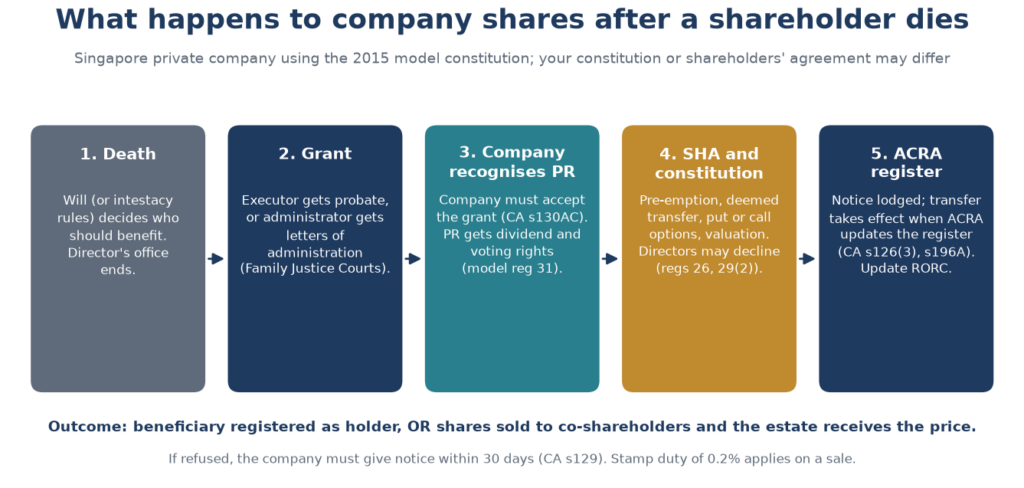
Quick answer
Raffles Corporate Services works with a panel of experienced Singapore law firms who offer cost-effective and efficient legal service and advice. This article is general information only and is not legal advice.
If you own shares in a private company, putting those company shares in a will is one of the most useful things you can do for your family and for the business. A will names the executor who will deal with the shares and says who should benefit. But a will does not work alone. The company’s constitution and any shareholders’ agreement may restrict who can hold the shares, give other shareholders the first right to buy them, or let directors refuse to register a new holder. A will cannot override those rules, so a gift of shares can turn into a right to the sale money instead. The safest approach is to plan the will, the constitution and the shareholders’ agreement together, with the company’s continuity in mind, so the business can keep trading, paying staff and meeting ACRA deadlines after a shareholder or director dies.
Key takeaways
- Shares in a Singapore company form part of your estate. Without a will, they pass under the Intestate Succession Act 1967 to relatives in fixed shares, who may not be the right people to own the business.
- The executor or administrator needs a grant of probate or letters of administration before the company will act on the shares. That can take months.
- The constitution and shareholders’ agreement usually decide what really happens to the shares. A will that ignores them may not work as intended.
- A company must always have at least one director ordinarily resident in Singapore. If the only director dies, nobody may be able to sign, pay or appoint a replacement until the estate is sorted out.
- A lasting power of attorney covers loss of mental capacity, not death. It ends on death and cannot be used to make a will.
- Review the will, constitution, shareholders’ agreement and insurance together, and again after any major life or business event.
Contents
- Why should company shares be in your will?
- What happens to your shares if you die without a will?
- What makes a will valid in Singapore?
- How do shares actually pass after death?
- How does the shareholders’ agreement interact with your will?
- Why must the will fit the company’s interests?
- What if the only director or shareholder dies?
- Does a lasting power of attorney solve the problem?
- Are there taxes or duties on inherited shares?
- What admin must the company do after a death?
- Practical checklist for business owners
- When should you get legal advice?
- How Raffles Corporate Services can help
- Frequently asked questions
Why should company shares be in your will?
For many owners, the company is the most valuable thing they own, and also the hardest asset to deal with after death.
A bank balance can be paid out. A flat can be sold. Shares in a private company are different. They come with voting control, board seats, obligations under a shareholders’ agreement, and a business that has to keep running while the estate is being administered. Dealing with company shares in a will lets you decide three things that the law will otherwise decide for you:
- Who deals with the shares. Your executor steps into your shoes for the shares until they are transferred. Choosing someone who understands the business, or who will work with your co-shareholders, makes a real difference.
- Who benefits. You can leave the shares to the family member who works in the business, give other family members other assets of equal value, or direct that the shares be sold and the money shared.
- How the gift fits the company’s rules. A well drafted will anticipates pre-emption rights, transfer restrictions and buy-out clauses, rather than colliding with them.
The point is not only to protect your family. It is to protect the company, its staff, customers and co-shareholders from months of uncertainty.
What happens to your shares if you die without a will?
Without a will, your shares pass under fixed statutory rules, whatever your wishes for the business.
For non-Muslims, section 7 of the Intestate Succession Act 1967 sets out the order. For example, if you leave a spouse and children, your spouse takes one half of the estate and your children share the other half equally. If you leave a spouse and parents but no children, your spouse takes half and your parents take half.
That can leave a 60% shareholding split between a spouse and several children, some of them minors, none of whom may want or be able to run the business. Co-shareholders may suddenly find themselves dealing with a group of new owners who need to agree among themselves before anything can be decided.
An administrator also has to be appointed. The Family Justice Courts’ guidance on letters of administration says the application should be filed within six months of death and usually takes about two to three months, depending on how complex the case is.
Muslim estates follow different rules. Section 2 of the Intestate Succession Act 1967 says that Act does not apply to the estate of any Muslim. Under the Administration of Muslim Law Act 1966, section 112, the estate of a Muslim domiciled in Singapore who dies intestate is distributed according to Muslim law, as modified where applicable by Malay custom. Section 111 says a Muslim domiciled in Singapore may only dispose of property by will in accordance with the school of Muslim law that he or she professes. Muslim business owners should take specific advice on how shares can be dealt with.
What makes a will valid in Singapore?
The formal rules are short, but getting them wrong can make the whole will fail.
Under the Wills Act 1838:
- You must be at least 21 years old to make a valid will (section 4).
- The will must be in writing and signed at the foot or end by you, or by someone else in your presence and at your direction (section 6).
- You must sign or acknowledge your signature in the presence of two or more witnesses present at the same time, and they must sign in your presence (section 6).
- Marriage revokes an existing will, unless the will was expressed to be made in contemplation of that marriage (section 13).
The marriage rule catches many business owners by surprise. A carefully planned gift of shares can be undone simply by getting married or remarried without updating the will.
How do shares actually pass after death?
Shares do not move straight to the beneficiary. They pass through the personal representative, and the company has to update its records.
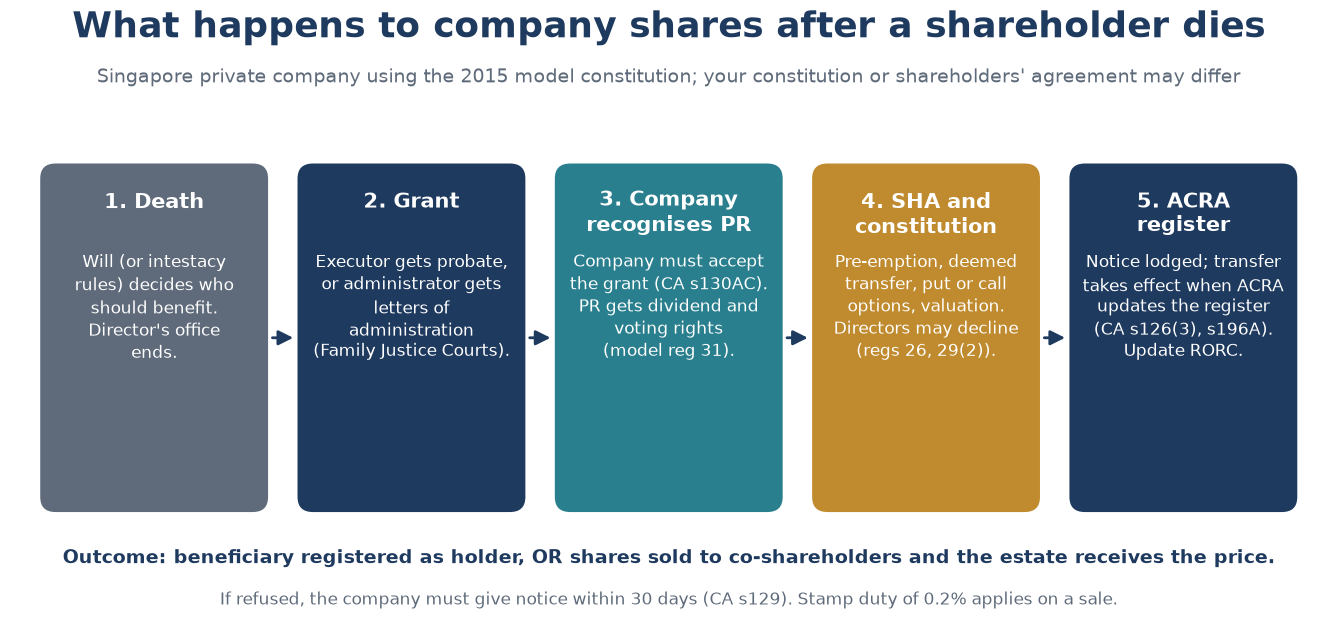
Step 1: The grant
The executor (if there is a will) applies for a grant of probate, or a beneficiary (if there is no will) applies for letters of administration. The Family Justice Courts explain that estates worth up to S$5 million are dealt with in the Family Courts and larger estates in the Family Division of the High Court. For smaller estates not exceeding S$50,000, the Public Trustee has discretion to administer the estate instead.
Step 2: The company recognises the personal representative
Under section 130AC(2) of the Companies Act 1967, the company must accept a document that is by law sufficient evidence of the grant, despite anything in its constitution. Section 130AC(1) also says a transfer signed by the personal representative is as valid as if they had been a member when they signed it.
Most private companies use, or are based on, the model constitution in the Companies (Model Constitutions) Regulations 2015. In its First Schedule:
- Where a sole holder dies, the company may recognise only the legal personal representatives as having any title to the shares (regulation 28(1)). Where a joint holder dies, it may recognise only the survivors (regulation 28(2)).
- A person entitled because of the death may, on producing the evidence the directors properly require, elect to be registered as holder or nominate someone else to be registered as transferee (regulation 29(1)).
- Once that evidence is produced, the personal representative is entitled to the same dividends and the same rights in relation to meetings, voting or otherwise as the deceased (regulation 31).
Step 3: The directors’ discretion
This is where the will meets the company’s rules. Under regulation 29(2) of the model constitution, directors have the same right to decline or suspend registration on a transmission as they would have had on a transfer by the member before death. Regulation 26 lets directors decline to lodge a transfer if the shares are not fully paid, if they do not approve of the transferee, or if the company has a lien on the shares.
If directors refuse, section 129 of the Companies Act requires the company to notify the transferor and transferee within 30 days. Where the refusal relies on a discretion in the constitution, the company must, within 30 days of the application, give the applicant a written notice stating the facts said to justify the refusal.
Step 4: ACRA updates the register
For private companies, ACRA keeps the electronic register of members under section 196A. Under section 126(3), a transfer of shares in a private company does not take effect until that register is updated by the Registrar. In practice, the new owner is not a member until the ACRA filing is done.
For a step-by-step look at what an executor can and cannot do before registration, see our guide on the rights of an executor of a deceased shareholder and updating the registers after a grant of probate.
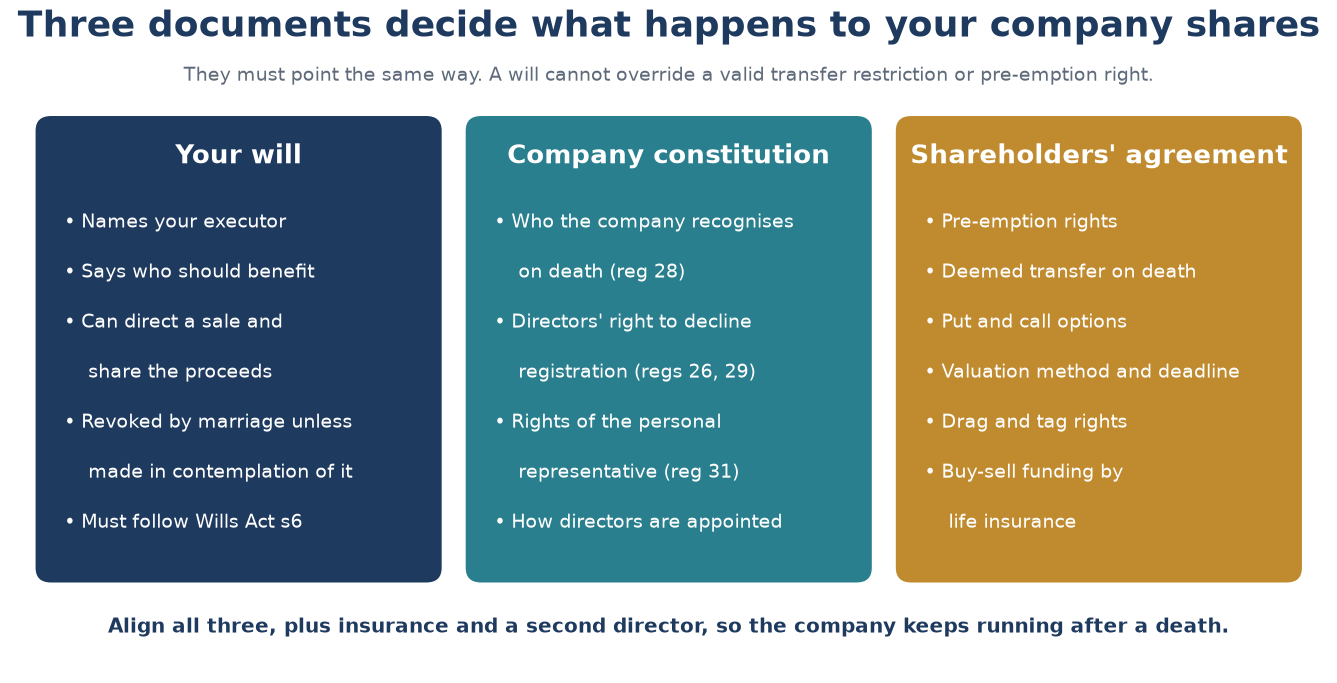
How does the shareholders’ agreement interact with your will?
In a company with more than one owner, the shareholders’ agreement often matters more than the will.
A will says who you would like to receive your shares. A shareholders’ agreement is a contract that may already have decided what must happen to them. Common clauses include:
| Clause | What it usually does on death | What it means for your will |
|---|---|---|
| Pre-emption right | Other shareholders get first refusal to buy the shares before they go to anyone else | Your beneficiary may receive the sale price rather than the shares |
| Deemed transfer notice | Death is treated as an offer to sell the shares to the other shareholders | The executor may be obliged to sell, often within a set period |
| Call option | Remaining shareholders can require the estate to sell | Your family cannot insist on keeping the shares |
| Put option | The estate can require the remaining shareholders to buy | Your family has a guaranteed exit and cash |
| Valuation clause | Sets the price, for example fair value fixed by the auditor or an independent valuer | Decides what your family actually receives |
| Drag and tag rights | Let a majority force, or a minority join, a sale to a third party | May affect the shares later, after they are inherited |
| Permitted transferee | Allows transfers to family members or a family trust without triggering pre-emption | Can let the shares pass as your will intends |
A will cannot override a valid transfer restriction
If the constitution or shareholders’ agreement validly restricts transfers, your executor takes the shares subject to those restrictions. Leaving shares to your son does not stop your co-shareholders exercising a pre-emption right or a call option. The practical effect is that the gift becomes a gift of whatever the shares are sold for.
That is not necessarily bad. Many owners prefer their family to receive cash at a fair price rather than a minority stake in a business they cannot control. The problem arises when the will, the constitution and the agreement point in different directions and nobody realises until after the death.
Put and call options need a price and a deadline
An option on death is only as good as its mechanics. A good clause sets out:
- what triggers it (death, and often incapacity);
- who can exercise it and by when, for example within 90 days after the grant;
- how the price is fixed, for example fair value determined by the company’s auditor or an independent valuer, and whether a minority discount applies;
- when the price is paid, and in what instalments if the buyers need time; and
- what happens if nobody exercises it.
Without a deadline, the estate can be left in limbo. Without a valuation method, the family and the remaining shareholders may end up in a dispute over price.
Funding the buy-out with insurance
The remaining shareholders often cannot afford to buy a deceased partner’s shares at short notice. Many businesses solve this with a buy-sell agreement funded by life insurance. There are two common structures:
- Cross-shareholder insurance. Each shareholder insures the lives of the others. On a death, the survivors receive the payout and use it to buy the shares from the estate.
- Key-person insurance. The company insures a key shareholder or director. The payout helps the company survive the loss and can, depending on the structure, support a share buyback.
Insurance, the buy-sell agreement and the will should all say the same thing. If the insurance is meant to fund a purchase of the shares, the will should not also leave those shares outright to someone else.
Why must the will fit the company’s interests?
A shareholder’s death is a family event, but it is also a business event. The company has its own obligations that do not pause.
Think about what could stop working on the day after a death:
- Signing authority. If the deceased was a director and authorised signatory, nobody may be able to sign contracts, approve payments or file returns until a new director is appointed and the board passes new resolutions.
- Bank mandates. Banks act on the mandate the board has given them. When a signatory dies, the bank may restrict operations on the account until it receives new board resolutions and updated signatories. Payroll and supplier payments can stop.
- Licences and approvals. Some licences name key officers or require a qualified person. Losing that person may need to be reported to the regulator.
- Change-of-control clauses. Loans, leases, franchise agreements and key customer contracts often let the other side terminate if ownership or control changes. A transmission of a controlling stake may trigger them.
- Statutory deadlines. Annual returns, AGMs where required, and tax filings keep running. Under section 157 the remaining directors must still act honestly and use reasonable diligence.
So the will should be drafted with the company in mind. That might mean choosing an executor who can work with the board, leaving voting control to one person rather than splitting it, or directing that shares be offered to co-shareholders first. Directors also have their own duties under section 157, which is one reason the board should know the succession plan in advance.
What if the only director or shareholder dies?
This is the situation most likely to freeze a company completely.
Section 145(1) of the Companies Act requires every company to have at least one director who is ordinarily resident in Singapore. If that director dies and there is no other director, the company is immediately without anyone who can run it.
The usual way to appoint a new director is by the board or by the shareholders. If the deceased was also the only shareholder, there may be nobody to do either until a grant is issued. Under the model constitution, the personal representative gets the deceased’s rights in relation to meetings and voting once they produce the evidence the directors properly require (regulation 31). Whether that is enough to appoint a new director depends on the company’s actual constitution, which is why it is worth checking now and, if necessary, amending it.
Steps that help:
- Appoint a second director now, ideally one who is ordinarily resident in Singapore and trusted by the family.
- Do not rely on an alternate director alone. Under regulation 98(3)(b) of the model constitution, an alternate must vacate office if the appointer vacates office as a director, which includes death. See our guide to alternate directors.
- Check the constitution for a clause dealing with appointments when no director remains, and consider adding one.
- Make sure the will appoints an executor who can act quickly, and that the original will can be found.
Under section 171(4A), the office of company secretary must not be left vacant for more than six months at any one time. If the deceased director was also the secretary, that clock matters too.
Our article on the death of a sole director and shareholder walks through the recovery steps in more detail.
Does a lasting power of attorney solve the problem?
No. A lasting power of attorney (LPA) covers loss of mental capacity during your lifetime. It does not cover death.
Under the Mental Capacity Act 2008, section 13, a donee may only make decisions where the donor lacks capacity, or the donee reasonably believes the donor lacks capacity. Section 13(9) says a property and affairs donee may not execute a will for the donor. The authority ends when the donor dies, and the executor takes over.
For business owners, an LPA is still important. A property and affairs donee may be able to deal with your shares as an asset, for example by voting or receiving dividends, while you are incapacitated. But an LPA does not make the donee a director. Directorship is a personal office. If you are the only director and you lose capacity, the company may still need someone else on the board. The company’s constitution and shareholders’ agreement may also have their own incapacity triggers.
Our related article on a donee buying an incapacitated shareholder’s shares covers some of the conflict issues.
Are there taxes or duties on inherited shares?
Singapore has no estate duty on deaths since 2008, but stamp duty can still apply on some share transfers.
- Estate duty. IRAS confirms estate duty has been removed for deaths on and after 15 February 2008.
- Stamp duty on a sale. Stamp duty on a transfer of shares is 0.2% of the purchase price or the value of the shares, whichever is higher, according to IRAS. For private companies, value is generally based on net asset value. A sale to co-shareholders under a pre-emption right or option will normally attract stamp duty.
- Distribution from an estate. IRAS lists a distribution from the estate of a deceased person that is not in accordance with the will, the Intestate Succession Act or Muslim law of inheritance as a type of acquisition on which stamp duty is payable. If the family agrees to rearrange who gets the shares, check the stamp duty position first.
What admin must the company do after a death?
The company secretary and remaining directors have filings to make, and the clock starts at the death.
- Notify ACRA of the director’s cessation. ACRA notes the company must report a person’s cessation as a director within 14 days. Section 173A sets the 14-day period for notifying changes in directors and other officers.
- Update the shareholder record. ACRA’s guide on updating shareholder information says that if a shareholder has passed away, the company updates their status and date of death. Their name stays on the company profile until the shares are transferred out.
- File the transfer or transmission. ACRA asks companies to update share ownership within 14 days.
- Update the register of registrable controllers. If the deceased was a registrable controller, the company must update its register of registrable controllers and identify any new controller. See our guide to controller requirements.
- Refresh bank mandates and signatories with new board resolutions.
- Give notice of general meetings to the person entitled to the shares, if the constitution requires it.
Practical checklist for business owners
Use this list to check whether your company shares and your company would cope with your death or incapacity:
- Make a will that deals expressly with your company shares, and name an executor who can act quickly and work with the board.
- Read the company’s constitution for transfer restrictions, directors’ discretion to refuse registration, and transmission rules.
- Read the shareholders’ agreement for pre-emption rights, deemed transfer on death, put and call options, valuation and deadlines.
- Make sure the will, constitution and shareholders’ agreement say the same thing. If they do not, change whichever is wrong.
- Consider a buy-sell agreement funded by cross-shareholder or key-person insurance, and check that the policy terms match it.
- Appoint at least one other director, ordinarily resident in Singapore, so the company is never left without a board.
- Make an LPA for incapacity, and remember it does not cover death or directorships.
- Check bank mandates so payments can continue if one signatory dies.
- Review change-of-control clauses in loans, leases and key contracts.
- Keep the will, constitution, shareholders’ agreement, share certificates, insurance policies and registers together, and tell your executor where they are.
- Review everything after marriage, divorce, the birth of a child, a new investor, a share sale or a move overseas.
When should you get legal advice?
Speak to a lawyer who handles wills and succession if:
- you hold a significant or controlling stake, or you are the only director or shareholder;
- your shareholders’ agreement or constitution has transfer restrictions or options you do not fully understand;
- you want to leave shares unequally between children, or to someone outside the family;
- you have shareholders, assets or family overseas;
- you are Muslim and want to understand how Muslim law affects your shares;
- you are considering a trust or holding company structure; or
- you have recently married, divorced or brought in new investors.
How Raffles Corporate Services can help
Raffles Corporate Services keeps the company side in order, and works with a panel of law firms that specialise in wills and succession for the legal side.
We can review your company’s constitution, registers of members, directors and controllers, and point out gaps that could cause problems after a death, such as a single director, an outdated constitution or unclear bank mandates. We can prepare board and shareholder resolutions, help appoint additional directors, and handle ACRA filings when a director or shareholder passes away. Raffles Corporate Services is not a law firm and does not give legal advice. Where you need a will, a shareholders’ agreement or succession advice, we can introduce you to law firms on our panel who specialise in this area. See our corporate secretarial services or email [email protected].
Frequently asked questions
Can I leave my company shares to anyone I like in my will?
You can name anyone as beneficiary, but the company’s constitution and any shareholders’ agreement may restrict who can actually be registered as a holder. If co-shareholders have pre-emption rights or a call option, your beneficiary may receive the sale price instead of the shares.
Does a will override the shareholders’ agreement?
No. A valid transfer restriction or pre-emption right in the constitution or shareholders’ agreement still applies after your death. Your executor takes the shares subject to those rules, so the will, constitution and agreement should be planned together.
What happens to my shares if I die without a will in Singapore?
For non-Muslims, they pass under section 7 of the Intestate Succession Act 1967. For example, a surviving spouse takes half and the children share the other half. An administrator must obtain letters of administration before dealing with the shares.
Can directors refuse to register shares inherited by a beneficiary?
They may, if the constitution gives them that discretion. Under the model constitution, directors have the same right to decline registration on a transmission as on an ordinary transfer. If they refuse, the company must give notice within 30 days under section 129 of the Companies Act.
What happens if the only director of a company dies?
The company has no one to run it, and section 145 requires at least one director ordinarily resident in Singapore. If the director was also the only shareholder, a new director usually cannot be appointed until the personal representative obtains a grant. Appointing a second director in advance avoids this.
Does a lasting power of attorney cover my shares after I die?
No. An LPA only works while you are alive and lack mental capacity. It ends on death, and a donee cannot make a will for you. After death, your executor or administrator deals with the shares.
Is there estate duty on inherited shares in Singapore?
No. Estate duty has been removed for deaths on and after 15 February 2008. Stamp duty of 0.2% may still apply if the shares are sold, for example to co-shareholders under a buy-out clause.
Can Raffles Corporate Services draft my will?
No. Raffles Corporate Services is not a law firm. We can review your company’s constitution and registers, and introduce you to law firms on our panel that specialise in wills and succession.
This article is general information as at 28 November 2026 and is not legal advice. The effect of a will on company shares depends on the will, the company’s constitution, any shareholders’ agreement and your personal circumstances, so speak to a lawyer before you act.
Last updated 28 November 2026
Need help with this?
Raffles Corporate Services can handle the ACRA filings, compliance documentation and records for you, and where court proceedings or legal advice are needed, we work with a panel of experienced Singapore law firms who offer cost-effective and efficient legal service and advice.
Email: [email protected]
Call, SMS or WhatsApp: +65 8501 7133