

ACRA’s grants page carries two items, and both of them are aimed at accounting practices rather than at ordinary Singapore companies. If you run a trading company, a consultancy or a restaurant, there is nothing on that page for you, and the sooner you know that the better.
Raffles Corporate Services works with a panel of experienced Singapore law firms who offer cost-effective and efficient legal service and advice. This article is general information only and is not legal advice.
That is worth saying plainly, because many business owners arrive at this page by searching for “Singapore business grants” and assume the regulator that holds their company registration must also hold the funding. It does not. ACRA is the registry and the accountancy regulator. Funding for the wider economy sits with Enterprise Singapore, IMDA, Workforce Singapore and the Economic Development Board.
What ACRA does support is the digitalisation of small and medium-sized accounting practices: the firms doing audit, tax, corporate secretarial and bookkeeping work. If that is you, the numbers below matter.
What is actually on ACRA’s grants page?
Two schemes, and they do different jobs.
The Accountancy Industry Digital Plan is not money. It is a published roadmap that tells a small practice which digital tools to consider at each stage of its development, and which staff training goes with them. It was put together by the Singapore Accountancy Commission, the Institute of Singapore Chartered Accountants and IMDA, and it sits under IMDA’s SMEs Go Digital programme. It is free to download from ACRA’s site.
The Productivity Solutions Grant for the accountancy sector is money. It part-funds the cost of adopting a pre-approved digital solution in an accounting practice.
The sensible order is to read the roadmap first and apply for the grant second, because the roadmap is what stops a firm buying practice management software it is not ready to use.
The two schemes side by side
| Accountancy Industry Digital Plan | PSG for the accountancy sector | |
|---|---|---|
| What it is | A roadmap and training guide | Co-funding for approved digital solutions |
| Cost to you | Free download | Application, then co-payment of your share |
| Who it is for | Small and medium-sized practices | Small and medium-sized practices |
| Application needed | No | Yes, through the Business Grants Portal |
| Status as at 16 September 2026 | Available | Applications closed |
What the PSG for accountancy actually funds
The grant covers digital solutions in five areas of practice: external audit management, taxation management, corporate secretariat management, practice management, and data analytics.
Eligible costs run wider than the licence fee alone. Software licences, subscription fees, professional services and training that are directly related to the approved solution can all be counted. That matters, because implementation and training are usually where the real money goes in a small firm.
You do not choose the vendor freely. Solutions and vendors have to come from the pre-approved list published on the Productivity Solutions Grant website. A tool that is perfect for your practice but not on that list is simply not fundable under this scheme.
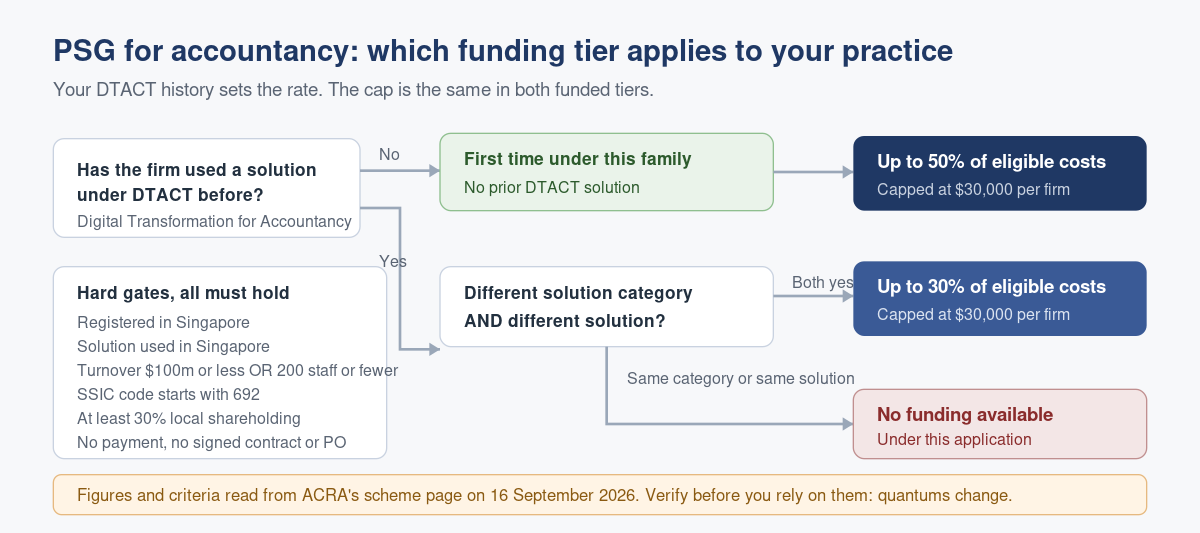
How much you get depends on your DTACT history
This is the part firms get wrong. The funding tier is set by whether the practice has previously used a digital solution under the Digital Transformation for Accountancy programme, and if so, whether this application is for something genuinely different.
| Your situation | Funding available |
|---|---|
| Never used DTACT | Up to 50% of eligible costs, capped at $30,000 per firm |
| Used DTACT before, and this application is for a different solution category and a different solution | Up to 30% of eligible costs, capped at $30,000 per firm |
| Used DTACT before, and this application is for the same solution category or the same solution | No funding |
Read the middle row carefully. Both conditions have to hold. A firm that took DTACT support for tax software and now wants a different tax product is applying within the same category, and that lands it in the bottom row, not the middle one.
Who qualifies
Your practice has to satisfy every one of these, not a selection of them:
- The business is registered in Singapore.
- The digital solution will be used in Singapore.
- The firm counts as a small or medium-sized practice, on either test: annual group sales turnover of $100 million or less, or group employment size of 200 workers or fewer.
- Your primary or secondary Singapore Standard Industrial Classification code begins with 692, the code range covering accounting, bookkeeping, auditing and tax consultancy services.
- At least 30% local shareholding.
- You have not paid any supplier, vendor or third party for the solution.
- You have not signed or confirmed any contract or purchase order for the solution.
The turnover and headcount test is generous because it is an either-or. Almost every genuine Singapore practice clears it. The two that actually disqualify firms are the SSIC code and the timing.
If your SSIC does not start with 692, you are outside the scheme even if accounting is most of what you do. That is a registry problem with a registry fix: your SSIC codes are part of your ACRA record and can be updated. Check what ACRA currently holds for you before you assume you are ineligible.
The steps, in order
Assuming applications are open when you read this:
- Get Corppass access for whoever will submit. Without it you cannot reach the Business Grants Portal at all. If your practice is newly set up, our guide to setting up Corppass for a new Singapore company covers the sequence.
- Choose a solution and a pre-approved vendor from the PSG solutions list.
- Get a written quotation from that vendor. Do not sign it.
- Assemble the supporting documents: main contact person, the letter of offer addressee (which must be the chief executive or managing director as registered with ACRA, or another authorised person), the vendor’s quotation, any supporting licences, the deployment location or tenancy agreement where relevant, a cost breakdown, and a description of the expected productivity gains.
- Submit through the Business Grants Portal.
- Wait for the letter of offer. Only then commit.
- Implement, and use the solution.
- Claim. The first claim comes once you have used the solution for at least six months, measured from grant approval or implementation, whichever is earlier, with a six-month report. The second claim comes at eighteen months on the same basis, with an eighteen-month report. Both claims require that you have paid in full for the relevant subscription year and have accepted the letter of offer.
- Register for PayNow Corporate against your UEN, because approved funds are disbursed that way.
Where it goes wrong: signing first
The single most common way a practice loses this grant is by signing the vendor’s contract or paying a deposit before the application is in. The eligibility conditions are explicit that no payment and no signed contract or purchase order may exist for the solution. A vendor keen to close the sale in the same quarter will happily send you a purchase order to sign “so we can hold the pricing”. Sign it and you have disqualified yourself, and no appeal will fix it, because the condition is not about intent.
The second failure is treating the letter of offer as a formality. Approval is not automatic, and spending in anticipation of it means you carry the whole cost if it never arrives.
The third is the claims window. Reimbursement is not paid on installation. It is paid after you have used the solution for a qualifying period and filed the report. A firm that buys a tool, abandons it after three months and then tries to claim has nothing to claim with. This is the same discipline that decides most grant outcomes across the board, and it is worth reading our note on why grant applications get rejected before you start.
One more thing that catches firms at year end: grant money is not automatically tax-free or outside the GST net. The treatment depends on what the grant is for and how it is structured. Our guide to the tax treatment of government grants in Singapore sets out how to book it properly.
Applications are closed. What now?
As at 16 September 2026, ACRA’s page states that applications for the accountancy PSG have closed. Closed is not abolished, and schemes in this family are routinely refreshed with new windows and revised quantums, so prepare rather than give up.
Fix your SSIC code if it does not start with 692. That takes a filing and a little time, and it is a hard gate.
Do the roadmap exercise. Decide which solution category you actually need next. Firms that apply on day one of a window are the ones that did this thinking during the closure.
Look at what is open. Broader enterprise funding does not sit with ACRA. The current shape of that landscape is covered in our notes on the Business Refresh Package under Budget 2026 and the 2026 EDGE grant timeline. For training cost recovery, SkillsFuture Enterprise Credit is the one most small practices forget they hold.
Frequently asked questions
Can my trading company get a grant from ACRA?
No. ACRA’s grants page carries only accountancy sector schemes, aimed at small and medium-sized accounting practices. Funding for other industries is administered by Enterprise Singapore, IMDA, Workforce Singapore and other agencies, and applications generally go through the Business Grants Portal rather than through ACRA.
How much is the accountancy PSG worth?
Up to 50% of eligible costs, capped at $30,000 per firm, if your practice has never used a solution under the Digital Transformation for Accountancy programme. If it has, and the new application is for both a different solution category and a different solution, the rate drops to up to 30% with the same cap. Verify current rates before applying.
What happens if I already signed the vendor contract?
You are ineligible for that solution. The criteria require that no payment has been made and no contract or purchase order signed or confirmed for the digital solution before application. There is no waiver for having signed in good faith, so the sequence is quotation, then application, then letter of offer, then contract.
Does the Accountancy Industry Digital Plan cost anything?
No. It is a free downloadable roadmap covering digital solutions to adopt and staff training to undertake at each stage of a practice’s digital development. There is no application and no approval process. It was developed jointly by the Singapore Accountancy Commission, ISCA and IMDA under the SMEs Go Digital programme.
My firm does accounting work but our SSIC code is something else. Are we out?
Under this scheme, yes, as it stands. The criterion is that your primary or secondary SSIC code starts with 692. SSIC codes form part of your ACRA registration and can be updated by filing, so this is usually a fixable problem rather than a permanent bar. Fix it before the next application window.
Getting the boring parts right before you apply
Grant applications fail on administration far more often than on merit. The SSIC code that was never updated. The director whose ACRA record still shows an old title, so the letter of offer addressee does not match the registry. The Corppass role that was never assigned, discovered at 11pm on the closing day.
Raffles Corporate Services keeps that layer clean for several hundred Singapore companies, including a good number of professional practices: registry records that match reality, Corppass access that works, and filings done inside their deadlines. If you are planning an application and are not certain your ACRA record supports it, that is a short conversation and usually a quick fix.
You can reach us through Raffles Corporate Services, or read more on Singapore corporate secretarial practice at Singapore Secretary Services.
— The Editorial Team, Raffles Corporate Services
Need help with corporate secretarial or compliance matters?
If you would like help with your company's corporate secretarial, governance or compliance requirements, email [email protected] or WhatsApp +65 8501 7133.
Our team can assist with corporate secretarial, accounting and tax matters. Where legal advice is needed, advisers from our associated law firms can assist.