

Four things need doing in your first weeks as a registered limited partnership: apply for Corppass, download the free Business Profile before it expires at 60 days, settle each partner’s MediSave position with the CPF Board, and diarise the registration renewal. Miss the last two and your LP quietly stops being a limited partnership at all.
Raffles Corporate Services works with a panel of experienced Singapore law firms who offer cost-effective and efficient legal service and advice. This article is general information only and is not legal advice.
That last point is the one worth reading twice. Unlike a company, an LP is not registered once and left alone. Its registration runs for a fixed term, and if it lapses, ACRA does not strike you off. It converts you. The entity keeps the same name and the same UEN, but the limited liability that was the whole reason you chose the structure is gone.
So the post-registration checklist for an LP is not administrative housekeeping. It is what keeps the structure you paid for.
What the LP structure actually gives you, and what it asks in return
A limited partnership under the Limited Partnerships Act 2008 has at least one general partner and at least one limited partner. The general partner runs the business and carries unlimited liability for its debts. The limited partner puts in capital, takes a share of profits, and is not liable beyond the agreed contribution.
The LP is not a separate legal entity. Section 4 of the Act makes the general law of private partnerships apply unless the Act says otherwise, which is why the partners, not the firm, remain the legal persons behind the contracts.
The price of the limited partner’s protection is set out in Section 6: a limited partner must not take part in the management of the limited partnership. The First Schedule to the Act lists acts that are not regarded as taking part in management, which is the safe harbour. Step outside it and the limited partner can be treated as a general partner for the period concerned, with the liability that goes with it.
This matters in month two, not month twenty. A limited partner who signs a supplier contract, hires the first employee, or starts instructing staff because the general partner is travelling has done something the Act notices.
The immediate tasks, and their deadlines
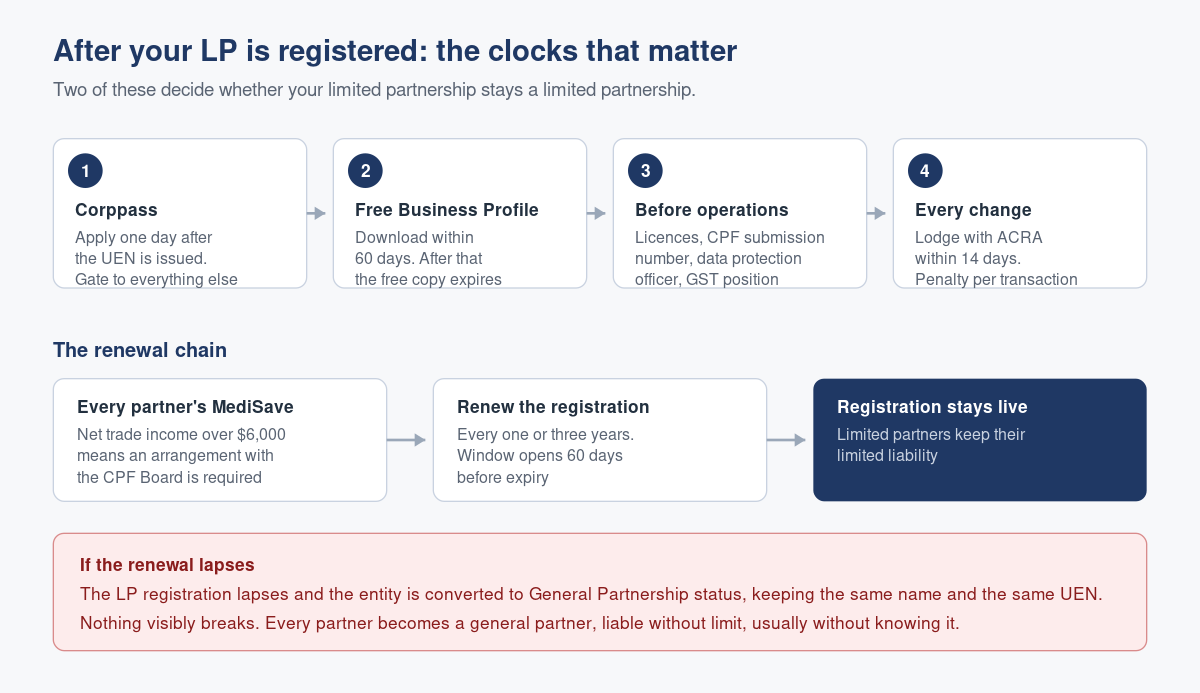
| Task | Timing | What happens if you skip it |
|---|---|---|
| Apply for Corppass | You can apply one day after the UEN is issued | You cannot transact with ACRA, IRAS, CPF or any other agency online |
| Download the free Business Profile | Within 60 days of registration | The free copy expires and you pay for it afterwards |
| Open a corporate bank account | Immediately after registration | Mixed personal and business money, which makes the tax position and the partners’ capital accounts a mess |
| Check licences and permits | Before you start operations | Trading without a required licence is an offence under the relevant sector legislation, not under the LP Act |
| Arrange MediSave with the CPF Board | Before renewal falls due | Outstanding MediSave blocks the renewal of your registration |
| Apply for a CPF Submission Number | Before your first payroll | You cannot make monthly CPF contributions for employees |
| Register a Data Protection Officer | Before you handle customer data | A standing obligation under the Personal Data Protection Act 2012 |
| Renew the registration | Every one or three years, renewable up to 60 days before expiry | The LP registration lapses and the entity converts to General Partnership status |
Corppass is the gate in front of nearly everything else, so do it first. Our walkthrough on setting up Corppass for a new entity covers the administrator appointment and the e-service assignments, and our note on what Bizfile is and is not explains which transactions you will actually be doing there.
The free Business Profile is worth collecting on day one
You get one free Business Profile after registration, and the free copy expires 60 days later. Download it immediately and save it somewhere your bank, your landlord and your insurers can be sent a copy from. Every one of them will ask for it, and after 60 days you are buying it.
MediSave is the requirement that catches LP partners
If you or your partners have annual net trade income exceeding $6,000, each of you must have made arrangements with the CPF Board either to pay your MediSave contributions in full, or to pay them by monthly instalments.
The consequence ACRA attaches to this is specific and severe: if you or your partners have outstanding MediSave payments, you will not be able to renew the LP’s registration. The renewal is not blocked by anything the firm did. It is blocked by an individual partner’s personal CPF position.
That is a governance problem, not an accounting one. A general partner who has diligently kept the firm’s filings current can still find the renewal refused because a limited partner has not logged in to the CPF self-employed dashboard in two years. Check every partner’s position at least 90 days before renewal, not on the day.
You can check the outstanding MediSave payable and set up an instalment arrangement on the CPF Board’s self-employed dashboard. CPF’s own explainer on saving under the Self-Employed Scheme covers the mechanics, and our guide to CPF MediSave contributions for self-employed persons sets out how the amount is worked out.
The renewal clock, and what happens when it runs out
You must renew the LP’s registration every one or three years to keep it active. ACRA lets you renew up to 60 days before expiry, which is the window to use.
If you do not renew, the LP registration lapses and the entity is converted to General Partnership status, with the same UEN and the same business name.
Read that consequence carefully, because it is unusually easy to miss. Nothing visibly breaks. The name is unchanged, the UEN is unchanged, invoices still look right and the bank account still works. What has changed is that there are no longer any limited partners. Every partner is now a general partner of a general partnership, exposed to the firm’s debts without limit, and probably unaware of it.
We have seen this discovered during due diligence, years later, by the buyer’s lawyers. By then the exposure has already existed for the whole intervening period.
Two practical defences:
- Choose the three-year term if the LP is a long-term vehicle, then diarise the renewal at 90 days, 60 days and 30 days before expiry, with the MediSave check at the 90-day mark.
- Make the renewal somebody’s named job in the partnership agreement. “The general partner shall keep the registration current” is a sentence worth having in writing.
Ongoing filing, display and accounting duties
Changes go to ACRA within 14 days. Any change in the LP’s registered particulars must be lodged within 14 days. Section 18 of the Limited Partnerships Act 2008 deals with registration of changes in particulars, and late lodgement attracts ACRA’s late lodgement penalties. The penalty is charged per late transaction, so a firm that lets three changes drift accumulates three of them.
The name and UEN go on your documents. The LP’s name and its UEN must be displayed on business documents including invoices, official receipts and letters to government agencies. Section 26 of the Act deals with publication of name.
Accounts must be kept. Section 27 of the Act covers accounts and audit for limited partnerships. An LP does not file financial statements with ACRA the way a company does, but that is not the same as having no obligation to keep proper books, and IRAS will want them regardless.
Partners must supply information to the firm. Section 18A imposes a duty on partners and managers to provide information to the limited partnership, which exists so the general partner can meet the 14-day filing deadline. If a limited partner changes address and tells nobody, the firm is still late.
Tax: the partner is taxed, not the partnership
An LP is transparent for income tax. Profits are taxed in the hands of the partners: individual partners at personal income tax rates, corporate partners at corporate tax rates. The firm itself does not pay income tax on its profits.
GST is different, and there is an LP-specific trap in it. Registration is compulsory once taxable turnover exceeds $1 million in a calendar year, or once you reasonably expect it to exceed $1 million in the next 12 months. For partnerships, taxable turnover/gst-registration-deregistration/do-i-need-to-register-for-gst) is assessed on the combined turnover of all partnership businesses with the same partners.
That last sentence is the one to underline. If the same two people run three partnerships, each turning over $400,000, none crosses the threshold alone and all three are compulsorily registrable on the combined figure. Our guide to compulsory versus voluntary GST registration works through both limbs.
If you do register, note the InvoiceNow requirement: from 1 April 2026, all new voluntary GST registrants must transmit invoice data to IRAS through the InvoiceNow network, regardless of business structure. Choose your accounting software with that in mind rather than migrating twice.
What goes wrong in practice
The renewal lapses and nobody notices. The single most expensive failure in the LP structure, because the loss of limited liability is invisible until someone looks.
A partner’s MediSave blocks the renewal at the last minute. The renewal window is 60 days. An instalment arrangement with the CPF Board is not always set up in an afternoon. Check early.
The limited partner drifts into management. Usually with the best intentions, covering for an absent general partner. Read Section 6 and the First Schedule with your limited partners at the start, not after a creditor has taken an interest.
Three partnerships, one GST threshold. The combined-turnover rule for partnerships with the same partners catches people who genuinely believed they were under the line.
Changes are filed late because the partners did not tell the general partner. The 14-day clock runs from the change, not from the day the general partner found out.
Frequently asked questions
How often must a Singapore limited partnership renew its registration?
Every one or three years, depending on the term you chose. You can renew up to 60 days before expiry. If you do not renew, the LP registration lapses and ACRA converts the entity to General Partnership status, keeping the same name and UEN but removing the limited partners’ protection.
What happens if an LP partner has not paid MediSave?
The renewal of the LP’s registration will be blocked. Each partner with annual net trade income exceeding $6,000 must have arranged with the CPF Board either to pay MediSave in full or by monthly instalments. The firm’s own compliance record does not cure an individual partner’s arrears.
Does a limited partnership file annual returns or financial statements with ACRA?
No. An LP does not file annual returns or financial statements the way a company does. Its ACRA obligations are to renew the registration on time, to lodge changes in registered particulars within 14 days, and to keep proper accounts under the Limited Partnerships Act 2008.
Can a limited partner help run the business?
Not without risk. Section 6 of the Limited Partnerships Act 2008 says a limited partner must not take part in management, and the First Schedule lists the acts that are not treated as management. Step outside that safe harbour and the limited partner can be treated as a general partner, with unlimited liability for that period.
How long do we have to download the free Business Profile?
Sixty days from registration. After that the free copy expires and you buy it from Bizfile like anyone else. Download it on day one and keep the PDF somewhere your bank, landlord and insurers can be sent a copy from.
Is a limited partnership a separate legal entity?
No. The general law of private partnerships applies unless the Limited Partnerships Act 2008 provides otherwise. If you want a structure with its own legal personality and its own liability shield, you are looking at a company or a limited liability partnership.
Keeping the structure you paid for
An LP is a good structure when you want passive capital alongside an active operator. It is also the one structure in Singapore that can silently degrade into something worse if a diary entry is missed.
Raffles Corporate Services handles LP registrations and the renewal cycle that follows, including the partner-by-partner MediSave check well before the renewal window opens. If you are not certain when your LP’s registration expires, or whether every partner is clear with the CPF Board, that is a short piece of work and much cheaper than finding out late.
If you have not registered yet, start with our note on registering a limited partnership.
You can reach us through Raffles Corporate Services, or read more on Singapore corporate secretarial practice at Singapore Secretary Services.
— The Editorial Team, Raffles Corporate Services
Need help with corporate secretarial or compliance matters?
If you would like help with your company's corporate secretarial, governance or compliance requirements, email [email protected] or WhatsApp +65 8501 7133.
Our team can assist with corporate secretarial, accounting and tax matters. Where legal advice is needed, advisers from our associated law firms can assist.