

A registered Singapore branch of a foreign company closes in one of three ways: you lodge a notice of cessation because the branch has stopped carrying on business here, you lodge notice that the head office has gone into liquidation or been dissolved abroad, or the Registrar strikes the branch off. Which one applies is decided by facts, not by preference.
Raffles Corporate Services works with a panel of experienced Singapore law firms who offer cost-effective and efficient legal service and advice. This article is general information only and is not legal advice.
This matters because a branch is not a separate company. It is the foreign company itself, registered under Division 2 of Part 11 of the Companies Act 1967 so that it may carry on business in Singapore. There is no liquidation of the branch as such, no distribution to shareholders, no final meeting. The Singapore registration simply ends, and the register records why.
What there is, however, is a set of short deadlines that fall on named individuals rather than on the company. Section 377 is the provision that does all the work, and it is worth understanding before you begin. The screen-by-screen mechanics are in our companion guide on filing cessation or dissolution of a foreign company; this article is the map of which route you are on.
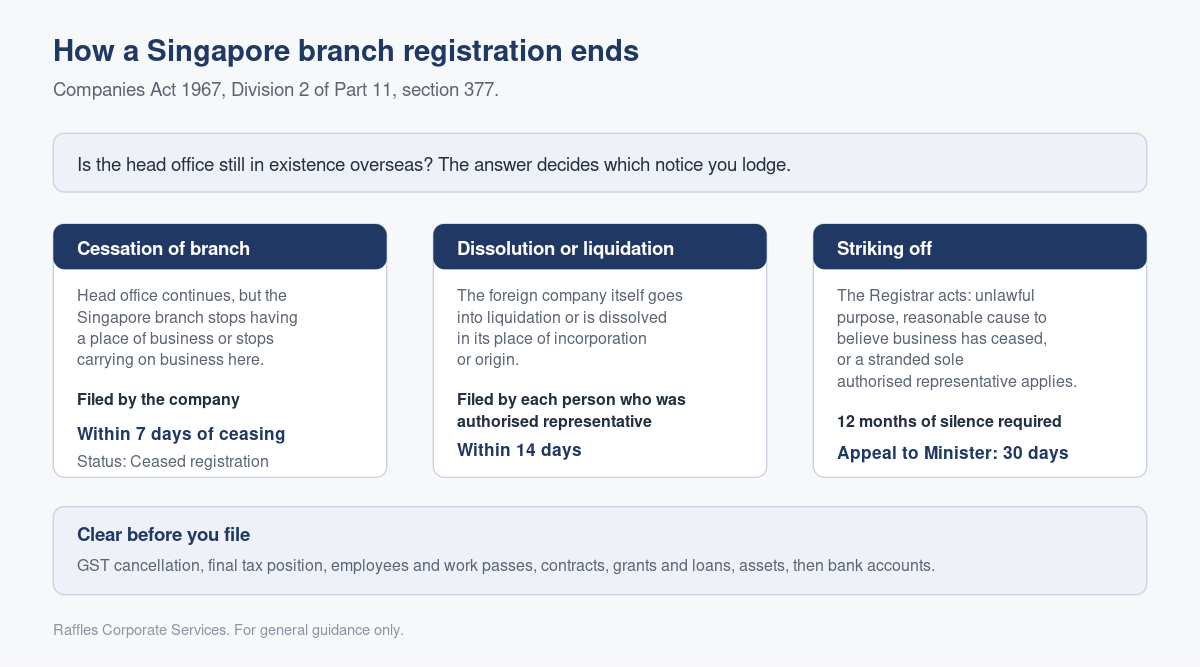
The three routes, side by side
| Route | When it applies | Who must act | Deadline |
|---|---|---|---|
| Cessation of branch | The foreign company ceases to have a place of business in Singapore, or ceases to carry on business here | The foreign company | Within 7 days of ceasing |
| Dissolution or liquidation of the head office | The foreign company goes into liquidation or is dissolved in its place of incorporation or origin | Each person who was an authorised representative immediately before the liquidation commenced | Within 14 days of the commencement of the liquidation or the dissolution |
| Striking off by the Registrar | The Registrar acts on statutory grounds, or the sole authorised representative applies | The Registrar, on its own initiative or on application | Not applicable |
Note who the obligation attaches to in the middle row. It is not the head office and it is not the liquidator overseas. It is each person who held the role of authorised representative immediately before the liquidation proceedings commenced. Resigning after the event does not remove the duty, because the duty is fixed by reference to who held the role at that moment.
Route one: the branch stops trading in Singapore
This is the ordinary commercial case. The regional office is being consolidated elsewhere, the Singapore contract has ended, the project is complete.
Section 377(1) requires the foreign company, within 7 days after it ceases to have a place of business in Singapore or ceases to carry on business in Singapore, to lodge notice of that fact with the Registrar. Seven days is short, and it runs from the factual event, not from the board’s decision to tidy up the paperwork.
There is a genuine benefit to lodging promptly. Under section 377(1A), from the day the notice is lodged, the foreign company’s obligation to lodge any further document with the Registrar ceases. That relief does not extend backwards: anything that ought to have been lodged before that day is still due. So the annual filing you were already late on does not disappear because you have now ceased. It just stops the clock on everything from that point forward.
The Registrar must then, as soon as practicable, record in the register that the company has ceased to have a place of business or ceased to carry on business in Singapore. The entity status on Bizfile changes accordingly.
What “ceases to carry on business” actually means
Directors tend to read this narrowly and assume it means closing the office. In practice either limb triggers it: no place of business, or no business being carried on. A branch that has surrendered its lease, moved its people out and is running down a handful of receivables has arguably ceased to have a place of business even though a bank account remains open. The safer approach is to fix a cessation date deliberately, document it in a head office resolution, and lodge within 7 days of that date. Bizfile will not accept a future cessation date, so you cannot pre-file and forget.
Route two: the head office is wound up or dissolved abroad
If the foreign company goes into liquidation or is dissolved in its place of incorporation, the Singapore registration cannot survive it. The branch has no separate legal existence to continue with.
Section 377(2) places the duty on each person who, immediately before the commencement of the liquidation proceedings, was an authorised representative. That person must, within 14 days after the commencement of the liquidation or the dissolution (or within such further time as the Registrar allows in special circumstances), lodge or cause to be lodged notice of that fact. When a liquidator is appointed, notice of the appointment must also be lodged.
On receiving notice that the foreign company has been dissolved, section 377(5) requires the Registrar to record the dissolution in the register.
The practical consequence is that the local authorised representative needs to be told what is happening overseas, and told quickly. A 14-day deadline is unworkable if news of the parent’s liquidation reaches Singapore a month later through a third party. Where a group is planning an insolvency process, the Singapore branch should be on the notification list from the outset. And “further time in special circumstances” is a discretion, not an entitlement. Plan on 14 days.
Route three: striking off
Striking off a foreign company is a different creature from a local company strike-off. It is largely the Registrar’s tool, with one narrow opening for a stranded authorised representative.
Section 377(8) requires the Registrar to strike the name of a foreign company off the register where satisfied that the company is being used for an unlawful purpose, for purposes prejudicial to public peace, welfare or good order in Singapore, or against national security or interest. That one is mandatory.
Section 377(9) is discretionary. The Registrar may strike the name off where there is reasonable cause to believe the company has ceased to carry on business or to have a place of business in Singapore, or where the company has failed to appoint an authorised representative within 6 months after the death of its sole authorised representative.
Section 377(10) is the route that matters to a person trapped in the role. The Registrar may strike the company off on the application of the sole authorised representative, in the prescribed form, where satisfied that either:
- the sole authorised representative gave written notice of a desire to resign, lodged the corresponding notice under section 370(3), and the company failed to respond or appoint a replacement within 12 months of that lodgment; or
- the company failed to respond within 12 months to a written request from the sole authorised representative asking whether it wishes to cancel or continue its Singapore registration.
That is a long wait, but it is an exit. The provisions of the Act relating to striking off defunct companies apply with the necessary adaptations, and any person aggrieved by a decision under section 377(8), (9) or (10) may appeal to the Minister within 30 days of the decision, whose decision is final. Our note on the trapped nominee director’s exit covers the parallel problem on the local company side and the evidential trail you should be building.
What to clear before you file
Lodging the cessation notice is quick. It is everything sitting behind it that takes the time, and ACRA’s filing screens will not stop you closing with loose ends.
- Cancel GST registration with IRAS where the branch is registered. IRAS sets out the cancellation process/gst-registration-deregistration/cancelling-gst-registration), and it is not automatic on cessation.
- Settle corporate tax. The branch’s Singapore tax position has to be closed out, including any final return and outstanding assessments.
- Deal with employees and work passes. Cancellations, notice periods, final salary, CPF and pass cancellation with MOM all run on their own timelines.
- Complete or assign contractual obligations. Leases, service agreements, customer contracts and supplier terms do not end because the register says “ceased registration”.
- Resolve loans, grants and incentives. Government support with clawback conditions can be triggered by cessation.
- Transfer or dispose of assets, including vehicles and any registered intellectual property held in the branch’s name.
- Close the bank accounts last, once everything else has cleared.
Missing any of these does not block the ACRA filing. It simply leaves an obligation attached to a foreign company with no local presence and no local representative, which is a much harder thing to fix afterwards.
What goes wrong in practice
The seven days are treated as seven days from the paperwork. The clock in section 377(1) runs from the factual cessation. By the time a head office has approved a closure memo, appointed advisers and instructed the Singapore representative, the window has usually gone.
The authorised representative finds out too late. In a parent-company insolvency, the Singapore branch is rarely anyone’s priority. The 14-day duty in section 377(2) still bites on the individuals who held the role, regardless of whether anyone told them.
Somebody assumes cessation cures earlier defaults. It does not. Section 377(1A) is forward-looking only. Outstanding annual filings and any accumulated penalties survive the cessation notice.
The branch is closed when a subsidiary was the better structure all along. If the group is restructuring rather than leaving, incorporating a subsidiary or transferring the registration may be the real answer. Our guides on the Singapore branch office of a foreign parent and on re-domiciliation of foreign companies into Singapore set out the alternatives. And a representative office is a different animal with a different closing process and its own three-year limit: see our note on the representative office sunset.
A local company that stops trading must also cancel its GST registration. See cancelling GST registration when closing a company.
Frequently asked questions
Does a Singapore branch have to be liquidated before it can be closed?
No. The branch is not a separate legal entity, so there is no branch liquidation. You lodge a notice of cessation if the branch stops carrying on business here, or a notice of dissolution or liquidation if the foreign company itself is wound up or dissolved in its place of incorporation.
How quickly must the cessation be reported to ACRA?
Within 7 days after the foreign company ceases to have a place of business in Singapore or ceases to carry on business in Singapore. The 7 days run from the factual cessation, not from the date the decision is documented or the filing is prepared.
Who is responsible for filing when the overseas parent is wound up?
Each person who was an authorised representative immediately before the commencement of the liquidation proceedings. They have 14 days after the commencement of the liquidation or the dissolution, unless the Registrar allows further time in special circumstances, and must also notify any liquidator’s appointment.
Can a sole authorised representative get the branch struck off if the head office goes silent?
Yes, in defined circumstances. Where the sole authorised representative has given notice of a desire to resign and lodged the corresponding notice, or has asked in writing whether the company wishes to continue its registration, and the company has not responded within 12 months, the Registrar may strike the company off on application.
Does filing the cessation notice clear outstanding ACRA filings?
No. From the day the notice is lodged, the obligation to lodge further documents ceases, but anything that ought to have been lodged before that day remains due. Late lodgement exposure accrued before cessation is unaffected.
Can I appeal if the Registrar strikes the branch off?
A person aggrieved by the Registrar’s decision to strike a foreign company off may appeal to the Minister within 30 days after the date of the decision. The Minister’s decision is final.
Closing cleanly, from Singapore
The paperwork side of closing a branch is genuinely light. The risk sits in the gap between an overseas decision and a Singapore deadline, and in the obligations that outlive the registration because nobody closed them first.
Raffles Corporate Services acts as authorised representative for foreign companies registered in Singapore, runs the cessation and dissolution filings inside their statutory windows, and works through the tax, employment and contractual clearance list before the register is closed rather than after. If your group is planning to exit Singapore, or your head office is heading into a restructuring, talk to us early enough for the 7-day and 14-day clocks to be manageable. Read more on Singapore corporate secretarial practice at Singapore Secretary Services.
The Editorial Team, Raffles Corporate Services
Need help with corporate secretarial or compliance matters?
If you would like help with your company's corporate secretarial, governance or compliance requirements, email [email protected] or WhatsApp +65 8501 7133.
Our team can assist with corporate secretarial, accounting and tax matters. Where legal advice is needed, advisers from our associated law firms can assist.