
Quick answer
Raffles Corporate Services works with a panel of experienced Singapore law firms who offer cost-effective and efficient legal service and advice. This article is general information only and is not legal advice.
Corporate income tax filing for YA2026 closes on 30 November 2026. Singapore companies must submit their return at mytax.iras.gov.sg by then, unless IRAS has granted a filing waiver. That includes loss-making companies and dormant companies. Most small companies can use Form C-S (revenue of S$5 million or below) or Form C-S (Lite) (revenue of S$200,000 or below). Everyone else files Form C with financial statements and a tax computation. Missing the deadline can lead to an estimated tax bill, a composition of up to S$5,000 and a court summons.
Key takeaways
- IRAS says more than 323,000 companies, including over 37,000 newly incorporated companies, must file for YA 2026 by 30 November 2026.
- YA 2026 covers income earned in the financial year that ended in 2025.
- Form C-S (Lite) needs only six essential fields. About 8 in 10 eligible companies used it in YA 2025.
- New IRAS tools this year include a Filing Obligations Checker for new companies and a Business Expense Deductibility Checker.
- From 1 July 2027, the law will require companies to submit revisions and objections through IRAS’s online service.
- Since January 2026, IRAS has issued more than 4,100 Notices to Attend Court to companies that failed to file, collecting more than S$2 million in penalties.
Contents
- When is the YA2026 corporate income tax filing deadline?
- Which companies must file for YA 2026?
- Form C-S, Form C-S (Lite) or Form C: which should you file?
- What should you prepare before you file?
- Which new IRAS tools can help this year?
- What happens if you miss the 30 November deadline?
- What if you find a mistake after filing?
- When must you pay the tax?
- Your last-minute filing checklist
- How Raffles Corporate Services can help
- Frequently asked questions
When is the YA2026 corporate income tax filing deadline?
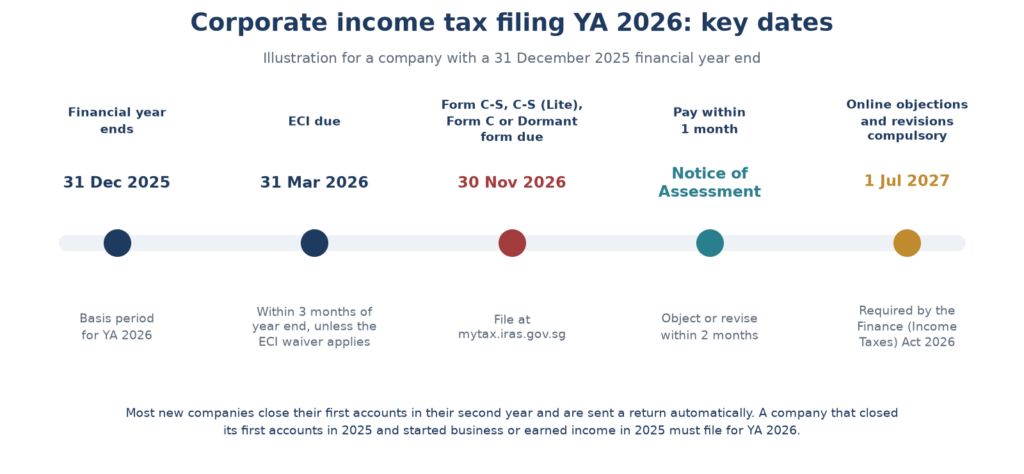
The deadline is 30 November 2026. Corporate income tax filing for YA2026 is done online at mytax.iras.gov.sg.
Singapore taxes companies on a preceding year basis. Income earned in the financial year that ended in 2025 is assessed in 2026, so 2026 is the Year of Assessment (YA). A company with a 31 December year end reports the year from 1 January to 31 December 2025.
IRAS set out the numbers for this filing season in a media release on 19 October 2026. More than 323,000 companies must file their YA 2026 returns, and over 37,000 of them are newly incorporated. In YA 2025, more than 90% of companies filed on time.
The 30 November date is the same every year, whatever your financial year end. IRAS’s filing guidance notes that this gives companies at least 11 months from the close of their accounts.
Directors carry the responsibility. IRAS’s YA 2026 filing season page says directors are responsible for timely and accurate filing even when the company has engaged a tax agent.
Which companies must file for YA 2026?
All companies must file unless IRAS has granted a waiver. A loss or a quiet year does not remove the obligation.
IRAS’s filing season page works through the common cases:
- Trading companies, including loss-making ones: file if the company carried on business or received income in the financial year 2025, even at a loss.
- Companies incorporated in 2025: file by 30 November 2026 if the company closed its first set of accounts in 2025 and started business or earned income in 2025. No YA 2026 filing is needed if it did not close its first accounts in 2025, or closed them without starting business or earning income.
- Dormant companies: check the status under “Update Corporate Profile” on myTax Portal. “No Business Done” means IRAS has granted a waiver and no filing is needed. “Active” means you must file, usually with the Form for Dormant Company.
- Companies whose YA 2025 return is under review: file anyway, using the brought forward amounts pre-filled from the YA 2025 return.
According to the release, most new companies close their first accounts in their second year and are sent a tax return automatically. A minority close their first accounts in the year they were incorporated. IRAS has simplified the process for these companies to request their first return through a guided online form.
A dormant company can ask to stop filing altogether. IRAS’s dormant companies page lists the conditions for a waiver. The company must have filed its returns up to the date it ceased business. It must not own investments, or must earn no income from any it owns. It must have deregistered for GST if it was registered. It must also have no intention of restarting business within two years. After applying, it has 21 days to file any outstanding returns, or the application is rejected.
Filing with IRAS is separate from your annual return with ACRA. Meeting one deadline does not satisfy the other. Your company secretary should track both.
Form C-S, Form C-S (Lite) or Form C: which should you file?
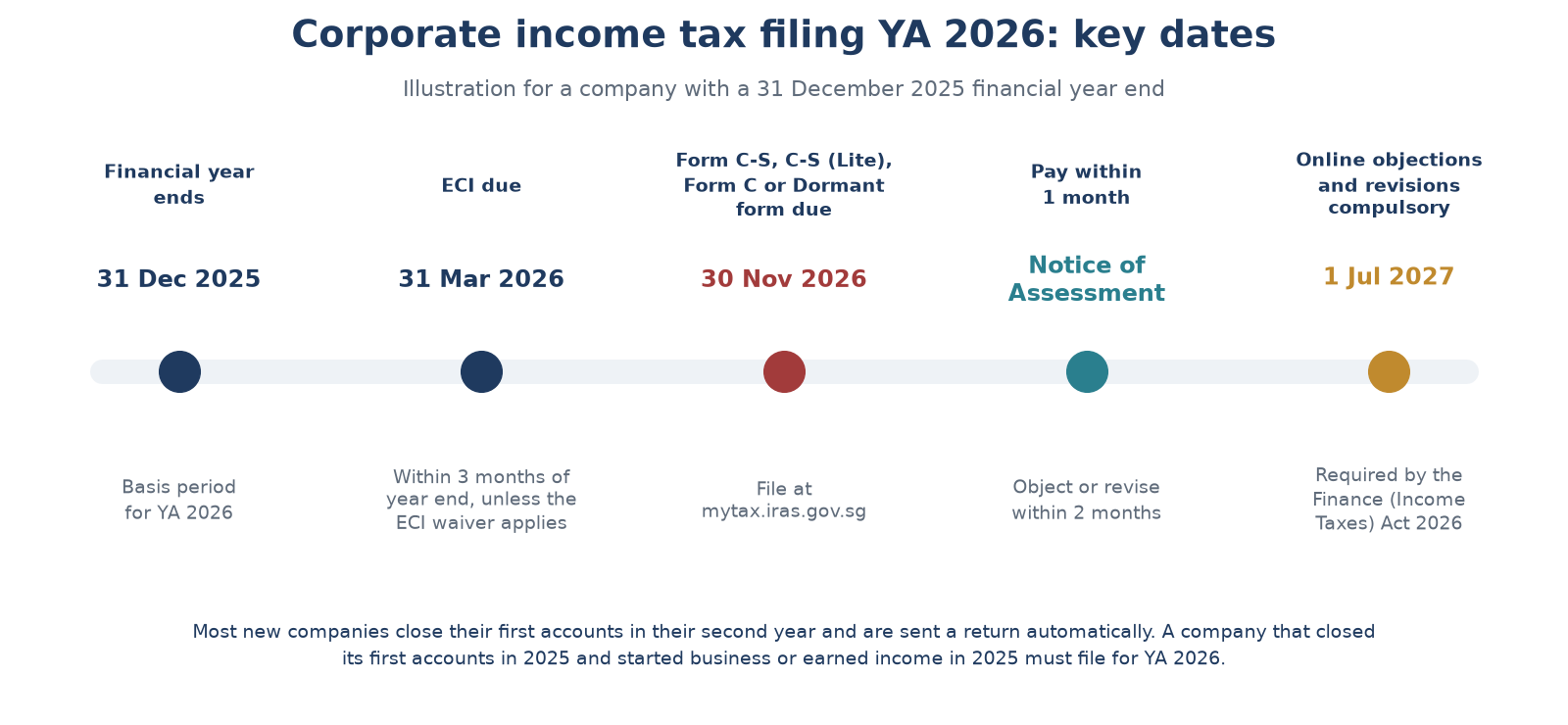
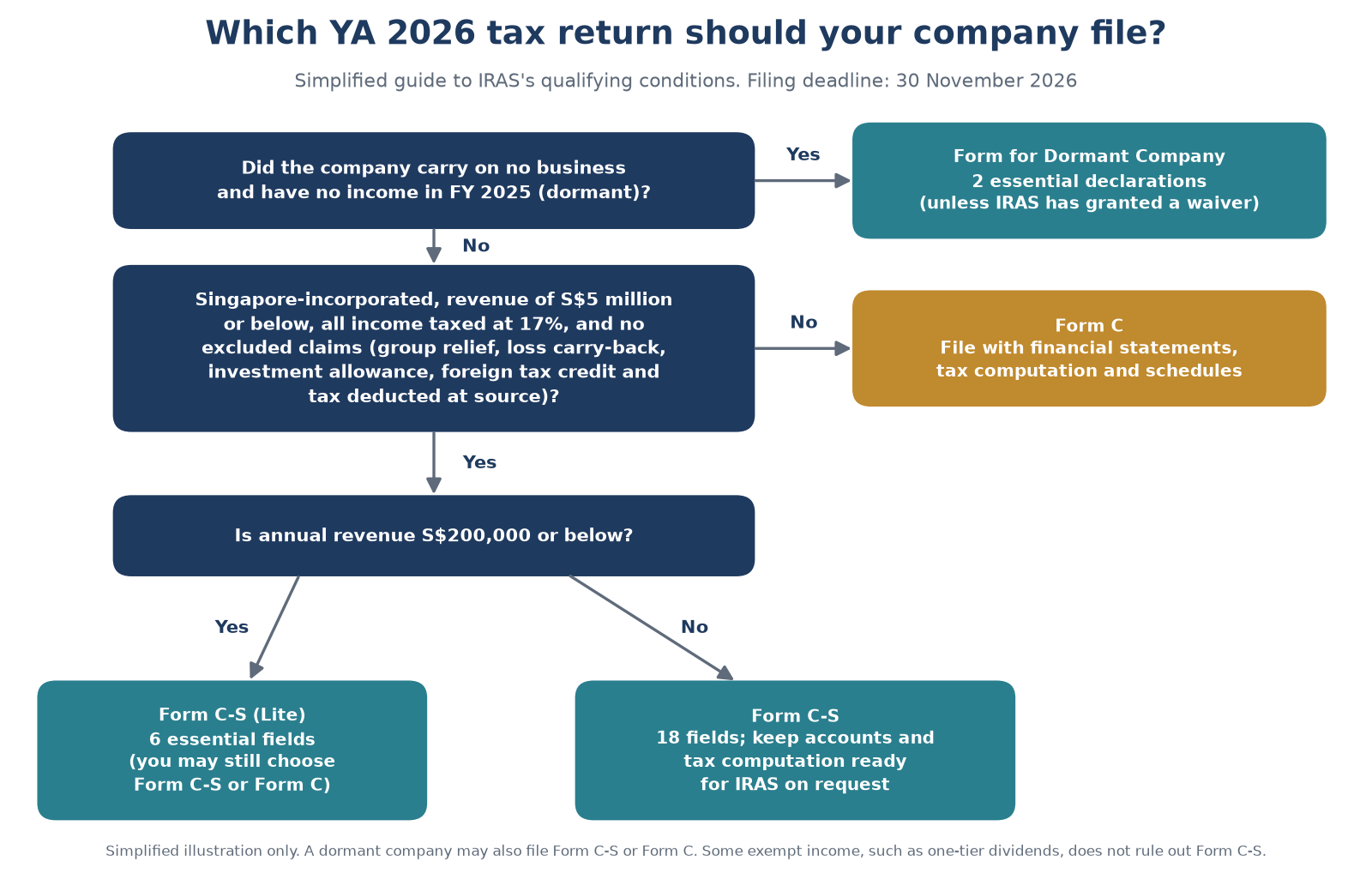
File Form C-S if your company qualifies, Form C-S (Lite) if it also has revenue of S$200,000 or below, and Form C in every other case.
IRAS’s overview of the three forms sets out the conditions. A company qualifies for Form C-S if it:
- is incorporated in Singapore;
- has annual revenue of S$5 million or below;
- derives only income taxable at the prevailing 17% rate; and
- is not claiming carry-back of current year capital allowances or losses, group relief, investment allowance, or foreign tax credit and tax deducted at source.
“Revenue” means the company’s main source of income and excludes separate source income such as interest. Income that is tax exempt or taxed at a concessionary rate under an incentive rules out Form C-S. There are two exceptions: one-tier tax exempt Singapore dividends, and specified foreign-sourced income exempted under section 13(8) of the Income Tax Act 1947.
| Form C-S (Lite) | Form C-S | Form C | Form for Dormant Company | |
|---|---|---|---|---|
| Who can use it | Companies that qualify for Form C-S and have revenue of S$200,000 or below | Singapore-incorporated companies with revenue of S$5 million or below that meet the other conditions | All companies | Companies that did not carry on business and had no income in the financial year |
| What you complete | 6 essential fields | 18 fields | Full return | 2 essential declarations |
| Financial statements and tax computation | Prepare and keep ready; IRAS may ask for them | Prepare and keep ready; IRAS may ask for them | Must be filed with the return | Not applicable |
| Can you choose a fuller form? | Yes, Form C-S or Form C | Yes, Form C | Not applicable | Yes, Form C-S or Form C |
Not having to submit accounts with Form C-S does not mean you need not prepare them. IRAS expects the financial statements and tax computation to exist and to be produced on request.
Form C-S (Lite) has proved popular. The IRAS release says about 8 in 10 eligible companies used it in YA 2025. A common mistake on this form, IRAS warns, is the “Adjusted Profit/Loss before Capital Allowances” field. It means the profit or loss after tax adjustments, and it should match net profit or loss before tax if you made no adjustments. It is not the amount of the adjustments themselves.
Not sure which form fits? Our free Form C-S eligibility checker walks through the conditions.
What should you prepare before you file?
Set up Corppass access, finalise your accounts and tax computation, and check which reliefs and rebates apply.
1. Corppass authorisation. Your employee or tax agent needs Corppass authorisation as an “Approver” for the “Corporate Tax (Filing and Application)” digital service. Without it, nobody can log in to file, so sort it out well before the deadline.
2. Records. Companies must keep source documents, accounting records, schedules and bank statements for at least 5 years from the relevant YA, according to IRAS’s record keeping requirements. IRAS lists poor record keeping, such as missing receipts, invoices or cash transactions, among the common causes of filing errors.
3. Estimated Chargeable Income (ECI). ECI is due within 3 months of the financial year end. IRAS’s ECI page sets out the waiver: you need not file ECI if annual revenue is S$5 million or below and ECI is nil. If ECI is due but not filed, IRAS may issue an estimated assessment.
4. Deductible expenses. Expenses are deductible only if they are “wholly and exclusively” incurred in producing income. IRAS names claiming non-deductible expenses, such as costs of S-plated cars, as a common filing error.
5. Tax exemptions. The corporate tax rate is a flat 17% of chargeable income. IRAS’s rates and exemptions page sets out two schemes:
- Start-up tax exemption (first 3 YAs): 75% exemption on the first S$100,000 of normal chargeable income and a further 50% on the next S$100,000, a maximum of S$125,000 exempt each YA.
- Partial tax exemption (all other companies): 75% exemption on the first S$10,000 and 50% on the next S$190,000, a maximum of S$102,500 exempt each YA.
6. YA 2026 CIT Rebate. Budget 2026 announced a rebate of 40% of corporate tax payable. It has since been enhanced to 50% for YA 2026, to help companies manage cash flow during the energy crisis. Active companies that made CPF contributions for at least one local employee (a Singapore citizen or permanent resident, not counting shareholders who are also directors) in 2025 receive a CIT Rebate Cash Grant of S$2,000. The combined maximum is S$40,000: for a company that gets the Cash Grant, the rebate is reduced by S$2,000, and no rebate is given if 50% of its tax is under S$2,000. The enhanced rebate and grant are now in section 92M of the Income Tax Act 1947, inserted by the Finance (Income Taxes) Act 2026. IRAS computes the rebate automatically, so do not deduct it in your return. Separately, eligible businesses are receiving an SME Cash Grant 2026 of up to S$2,500 in November 2026, assessed automatically with no application needed.
Illustration (not a real client): a company on the partial tax exemption has chargeable income of S$300,000. S$102,500 is exempt, leaving S$197,500 taxed at 17%, which is S$33,575. Ignoring any tax set-offs, the 50% rebate is S$16,787.50, well under the S$40,000 cap. A company that does not qualify for the Cash Grant pays S$16,787.50. A company that received the S$2,000 Cash Grant gets a rebate of S$14,787.50 and pays S$18,787.50, so the rebate and grant together are still worth S$16,787.50. A qualifying start-up in one of its first three YAs would have S$125,000 exempt instead, leaving S$175,000 taxed at 17%: S$29,750 before the rebate and S$14,875 after it (without the Cash Grant). You can run your own figures in our corporate tax calculator.
Which new IRAS tools can help this year?
IRAS has added self-help tools for each stage of filing, from checking whether a new company must file to tracking an objection.
The 19 October 2026 release and its Annex A group the tools into three stages:
| Stage | Tool | What it does |
|---|---|---|
| Pre-filing | Filing Obligations Checker (new) | Tells newly incorporated companies, through the IRAS chatbot, whether and when they must file a return |
| Pre-filing | Request for Income Tax Return | A guided online form for new companies that closed their first accounts in the year of incorporation |
| Pre-filing | Record Keeping Assistant (new) | Keeps business records for tax preparation in one file, in line with Form C-S (Lite) requirements |
| During filing | e-Learning Webinar Series (new) | Self-paced guidance on record keeping, filing requirements and common tax adjustments |
| During filing | Business Expense Deductibility Checker (new) | Helps you decide whether common business expenses are tax deductible |
| During filing | Basic Tax Calculator | Guides you through the tax computation and schedules, with validation checks |
| During filing | myTax Portal Troubleshooting Assistant (new) | Step-by-step help with common login and access problems |
| Post-filing | Payment Status Checker (new) | Shows payment processing timelines, payment status and next steps |
| Post-filing | Digital Submission for Revisions / Objections | One service on myTax Portal to submit revised returns and objections |
| Post-filing | Objection Status Checker (new) | Shows the status of an objection, expected timelines and any follow-up needed |
Two of these matter most in the last week before the deadline. The Business Expense Deductibility Checker helps you settle doubtful expense claims before they reach the return. The myTax Portal Troubleshooting Assistant helps when a login fails at the last minute.
For companies set up in 2025, the Filing Obligations Checker answers the first question: do we need to file at all this year? IRAS says it aims to reduce the risk of non-compliance by companies new to the tax system.
The release also covers post-filing changes. Companies can already use the Revise/ Object to Assessment service on myTax Portal. From 1 July 2027, companies must use it. The Finance (Income Taxes) Act 2026, passed by Parliament on 6 October 2026, amends the Income Tax Act 1947 so that a company must object to an assessment, or apply for relief for an error, through IRAS’s electronic service, unless IRAS permits another method in a particular case. It makes sense to try the service now.
What happens if you miss the 30 November deadline?
Late filing is an offence. IRAS may raise an estimated assessment, offer a composition of up to S$5,000, and summon the company and its directors to court.
IRAS’s page on late filing or non-filing lists the actions it may take:
- Estimated Notice of Assessment. IRAS estimates tax from past income or other information and may assume an increase in income. The tax must be paid within 1 month, even if you object. To object, you must do so within 2 months and file the return, financial statements and tax computation. Otherwise the estimate will not be revised.
- Offer of composition. Instead of prosecuting, IRAS may offer a composition of up to S$5,000 per offence, depending on the company’s compliance record. You must pay it and file the overdue return by the stated date. Paying alone does not end the matter.
- Section 65B(3) notice. IRAS may require a director to provide the missing information. A director convicted of failing to comply faces a fine of up to S$10,000, imprisonment of up to 12 months, or both, for each offence.
- Notice to Attend Court or summons. On conviction, the company may be fined up to S$5,000 for each offence. If nobody attends court, further action may follow, potentially including a warrant of arrest against the director.
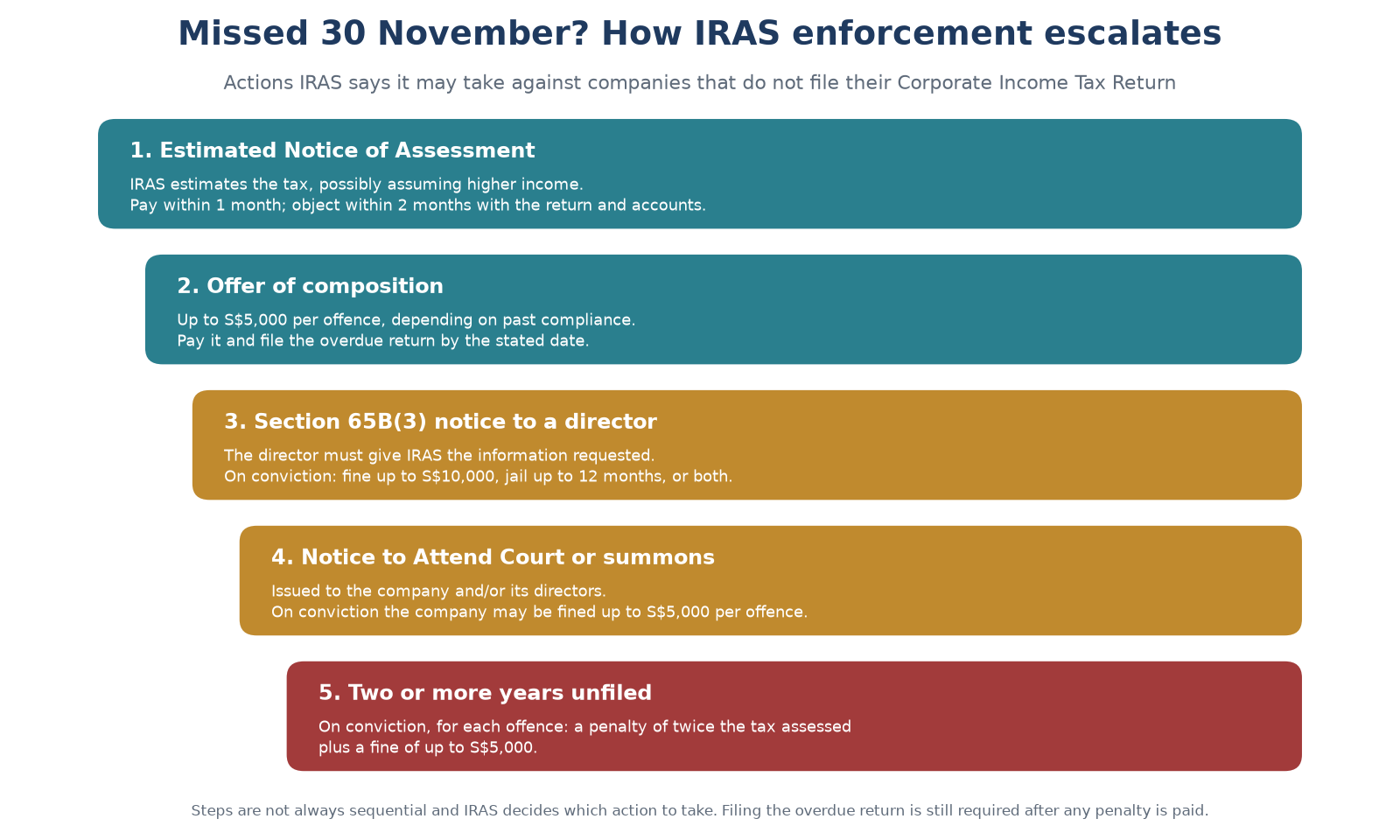
The release adds that continued non-compliance may attract additional daily penalties of S$100. Companies that fail to file for two years or more face progressively stronger action. A court may order a penalty of twice the tax assessed, on top of the fine.
These are not idle warnings. Since January 2026, IRAS has issued more than 4,100 Notices to Attend Court to companies that failed to file returns for YA 2025 and earlier years, collecting more than S$2 million in penalties.
There is some relief for late filers with a clean record. A waiver of the composition amount can be requested through the Appeal Penalty Waiver service, but IRAS considers an appeal only if the overdue return was filed before the composition due date and the company filed on time for the past 2 years. IRAS also notes that requests for an extension of time to file the current YA are available only after 30 November. An extension is not something to plan around.
For a step-by-step recovery plan, read missed the Form C-S deadline? What IRAS does next.
What if you find a mistake after filing?
File a revision promptly through the Revise/ Object to Assessment service. To dispute an assessment, object within 2 months of the Notice of Assessment.
IRAS’s guidance asks companies to revise promptly when they discover an error. For revisions to Form C-S or Form C-S (Lite), attach the company’s financial statements as well. If no objection reaches IRAS within 2 months of the Notice of Assessment, the assessment becomes final.
Errors cost money. IRAS’s page on penalties for errors in tax returns sets out the ranges under the Income Tax Act 1947:
- Without intention to evade: a penalty of up to 200% of the tax undercharged, a fine of up to S$5,000, and/or imprisonment of up to three years.
- With intention to evade: a penalty of up to 400% of the tax undercharged, a fine of up to S$50,000, and/or imprisonment of up to five years.
Coming forward helps. Under IRAS’s Voluntary Disclosure Programme, a company that discloses errors on its own can face reduced penalties. Late filing of returns and ECI also counts as a “bad compliance record”, which IRAS treats as an aggravating factor when it decides penalties for errors.
When must you pay the tax?
Pay within 1 month of the Notice of Assessment, even if you have objected.
GIRO is IRAS’s preferred payment method, and PayNow QR, AXS and internet banking are also accepted. IRAS’s page on late payment sets out the penalties. A 5% penalty applies if full payment is not received by the due date. If the tax is still unpaid 60 days after the 5% penalty is imposed, a further 1% may be added for each completed month, up to 12% of the unpaid tax. IRAS can also appoint agents, such as the company’s bank or tenant, to recover the money.
Refunds come back automatically via GIRO or PayNow Corporate within 30 days of the date the credit arose, and no claim is needed.
Your last-minute filing checklist
Work through these steps now. Each one depends on information you already hold.
- Confirm the person filing has Corppass “Approver” access for Corporate Tax (Filing and Application).
- Log in to myTax Portal and check the company’s status and filing requirement for YA 2026.
- If the company is new, run the Filing Obligations Checker to confirm whether it must file this year.
- Finalise the FY 2025 financial statements.
- Decide the correct form: Form C-S (Lite), Form C-S, Form C or the Form for Dormant Company.
- Prepare the tax computation and remove non-deductible expenses. Use the Business Expense Deductibility Checker where in doubt.
- Apply the start-up or partial tax exemption, but do not deduct the CIT Rebate yourself.
- If your company claims an excluded item, such as group relief or foreign tax credit, file Form C with accounts and computation.
- Keep the accounts, computation and source documents for at least 5 years.
- File by 30 November 2026 and save the acknowledgement.
- Diarise the payment date (1 month from the Notice of Assessment) and the objection window (2 months).
- Try the Revise/ Object to Assessment service now, before its use becomes compulsory on 1 July 2027.
How Raffles Corporate Services can help
Raffles Corporate Services prepares the tax computation and files the return for you, while your directors keep the final say.
Our corporate tax filing service covers Form C-S, Form C-S (Lite) and Form C, together with the ECI for the same period where one is needed. You authorise us as the company’s tax filing agent through Corppass. We prepare the computation from your financial statements, and you review and endorse it before we file.
If your books are not ready, our accounting and bookkeeping team can bring the accounts up to date. Our corporate secretarial service keeps the ACRA side, including AGMs and annual returns, on track. For more tax guides, visit our tax and GST hub.
To discuss your YA 2026 filing, email [email protected].
Frequently asked questions
What is the deadline for corporate income tax filing for YA 2026?
30 November 2026. Companies file Form C-S, Form C-S (Lite), Form C or the Form for Dormant Company at mytax.iras.gov.sg for income earned in the financial year that ended in 2025.
Does my company need to file if it made a loss or had no income?
Yes, if it carried on business or received income during the year, even at a loss. A dormant company must also file, usually with the Form for Dormant Company, unless IRAS has granted a waiver and its status shows “No Business Done”.
Who can file Form C-S (Lite)?
A company that qualifies for Form C-S and has annual revenue of S$200,000 or below. Form C-S itself needs a Singapore-incorporated company with revenue of S$5 million or below, only income taxed at 17%, and none of the excluded claims, such as group relief or foreign tax credit.
What is the penalty for filing the corporate tax return late?
IRAS may issue an estimated assessment and offer a composition of up to S$5,000 per offence. If the composition is not paid or the return is not filed by the due date, the company and its directors may be summoned to court, where the company faces a fine of up to S$5,000 per offence.
How much is the YA 2026 CIT Rebate?
50% of the corporate tax payable. Active companies that made CPF contributions for at least one local employee in 2025 also get a S$2,000 Cash Grant, which is deducted from the rebate, and the rebate and grant together are capped at S$40,000. IRAS applies the rebate automatically, so do not deduct it in your return.
Do I need to submit financial statements with Form C-S?
No. Form C-S and Form C-S (Lite) filers do not submit financial statements or tax computations with the return, but must prepare them and produce them if IRAS asks. Form C filers must submit both with the return.
What are IRAS’s new tools for YA 2026 filing?
They include a Filing Obligations Checker for newly incorporated companies, a Business Expense Deductibility Checker, a Record Keeping Assistant, an e-Learning Webinar Series, a myTax Portal Troubleshooting Assistant, and Payment and Objection Status Checkers.
This guide is general information and not tax or legal advice. IRAS requirements change, so check the current rules or speak to us before you act.
Last updated 26 November 2026
Need help with this?
Raffles Corporate Services can handle the ACRA filings, compliance documentation and records for you, and where court proceedings or legal advice are needed, we work with a panel of experienced Singapore law firms who offer cost-effective and efficient legal service and advice.
Email: [email protected]
Call, SMS or WhatsApp: +65 8501 7133