
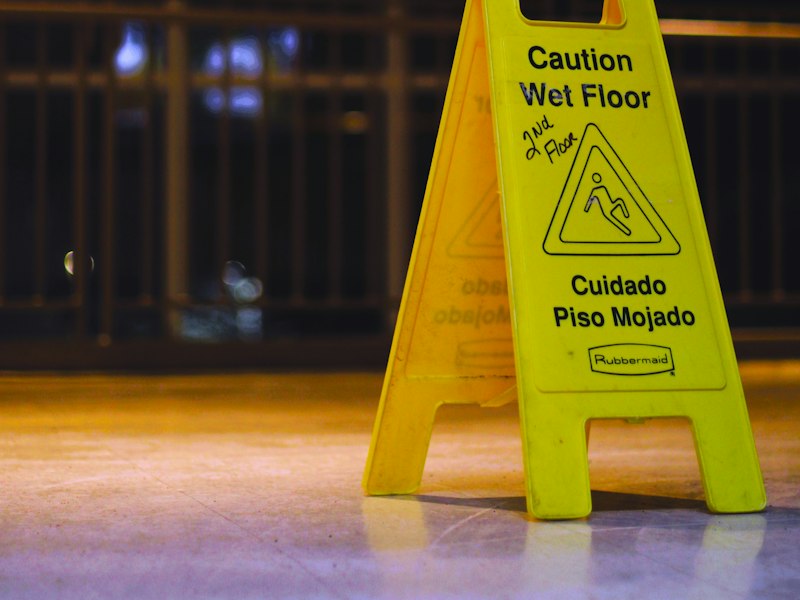
Short answer: If a customer is injured on your business premises in Singapore, give first aid, record the incident, preserve CCTV and notify your public liability insurer at once, without admitting fault. Liability is decided under the ordinary law of negligence. The customer must follow the State Courts pre-action protocol and generally has 3 years to sue.
A customer injured on business premises in Singapore, whether from a slip on a wet shop floor or a fall on a broken step in a restaurant, can become a personal injury claim against your company months later. What the business does in the first few hours often decides how that claim goes. This guide covers the immediate steps, the legal basis for an occupier’s liability, the court protocol, the time limit and the records to keep.
Key facts at a glance
- Occupiers’ liability in Singapore is decided under the general law of negligence, following the Court of Appeal in See Toh Siew Kee v Ho Ah Lam Ferrocement (Pte) Ltd [2013] 3 SLR 284.
- Time limit: a personal injury claim must generally be brought within 3 years of the accident, or 3 years from when the injured person had the required knowledge if later (Limitation Act 1959, section 24A(2)).
- A warning sign or notice cannot exclude a business’s liability for death or personal injury caused by negligence (Unfair Contract Terms Act 1977, section 2(1)).
- Before suing in the State Courts, the claimant must follow the Pre-Action Protocol for Personal Injury Claims in Appendix B of the State Courts Practice Directions 2021 (Practice Direction 39).
- Under the protocol, the potential defendant must acknowledge a letter of claim within 14 days and reply substantively within 8 weeks.
- Court by claim size: Magistrate’s Court up to S$60,000; District Court up to S$250,000; General Division of the High Court above that.
- If the customer was partly at fault, damages are reduced to reflect their share of responsibility (Contributory Negligence and Personal Injuries Act 1953, section 3).
Raffles Corporate Services works with a panel of experienced Singapore law firms who offer cost-effective and efficient legal service and advice. This article is general information only and is not legal advice.
Customer injured on business premises in Singapore: what should you do first?
Look after the injured person first, then secure the evidence and tell your insurer. Any discussion of fault or compensation should go through the insurer or a lawyer.
- Give first aid and call an ambulance if the injury looks serious.
- Make the area safe so no one else is hurt: cordon off the spill, broken fitting or obstruction, but photograph it before anything is cleaned or repaired.
- Write an incident record the same day: date, time, exact location, what the person says happened, what staff saw, the condition of the floor or fitting, signage in place, and witness names and contact details.
- Preserve CCTV footage before it is overwritten, including the period before the incident, which shows how long the hazard was there. Keep that day’s cleaning and inspection logs too.
- Be courteous and show concern, but do not admit liability, promise to pay medical bills, or sign anything for the customer. Most liability policies contain a condition that the insured must not admit liability or settle without the insurer’s consent; check your policy wording.
- Notify your public liability insurer (and your broker) promptly, even if the customer has not yet said they will claim. Late notification is a common reason insurers dispute cover.
- Check whether the accident must be notified to the Ministry of Manpower (see the reporting section below).
- If you lease the premises, tell the landlord or mall management, and any contractor whose work may be involved, in writing.
Is the company liable? Occupiers’ liability and negligence in Singapore
The company is liable only if it owed the injured person a duty of care, failed to take reasonable care, and that failure caused the injury. An accident on your premises does not by itself mean the business was negligent.
Singapore did not adopt England’s Occupiers’ Liability Act 1957. In See Toh Siew Kee v Ho Ah Lam Ferrocement (Pte) Ltd [2013] 3 SLR 284, the Court of Appeal held that the law on occupiers’ liability in Singapore should be subsumed under the general tort of negligence, and applied the two-stage duty of care framework from Spandeck Engineering (S) Pte Ltd v Defence Science & Technology Agency [2007] 4 SLR(R) 100. For a lawful entrant such as a customer, diner or visitor, the court found that the proximity needed for a duty of care is present because the occupier consented to the person being there.
In practice, a court will ask whether there was a hazard, whether the business knew or should have known about it, whether it took reasonable steps to remove it or warn visitors, and whether the hazard caused the injury.
Two statutes shape the outcome. Section 2(1) of the Unfair Contract Terms Act 1977 says a person cannot, by a contract term or a notice, exclude or restrict liability for death or personal injury resulting from negligence. A “We are not responsible for any injury” sign at the entrance therefore will not protect the business, although a clear warning sign is still useful evidence that reasonable care was taken. We explain the wider rules in our guide to exclusion clauses under the Unfair Contract Terms Act. Section 3 of the Contributory Negligence and Personal Injuries Act 1953 allows the court to reduce damages to reflect the injured person’s own share of responsibility.
The landlord, mall management or a cleaning contractor may also be responsible. Under the protocol, a potential defendant who wants to bring in a third party must inform the claimant by letter within 14 days of receiving the letter of claim.
Does the business have to report the accident to MOM?
Only in some cases. The Ministry of Manpower requires a workplace occupier to notify the Commissioner as soon as reasonably practicable when a member of the public is injured as a result of works done at a workplace and is sent to hospital for treatment, and to notify and submit an incident report within 10 days if a member of the public dies as a result of works done.
The test is whether the injury resulted from works being carried out, such as renovation, cleaning operations or equipment in use. MOM’s own examples of accidents that are not reportable include a member of the public who faints at a shopping centre, not as a result of any works within the premises, and is taken to hospital as a precaution. Check the MOM page on what and when to report against the facts, and report if in doubt.
Do not confuse this with the rules for your own staff. If an employee is hurt at work, the employer’s reporting and compensation duties arise under the Work Injury Compensation Act 2019 and the Workplace Safety and Health Act 2006, which we cover in our WICA guide for employers and our article on workplace accidents, MOM investigations and WSH Act penalties.
How does the State Courts pre-action protocol for personal injury claims work?
Before suing in the Magistrate’s Court or District Court, a claimant must comply with the Pre-Action Protocol for Personal Injury Claims and Non-Injury Motor Accident Claims set out in Appendix B of the State Courts Practice Directions 2021. Practice Direction 39 makes this mandatory, and the protocol covers personal injury claims arising out of claims in negligence, which includes most premises accidents.
The main steps under the Appendix B protocol are:
- Letter of claim: the claimant sends every potential defendant (and its insurer, if known) the facts, the injuries, an estimate of damages, witnesses and copies of supporting documents such as medical reports, bills and evidence of lost income.
- Acknowledgement within 14 days: the potential defendant (or its insurer) must acknowledge the letter within 14 days of receipt. If no acknowledgement is received, the claimant may sue without any sanction.
- Medical experts: for claims within the Magistrate’s Court limit, the defendant must say within 14 days of its acknowledgement whether it agrees to a medical expert proposed by the claimant.
- Substantive reply within 8 weeks: the defendant must state its position on liability and quantum, or make an offer, with reasons and copies of relevant documents if the claim is not admitted in full.
- Exchange of documents: medical reports a party intends to rely on, and any new information or documents, must be sent to the other side within 7 days of receipt.
- Interim payment: the claimant may ask for an interim payment; the defendant must reply within 14 days and pay any sum offered within 28 days of its reply.
- Negotiation and notice: if there is no reasonable prospect of settlement after at least 8 weeks from receipt of the letter of claim, the claimant may sue after giving 10 clear days’ notice of the intention to file an originating claim.
Under Practice Direction 39, a party whose non-compliance caused unnecessary costs can be deprived of its costs or ordered to pay the other side’s costs, including on an indemnity basis. If the insurer has taken over the claim it will usually run these steps, but the company must still supply the evidence quickly.
Which court hears the claim, and how long does the customer have to sue?
The court depends on the amount claimed, and the customer generally has 3 years from the accident to start proceedings. Small personal injury claims are heard in the State Courts, where they go through Court Dispute Resolution before any trial.
| Claim value | Court | Notes |
|---|---|---|
| Up to S$60,000 | Magistrate’s Court | Simplified civil process applies |
| Above S$60,000 up to S$250,000 | District Court | The higher S$500,000 District Court limit is for road traffic accidents and industrial accidents, not ordinary premises accidents |
| Above S$250,000 | General Division of the High Court | Rare for a typical shop or restaurant fall |
Section 24A(2) of the Limitation Act 1959 provides that an action for negligence where the damages include personal injuries cannot be brought after 3 years from the date the cause of action accrued, or 3 years from the earliest date on which the claimant had the knowledge required to bring the action, if that is later.
Once a claim is filed and the company files a notice of intention to contest, the court will convene the first Court Dispute Resolution Case Conference within 6 weeks (Practice Direction 39). The judge gives an early neutral evaluation of the case and directs negotiations. Many are conducted by email. For the defendant’s side of court procedure, see our first-steps guide for a company that has been sued.
What documents should the company keep after a premises accident?
Keep everything that shows what happened and what care the business took, in one file, for at least the 3-year limitation period plus time for proceedings.
| Document | Why it matters |
|---|---|
| Incident report and staff statements | Fixes the facts while memories are fresh |
| CCTV export and photographs of the scene | Shows the hazard, how long it was there and how the person fell |
| Cleaning logs and inspection checklists | Evidence of a reasonable inspection system |
| Maintenance and repair records | Shows whether a defect was known and when it was fixed |
| Witness names and contact details | Independent accounts carry weight |
| Insurance policy, notification email and claim reference | Proves timely notice and preserves cover |
| Lease, management rules and contractor agreements | Identifies who controlled the area and any indemnities |
| Letter of claim and all protocol correspondence | Starts the protocol timetable |
How are premises injury claims settled, and what affects the cost?
Most claims settle through the insurer. The cost depends on the injury, the evidence on fault and the policy excess.
| Cost item | What drives it |
|---|---|
| Damages | Severity of injury, medical expenses, lost earnings, and any reduction for the customer’s own fault |
| Claimant’s pre-action legal costs | Under the protocol costs guide, if a personal injury claim settles before proceedings for less than S$20,000, pre-action costs should be between S$1,500 and S$2,500, excluding disbursements |
| Medical expert fees | Number of specialties and whether a single joint expert is agreed |
| Policy excess | Set by your public liability policy; small claims may fall wholly within it |
A minor sprain that settles early differs greatly from a fracture needing surgery. Any settlement should be in writing, expressed to be in full and final settlement of all claims arising from the incident, and agreed with the insurer first. If the case is already in court, the parties record the settlement or consent judgment using Form 7 of Appendix A1 to the State Courts Practice Directions.
What does the company secretary prepare, and what does the solicitor file?
Court proceedings are conducted by a Singapore Advocate and Solicitor, usually appointed by the insurer under the policy. The company’s own team, including its corporate secretary, supports the defence with records and approvals.
- The company and its corporate service provider can keep the incident file, prepare a directors’ resolution authorising a director to deal with the insurer and solicitors and approve any settlement within a stated limit, locate the lease and insurance policy, and reflect any provision or contingent liability in the financial statements.
- The solicitor handles the protocol correspondence, the notice of intention to contest, the defence, any third-party claim, Court Dispute Resolution and the settlement or consent judgment.
Unlike a change of directors or share capital, settling or losing a personal injury claim does not by itself require an ACRA lodgement. What changes is the company’s own records: the payment, the board approval and the accounting treatment. If you receive a lawyer’s letter before the formal letter of claim, our guide on responding to a lawyer’s letter of demand explains how to reply without making things worse. When the stakes are high or cover is disputed, speak to a lawyer early.
What are the common mistakes businesses make?
- Staff saying “it’s our fault, we’ll pay your bills” at the scene, or offering cash without the insurer’s consent.
- Waiting for a lawyer’s letter before telling the insurer, and then finding cover disputed for late notice.
- Relying on a disclaimer sign, which cannot exclude liability for personal injury caused by negligence.
- Ignoring the 14-day acknowledgement and 8-week reply deadlines in the protocol, which can lead to costs orders.
- Treating a customer’s injury as a WICA matter. WICA covers employees, not members of the public.
- Throwing away cleaning logs and incident files after a few months, when a claim can be brought up to 3 years later.
Frequently asked questions
Can a customer sue my company for a slip and fall in my shop?
Yes, in negligence, if they show the business failed to take reasonable care and that this caused the injury. An accident on the premises does not by itself prove negligence.
Does a “wet floor” sign protect my business from liability?
A sign cannot exclude liability for personal injury caused by negligence (Unfair Contract Terms Act 1977, section 2(1)). However, a visible warning placed promptly is good evidence that the business took reasonable care, which may defeat or reduce a claim.
Should I apologise to the injured customer?
Show concern and help the person, but avoid statements that accept blame or promise compensation. Leave payment discussions to your insurer or lawyer.
How long after the accident can the customer bring a claim?
Generally 3 years from the accident, or 3 years from when the injured person first had the knowledge needed to bring a claim, if that is later (Limitation Act 1959, section 24A).
Can Raffles Corporate Services defend the claim in court?
No. Raffles Corporate Services does not give legal advice or appear in court. We keep your company records, board resolutions and insurance documents in order, and introduce you to a panel law firm where a Singapore Advocate and Solicitor is needed. Our free tools can help with other company compliance tasks.
Need help with this?
Raffles Corporate Services can handle the ACRA filings, compliance documentation and records for you, and where court proceedings or legal advice are needed, we work with a panel of experienced Singapore law firms who offer cost-effective and efficient legal service and advice.
Email: [email protected]
Call, SMS or WhatsApp: +65 8501 7133
Last reviewed: 3 November 2026. The Editorial Team, Raffles Corporate Services.