

A Variable Capital Company is a corporate vehicle built for investment funds, not for trading businesses. To register one you need a permissible fund manager, at least one qualifying director, a company secretary, an auditor, and roughly $8,015 in ACRA fees before a single sub-fund is added.
Raffles Corporate Services works with a panel of experienced Singapore law firms who offer cost-effective and efficient legal service and advice. This article is general information only and is not legal advice.
The Variable Capital Companies Act 2018 created a structure Singapore did not previously have: a company that can issue and redeem its own shares freely, pay dividends out of capital, and hold multiple ring-fenced portfolios under one legal entity. Those three abilities are the entire reason the VCC exists. A private limited company cannot do any of them without significant friction.
What follows is what the structure actually gives you, who qualifies to register one, and the requirements that people discover too late.
What a VCC is, in one paragraph
A VCC is a body corporate incorporated under the Variable Capital Companies Act 2018. Its shares are, by definition in section 2 of that Act, units in a collective investment scheme. That single definitional move is what separates it from an ordinary company: you are not buying equity in a trading enterprise, you are buying units in a fund that happens to wear a corporate shell.
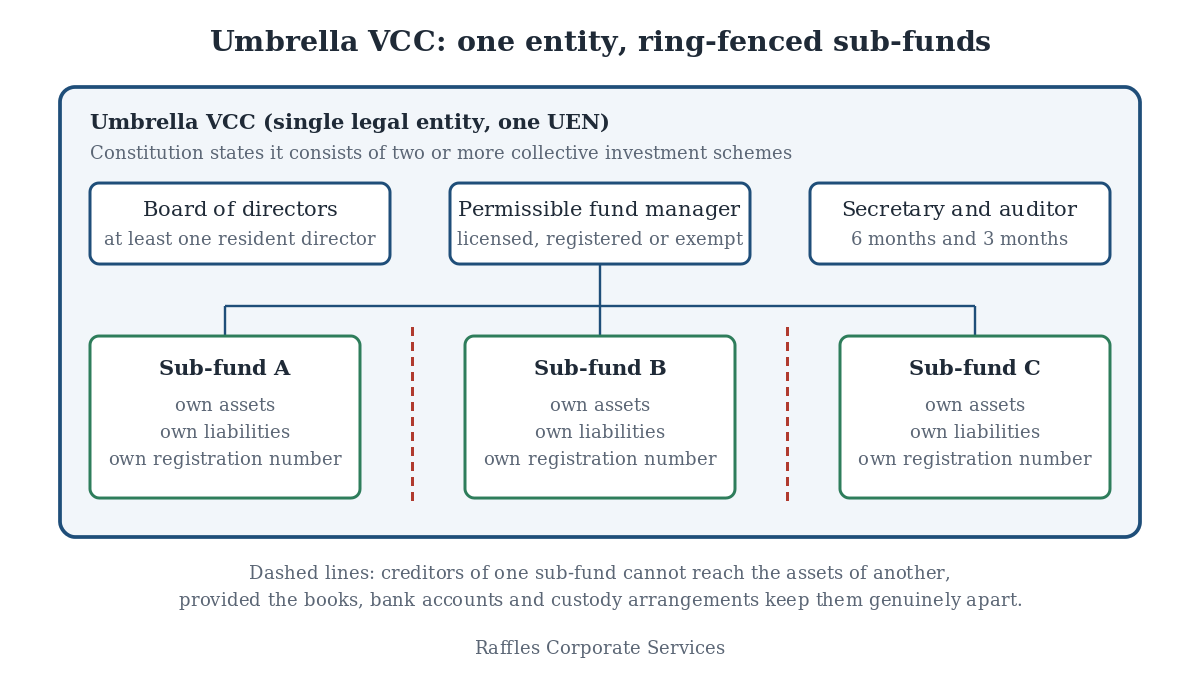
It comes in two forms. A non-umbrella VCC is one fund in one entity. An umbrella VCC is an entity whose constitution states that it consists of two or more collective investment schemes, each of which is a sub-fund. If you are new to the concept, our companion piece on what a VCC is and who it suits sets out the commercial case before you get to the mechanics.
The features that actually matter
Most summaries list a dozen features. Four of them drive almost every decision to use a VCC.
Capital that moves with the fund
An ordinary Singapore company reducing its share capital goes through a solvency statement and a waiting period, or a court process. A VCC does not. It can issue and redeem shares in line with its net asset value without going back to shareholders for approval each time. For an open-ended fund taking subscriptions and paying redemptions continuously, that is not a convenience, it is the difference between workable and unworkable.
Dividends out of capital
A company may generally only pay dividends out of profits. A VCC may pay them out of capital. Income funds and funds with lumpy realisation profiles need this. It also means the directors cannot rely on the usual “is there a distributable profit” test as their safety net, and must think harder about solvency before declaring.
Segregation between sub-funds
In an umbrella VCC, the assets and liabilities of each sub-fund are attributed to that sub-fund and are not available to meet the debts of another. The Act builds this into its own interpretation provisions: section 2(3) defines a debt, obligation or liability of a sub-fund as one incurred by the umbrella VCC for the purpose of, or attributable to, that sub-fund, and does the same for assets, debentures and creditors.
The practical effect is that a failed strategy in sub-fund C should not reach the investors in sub-fund A. The practical caveat is that segregation only holds if your books, bank accounts, contracts and custody arrangements actually keep the sub-funds apart. Segregation is a legal consequence of proper administration, not a substitute for it. Each sub-fund is separately registered and receives its own registration number from the Registrar under section 27 of the Act, and each can be wound up or struck off on its own. Our guide to winding up or dissolving a VCC sub-fund covers that exit route.
Privacy of the member register
A VCC keeps its own register of members under section 81 of the Act. Unlike a private company, it is not required to make that register publicly available. Public authorities, supervisors and law enforcement can require production of it, and your fund manager and its anti-money laundering programme will know exactly who every investor is. So this is confidentiality from the general public, not anonymity from the regulator.
Eligibility: what you must have in place
| Requirement | What it means in practice |
|---|---|
| At least one director | Must be ordinarily resident in Singapore and meet the fit and proper standard. A VCC with an authorised scheme needs at least three directors, one of them independent |
| One company secretary | A natural person, ordinarily resident, and not the sole director. Must be in place within six months of incorporation |
| One permissible fund manager | A licensed fund management company, a registered fund management company, or an exempt financial institution such as a bank or merchant bank |
| One auditor | Appointed within three months of incorporation. The small company audit exemption in sections 205B and 205C of the Companies Act 1967 is not extended to VCCs |
| At least one shareholder | No maximum. A shareholder may be an individual or a corporate |
| Registered office and constitution | The constitution is registered with the Registrar under section 16(4) of the Act |
The fund manager requirement is the gate almost everyone underestimates. You cannot register a VCC and go looking for a manager afterwards. If you do not already have a regulated manager, you are running two projects at once: a Monetary Authority of Singapore licensing or registration exercise, and an ACRA registration. Our explainers on the Licensed Fund Management Company regime and the Capital Markets Services licence set out what that second project involves.
If the applicant is a foreigner living overseas
You must be 18 or above, you must engage a registered corporate service provider to file on your behalf, and you must appoint at least one director who satisfies the residency test. You cannot do it yourself from abroad. If you intend to relocate to Singapore to run the VCC, that is a separate approval from the Ministry of Manpower.
What it costs to register
ACRA’s set-up fee for a VCC is $8,015, made up of a $15 name application fee and an $8,000 incorporation fee. Registering a sub-fund costs $400 per sub-fund.
That is the government’s number only. It does not include the fund manager’s fees, legal drafting of the constitution and offering documents, fund administration, custody, the auditor, or the corporate secretarial function. For most sponsors the ACRA fee is the smallest line on the page. Budget honestly for the rest before committing.
Re-domiciling an existing offshore fund
You do not have to start from nothing. An existing overseas fund with a comparable corporate structure can transfer its registration to Singapore and continue life as a VCC, keeping its history and, usually, its track record.
The conditions are stricter than they first appear:
- The foreign entity must have a corporate structure similar to a VCC. Unit trusts and limited partnerships do not qualify by this route.
- The jurisdiction of origin must permit an outward transfer of registration. Many do not.
- All directors must confirm that the financial requirements in the Variable Capital Companies Regulations are satisfied, and the entity must be able to meet its obligations as they fall due.
- The application must be made in good faith and not to defeat creditors.
- The entity must not be in liquidation, judicial management or the course of being wound up.
That good faith condition does real work. A fund re-domiciling with a live dispute behind it should expect the question to be asked. The general principles are the same ones covered in our note on re-domiciliation of foreign companies into Singapore.
What goes wrong
Treating a VCC as a cheaper holding company. It is not one. A VCC without a genuine collective investment scheme behind it is the wrong vehicle, will cost more to run than a private limited company, and will struggle at the fund manager gate. If you want a holding structure for family assets, look at the options in our piece on multi-jurisdiction family office structures instead.
Missing the appointment deadlines after registration. The auditor clock is three months from incorporation and the company secretary clock is six months. Both are easy to lose in the noise of launching a fund, and both are compliance failures rather than administrative slips.
Assuming segregation is automatic. If sub-fund assets sit in a commingled account and expenses are allocated by guesswork, you will have a difficult conversation with an auditor, and a much worse one with a liquidator. Get the allocation policy written before the second sub-fund launches, not after.
Underestimating the anti-money laundering overlay. Every VCC must engage an eligible financial institution to carry out its anti-money laundering and countering the financing of terrorism obligations, under the Monetary Authority of Singapore’s notice for VCCs. See our MAS AML and CFT explainer and the notice itself at mas.gov.sg.
Frequently asked questions
Can I register a VCC to run an operating business?
No. The VCC is designed for collective investment schemes, and the fund manager requirement makes it impractical for anything else. A trading business should use a private company limited by shares. If your plan is not a fund, the VCC will cost you more and give you nothing you need.
How is a VCC taxed?
A VCC is taxed at Singapore corporate income tax rates, and for an umbrella VCC each sub-fund is assessed separately. Fund tax incentives may apply where the conditions are met. Confirm the current rates and treatment on the IRAS website before modelling returns.
Do I need a Singapore resident director if I already have a Singapore fund manager?
Yes. The manager requirement and the director requirement are separate. At least one director must meet the residency and fit and proper requirements in their own right, even where the manager is a fully licensed Singapore entity with local staff.
Can a VCC have just one shareholder?
Yes. Every VCC must have at least one shareholder and there is no maximum. A single investor VCC is common where a single institutional or family investor wants the sub-fund architecture available for future strategies.
Is the register of members really private?
It is not published in the way a private company’s shareholder information is. Public authorities can require it to be produced, and the fund manager and its anti-money laundering programme will hold full beneficial ownership records. Treat it as confidentiality from the public, not from regulators.
How long does the whole thing take?
Name approval usually takes up to three working days, and registration follows once the officers and constitution are ready. The realistic constraint is not ACRA, it is assembling the manager, custodian, auditor and constitution. Most first-time sponsors should plan in months, not weeks.
Before you commit to the structure
The VCC is an excellent vehicle when the substance matches it: a real fund, a real manager, real investors. It is an expensive mistake when it is chosen for the label.
The most useful hour you can spend is the one before the name application, testing whether your strategy genuinely needs segregated sub-funds and capital variability, and whether your manager arrangement will survive scrutiny. When you are satisfied it does, our guide to how to register a VCC takes you through the filing itself, and the companion pieces on VCC officers and on reserving the name deal with the two steps that come first.
Raffles Corporate Services advises fund sponsors on VCC structuring, registration and ongoing corporate secretarial compliance, and works alongside your fund manager and auditor rather than around them. You can also read more on Singapore corporate secretarial practice at Singapore Secretary Services.
The Editorial Team, Raffles Corporate Services
Need help with corporate secretarial or compliance matters?
If you would like help with your company's corporate secretarial, governance or compliance requirements, email [email protected] or WhatsApp +65 8501 7133.
Our team can assist with corporate secretarial, accounting and tax matters. Where legal advice is needed, advisers from our associated law firms can assist.