

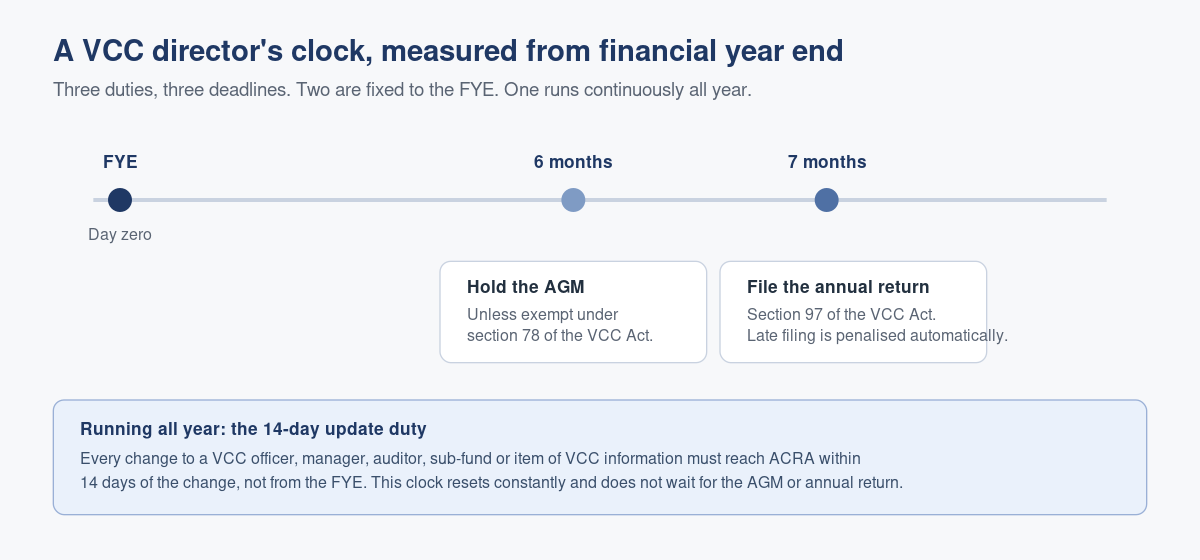
A VCC director must hold the annual general meeting within six months of the financial year end, file the annual return within seven months, and keep the VCC’s information and registers current, reporting most changes within 14 days.
Raffles Corporate Services works with a panel of experienced Singapore law firms who offer cost-effective and efficient legal service and advice. This article is general information only and is not legal advice.
Those three duties come directly from the Variable Capital Companies Act 2018, and ACRA treats them as the baseline against which every VCC director is measured. They sit alongside a broader, less itemised duty: the general obligation to act honestly and with reasonable diligence in running the vehicle, which the VCC Act carries into the fund context from the ordinary law of directors’ duties.
None of this is unique to VCCs in spirit. What is unique is the context: a VCC director is usually also dealing with a fund manager, sub-funds with their own economics, and investors who expect the corporate housekeeping to be invisible precisely because it is being done properly.
The three duties ACRA measures you against
| Duty | Deadline | Statutory basis |
|---|---|---|
| Hold the annual general meeting, unless exempt | Within six months of the financial year end | Sections 77 and 78 of the VCC Act 2018 |
| File the annual return | Within seven months of the financial year end | Section 97 of the VCC Act 2018 |
| Maintain VCC information and registers, reporting changes to the VCC, its sub-funds or its officers | Within 14 days of the change | Section 71 (registers of directors, secretaries, auditors and managers) and section 81 (register of members) of the VCC Act 2018 |
The first two deadlines move together but are not the same deadline. A VCC that holds its AGM on time but files the annual return late has still committed a separate breach, and vice versa. The third duty is different in kind: it does not wait for the financial year end at all. It runs continuously, triggered by whatever change actually happens.
Consequences for missing the first two run from an automatic late lodgment penalty through to court prosecution and, for repeat offenders, director disqualification. That full escalation is set out in our guide to penalties and enforcement for late VCC annual return filing, and the mechanics of the 14-day update duty are covered in updating VCC information and officers.
The duty behind the deadlines: acting honestly and with diligence
The three itemised duties above are specific obligations with fixed dates attached. Underneath them sits a more general duty that does not come with a calendar entry: section 63 of the VCC Act 2018, headed “duty and liability of officers”, carries the ordinary standard expected of a company director into the VCC framework.
In substance, this means a VCC director is expected to act honestly and to use reasonable diligence in the discharge of the role, and not to make improper use of information or of the director’s position, whether to gain an advantage personally or to cause detriment to the VCC or its sub-funds. This is the same standard Singapore company law applies to directors generally, adapted to sit inside the VCC Act rather than the Companies Act 1967.
The itemised deadlines are, in a sense, the easiest part of this duty to comply with, because they come with fixed dates and clear filing steps. The general duty is harder precisely because it has no date attached: it applies continuously to every decision a director makes, from approving a sub-fund’s valuation methodology to signing off on a related-party arrangement with the manager.
Keeping a manager in place is a director’s problem too
One obligation that gets less attention than the filing deadlines, but carries real consequences, is making sure the VCC always has an appointed manager. A VCC that goes without a manager for longer than the law allows is not merely in an administrative grey area. A manager vacancy that persists is a ground on which the Court can order the VCC wound up.
This matters to directors specifically because a manager’s resignation is usually announced to the board before it becomes public, which means the directors are typically the first people in a position to start the search for a replacement. Treating a manager’s departure as the manager’s own problem to solve, rather than a board-level compliance risk, is a common way this obligation gets missed until it is too late to fix quietly. Our guide to winding up or dissolving a sub-fund of a Singapore VCC and MAS’s own findings in its governance and management thematic review of Singapore’s VCCs both touch on how quickly a governance gap at the manager level turns into a structural problem for the vehicle.
What a new VCC director should do in the first month
A director stepping onto a VCC board for the first time, whether at incorporation or by later appointment, is taking on obligations that start immediately, not once the first AGM season arrives.
- Confirm the VCC’s financial year end and calculate the AGM and annual return deadlines from it, rather than assuming they mirror another entity’s calendar.
- Check who currently holds Corppass access to the VCC’s eServices account, and confirm you or someone accountable to you can actually log in and file when the time comes.
- Ask for sight of the VCC’s constitution and confirm which sub-funds, if any, sit under it, since obligations can run at the sub-fund level as well as the umbrella level.
- Confirm the manager’s appointment is current and find out who is responsible for flagging early if that changes.
- Establish, in writing, who within the manager’s team or the corporate secretary’s team owns the 14-day update clock for officer, information and register changes, so it is not assumed to be someone else’s job.
- Review the register of members and the register of directors, secretaries, managers and auditors to confirm they reflect reality as of the day you join.
None of these steps is difficult on its own. What causes problems later is skipping them at the outset and discovering months in that nobody actually owns the compliance calendar.
What goes wrong in practice
A director assumes the fund administrator is also handling ACRA compliance. Fund administrators handle investor-facing record-keeping, not statutory filings with ACRA. The two functions look similar from a distance and are not the same job, and a director who has not confirmed who actually owns ACRA compliance may discover the gap only when a deadline has already passed.
The AGM is treated as a formality and scheduled without reference to the seven-month annual return deadline. Because the AGM deadline (six months) and the annual return deadline (seven months) are close together but not identical, scheduling the AGM late in its own window leaves almost no buffer if anything about the annual return needs correcting before filing.
A director who also sits on several other VCC or company boards loses track of which entity’s clock is running. Directors serving multiple fund vehicles are a normal feature of the industry, but each VCC has its own financial year end and its own deadlines. Treating them as interchangeable is how a director ends up missing a deadline for one entity while correctly meeting it for another.
Nobody escalates a manager’s informal signal that they may resign. A manager who mentions, even casually, that the mandate is under review has effectively started a clock that the board should be tracking. Waiting for a formal resignation letter before starting to look for a replacement compresses the time available and increases the risk of a manager vacancy running long enough to matter.
Frequently asked questions
Is a VCC director’s duty to hold an AGM absolute?
Not quite. Section 78 of the VCC Act sets out circumstances in which a VCC need not hold an AGM, and where those apply, the exemption removes that specific obligation. Where no exemption applies, the AGM must be held within six months of the financial year end, and the general duty to act diligently still governs how a director approaches the decision.
What does “reasonable diligence” actually require of a VCC director?
It requires more than passive attendance at board meetings. A director is expected to inform themselves about the VCC’s affairs, including its sub-funds, its manager arrangements and its filing calendar, and to act on that information rather than defer entirely to the manager or the corporate secretary. Section 63 of the VCC Act carries this standard into the VCC framework.
Can a VCC director be personally liable for a late annual return?
Yes, in the sense that enforcement action for filing offences can be directed at directors as well as the VCC itself, and repeated convictions expose a director personally to disqualification. The escalation from an automatic penalty through to court prosecution and disqualification is set out in our guide to late VCC annual return penalties.
Does a VCC director need to personally track sub-fund level obligations, or is that the manager’s job?
Both. The manager typically runs day-to-day fund operations, but the director’s oversight duty does not stop at the umbrella level. Obligations such as sub-fund registration changes and the requirement to keep a manager in place at all times sit with the VCC as a whole, and directors remain accountable for them.
What happens if a VCC has no manager for a period of time?
A prolonged gap without an appointed manager is a ground on which the Court may order the VCC wound up. Directors should treat a manager’s departure as an immediate board-level priority rather than an administrative matter to resolve at leisure.
Where do these duties sit relative to ordinary company director duties in Singapore?
They run on the same general principle, honesty and reasonable diligence, but are set out in the VCC Act 2018 rather than the Companies Act 1967, with deadlines tailored to a fund vehicle’s annual cycle. A director moving from an ordinary Companies Act board to a VCC board should not assume the two sets of deadlines are identical.
Getting the calendar right so the duty takes care of itself
Most VCC directors do not fail these duties through bad faith. They fail them through an unclear division of labour: nobody was quite sure whether the manager, the corporate secretary or the director’s own office was tracking a particular deadline, and by the time anyone checked, it had passed.
Raffles Corporate Services supports VCC directors and their boards with the corporate secretarial side of this: tracking AGM and annual return deadlines against the actual financial year end, keeping the statutory registers current, and flagging a manager vacancy or a governance gap before it becomes a winding up ground. If you have recently joined a VCC board, or you are not certain who currently owns your VCC’s compliance calendar, that is worth a conversation before the next deadline arrives.
The statutory source is the Variable Capital Companies Act 2018, and ACRA’s own summary sits on its page for legal obligations of a VCC director. For the AML and CFT obligations that sit alongside these general duties, see our MAS AML/CFT for licensed entities FAQ.
The Editorial Team, Raffles Corporate Services
Need help with corporate secretarial or compliance matters?
If you would like help with your company's corporate secretarial, governance or compliance requirements, email [email protected] or WhatsApp +65 8501 7133.
Our team can assist with corporate secretarial, accounting and tax matters. Where legal advice is needed, advisers from our associated law firms can assist.