
If a share filing has gone to ACRA with the wrong numbers, names or dates, you fix it by filing a Notice of Error (NOE) on the original transaction. The fee is $60, and ACRA states a processing time of 15 working days for most NOEs.
Raffles Corporate Services works with a panel of experienced Singapore law firms who offer cost-effective and efficient legal service and advice. This article is general information only and is not legal advice.
You cannot edit a lodged transaction. Once a return of allotment or a transfer of shares has been submitted and accepted, the record is fixed and the only way to change it is to ask the Registrar to rectify it. That is what an NOE is: a formal application for rectification, not an amendment button.
The mechanism sits in the Companies Act 1967. Section 12C allows the Registrar to rectify the register on application, and section 12D allows the Registrar to do it on their own initiative. Where the correction is contested or goes beyond what the Registrar can properly do, section 12B sends you to the Court instead. Most share filing mistakes never get near a court. They are typing errors, and they are fixable in one application.
Here is how to pick the right route and how to avoid paying $60 for a rejection.
What counts as a share transaction error
The NOE route described here covers errors in share-related filings: returns of allotment, transfers of shares, conversions of shares, redenominations, alterations to share capital and the like. In practice these are the transactions where a slipped digit does the most damage, because share numbers cascade through the register of members, the shareholding percentages and every document that relies on them.
ACRA splits share NOEs into two types, and choosing the wrong one is the single most common reason an application stalls.
Type 1: clerical or typographical errors
This is the straightforward one. The intention was right, the keystrokes were not. A shareholder’s name spelt wrongly, a transfer date keyed as 2025 instead of 2026, 10,000 shares entered as 1,000, a share class labelled incorrectly.
You state what was filed, what should have been filed, and why the correction is needed. The bar is low because nothing substantive is changing: the filing is simply being made to say what everyone already intended it to say.
Type 2: application to the Registrar for other errors
This is for unintended errors that go beyond a typing slip, where the correction does not prejudice anybody. The extra work here is the justification. You have to describe the error clearly, explain how the wrong information came to be filed in the first place, and satisfy the Registrar that rectifying it will not harm any person who might have relied on the record.
That last limb is the one people underestimate. “No prejudice” is not a formality. If a third party has dealt with the company on the strength of the filed position, say a lender who took security by reference to the shareholding, then the Registrar is entitled to ask what happens to that party when the record changes. Think this through before you file, not after the query lands.
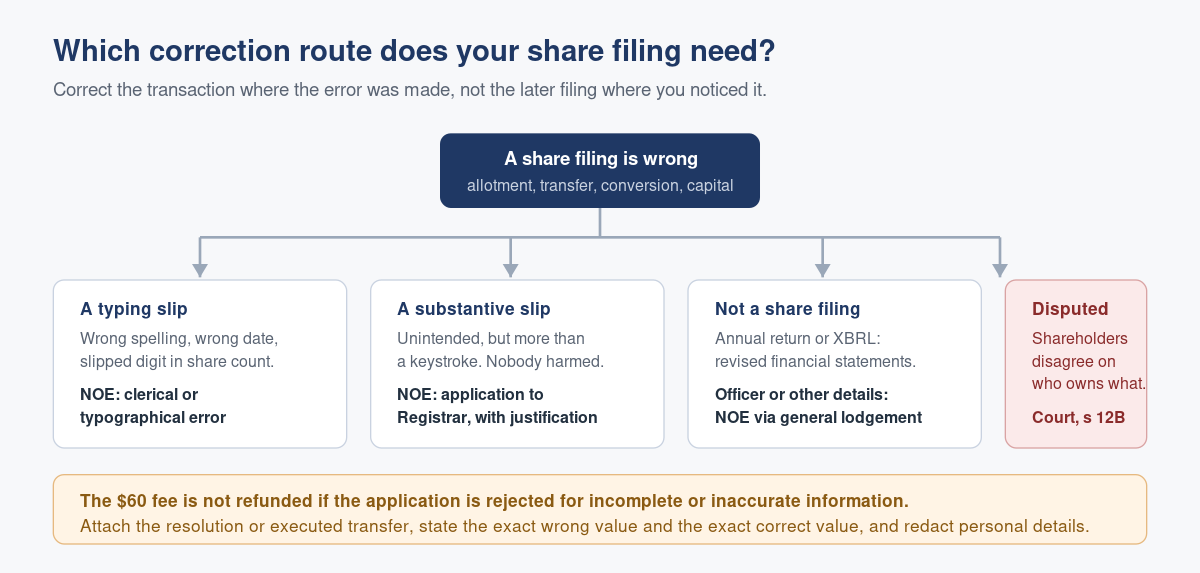
File on the transaction where the error was made, not where you noticed it
This is the rule that saves the most wasted fees, so it is worth stating plainly.
You file the NOE against the transaction in which the incorrect information was originally lodged. You do not file it against the later transaction in which you happened to spot the error.
The classic example: a return of allotment records the wrong number of shares. Twelve months later the annual return displays the wrong number, because the annual return is drawing on the underlying record. The error lives in the return of allotment. That is what you correct. Fix the source and the downstream display follows.
Which route applies to your error
| The error is in | Route to take |
|---|---|
| A share transaction filed on or after 13 January 2003 | Share transaction NOE, as described here |
| A share transaction filed before that date | ACRA runs a separate NOE process for historical share transactions |
| An annual return or XBRL financial statements | Notification of revised financial statements, not an NOE |
| A non-share matter, for example a wrong officer cessation date | NOE via general lodgement |
| A matter in genuine dispute between shareholders | Rectification by the Court under section 12B, Companies Act 1967 |
If you are not sure which of your filings introduced the error, pull your filing history first. Our guide on using your Bizfile transaction history as an audit trail shows how to work backwards to the originating transaction.
Who can file, and what you need before you start
Only position holders of the entity or a registered corporate service provider can lodge the NOE. If you hold positions in more than one company, confirm you are on the right entity dashboard before you begin, because an NOE keyed against the wrong company is a $60 lesson. Our note on switching profiles on Bizfile covers that trap.
Have these ready:
- The company’s UEN
- The transaction number of the filing to be corrected, or a date range to search within
- A clear, written description of the error
- The correct share information, in the exact form it should appear
- Supporting documents, for example the directors’ resolution, the share transfer form or the board minutes evidencing what was actually approved
- For a type 2 application, your written justification that nobody is prejudiced
One warning on supporting documents. NOE material can end up in publicly accessible records. Redact dates of birth, mobile numbers and residential addresses before you upload anything. A scanned resolution with a director’s NRIC and home address in the footer is a privacy problem you have created for yourself.
The filing steps, in order
- Log in to Bizfile as a Business User through Corppass, and confirm you are on the correct entity dashboard.
- Open the File Notice of Error eService and start a new application.
- Confirm the transaction you are correcting was filed on or after 13 January 2003, so the system routes you to the current process rather than the historical one.
- Retrieve the transaction, either by transaction number or by searching a date range. Select the filing to correct.
- Choose your NOE type, then complete the details: for a clerical error, the wrong information and the correct information; for an application to the Registrar, the full description, explanation and no-prejudice justification.
- State whether the correction changes the company’s current share capital or shareholding. If it does, key the corrected figures field by field, including any share classes, sub-classes or shares held in trust.
- Review everything, complete the declaration, and pay.
The Bizfile Inbox notification is your receipt that the application landed. Track progress under My Transactions. If the payment itself misbehaves, our guide to ACRA payments, failed transactions and refunds covers what to do next.
Fee, timing and the refund you will not get
| Item | Position |
|---|---|
| Fee | $60 |
| Processing, clerical or typographical errors | 15 working days |
| Processing, application to Registrar for other errors | 15 working days |
| Processing, where the NOE changes underlying data | Up to 30 working days |
| Refund if rejected for incomplete or inaccurate information | None |
That last line deserves emphasis. The fee is not refunded when an application is rejected because it was incomplete or inaccurate. Filing a thin NOE and hoping the Registrar fills in the gaps is an expensive habit.
Note also that ACRA may update the transaction information in the system before the application is finally approved. Seeing the corrected figure appear is not the same as approval. Wait for the outcome before you rely on it in a transaction.
What goes wrong in practice
The NOE is filed against the wrong transaction. Usually the annual return rather than the return of allotment. Rejected, fee gone, and the clock restarts on a matter that may already be holding up a financing.
The description is vague. “Shares were wrong” tells the Registrar nothing. The application needs to be readable by someone who has never seen your company: the exact field, the exact wrong value, the exact correct value.
No supporting evidence. A correction to a shareholding is a correction to who legally owns part of a company. It needs a document behind it. A resolution, an executed transfer, a subscription agreement. Assertion alone is weak.
The current shareholding is not updated. Correcting a historical allotment often changes today’s numbers. If you answer “no changes” when the correction does in fact move the current position, ACRA’s record stays internally inconsistent and you will be back.
Nobody checks the register afterwards. Once the NOE is approved, download the register of members and confirm it reads the way you intended. Free downloads make this a two-minute step, and skipping it is how a second error survives for years.
The error is actually a dispute. If two shareholders disagree about who owns what, an NOE is the wrong instrument. The Registrar rectifies records; the Court resolves title. Trying the cheap route first usually costs more.
Frequently asked questions
How much does a Notice of Error cost, and is it refundable?
ACRA charges $60 for an NOE on a share transaction. The fee is not refunded if the application is rejected because the information supplied was incomplete or inaccurate. Prepare the application properly the first time rather than treating the fee as a retry token.
Can I just refile the correct transaction instead of an NOE?
No. Filing a second, contradictory transaction does not remove the first one, and it leaves ACRA’s record showing two inconsistent positions. The lodged filing has to be rectified through the NOE process so that the corrected record replaces the wrong one.
How long does a Notice of Error take to process?
ACRA states 15 working days for clerical or typographical corrections and for applications to the Registrar for other errors, and up to 30 working days where the NOE results in a change to underlying data. Figures may appear updated in the system before final approval.
Who is allowed to file a Notice of Error?
Position holders of the company, meaning directors and the company secretary, and registered corporate service providers acting for the company. A shareholder who holds no office cannot file the NOE themselves and must go through an officer or the company’s corporate secretary.
What if the mistake is in an annual return rather than a share transaction?
That is a different process. Errors in annual return transactions or in XBRL financial statements are corrected through a notification of revised financial statements, not through a share transaction NOE. Where the annual return merely displays an error made in an earlier share filing, correct the earlier filing.
Does filing an NOE attract a late lodgement penalty?
The NOE fee is separate from late lodgement penalties. If the underlying transaction was itself filed late, that penalty is assessed on the original filing. Correcting an error does not retrospectively cure lateness, and it does not create a new penalty either.
Getting the filing right the first time
Almost every share NOE we see could have been avoided at the point of the original filing, usually by one person reading the resolution against the Bizfile screen before pressing submit. That takes a minute. An NOE takes a fee, a form, an evidence pack and up to six weeks.
The wider point is that the ACRA record is the one that counts. A share transfer everybody agreed to in an email is not effective because everybody agreed to it; it is effective because it is properly executed and properly lodged. If you want to understand where the statutory lines fall, the Companies Act 1967 deep-dive FAQ is a good starting point, and the Act itself is on Singapore Statutes Online. Before you rely on any company’s filed position in a transaction, our guide to Bizfile’s search functions explains what you can verify and what you cannot.
If you have found an error and are not certain which transaction introduced it, that is exactly the kind of thing we unpick every week. Raffles Corporate Services traces the filing history, prepares the NOE with the supporting evidence attached, and checks the register afterwards to confirm the correction landed. You can also read more on Singapore corporate secretarial practice at Singapore Secretary Services.
— The Editorial Team, Raffles Corporate Services
Need help with corporate secretarial or compliance matters?
If you would like help with your company's corporate secretarial, governance or compliance requirements, email [email protected] or WhatsApp +65 8501 7133.
Our team can assist with corporate secretarial, accounting and tax matters. Where legal advice is needed, advisers from our associated law firms can assist.