

A free register extract downloaded from Bizfile proves one thing: what has been lodged with ACRA, as at the moment you pressed download. It does not prove that the lodgement was correct, that it was authorised, or that nothing has changed since.
Raffles Corporate Services works with a panel of experienced Singapore law firms who offer cost-effective and efficient legal service and advice. This article is general information only and is not legal advice.
That distinction matters enormously the day someone relies on the extract to buy shares, release funds, appoint a signatory or sign off a set of accounts. The extract is a genuinely useful document and it costs nothing, which is exactly why people over-read it.
This article is about the reading, not the downloading. If you want the click-by-click route to the free registers, that is covered separately in our guide to downloading your company registers free from Bizfile.
What the extract actually is
A register extract is a print of ACRA’s electronic register for your company at a point in time. Since the Companies Act 1967 was amended to move the statutory registers into the Registrar’s electronic system, the ACRA record is the register for a private company rather than a copy of one kept elsewhere. Section 196A does that work for the register of members, and Section 173 for the register of directors, chief executive officers, secretaries and auditors.
So the extract is not a summary of the register. It is the register, rendered as a PDF.
That is why it carries real weight. It is also why its limits are so easy to miss: because the document is authoritative about the register, people assume it is authoritative about the company. Those are different things.
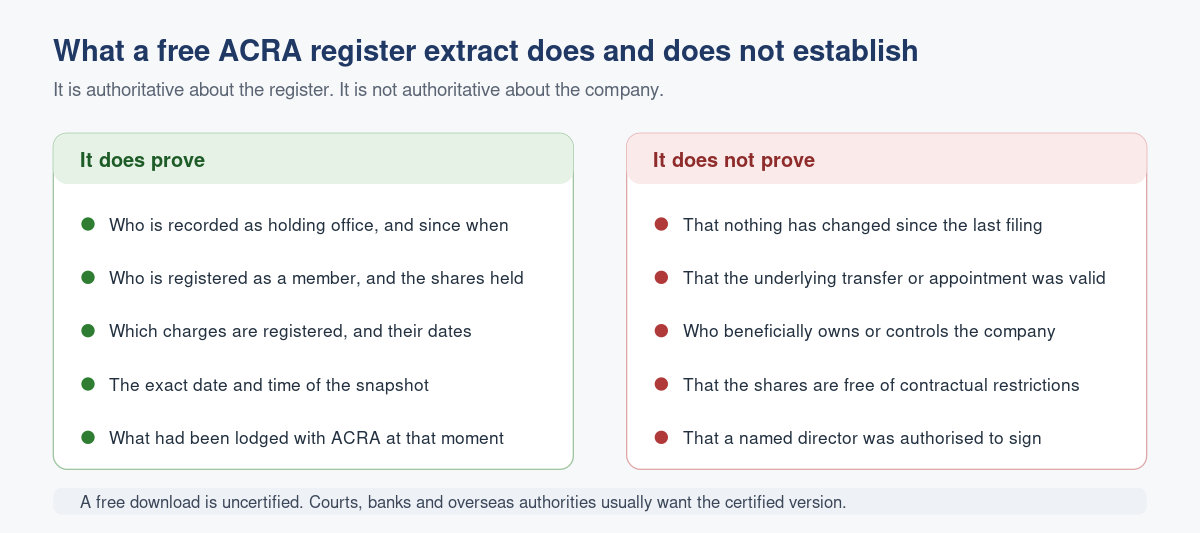
What it does prove
Used properly, the extract is strong evidence of four things.
Who is recorded as holding office, and since when. For most purposes involving a counterparty, bank or regulator, “is this person a director of the company” is answered by the register of directors. Section 173 makes the Registrar’s record the register, and the extract shows appointment and cessation dates.
Who is recorded as a member, and how many shares of which class. For a private company, entry in the register of members is what establishes legal title to the shares. A share certificate is evidence of title. The register entry is the title.
What charges have been registered, and when. The register of charges tells you what security has been lodged against the company’s assets and the date of registration. Registration date matters for priority, so the date on the extract is not decorative.
The exact moment of the snapshot. Every extract is timestamped. When a dispute later turns on what the register said on a particular day, a dated extract in the file is worth far more than anyone’s recollection.
What it does not prove
Here is the honest list, and each line of it has cost somebody money.
| The question | Does the extract answer it? | What closes the gap |
|---|---|---|
| Is the shareholding shown still current? | No. It shows what has been lodged. | A completion-day extract, plus signed undertakings on pending transfers |
| Was the underlying transfer valid? | No. Lodgement is not validation. | The executed instrument of transfer, board approval, and stamping evidence |
| Who ultimately owns or controls the company? | No. The register of members shows legal holders only. | The register of registrable controllers and the nominee registers |
| Are the shares free of encumbrances? | No. A share charge or a shareholders’ agreement restriction will not appear. | Search of the register of charges, plus the constitution and any shareholders’ agreement |
| Did the directors have authority to act? | No. It confirms office, not the scope of authority. | Board resolutions, the constitution, and any delegated authority matrix |
| Is this copy acceptable to a bank, court or foreign authority? | Often not. A free download is uncertified. | A purchased certified extract from Bizfile |
The lag problem, stated plainly
Changes to officers and to shareholdings must be filed with ACRA within a short statutory window, generally 14 days. A register extract cannot show a change that has not yet been lodged, and it cannot show a change that was lodged an hour after you downloaded it.
So there is always a window in which the register is behind the company. In a quiet year that window is irrelevant. On the day of a share sale it is the whole ball game, because the seller may have signed something you have not seen.
The practical answer is not to distrust the register. It is to take a fresh extract on the day that matters, and to paper the window with a warranty rather than a hope.
Free, certified, and purchased: which one does your counterparty want?
People often download the free copy, send it to a bank or an overseas registry, and are told it is not acceptable. That is not a rejection of the content. It is a rejection of the format.
| What you need it for | Free download is enough? | Why |
|---|---|---|
| Internal reconciliation before year end | Yes | Nobody outside the company relies on it |
| Checking a filing actually went through | Yes | You only need to see the current record |
| Board pack or auditor’s file | Usually | Auditors will pull their own copy anyway |
| Singapore bank account opening | Sometimes | Ask first, banks differ on what they accept |
| Court filing or affidavit exhibit | No | A certified extract is the safer exhibit |
| Overseas authority, legalisation, apostille | No | Certification is the starting point of the chain |
The rule of thumb: if the document is going to leave Singapore or go in front of a judge, buy the certified version and stop arguing about the fee.
Where this goes wrong in practice
The extract that was taken too early. Due diligence is done in February, completion happens in May, and nobody refreshes the register search. In between, a director resigned and a small parcel of shares moved. The buyer completes against a three-month-old picture.
Reading the register of members as a list of owners. It is a list of registered holders. Where nominees are involved, the person on the register is not the person with the economic interest. The controller and nominee registers exist precisely because the register of members does not answer that question, and they carry their own filing duties and their own penalties. If nominees are anywhere near your transaction, that is a separate enquiry, not a footnote.
Treating silence in the register of charges as “unencumbered”. The register shows registered charges. It does not show a share pledge sitting in a shareholders’ agreement, a negative pledge in a loan facility, or a pre-emption right in the constitution. Those are found by reading documents, not by downloading an extract.
Assuming the company’s own register matches ACRA’s. It very often does not, usually because a change was agreed commercially and never filed. Where the two diverge, ACRA’s record is the one that governs for a private company, and the correction is a filing exercise rather than a note in the minute book. The harder version of that problem, where records must be rebuilt after a company has been restored, is set out in our note on restoring statutory registers and records after court restoration.
How to use an extract properly in a transaction
- Take an extract at the start of diligence and date-stamp it into the file.
- List every discrepancy between the extract and the documents the company has given you, and resolve each one in writing.
- Ask for the constitution and any shareholders’ agreement, and read the transfer restrictions before you value anything.
- Ask specifically about nominee arrangements and registrable controllers, because the extract will not raise them for you.
- Take a fresh extract on completion morning and compare it line by line with the diligence copy.
- Make the seller warrant the register position at completion, so the gap between lodgement and reality sits with the party who knows the answer.
None of that is expensive. Steps 1 and 5 are free and take two minutes each.
Frequently asked questions
Is a free Bizfile register extract a legal document?
It is an authentic print of the Registrar’s electronic register, so its contents carry real evidential weight. It is not certified, however, which is a separate product. Banks, courts and overseas authorities generally want the certified version, so check what your recipient requires before you send an uncertified download.
If the ACRA register and my company’s own register disagree, which one wins?
For a Singapore private company, the Registrar’s electronic register is the statutory register. Your internal spreadsheet or minute book is a working record, not the register. Where the two diverge, the correct response is to establish what actually happened and file the necessary correction, not to quietly align the internal copy.
Does the register of members show the beneficial owner of the shares?
No. It shows the registered legal holder. Where a nominee holds shares for someone else, the register of members will name the nominee. Beneficial ownership is addressed through the register of registrable controllers and the nominee registers, which are maintained separately and carry their own obligations.
How old is too old for a register extract in a transaction?
Any extract older than the last filing deadline should be treated as stale. Because most changes must be filed within 14 days, an extract more than a fortnight old may already be behind the company. For a completion, take a fresh one on the day and compare it against the diligence copy.
Can I rely on the extract to confirm a director has authority to sign?
Only partly. The extract confirms that the person holds office as a director. It says nothing about whether the board authorised the particular transaction or whether the constitution restricts what a single director may do. For anything material, ask for the board resolution as well.
Does a clean register of charges mean the company has no security over its assets?
No. It means no registrable charge has been registered. Contractual restrictions such as negative pledges, share pledges recorded in a shareholders’ agreement, or retention of title arrangements with suppliers will not appear. Those are found by reading the finance and shareholder documents.
Getting the evidence layer right
Register extracts are cheap, fast and genuinely useful. The trouble starts when a free document is asked to carry a weight it was never built for: proving ownership rather than recording it, proving authority rather than office, proving the present rather than the last lodgement.
Closing that gap is ordinary corporate secretarial work. Raffles Corporate Services reconciles ACRA’s record against clients’ own registers before every year end, files changes inside the statutory window, and prepares the register position for transactions so that buyers, lenders and auditors are looking at the same picture your board is. You can also read more on Singapore corporate secretarial practice at Singapore Secretary Services, and check the current statutory text at sso.agc.gov.sg.
If you are not confident that your registers and ACRA’s currently agree, that is a short conversation and usually a quick fix.
— The Editorial Team, Raffles Corporate Services
Need help with corporate secretarial or compliance matters?
If you would like help with your company's corporate secretarial, governance or compliance requirements, email [email protected] or WhatsApp +65 8501 7133.
Our team can assist with corporate secretarial, accounting and tax matters. Where legal advice is needed, advisers from our associated law firms can assist.