

When you register a Singapore company or file a transaction with ACRA, you get 30 days to download the constitution and the filing extracts free of charge. After 30 days the same documents are still available, but you have to buy them.
Raffles Corporate Services works with a panel of experienced Singapore law firms who offer cost-effective and efficient legal service and advice. This article is general information only and is not legal advice.
Two things make this trip people up. The free copy is tied to the person who made the filing, not to the company. And the window runs from the transaction, not from when somebody notices they need the document.
So the most common version of this problem is a director who asks for the constitution in month four, from a company secretary who did not file the incorporation, about a transaction nobody downloaded at the time.
What you are actually downloading
Two different things sit behind this, and they are worth separating.
The constitution. Every Singapore company must have one. It is the company’s governing document: the rules on share classes and transfers, director appointment and removal, meetings and voting, and dividends. If you incorporated using the model constitution, it is still your constitution, and you will still be asked for it by banks, auditors, landlords and anyone doing diligence on you.
The extracts. These are the system-generated confirmations that a filing was accepted and what it recorded. They are the paper trail behind a change of directors, an allotment of shares, a change of registered office or a change of financial year end. They are the document you produce when somebody asks you to prove not just that the record is correct today, but that you filed it on the date you say you did.
Both are generated as part of the transaction, and both sit in the transaction record rather than in a general company file.
Who gets the free copy
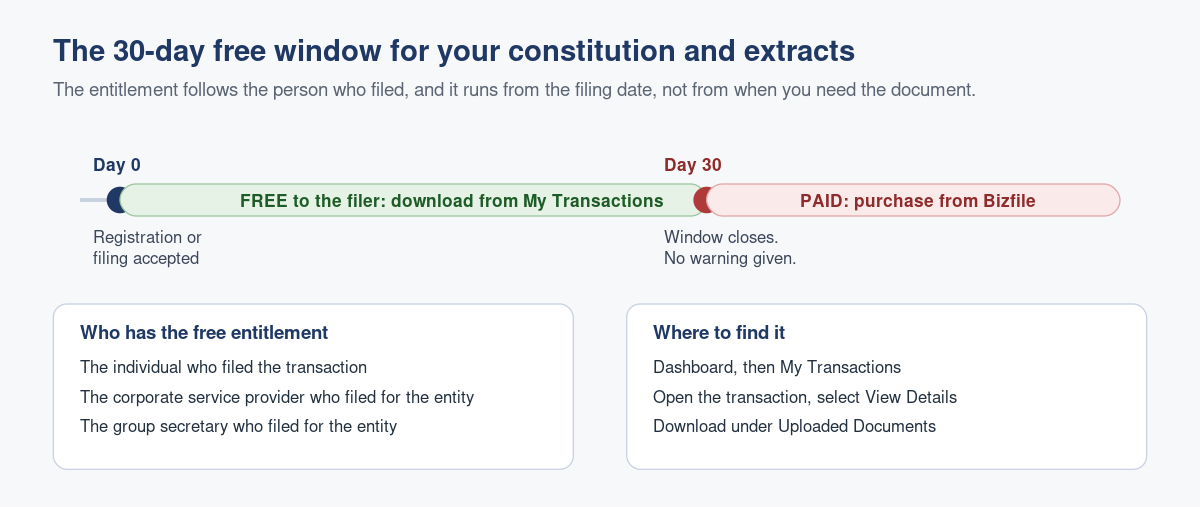
Eligibility follows the filer. You can take the free download if you filed the eligible transaction, which in practice means one of three people:
- The individual who filed the transaction directly
- The corporate service provider who filed on behalf of the entity
- The group secretary who filed on behalf of the entity
Note what is missing from that list. A director who did not file. A shareholder. A newly appointed company secretary who inherited the file from a predecessor. An incoming corporate service provider taking over the client. None of them have the free entitlement, even though all of them may have a perfectly good reason to want the document.
This is the single most useful thing to understand about the free copy, because it drives everything you should do about it.
Free, then paid: how the entitlement decays
| Document | Free to whom | Free for how long | After that |
|---|---|---|---|
| Constitution | The party who filed the registration | 30 days from business registration | Purchase from Bizfile |
| Filing extracts | The party who filed the transaction | 30 days from the filing | Purchase from Bizfile |
| Same documents, requested by a non-filer | Nobody | Not applicable | Purchase from Bizfile |
The paid route is the ordinary Bizfile information product. We set out how the company fee schedule is structured in our guide to ACRA service and transaction fees for companies.
How to download, in order
You will need to be logged in to Bizfile in your business user capacity, using the same account that made the filing. If Bizfile access is new to you, start with our walkthrough of logging in to Bizfile as a business user, and, for a brand new company, setting up Corppass from UEN to first login.
- Log in to Bizfile as a business user via Singpass.
- Go to your Dashboard.
- Open My Transactions.
- Find the registration or filing transaction in the list and select View Details.
- Open Uploaded Documents and download the constitution or extract from there.
The step most people miss is step 3. They look for the constitution under the company’s entity information, where the registers and business profile live, and conclude it is not available. It is not filed under the company. It is filed under the transaction.
What goes wrong, and what it costs
The window closes quietly. Nothing warns you on day 29. The documents do not disappear on day 31, they simply become chargeable, and the charge is typically discovered at the worst moment: a bank asking for the constitution during account opening, or an auditor asking for filing evidence in the middle of a year end.
The cost is small. The delay is not. Buying a document takes minutes, but chasing down who filed the transaction, whether they still act for the company, and whether they kept a copy can take days.
Nobody owns the download. Where a corporate service provider incorporated the company, the free entitlement sat with the provider. If nobody asked for the pack, the client may genuinely have no copy of their own constitution. When the relationship later ends, the client is buying back documents that were free at the time. Corporate service providers carry their own record-keeping and client due diligence obligations, which we cover in our Corporate Service Providers Act 2024 compliance FAQ.
The constitution gets amended and nobody re-downloads. The constitution you saved at incorporation stops being current the moment members pass a special resolution to alter it. If you have adopted a new constitution or amended an article, the version in your onboarding folder is now historic. Save the extract from that amendment filing, and save the amended constitution alongside it.
Filing extracts are treated as receipts. They are not receipts. They are the evidence that a statutory filing was made and when. Because most changes must be lodged within a short window, generally 14 days, the date on the extract is exactly the thing you will want if a late filing is ever queried.
A simple policy that removes the problem
Adopt one rule: every ACRA filing produces a document that goes into the company’s permanent file on the day it is filed.
That is it. Not a diary reminder on day 25, not a quarterly sweep. Download at the point of filing, while the free entitlement is live and while the person who filed is still the person at the keyboard.
A workable permanent file for a Singapore private company holds:
- The constitution, current version, plus any superseded versions
- The incorporation transaction extract
- One extract per subsequent filing, in date order
- Current register downloads for directors, members and charges
- Board and members’ resolutions supporting each filing
- Share certificates and instruments of transfer, with stamping evidence
Items 1 to 3 are free at the moment of filing and chargeable afterwards. Items 4 onward are free on demand to officers and members, which is covered in our note on what Bizfile actually is and what you can do in it.
Frequently asked questions
I am a director but my corporate secretary filed the incorporation. Can I download the constitution free?
No. The free entitlement follows the person who filed the transaction, not the company or its officers. Ask your corporate secretary for their copy, which is the fastest route. If nobody kept one, or the 30 days have passed, the constitution can be purchased from Bizfile at the usual information product charge.
How long do I have to download the free constitution?
Thirty days from the business registration. Filing extracts follow the same rule, counted from the date of the relevant filing. There is no grace period and no notification before the window closes, so the reliable approach is to download at the moment of filing rather than diarising it for later.
Where in Bizfile are these documents kept?
Not under the company’s entity information, which is where the registers and business profile sit. They are attached to the transaction. Go to your dashboard, open My Transactions, find the registration or filing, view its details, and the documents are under the uploaded documents section of that transaction.
Does the free copy differ from the paid copy?
The content is the same document. What you are paying for after the window is access, not a different version. If you need a certified copy for a court, a bank or an overseas authority, that is a separate certified product again, and neither the free download nor an ordinary purchase satisfies it.
We amended our constitution last year. Which version will I get?
The transaction record gives you the document generated by that particular filing. The constitution attached to your incorporation is the original. If members later adopted a new or amended constitution, the current version is attached to that later filing, so download from the amendment transaction and keep both versions on file.
What counts as an eligible transaction for a free extract?
Broadly, a successful registration or filing that you made yourself or that your corporate service provider or group secretary made on the entity’s behalf. If the filing was made by someone outside that group, there is no free entitlement attached to it for you, regardless of your position in the company.
Keeping the pack complete
A company’s document pack is one of those things that is almost free to maintain and surprisingly expensive to rebuild. Thirty days is a generous window when somebody is watching it and a very short one when nobody is.
Raffles Corporate Services downloads and files the constitution and every filing extract at the point of lodgement for the companies we act for, so the pack is complete before anyone asks for it, and hands over cleanly if you ever move. If you have inherited a company with gaps in its file, we can tell you quickly what is missing and what it will take to rebuild.
Further reading on Singapore corporate secretarial practice is at Singapore Secretary Services, and the governing statute is at sso.agc.gov.sg.
— The Editorial Team, Raffles Corporate Services
Need help with corporate secretarial or compliance matters?
If you would like help with your company's corporate secretarial, governance or compliance requirements, email [email protected] or WhatsApp +65 8501 7133.
Our team can assist with corporate secretarial, accounting and tax matters. Where legal advice is needed, advisers from our associated law firms can assist.