
A foreign company registered in Singapore must lodge two sets of financial statements with ACRA every year: the head office accounts and a separate set covering the Singapore branch. Both obligations sit in section 373 of the Companies Act 1967. Missing either is an offence.
Raffles Corporate Services works with a panel of experienced Singapore law firms who offer cost-effective and efficient legal service and advice. This article is general information only and is not legal advice.
This catches out a lot of well run groups. The head office accounts are already prepared and audited somewhere else, so it feels as though sending them over should satisfy Singapore. It does not. Singapore also wants to see what the branch itself did, because a branch is not a separate legal person and its numbers would otherwise be invisible here.
Here is what each set has to contain, when it is due, and which parts you can be released from.
The head office financial statements
Section 373(1) requires a foreign company to lodge financial statements made up to the end of its last financial year, together with a declaration in the prescribed form verifying that the copies are true copies. Where the statements are audited, you also lodge a statement naming the auditor.
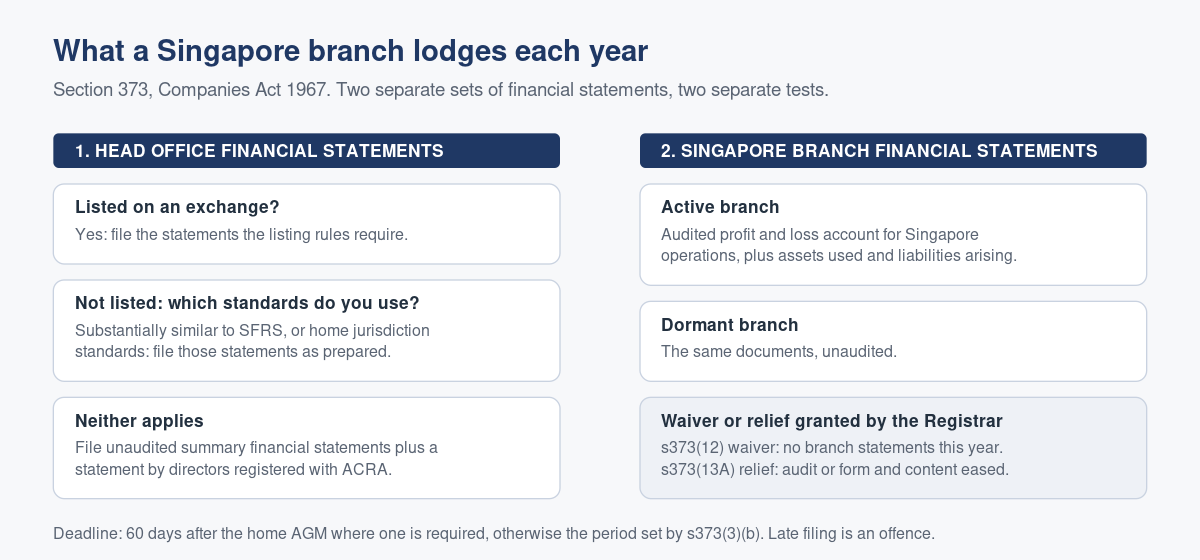
What counts as “financial statements” depends on where the company sits, and section 373(2) sets out the ladder:
If the company’s shares are listed, on an approved exchange in Singapore or overseas, and the listing rules require it to prepare financial statements, those are the statements you file. You do not rebuild them to a Singapore template.
If it is not listed, you work down three rungs. Where the company prepares statements under accounting standards substantially similar to the Singapore Accounting Standards, such as IFRS or SFRS(I), you file those. Where it does not but prepares statements under the applicable standards required by the law of its place of incorporation, audited or unaudited as that law requires, you file those. Where neither applies, you file unaudited summary financial statements.
Summary financial statements are not a licence to be vague. They need a statement of financial position, a statement of comprehensive income, the material accounting policies including the basis of measurement, and a statement by directors signed by two directors registered with ACRA, or by the sole registered director where there is only one.
A translation point people forget
If the financial statements are not in English, you lodge both the original and an English translation. A certified translation of a full set of audited accounts is not a same-day job, and it is a common reason well run groups file late.
The Singapore branch financial statements
This is the set that exists only because of Singapore. Under section 373(7), in addition to the head office statements, a foreign company must lodge:
- A duly audited statement showing the assets used in, and the liabilities arising out of, its operations in Singapore as at the balance sheet date
- A duly audited profit and loss account for its last preceding financial year
- A statement of the name of the auditor who audited those documents
Section 373(7A) adds a standard with real teeth. The branch profit and loss account must, so far as is practicable, comply with the Accounting Standards and give a true and fair view of the profit or loss arising out of the company’s Singapore operations. Section 373(8) then allows you to apportion expenses incurred for operations affecting both Singapore and elsewhere, and to add notes and explanations, so that the view given is a fair one.
That apportionment is where the judgement lives. Group overheads, regional management time and shared platform costs must be allocated on a basis you can defend. Document the basis when you set it, and apply it consistently.
When the branch is dormant
Section 373(9) lets a foreign company that is dormant in Singapore lodge an unaudited statement of assets and liabilities and an unaudited profit and loss account instead of the audited set. The documents are still filed. Only the audit falls away.
Dormancy is defined narrowly. Section 373(19) says a foreign company is dormant in Singapore during a period in which no accounting transaction arising out of its Singapore operations occurs, and it ceases to be dormant the moment such a transaction happens. An accounting transaction means one for which records would have to be kept in order to prepare the section 373(7) documents. ACRA’s guidance also points to the dormancy concept in section 205B of the Companies Act 1967, which carves out a short list of administrative items.
Either way, the test is strict. One paid supplier invoice or one bank charge on a Singapore account, and the branch is not dormant that year.
When it is due
Section 373(3) sets two different clocks, and the one that applies to you depends on your home jurisdiction, not on Singapore.
| Your situation | The deadline under section 373(3) |
|---|---|
| The law of your place of incorporation requires the financial statements to be tabled at an annual general meeting | Within 60 days after the date the AGM is held |
| It does not | The period a Singapore public company which does not keep a branch register outside Singapore would have had to lodge its financial statements |
The second limb is deliberately indirect, and it is the one to confirm with your adviser before you diarise a date. Note also that the first limb is pegged to the AGM actually held, not the AGM that should have been held. If the head office AGM slips, the Singapore clock slips with it, and you should be able to evidence the AGM date.
Waivers and relief you can apply for
Section 373 contains four distinct escape valves, and they are not interchangeable. Confusing them is a common reason an application is rejected.
| Provision | What it does | Applies to |
|---|---|---|
| Section 373(10) | Extends the time to comply | Deadline only |
| Section 373(12) | Waives the requirement to lodge the branch documents | Branch statements |
| Section 373(13) | Relieves from form and content of the head office statements, or allows another document instead | Head office statements |
| Section 373(13A) | Relieves from audit, or from form and content, of the branch documents | Branch statements |
The section 373(12) waiver is the strongest and the hardest to get. The Registrar may waive the branch documents where satisfied that compliance is impractical given the nature of the Singapore operations, would be of no real value given the amounts involved, would involve expense unduly out of proportion to its value, or would be misleading or harmful to the business of the foreign company or a related company.
For relief under section 373(13) or (13A), section 373(15) is the gatekeeper: the Registrar must not make the order unless satisfied that compliance would render the documents misleading or inappropriate to the circumstances of the foreign company, or would impose unreasonable burdens on it. Orders can be conditional, can be limited to a specific period, and can be revoked or suspended.
Applications go through the General Lodgement eService in Bizfile, under the section 373 exemption and waiver option, with the completed form and a directors’ declaration attached. The fee is $200 and it is not refundable, so do not submit drafts. Our note on paying ACRA on Bizfile covers methods, failed payments and receipts.
What goes wrong in practice
The branch audit is scoped too late. An audit of Singapore operations is a different engagement from the group audit. Tell your auditor in month eleven that you need a true and fair view of a branch profit and loss account with defensible cost apportionments, and you will be filing late.
Nobody owns the deadline. A branch has an authorised representative, not a board. Group finance assumes the local representative is watching the ACRA clock; the local representative assumes group finance is. Our piece on the ACRA alerts companies miss is about this failure mode.
Section 373(7A) is treated as boilerplate. It is not. A default in complying with section 373 generally makes the company, and every director or equivalent person and every authorised representative who knowingly and wilfully authorises or permits the default, liable on conviction to a fine not exceeding $10,000. A default specifically in complying with section 373(7A), the true and fair view requirement for the branch profit and loss account, carries a fine not exceeding $250,000 for the company, and the same ceiling for a director or authorised representative who knowingly and wilfully authorises or permits it. Where the default is committed with intent to defraud creditors or for a fraudulent purpose, imprisonment for up to three years is available. That gap tells you where ACRA’s attention sits.
The structure was wrong from the start. Some groups register a branch when a subsidiary would have been simpler to administer. If you are still deciding, read our Singapore branch office of foreign parent FAQ and the note on common mistakes and rejection reasons. To move the whole company here instead, see our re-domiciliation FAQ.
Frequently asked questions
Does a Singapore branch have to file an annual return like a local company?
No. The annual return regime in section 197 of the Companies Act 1967 applies to companies incorporated here. A foreign company’s annual obligation is the financial statements lodgement under section 373, which is a different filing with a different deadline.
Can we file the group consolidated accounts and stop there?
No. The head office statements satisfy only the first half of section 373. You still owe the Singapore branch documents under section 373(7), unless the Registrar has granted a waiver under section 373(12) or relief under section 373(13A).
Our branch had no activity all year. Do we still file?
Yes. Section 373(9) allows a dormant branch to file unaudited statements instead of audited ones, but the documents are still lodged. Dormancy means no accounting transaction arising out of Singapore operations occurred at all during the period.
What if we need more time?
Apply under section 373(10) before the deadline passes. The Registrar may extend the period on application and payment of the prescribed fee. We cover the process in applying for an EOT to file foreign company financial statements.
Who is personally exposed if we file late?
Under section 373(18), every director or equivalent person and every authorised representative who knowingly and wilfully authorises or permits the default is liable, alongside the company. The authorised representative cannot treat this as a head office problem.
Keeping the branch calendar honest
Branch compliance fails for organisational reasons far more often than technical ones. The requirement is not difficult. It is owned by nobody in particular, sitting between a finance team in another time zone and a representative in Singapore appointed for commercial reasons rather than filing ones.
Raffles Corporate Services acts as authorised representative and corporate secretary for foreign company branches in Singapore, scopes the branch audit with your group timetable rather than against it, and files under section 373 before the clock runs out. If your branch deadline is inside the next quarter and nobody has started, that is the conversation to have now.
You can reach us through Raffles Corporate Services, or read more on Singapore corporate secretarial practice at Singapore Secretary Services.
— The Editorial Team, Raffles Corporate Services
Need help with corporate secretarial or compliance matters?
If you would like help with your company's corporate secretarial, governance or compliance requirements, email [email protected] or WhatsApp +65 8501 7133.
Our team can assist with corporate secretarial, accounting and tax matters. Where legal advice is needed, advisers from our associated law firms can assist.