

A late lodgement penalty is what ACRA charges for filing required information after its due date. The scale has two tiers, based only on how long the default ran: one rate if you file within three months of the deadline, a higher rate if you file after that. For most filings by most entities the rates are $50 and $200.
Raffles Corporate Services works with a panel of experienced Singapore law firms who offer cost-effective and efficient legal service and advice. This article is general information only and is not legal advice.
Two features of the scale matter more than the rates.
It is charged per late filing, not per entity. If two directors changed on the same day and neither was filed, that is two penalties. Three drifting changes produce three, and the total can exceed a year of the entity’s routine ACRA fees.
And it is a step, not a meter. Nothing accrues daily. Crossing the three-month line quadruples the charge in a single day, so the difference between filing on day 89 and day 91 is real money.
What triggers a late lodgement penalty
Almost every registered entity in Singapore owes the Registrar a duty to keep its public record current, and the standard window is 14 days from the event.
The filings that most commonly attract a penalty are the ordinary ones:
- A change of registered office address, or of a business’s principal place of business
- A change of position holders: directors, partners, managers, the company secretary
- A change in a position holder’s own particulars
- An LLP’s annual declaration
The pattern is worth naming. None of these are complicated filings. They are the small administrative ones that happen between the annual milestones, when nobody is thinking about ACRA, which is precisely why they get missed.
A late annual return by a company sits outside this scale entirely, under its own regime that escalates into composition sums and prosecution. Do not read the figures below as covering it.
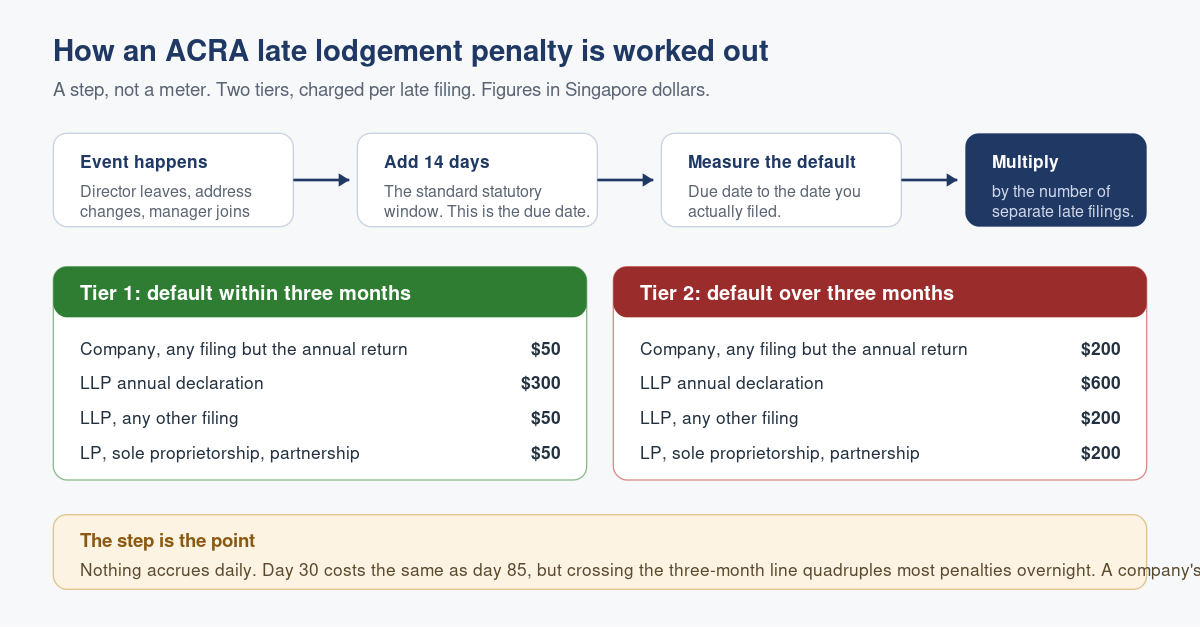
The scale, by entity type
| Entity | Filing | Default within three months | Default over three months |
|---|---|---|---|
| Company | Any filing other than the annual return | $50 | $200 |
| LLP | Annual declaration | $300 | $600 |
| LLP | Any other filing | $50 | $200 |
| Limited partnership (LP) | Any filing | $50 | $200 |
| Sole proprietorship or partnership | Any filing | $50 | $200 |
One row is different, and it is the one to remember. The LLP annual declaration carries a much higher tier: $300 and $600 rather than $50 and $200.
That is deliberate. An LLP does not lodge financial statements the way a company does, so the annual declaration, in which the manager states whether the LLP can pay its debts as they fall due, is the only periodic solvency signal the Registrar and the public receive. Pricing lateness hard protects the value of that single disclosure. The fee to file is $30, which makes the day-one penalty ten times the fee.
Which rate applies to an old default
The rates above attach to filings whose due date falls on or after the relevant commencement date, not to the date you eventually file. An entity clearing a very old backlog may find an earlier scale applies to the oldest items. Bizfile calculates the exact amount at the point of filing, and that figure, not any published table, is what you pay.
How the arithmetic actually works
The mechanics are simple, and worth walking through once because the per-filing multiplier surprises people.
- Identify the event date. The clock starts when the change happens, not when you notice.
- Add the statutory window, normally 14 days, to get the due date.
- Count from the due date to the date you filed. That is the length of default.
- Pick the tier: within three months, or more than three months.
- Multiply by the number of separate late filings.
A worked illustration. A company changes its registered office on 8 December and does not file until 30 December. The due date was 22 December, so the default ran eight days, inside three months. One filing, one penalty, $50.
Now suppose the same company has one director resign and appoints a replacement on the same day, and nothing is filed for six months. The default is over three months, so the higher tier applies. But there are two filings, a cessation and an appointment, so the penalty is $200 twice. $400, for one afternoon’s paperwork nobody did.
Why step pricing punishes the middle
Because the scale steps rather than accrues, the cost of delay is not linear. There is no advantage to filing on day 30 of a default over day 85: both cost the same. But there is a fourfold penalty for slipping from day 89 to day 91.
So if you have just discovered an old default, the first thing to establish is not how bad it looks. It is whether it is still inside three months. If it is, drop other work and get the filing in today.
The obligations behind the penalties
The penalty is a consequence, not the rule. The rules sit in the legislation for each entity type, and ACRA’s penalty guidance points to the following provisions.
| Entity | Obligation | Provision cited by ACRA |
|---|---|---|
| Company | Notify changes to entity information, including registered office, within 14 days | Section 143(1), Companies Act 1967 |
| Company | File within 14 days when a director joins or leaves | Section 173A(1)(b), Companies Act 1967 |
| LLP | File an annual declaration within 15 months of registration, then once each calendar year at intervals of no more than 15 months | Section 30, Limited Liability Partnerships Act 2005 |
| LLP | File within 14 days on a change of registered office or of managers | Section 34, Limited Liability Partnerships Act 2005 |
| LP | File within 14 days on a change of principal place of business or of partners | Section 18, Limited Partnerships Act 2008 |
| Sole proprietorship or partnership | Notify ACRA within 14 days of a change of principal place of business | Section 18, Business Names Registration Act 2014 |
The common thread is the 14-day window. If you remember one number from this article, remember that one. It governs far more filings than any other deadline in the ACRA system.
Where this goes wrong in practice
Nobody owns the 14-day window. Annual deadlines get owned because they appear on a calendar. Event-driven deadlines do not, because the event has to be noticed first. A director resigns by email in March, everyone accepts it, and the filing sits in nobody’s inbox.
The change is treated as done when it is agreed. A resignation takes effect between the parties immediately. The register does not update itself. Until it is filed, ACRA’s record still shows that person as a director, with all the exposure that implies for them and all the inaccuracy that implies for you.
Multiple changes on one day are counted as one job. Each is a separate filing carrying its own penalty. Board reshuffles are the expensive version of this.
The backlog is discovered at the worst moment. Typically during due diligence or a bank facility application, when somebody pulls the ACRA record and it does not match reality. The penalty is then the small part of the problem.
A dormant entity is assumed to have nothing to file. An LLP that stopped trading still owes annual declarations at $300 or $600 a time until it is properly closed. If it is finished, close it: see closing an LLP and striking off an LLP.
Penalties are treated as the worst outcome. They are the mild end. Persistent failure to file is an offence, and enforcement against directors and managers personally is the end of that road, not a slightly larger invoice.
Checking your own exposure
The cheapest audit in Singapore corporate compliance takes about ten minutes.
- Pull your entity’s current record from Bizfile. If you are an officer or member, the relevant extracts are free to you. Our guide to what a free ACRA register extract proves explains what you are looking at.
- Read the position holders and the registered address against what is true today.
- For anything that does not match, find the date the change actually happened.
- Count forward 14 days, then work out which tier the default is in.
- File the ones inside three months today, and the rest today too.
If you have never set up your own Bizfile access, start with setting up Corppass for a new Singapore company and logging in to Bizfile as a business user.
Frequently asked questions
How much is ACRA’s late lodgement penalty?
For most filings by companies, limited partnerships, sole proprietorships and partnerships, and for LLP filings other than the annual declaration: $50 if the default runs up to three months and $200 if it runs longer. An LLP’s late annual declaration is charged at $300 and $600 on the same two tiers. Bizfile shows the exact amount when you file.
Is the penalty charged per filing or per company?
Per filing. Each late transaction attracts its own penalty. If a company failed to file one director’s resignation and one appointment, that is two late filings and two penalties, so a six-month default costs $400 rather than $200. Entities clearing a backlog should expect the total to multiply accordingly.
Does the penalty increase the longer I wait?
It steps rather than accrues. There are only two tiers: within three months of the due date, and more than three months. Nothing is added daily. That means filing on day 30 costs the same as day 85, but slipping from day 89 to day 91 moves you into the higher tier and quadruples the charge on most filings.
Do late annual return penalties work the same way?
No. A company’s late annual return falls under a separate regime with its own charges, escalating into composition sums and potential court prosecution. The two-tier scale described here covers other filings, such as changes of address, changes of officers and LLP annual declarations.
What is the deadline I am most likely to miss?
The 14-day window for notifying a change of registered office, principal place of business, or position holders. It applies to companies, LLPs, LPs and registered businesses alike, and it is event-driven rather than calendar-driven, which is why it slips.
Can a late lodgement penalty be waived?
Do not plan on it. The penalty is a standard consequence of filing after the due date and Bizfile assesses it automatically. Any request for relief is a matter for ACRA on the specific facts. The reliable strategy is filing inside the statutory window, or at minimum inside the first three-month tier.
Making the 14-day window somebody’s job
Late lodgement penalties are the most avoidable money a Singapore entity spends. No judgement, no complexity, no professional opinion required. Something changed, and a form did not go in.
The entities that never pay them are not more diligent. They have made the 14-day window a named person’s responsibility rather than a shared assumption, so a resignation letter triggers a filing rather than a conversation.
Raffles Corporate Services does exactly that for several hundred Singapore companies, LLPs and registered businesses: changes filed inside the window, the register reconciled against reality before every year end, and old backlogs cleared in the cheaper tier. If you suspect something unfiled is sitting behind you, that is a short conversation and usually a same-day fix.
More on Singapore corporate secretarial practice at Singapore Secretary Services. ACRA’s current penalty page is at acra.gov.sg, and the governing legislation is on sso.agc.gov.sg.
— The Editorial Team, Raffles Corporate Services
Need help with corporate secretarial or compliance matters?
If you would like help with your company's corporate secretarial, governance or compliance requirements, email [email protected] or WhatsApp +65 8501 7133.
Our team can assist with corporate secretarial, accounting and tax matters. Where legal advice is needed, advisers from our associated law firms can assist.