

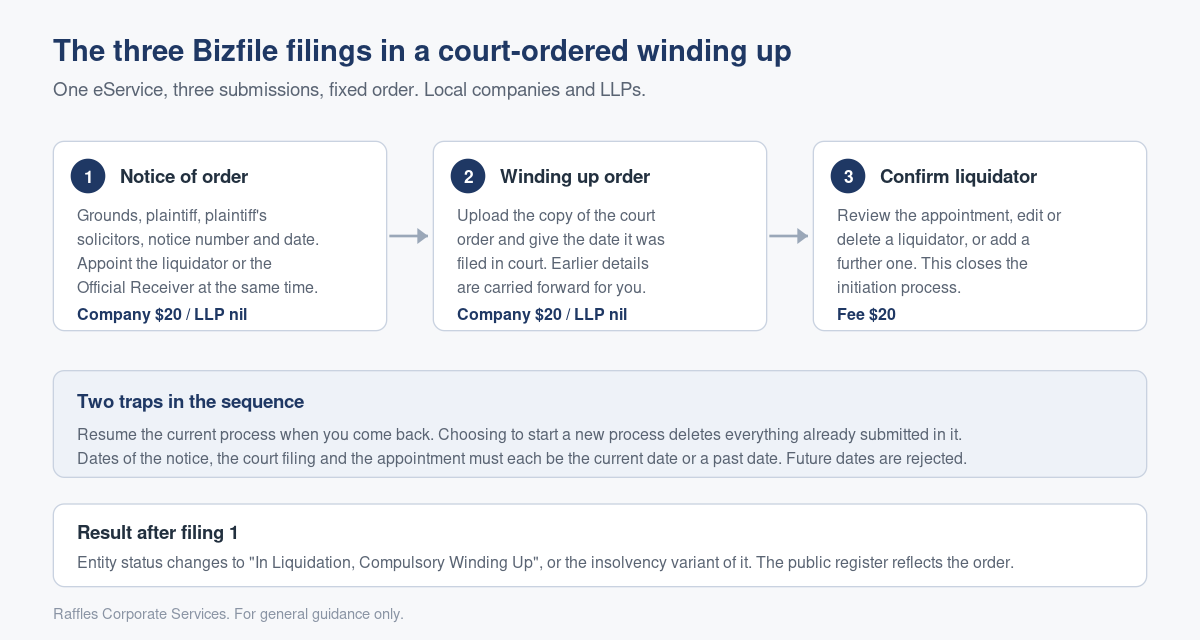
When a Singapore court orders a company or LLP to be wound up, somebody still has to tell ACRA. That is done through Bizfile, and it takes three separate filings in a fixed order. This article covers the first one: the Notice of winding up order, filed together with the appointment of the liquidator or provisional liquidator.
Raffles Corporate Services works with a panel of experienced Singapore law firms who offer cost-effective and efficient legal service and advice. This article is general information only and is not legal advice.
This is the filing that changes the public record. Until it is submitted, ACRA’s register still shows a live trading entity, whatever the Court has said. Once it goes through, the entity status becomes “In Liquidation, Compulsory Winding Up”, or the insolvency variant of that status, and everyone who searches the company sees it.
That gap between the order and the filing is where most of the practical damage happens, so the sensible instinct is to file quickly rather than to wait until the liquidator has settled in.
What a compulsory winding up actually is
A compulsory winding up is a liquidation that the Court imposes, as distinct from one the members or partners choose. The grounds on which the Court may wind up a company are set out in section 125 of the Insolvency, Restructuring and Dissolution Act 2018. Inability to pay debts is the common one, but it is not the only one, and the application does not have to come from a creditor.
Two consequences follow immediately from the order, and both are worth understanding before you touch Bizfile.
First, the winding up is treated as having commenced earlier than the order itself. Section 126 of the Act deals with commencement, and in a court-ordered winding up the relevant date is usually the date the application was made rather than the date the order was pronounced. That backdating is what gives section 130 its bite: dispositions of company property made in the intervening period are liable to be avoided. Our note on validation orders under section 130 explains how a company keeps paying suppliers during that window without the payments unravelling later.
Second, control moves. Section 133 sets out the effect of the winding up order, and section 140 deals with the custody and vesting of the company’s property. The directors do not resign, but they stop running the company. Anyone who carries on signing contracts as though nothing has changed is taking a personal risk.
Who files this, and who cannot
Two categories of filer can submit the notice:
- Authorised position holders of the entity being wound up, filing on the entity’s own behalf through Corppass.
- Registered corporate service providers, filing on behalf of a third party such as the plaintiff creditor. A CSP has to add the entity to its client list before the eService will let it act.
That second route matters more than it looks. In a contested winding up, the company’s own officers are frequently unco-operative, unreachable, or simply gone. The creditor who obtained the order still needs the register updated, and the CSP route is how that is done without the company’s help.
If you have never filed as a business user before, start with our walkthrough of the Corppass login route into Bizfile. If you act for several entities, check you are in the right one before you begin, using profile switching. Filing a winding up against the wrong UEN is not a mistake you fix with a phone call.
What you need in front of you before you start
The form will not let you save your way out of missing information, so assemble it first.
About the order itself:
- The entity’s UEN and registered name, confirmed against the order
- The notice of winding up number
- The date of the notice, which must be today or a past date. Future dates are rejected outright
- The plaintiff’s name and the plaintiff’s solicitors
- The grounds on which the Court ordered the winding up
- A copy of the notice of winding up order, ready to upload
About the liquidator:
| Liquidator type | What you must supply |
|---|---|
| Approved insolvency practitioner | Appointment date (current or past), IP licence number, email address, mobile number, and the UEN of the practitioner’s firm |
| Official Receiver | Nothing. Select the Official Receiver and the system fills in the contact details itself |
The IP licence number is the field that does the work. Bizfile uses it to retrieve the practitioner’s registered particulars, so a mistyped licence number does not produce an error message about the licence, it produces the wrong person’s name in a statutory filing.
Liquidator, provisional liquidator, or Official Receiver
The form asks you to state which of these you are filing. They are not interchangeable.
A provisional liquidator is appointed under section 138 of the Act, typically to preserve assets before the winding up order is made or before a full liquidator is in place. The role is protective and its powers are narrower.
A liquidator is appointed under section 134 and runs the liquidation: realising assets, adjudicating claims, distributing to creditors under the priority rules, and investigating what happened. Our article on the powers and duties of a liquidator sets out the scope of the office.
Where the Court appoints nobody, the Official Receiver takes the role. This is common in small, asset-poor insolvencies where no licensed practitioner will act without funding. The Official Receiver sits within the Ministry of Law, and the Act gives that office a supervisory function over private liquidators as well, under section 137.
The filing, step by step
- Log in to Bizfile as a business user through Corppass. If you are a CSP, select the Corporate Service Provider tab on the profile selection page and pick the right firm.
- Confirm the entity name and UEN shown on the dashboard is the entity the Court ordered wound up.
- Open the File winding up of business entity eService and click Start.
- Check the entity details on the first screen of the form.
- Choose Compulsory winding up as the type of winding up. This is the fork in the road. Selecting a voluntary type here produces a filing that describes something that did not happen.
- Enter the grounds for the winding up, the plaintiff’s name, the plaintiff’s solicitors, the notice number and the date of the notice. Upload the copy of the notice.
- State whether you are appointing a liquidator or a provisional liquidator, enter the appointment date, and select the liquidator type.
- For an approved insolvency practitioner, enter the IP licence number and retrieve the information, then add the email address, mobile number and firm UEN, and save. For the Official Receiver, simply save.
- If the Court appointed more than one, add each additional liquidator before moving on.
- Review everything, tick the declaration, and submit.
The transaction is processed immediately. Fees are $20 for a local company and nil for an LLP.
What goes wrong, and what it costs
The filing is left half-finished. The eService carries the winding up through three linked submissions, and a part-completed process sits waiting to be resumed. If someone returns later and chooses to start a new process instead of resuming, everything already keyed is deleted. That is not a warning about tidiness, it is a warning about re-uploading court documents and re-entering licence numbers from scratch.
Nobody files at all. There is no automatic feed from the Courts into ACRA’s register. A company can be under a winding up order for weeks while its BizFile profile still reads as live and in good standing. Counterparties rely on that profile. Every day it stays wrong is a day someone may extend credit to an entity that cannot pay, and a day the directors are exposed to questions about what they knew.
The wrong date is entered. The date of the notice is not the date you are filing, and the appointment date of the liquidator is not necessarily either of those. Getting these wrong distorts the public record of when the liquidation began, and commencement dates are exactly what a liquidator later relies on when unwinding transactions.
The company keeps trading. After the order, directors’ authority is displaced. Dispositions of property are vulnerable. If the business genuinely needs to continue for a short period, that is a matter for a validation order from the Court, not a matter of quietly carrying on.
The wrong entity is selected. Group structures with similar names are the usual culprit. Confirm the UEN against the sealed order, not against memory.
What happens straight after this filing
The entity status changes and an acknowledgement lands in your Bizfile Inbox. Then two things are outstanding.
The next filing is the winding up order itself, which is the second of the three. Our guide to filing the Winding Up Order in Bizfile covers it. The third is the confirmation of the liquidator appointment. You can do them immediately or return to the eService later, but the sequence is fixed.
Separately, the officers of the company acquire obligations of their own. Section 141 requires a statement of the company’s affairs to be submitted to the Official Receiver, and section 194 deals with notification that the company is in liquidation, which is why invoices, letters and order forms have to carry the liquidation status. Creditors, meanwhile, will start lodging claims, and our article on proof of debt explains how that process runs.
Frequently asked questions
Does filing this notice mean the company is closed?
No. It means the company has entered liquidation. The entity remains on the register, under the control of a liquidator, until the liquidation is completed and the company is dissolved. Dissolution is a separate event at the end of the process, and it can be months or years away.
Can I file this if the Court appointed the Official Receiver rather than a named liquidator?
Yes, and it is simpler. Select the Official Receiver as the liquidator type and the system populates the Ministry of Law’s contact details automatically. No licence number, email address or mobile number is required from you.
What if the Court appointed two liquidators jointly?
Add them both in this filing. The form allows additional liquidators to be entered before you reach the review screen. Do not file one and leave the other for a later transaction, because the public record should reflect the appointment the Court actually made.
We are the creditor, not the company. Can we file?
Not directly. A creditor files through a registered corporate service provider, which must add the entity to its client list first. In practice this is the normal route where the company’s own officers have stopped co-operating after the order.
How much does it cost and how long does it take?
For a local company the fee is $20. For an LLP there is no fee. Processing is immediate, so the entity status changes and the acknowledgement issues as soon as you submit rather than after a review period.
Is a winding up order ever reversed?
It can be. The Court has power to stay winding up proceedings, and an order can be discharged in the right circumstances. That is a court application, not a Bizfile transaction, and it needs to be pursued promptly rather than after the liquidator has begun realising assets.
Getting the record right while everything else is going wrong
A compulsory winding up is rarely calm. There is usually a dispute behind it, often an unpaid debt that was argued over for months, and by the time the order is made the people who know where the company’s records are have frequently stopped answering emails.
The filing still has to be made, accurately, by someone who can read a sealed order and key it without introducing a new error into the public register. That is a small job done badly at real cost, or a small job done properly in an afternoon.
Raffles Corporate Services handles ACRA winding up filings for companies, liquidators and creditors, including the CSP route where the company itself is not co-operating. If you are holding a winding up order and are not sure what has to reach ACRA or when, that is a short conversation. You can also read more on Singapore corporate secretarial practice at Singapore Secretary Services, and ACRA’s own overview of winding up a local company is a useful companion reference.
The Editorial Team, Raffles Corporate Services
Need help with corporate secretarial or compliance matters?
If you would like help with your company's corporate secretarial, governance or compliance requirements, email [email protected] or WhatsApp +65 8501 7133.
Our team can assist with corporate secretarial, accounting and tax matters. Where legal advice is needed, advisers from our associated law firms can assist.