

The declaration of inability to continue business is the statement by which the directors of a Singapore company accept that the company cannot carry on because of its liabilities. Bizfile treats it as an optional first filing in a creditors’ voluntary winding up. Legally, it is nothing like optional in its effects.
Raffles Corporate Services works with a panel of experienced Singapore law firms who offer cost-effective and efficient legal service and advice. This article is general information only and is not legal advice.
Two things follow the moment it is made. The directors must immediately appoint a licensed insolvency practitioner as provisional liquidator, and meetings of the company and of its creditors must already have been summoned for a date within 30 days. That is section 161 of the Insolvency, Restructuring and Dissolution Act 2018, and it is the reason this filing is not a piece of paperwork you knock out on a Friday afternoon.
This article covers the first of the three filings in a creditors’ voluntary winding up. The notice of resolution comes second, and appointing the liquidator comes third. If you want the shape of the whole process first, start with our overview of creditors’ voluntary winding up.
What the declaration actually is
It is not one document. It is two, and they go to two different places.
The first is a statutory declaration in the prescribed form, made by the directors and lodged with the Official Receiver. The second is a declaration in the prescribed form lodged with the Registrar of Companies, which is the part you do through Bizfile. Both say the same two things: that the company cannot, by reason of its liabilities, continue its business, and that meetings of the company and of its creditors have been summoned for a date within 30 days after the date of the declaration.
Read that second limb again. The meetings must have been summoned already. The declaration is not the thing that sets the process in motion. It is the thing that confirms the process is already in motion, and that the directors have committed themselves to a date.
Who makes it
For a local company, the directors. For a limited liability partnership, the managers. Bizfile will let a director or an authorised position holder submit the filing, and a corporate service provider can submit on the entity’s behalf if the entity is already on its client list. The filing is made as a business user through Corppass, so if Corppass access has lapsed, sort that out first: our guide to logging in to Bizfile as a business user covers it.
The declarants are named in the filing. If a director’s name does not appear in the dropdown, because they are newly appointed or the register has drifted, the form allows the name to be typed in. That is a convenience, not a cure. If your register of directors does not match the people signing an insolvency declaration, fix the register.
Why “optional” is the wrong word for it
Bizfile lets you select “Not applicable” and move straight to the notice of resolution. Plenty of companies do exactly that, and the winding up proceeds perfectly lawfully. So what is the difference?
Control of the gap. A creditors’ voluntary winding up needs a members’ meeting to pass the resolution and a creditors’ meeting held on the same day or the day after, with at least 10 days’ notice to creditors and a newspaper and Gazette advertisement before that. That is a fortnight or more in which nobody has authority over the company’s assets. The declaration route closes that gap by putting a provisional liquidator in place from day one.
| With the declaration | Without the declaration | |
|---|---|---|
| Provisional liquidator | Appointed immediately by the directors | None until the liquidator is appointed at the meetings |
| Who controls assets in the interim | The provisional liquidator, within limits | Nobody, beyond the directors’ residual protective powers |
| When the winding up commences | When the declaration is lodged with the Registrar | When the members pass the resolution |
| Meetings | Must already be summoned for a date within 30 days | Summoned in the normal way before the resolution |
| Cost of this filing | Free | Not applicable |
Section 182 is the reason the second column is uncomfortable. Where a voluntary winding up is proposed and no liquidator or provisional liquidator has been appointed or nominated, the directors’ powers must not be exercised except with the court’s permission, or so far as necessary to comply with the creditors’ meeting requirements, or to protect perishable and wasting assets. A board that has resolved to wind up and then carries on trading in the interim is exposed personally.
The 30-day clock
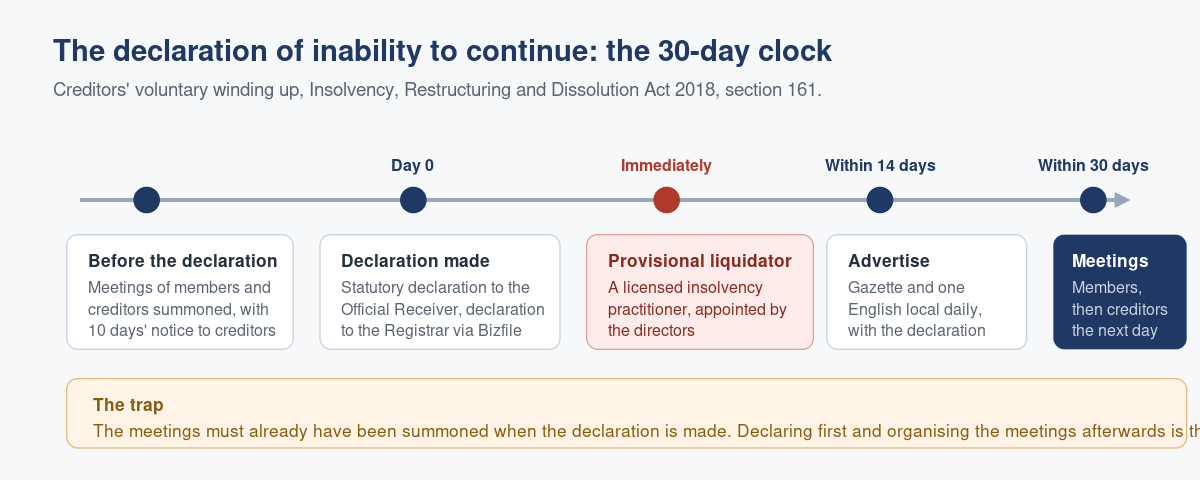
- The board forms the view. The company cannot continue by reason of its liabilities. This is a judgement about liabilities, not an accounting exercise you can leave to the year end.
- The meetings are summoned. Notices to members for the meeting at which the special resolution will be proposed, and notices to creditors for a meeting on that day or the next, sent simultaneously, with at least 10 days’ notice and a statement of all creditors and the amounts of their claims. The creditors’ meeting is advertised in the Gazette and at least one English local daily newspaper at least 7 days before.
- The statutory declaration is made and lodged with the Official Receiver. Note the date. Bizfile will ask for it.
- The declaration is lodged with the Registrar through Bizfile. This is the filing described here. It is free and processed immediately.
- A licensed insolvency practitioner is appointed provisional liquidator, immediately. Not next week.
- The appointment is advertised within 14 days, in the Gazette and at least one English local daily newspaper, together with a copy of the statutory declaration lodged with the Official Receiver.
- The meetings are held within 30 days of the date of the declaration, and the process moves on to the resolution and the appointment of the liquidator.
What Bizfile asks you for
The entity’s UEN and name. The date of the declaration, which must be today or earlier. The names of the directors, or for an LLP the managers, who made it. The date the statutory declaration was lodged with the Official Receiver, again today or earlier. And the proposed date of the members’ meeting and of the creditors’ meeting.
Those last two fields are the ones people fill in casually. They are the dates you have just told the Registrar you will meet.
What the provisional liquidator can and cannot do yet
A provisional liquidator appointed under this route has, in principle, the functions and powers of a liquidator in a creditors’ winding up. In practice those powers are held back until the creditors have had their meeting.
Before the creditors’ meeting is held, the provisional liquidator must not exercise those powers without the court’s sanction, with three exceptions: taking the company’s property into custody or control, disposing of perishable goods and goods that will lose value if not sold immediately, and doing whatever else is necessary to protect the company’s assets. The provisional liquidator must also attend the creditors’ meeting and report on any powers they did exercise.
The appointment is deliberately short. It runs for 30 days from the date of appointment, or for such further period as the Official Receiver allows in a particular case, or until a liquidator is appointed, whichever happens first. It is a bridge, not a destination.
What goes wrong in practice
Filing the declaration before the meetings have been summoned. The form does not stop you. The statute assumes the notices have gone out. Declaring first and organising the meetings afterwards leaves you with a declaration whose second limb was untrue when it was made.
Naming a proposed meeting date that cannot be met. Ten days’ notice to creditors plus a 7-day newspaper advertisement, arranged around the Gazette’s own publication cycle, does not leave much room inside 30 days. Work backwards from the notice requirements, then pick the date.
Treating “immediately appoint a provisional liquidator” as aspirational. The obligation is immediate and it falls on the directors. If no insolvency practitioner has agreed to take the appointment before the declaration is lodged, the declaration is premature.
Missing the 14-day advertisement of the appointment. It is a separate step from the advertisement of the creditors’ meeting and from the later advertisement of the resolution, and it must carry a copy of the statutory declaration lodged with the Official Receiver.
Leaving it so late that the choice is gone. Where an application has already been made to court to wind the company up on the ground that it cannot pay its debts, the company cannot resolve to wind itself up voluntarily without the court’s permission. Directors who spend three months negotiating with one determined creditor frequently lose the cheaper route while doing it. Our note on disputed debts and winding up applications explains how quickly that pressure builds.
Frequently asked questions
Do I have to file the declaration of inability to continue business?
No. Bizfile lets you select “Not applicable” and proceed directly to the notice of resolution. You would still need a lawful creditors’ voluntary winding up. What you give up is the ability to put a provisional liquidator in charge immediately, which matters most where the company still holds assets, staff or stock that need someone in authority.
Is this the same as a declaration of solvency?
It is the opposite. A declaration of solvency, under section 163 of the Insolvency, Restructuring and Dissolution Act 2018, is the directors’ statement that the company can pay its debts in full within twelve months, and it is what makes a winding up a members’ voluntary one. See our note on the declaration of solvency and directors’ personal liability.
What does it cost and how long does it take?
The Bizfile filing itself is free and is processed immediately. The cost sits outside the filing: the provisional liquidator’s engagement, the Gazette and newspaper advertisements, and the corporate secretarial work in convening two sets of meetings on a compressed timetable.
When does the winding up actually commence?
Where a provisional liquidator was appointed before the resolution was passed, the winding up commences at the time the declaration was lodged with the Registrar of Companies. Otherwise it commences when the resolution is passed. The commencement date matters because share transfers and alterations in members’ status after it are void without the liquidator’s sanction.
Can a corporate service provider file this for us?
Yes, where the CSP has been appointed to file on the entity’s behalf and the entity has been added to its client list. The declaration itself is still the directors’ own statement, and their names are recorded on the filing.
Getting the sequence right the first time
Almost every problem in a creditors’ voluntary winding up traces back to this stage: meetings summoned too late, a provisional liquidator lined up after the fact, an advertisement missed while everyone was busy with the creditors.
Raffles Corporate Services works alongside licensed insolvency practitioners on the corporate secretarial side of these liquidations, which means the meeting notices, the statement of creditors and claims, the Gazette and newspaper advertisements, and the Bizfile lodgements land in the right order and inside the statutory windows.
You can reach us through Raffles Corporate Services, or read more on Singapore corporate secretarial practice at Singapore Secretary Services.
— The Editorial Team, Raffles Corporate Services
Need help with corporate secretarial or compliance matters?
If you would like help with your company's corporate secretarial, governance or compliance requirements, email [email protected] or WhatsApp +65 8501 7133.
Our team can assist with corporate secretarial, accounting and tax matters. Where legal advice is needed, advisers from our associated law firms can assist.